- The paper demonstrates a systematic dispersive framework to extract B-meson form factors using lattice QCD and LCSR, reducing hadronic uncertainties.
- It disentangles short-distance new physics effects from long-distance hadronic contributions in b→s transitions through both data-driven and model-dependent analyses.
- Global fits reveal tensions with Standard Model predictions, indicating potential NP signatures in Wilson coefficients affecting b→sℓ⁺ℓ⁻ and b→sνν̅ decays.
Dispersive Approaches to Rare B-Meson Semileptonic Decays: Theory, Global Analysis, and Implications
Introduction
The paper conducts a comprehensive theoretical and phenomenological study of rare semileptonic b→s flavor-changing neutral current (FCNC) decays, focusing on the channels B→K(∗)ℓ+ℓ− and Bs→ϕℓ+ℓ−. These modes serve as precision probes of the Standard Model (SM) and potential New Physics (NP) effects due to their loop-level suppression and sensitivity to heavy virtual particles. The paper's central contribution is a systematic treatment of hadronic uncertainties, including both local form factors (FFs) and non-local matrix elements arising from four-quark operators, using a dispersive (unitarity- and analyticity-based) approach. This analysis is performed in the context of the latest experimental results from LHCb, CMS, and Belle~II. The implications for NP searches, particularly in the Wilson coefficients (WCs) of the Weak Effective Theory, are rigorously explored.
Accurate and model-independent determination of FFs is vital in the theoretical prediction for exclusive b→s semileptonic decays. The authors adopt the Dispersive Matrix (DM) method, which provides bounds on the FFs using analyticity, unitarity, and crossing symmetry, with no reliance on truncated z-expansion parameterizations. This approach is directly informed by lattice QCD (LQCD) results, supplemented at large recoil by light-cone sum rule (LCSR) calculations where lattice coverage is incomplete, particularly for vector final states.
In the B→K mode, LQCD now covers the entire kinematic range, allowing for a purely lattice-based determination. For B→K∗ and Bs→ϕ, LQCD is restricted to low recoil (large q2), necessitating LCSR input at low b→s0 unless one extrapolates LQCD data using the DM framework alone. The authors contrast two FF setups: (i) DM bands generated solely from LQCD inputs ("LQCD DM"), and (ii) DM bands from a combination of LQCD and LCSR inputs ("LQCD+LCSR DM"), quantifying the impact of theoretical input assumptions.
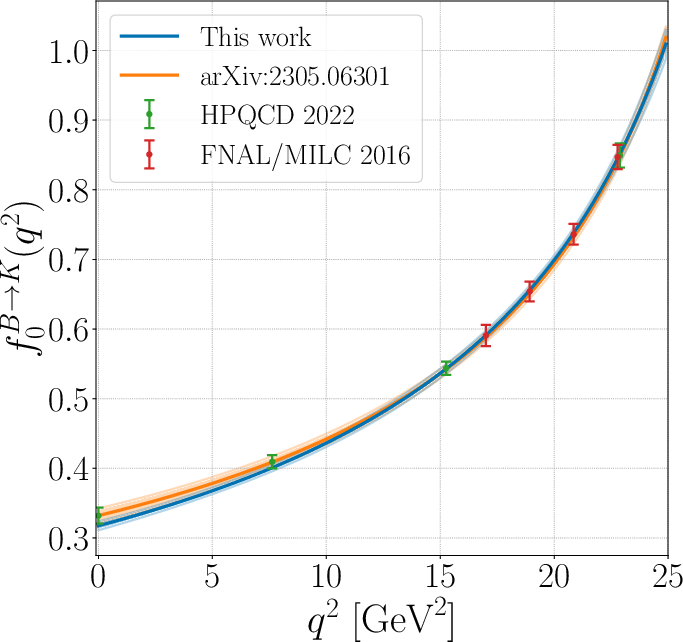
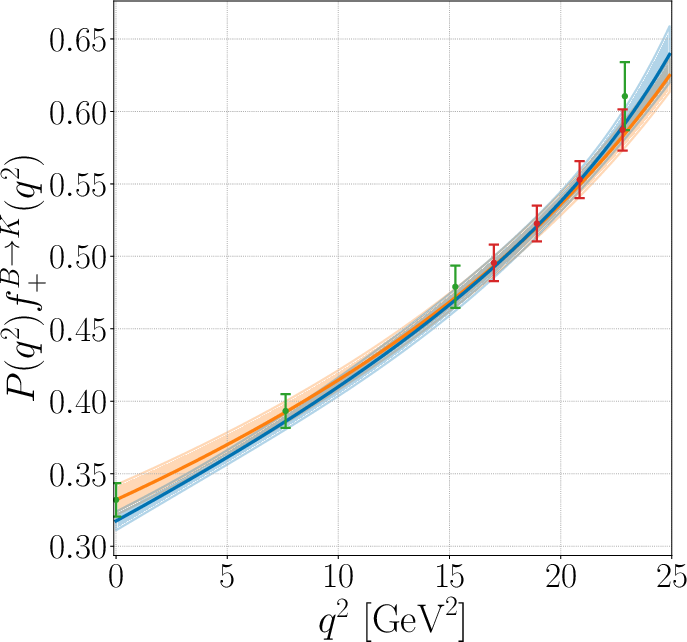
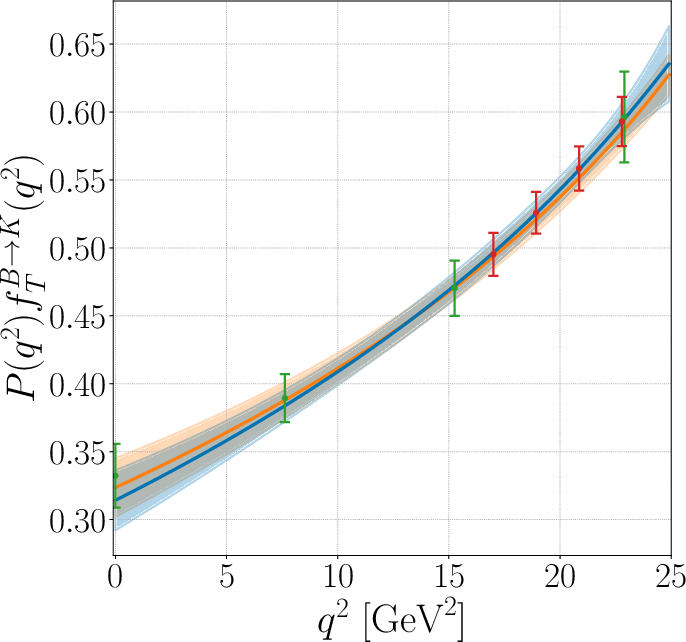
Figure 1: b→s1 form factor comparison. The DM band (blue) extracted in this work is contrasted with the previous result (orange); lattice points from HPQCD and FNAL/MILC are also shown.
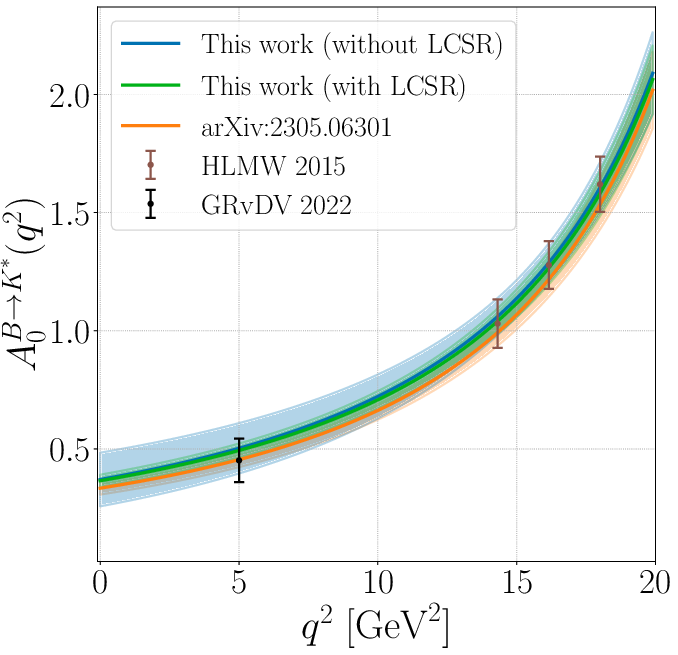
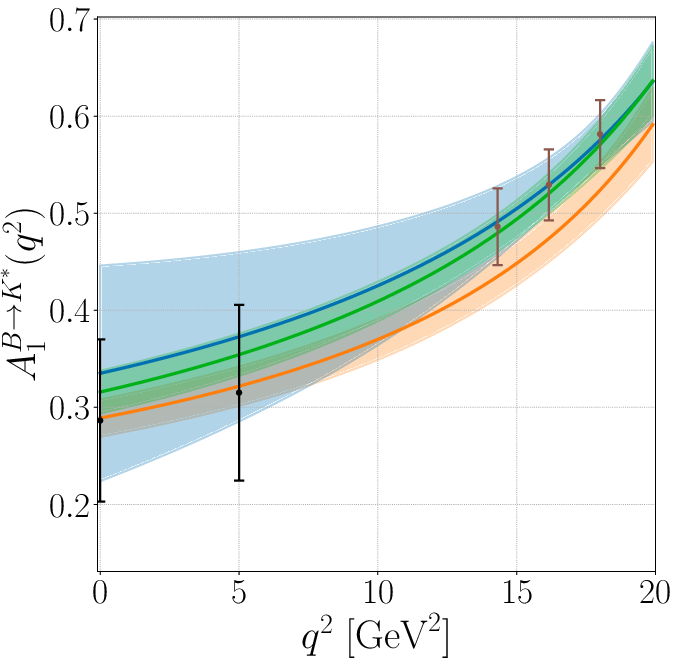
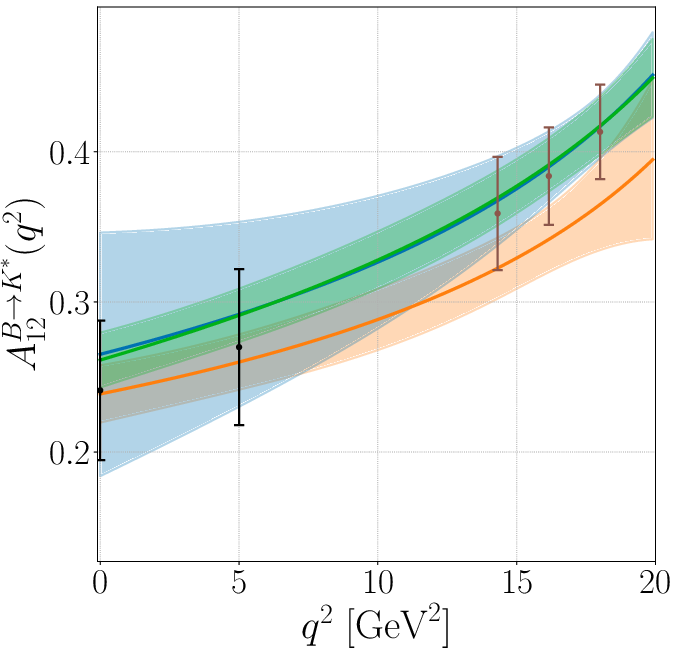
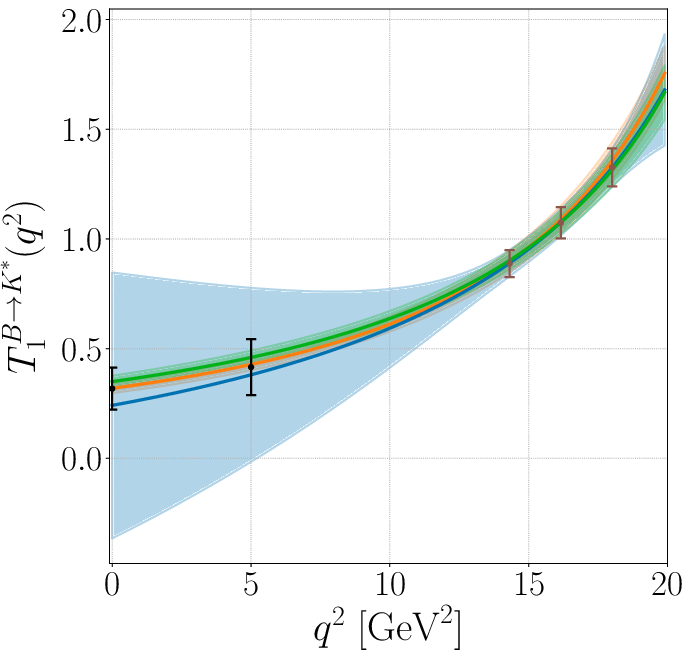
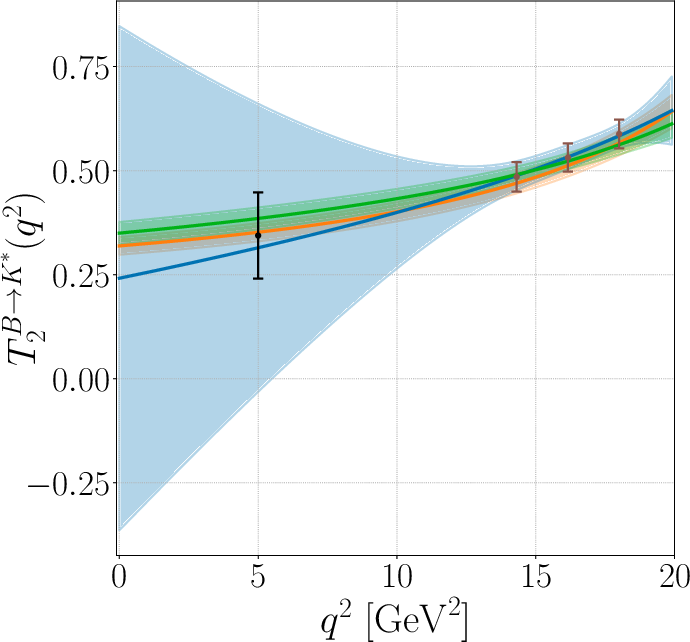
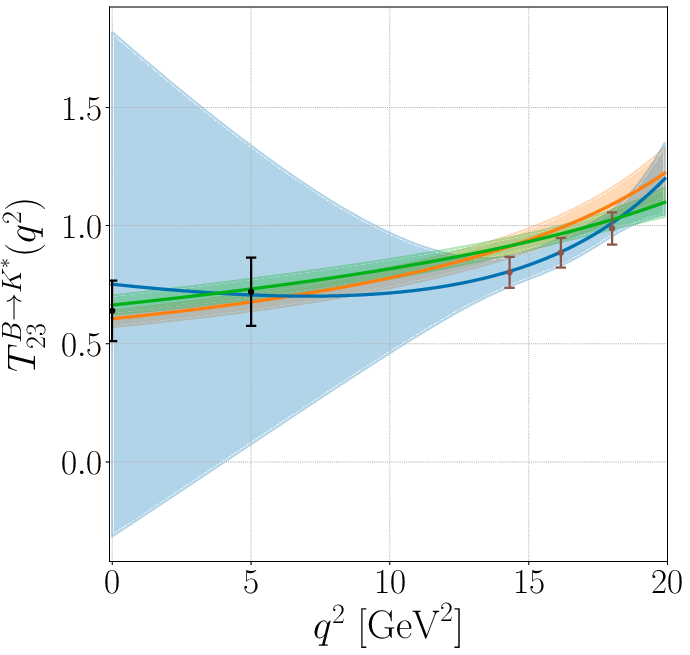
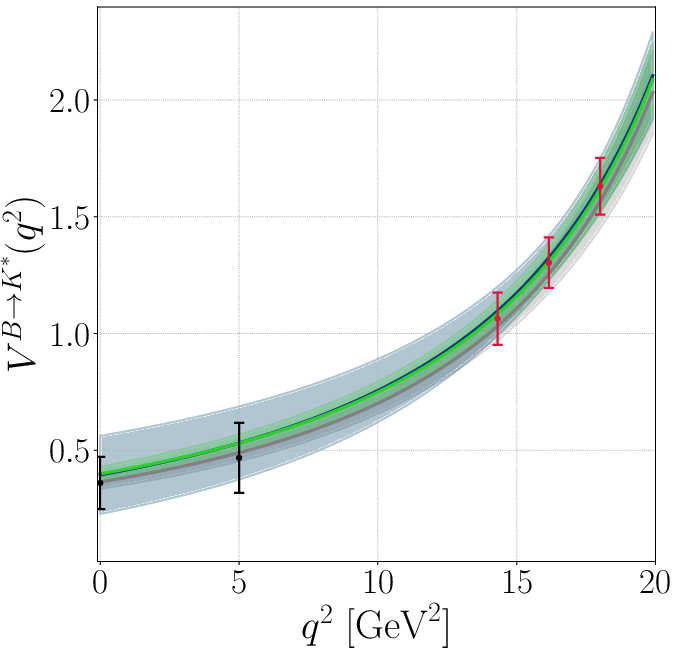
Figure 2: b→s2 form factor comparison, showing the difference between LQCD-only DM (blue), DM including LCSR input (green), and earlier results (orange).
Key findings are:
- Purely lattice-based FF uncertainties become substantially larger at high recoil for b→s3. The inclusion of LCSR input (as typically done in the literature) yields noticeably narrower FF error bands in these regimes.
- Extracting hadronic parameters and NP effects is highly sensitive to the FF input choices due to correlated uncertainties, especially in angular observables optimized for reduced hadronic sensitivity.
Data-Driven and Model-Dependent Analysis of Hadronic Corrections
The theoretical challenge in interpreting b→s4 decays lies in separating short-distance (SD) from long-distance (LD) effects. LD effects, particularly "charming penguins"—non-local contributions from intermediate charmed quark loops—can imitate NP shifts in WCs like b→s5. To address this, the authors consider two frameworks:
- Data-Driven (DD) Approach: Non-factorizable hadronic contributions are parameterized with minimal theory bias (using a phenomenological basis), and their coefficients are fitted directly to experimental observables, subject to broad priors.
- Model-Dependent (MD) Approach: Theoretical prejudice is imposed that power corrections are suppressed, and only leading charm-loop contributions are considered, following LCSR/dispersive calculations.
Strong evidence for sizable LD hadronic effects comes from joint posterior distributions of the hadronic parameters (see e.g., the b→s6 and b→s7 analysis in Figure 3), which show preferred regions away from the SM point in the DD scenario. Notably, the latest data on angular observables sensitive to strong phases, particularly b→s8 in b→s9, favor nonzero imaginary parts in the hadronic parameters, supporting the DD interpretation.
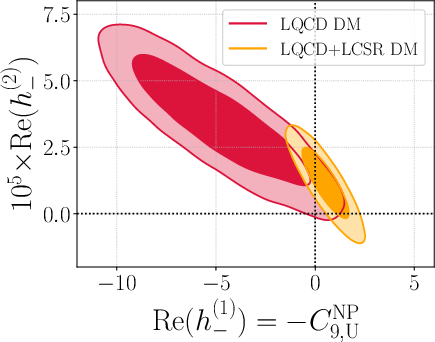
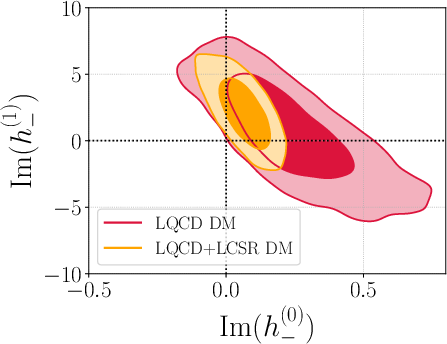
Figure 3: Joint posterior probability for real parts of hadronic parameters B→K(∗)ℓ+ℓ−0 and B→K(∗)ℓ+ℓ−1, illustrating sensitivity to LQCD-only versus LQCD+LCSR DM FFs.
Standard Model Predictions for B→K(∗)ℓ+ℓ−2 and Comparison to Experiment
The theoretically clean B→K(∗)ℓ+ℓ−3 transitions are recalculated using the new DM FFs. Since these decays are free from non-local hadronic contamination, FF uncertainties dominate the SM theoretical error.
- For B→K(∗)ℓ+ℓ−4, purely LQCD-based predictions are very precise, not significantly affected by the inclusion of LCSR.
- For B→K(∗)ℓ+ℓ−5, the LQCD-only approach leads to larger uncertainties, illustrating the critical value of LCSR input until LQCD is extended to low B→K(∗)ℓ+ℓ−6 for vector states.
The authors provide B→K(∗)ℓ+ℓ−7 SM predictions that are slightly shifted downward compared to previous works, mildly increasing the tension with recent Belle~II results to approximately B→K(∗)ℓ+ℓ−8.
Global NP Fits and Wilson Coefficient Inference
The impact of theoretical uncertainties and the treatment of long-distance hadronic effects on NP interpretation is rigorously quantified via global fits to the WCs of the Weak Effective Theory. The fits incorporate both B→K(∗)ℓ+ℓ−9 and Bs→ϕℓ+ℓ−0 measurements, with varying FF treatment and theory bias.
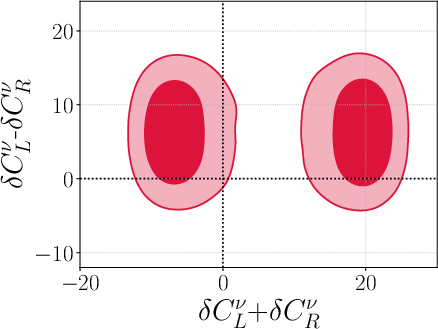
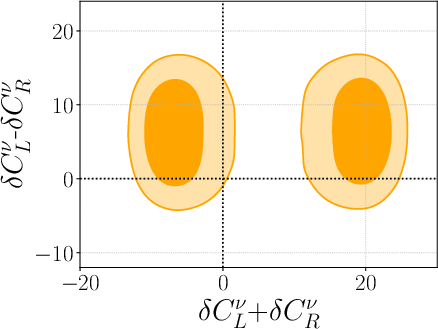
Figure 4: Posterior distribution in the Bs→ϕℓ+ℓ−1 plane for NP in Bs→ϕℓ+ℓ−2, showing complementarity of Bs→ϕℓ+ℓ−3 and Bs→ϕℓ+ℓ−4 final states.
Main findings:
- Bs→ϕℓ+ℓ−5: The combined constraints from Bs→ϕℓ+ℓ−6 and Bs→ϕℓ+ℓ−7 modes allow significant room for flavor-universal NP, with best-fit regions favoring a negative right-handed contribution at Bs→ϕℓ+ℓ−8 even when FF input variations and experimental uncertainties are accounted for.
- Bs→ϕℓ+ℓ−9: In the Data-Driven scenario, the data are compatible with the SM once sufficient hadronic freedom is allowed. In the Model-Dependent scenario, preference for negative NP contributions to b→s0 (in both electron and muon channels) emerges, matching the pattern historically associated with the so-called "b→s1 anomaly."
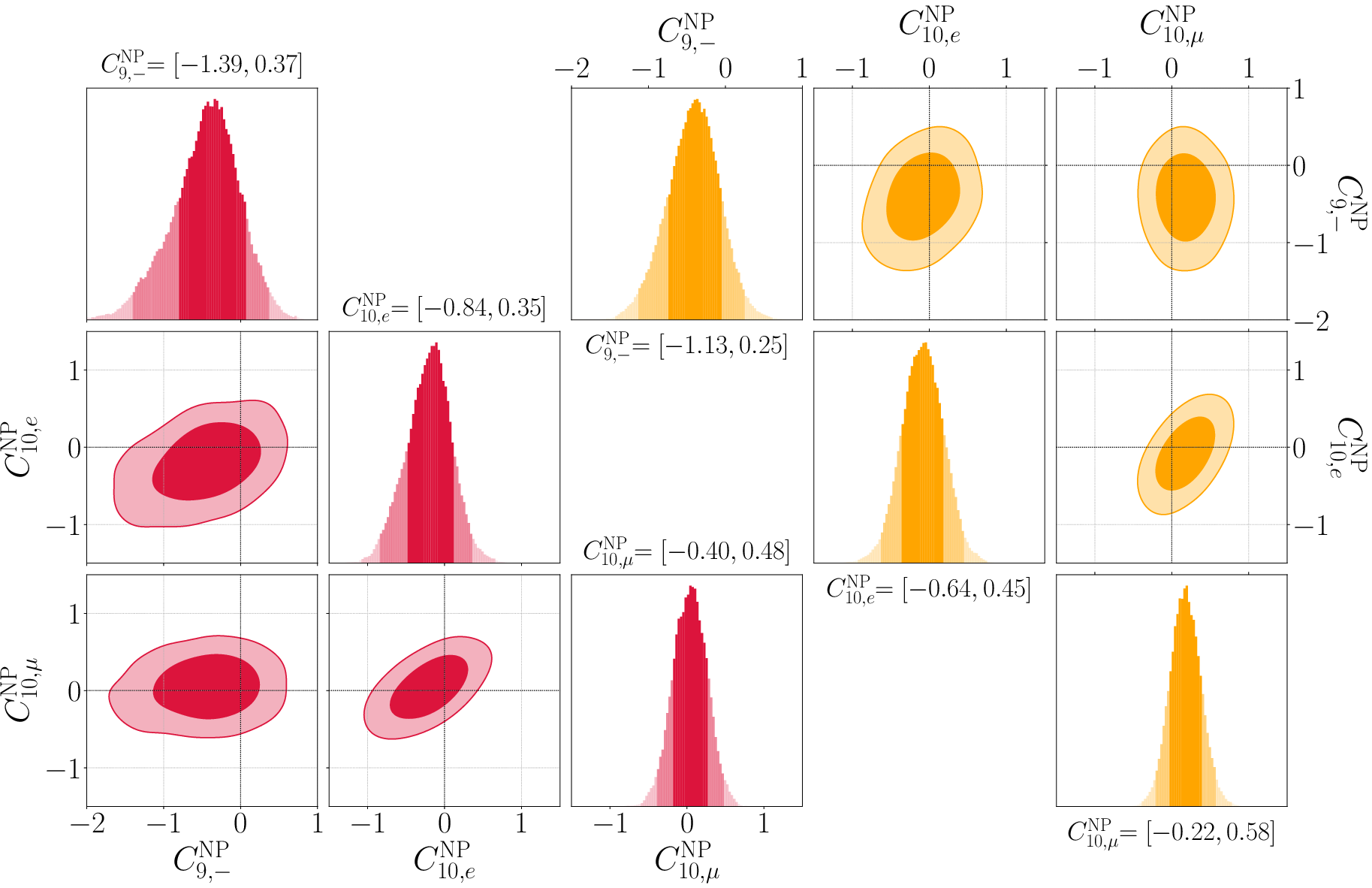
Figure 5: Two- and one-dimensional marginalized joint posterior for a set of key WCs in the Data Driven fit.
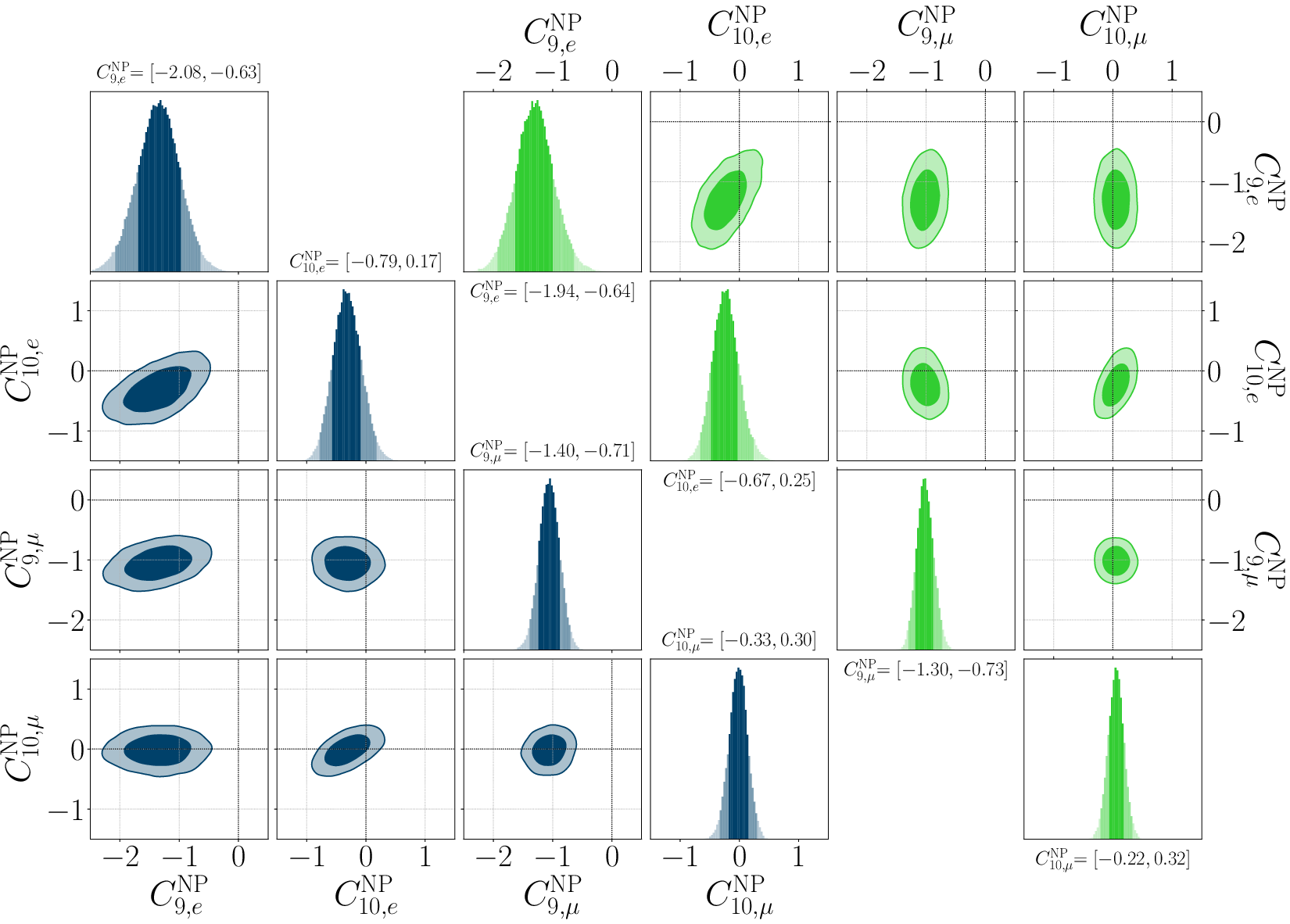
Figure 6: Marginalized posterior for 4 WC NP fit under Model Dependent power correction assumptions.
Implications, Theoretical Developments, and Future Outlook
The analysis demonstrates that the global interpretation of b→s2 measurements and the evidence for NP are highly sensitive to both the treatment of hadronic uncertainties (in FFs and non-local contributions) and to experimental binning choices. The work establishes that claims of NP based only on optimized observables without robust control of theory uncertainties are likely premature. Improved lattice determinations of non-local matrix elements, as recently proposed, and new angular measurements at high precision, can help resolve present degeneracies between hadronic and NP explanations.
The b→s3 modes, being theoretically pristine, are poised to become central in NP searches with improved experimental statistics. The b→s4 observable, in particular, offers a unique opportunity for clean NP diagnostics when combined with further precise measurement of b→s5.
Conclusion
This work provides a rigorous, conservative evaluation of theoretical and experimental constraints in rare b→s6-meson semileptonic decays using a dispersive framework for FF determination and a broadly agnostic approach to hadronic matrix elements. The resulting global fits show that while some tension exists between data and SM predictions, particularly in b→s7 and certain b→s8 angular observables, their NP interpretation is strongly contingent on hadronic uncertainty modeling. As experimental precision improves and lattice calculations are extended, these tools and the quantitative discipline they impose will be essential for definitive NP searches in heavy flavor physics.
References:
- "A Dispersive Look at Rare b→s9-meson Semileptonic Decays" (2607.03531).
- EOS collaboration LCSR and DM form factor results [Gubernari:2023puw].
- Recent experimental angular analyses: LHCb [LHCb:2025mqb]; CMS [CMS:2024atz].
- Discussions of the impact of strong phases and new theoretical lattice frameworks [Altmannshofer:2026cwk, Frezzotti:2025hif].