- The paper establishes the world’s most precise Λ→p μ⁻ν̄₍μ₎ branching fraction measurement at (1.46 ± 0.10)×10⁻⁴ with a 6.9% uncertainty.
- The paper presents the first full angular analysis of B⁰→D*⁻μ⁺ν₍μ₎ decays, employing multiple theoretical models (CLN, BGL, BLPR) to extract hadronic form factors.
- The precision results validate Standard Model predictions and constrain potential new physics in semileptonic flavor transitions through detailed comparisons with lattice QCD.
Precision Measurements of Flavour Changing Charged Current Decays at LHCb
Introduction
Semileptonic transitions of b-hadrons via charged current interactions are essential probes of the Standard Model (SM) and sensitive tests for new physics contributions. The flavor sector currently exhibits non-negligible anomalies both in lepton flavor universality (LFU) ratios, such as R(D) and R(D∗), and in the determination of the CKM matrix elements ∣Vub∣ and ∣Vcb∣ between inclusive and exclusive measurements. This work presents the most precise determination to date of the branching fraction of Λ→pμ−νˉμ and the inaugural LHCb measurement of hadronic form-factor parameters from the angular analysis of B0→D∗−μ+νμ decays, spanning multiple theoretical parameterizations.
The measured anomalies in LFU ratios and CKM elements, as summarized in (Figure 1), highlight persistent $2$–4σ tensions. The improved precision and systematic control in LHCb measurements can provide robust data to clarify whether these tensions are harbingers of physics beyond the SM or due to underestimated theoretical uncertainties.
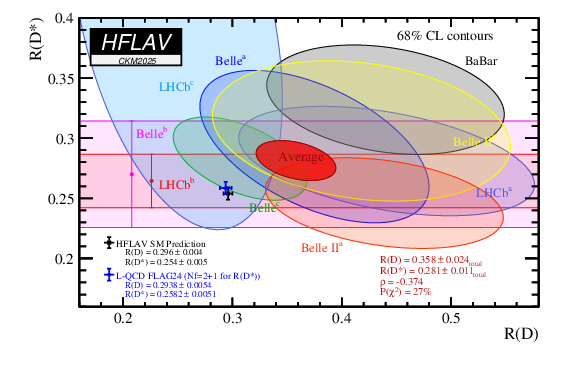
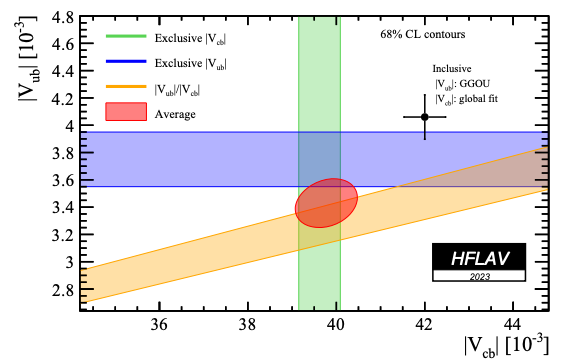
Figure 1: Summary of recent world measurements of R(D), R(D)0 and the CKM parameters R(D)1 and R(D)2.
Branching Fraction of R(D)3
The decay R(D)4 is a theoretically clean channel, providing a crucial determination of R(D)5 and enabling stringent tests of first-row CKM unitarity. The analysis exploits the LHCb dataset (2016–2018, R(D)6) and normalizes the signal yield to the precisely-known R(D)7 channel. The selection is highly optimized, employing kinematic constraints in the R(D)8 vs.\ R(D)9 plane and Armenteros–Podolanski variables, resulting in significant background suppression and signal efficiency.
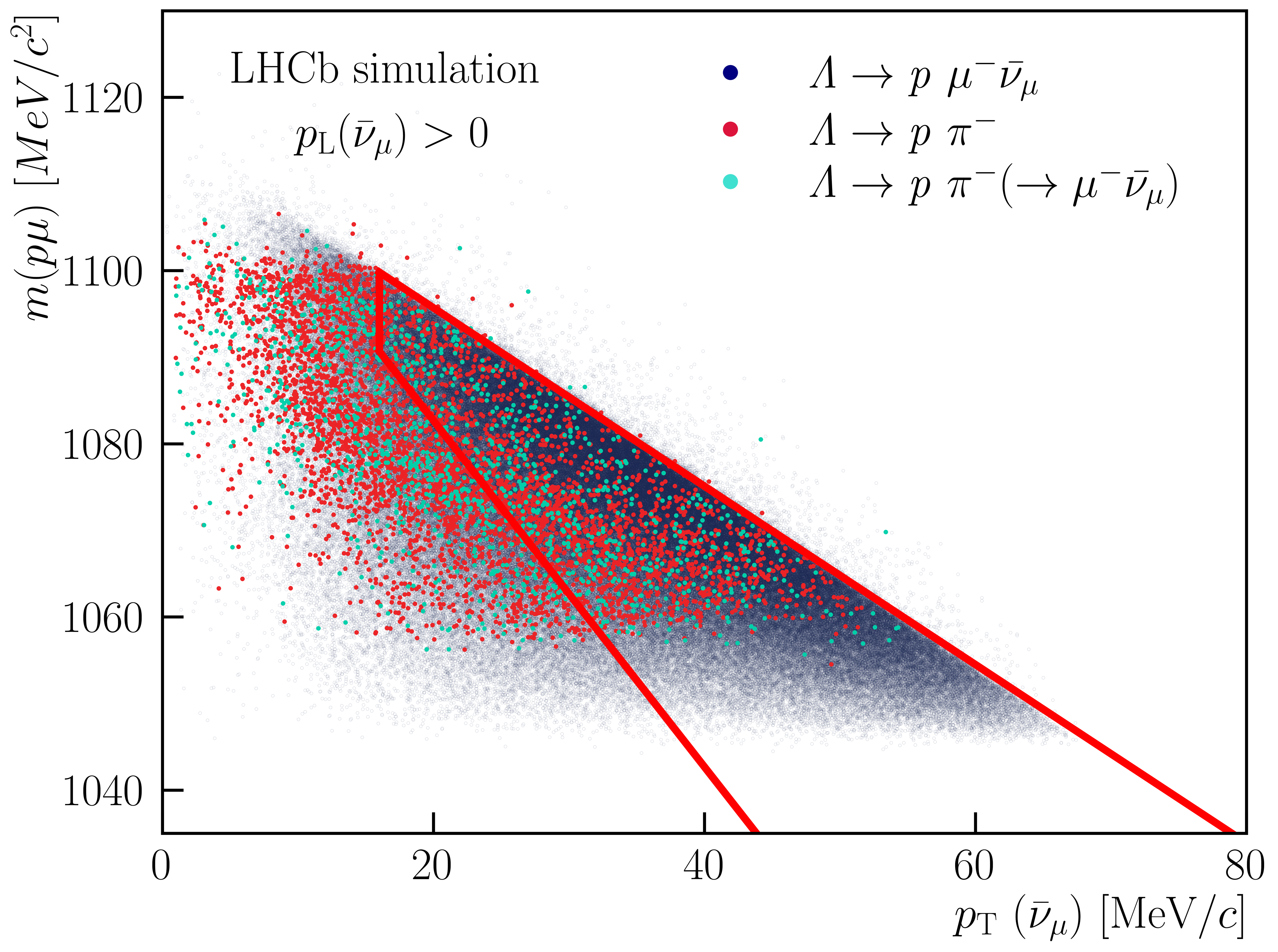
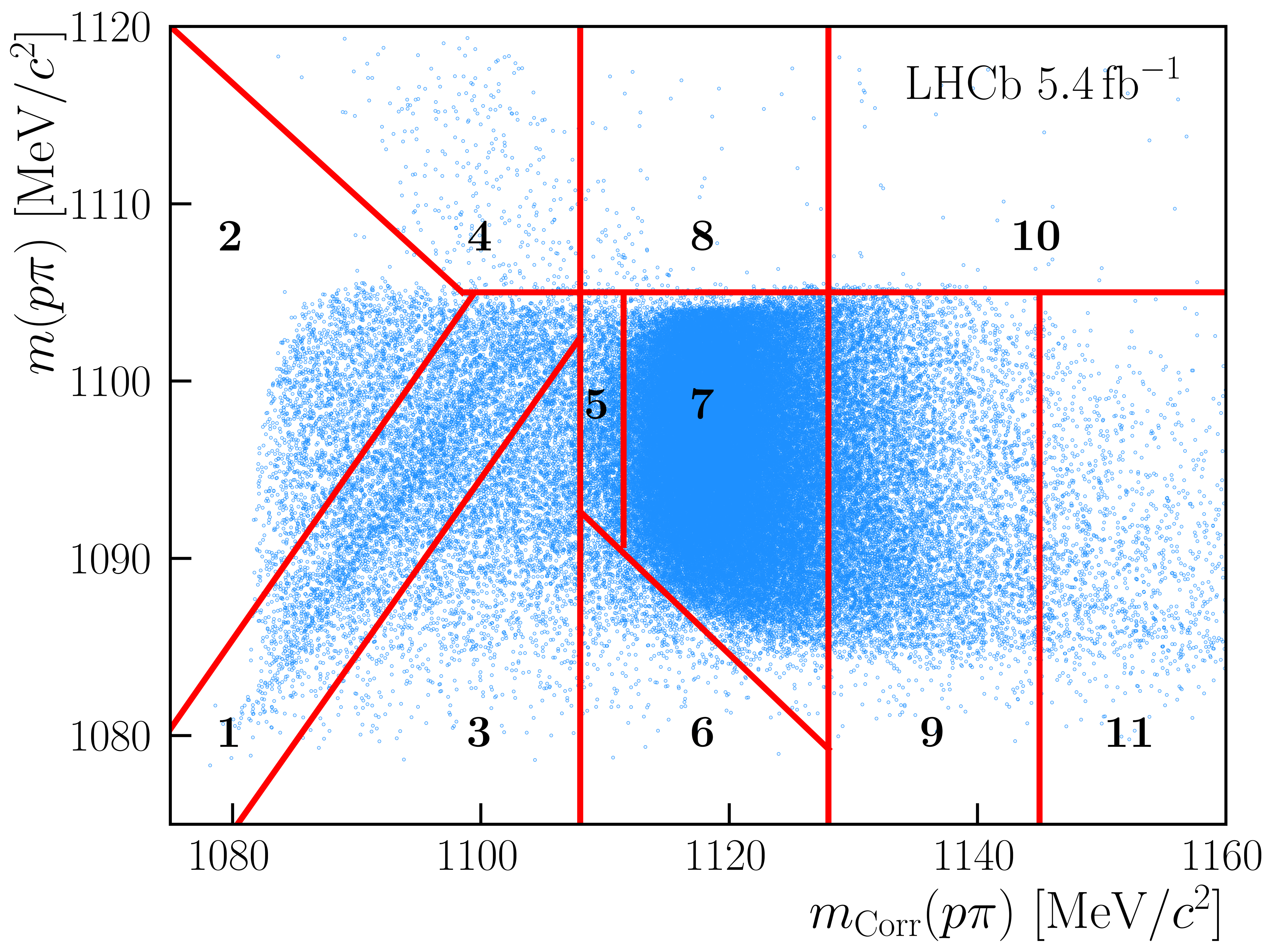
Figure 2: (Left) Signal selection in the R(D∗)0 vs.\ R(D∗)1 plane. (Right) Binning scheme for the 2D fit on R(D∗)2 vs.\ R(D∗)3. Candidates within the red box are selected.
A two-dimensional binned maximum-likelihood fit is performed using simulation templates for both the signal and backgrounds. The branching fraction is determined as:
R(D∗)4
This result achieves a total uncertainty of R(D∗)5, representing a factor of two improvement over the BESIII measurement, and is consistent with theoretical predictions from lattice QCD for the LFU observable R(D∗)6.
The value extracted for R(D∗)7 using state-of-the-art lattice inputs ranges from R(D∗)8 to R(D∗)9, consistent within uncertainties with CKM unitarity, while the measured ∣Vub∣0 is in excellent agreement with current predictions. These precision results, alongside electron mode and lattice inputs, provide strong constraints on BSM contributions in ∣Vub∣1 transitions.
A comprehensive five-dimensional angular analysis is performed on ∣Vub∣3 decays, fitting decay angles ∣Vub∣4, kinematic quantity ∣Vub∣5, and missing mass squared ∣Vub∣6. LHCb data (2011–2012, ∣Vub∣7) are analyzed. The missing neutrino requires a rest-frame approximation and introduces modest resolutions in reconstructed observables.
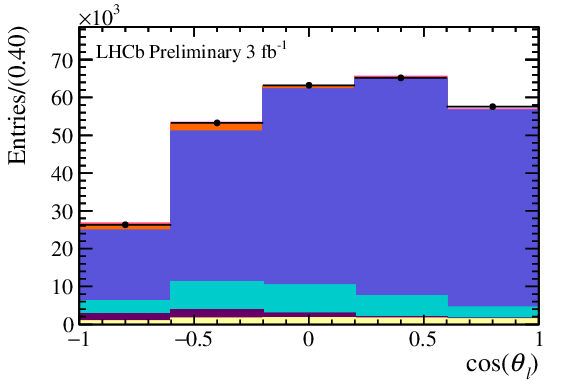
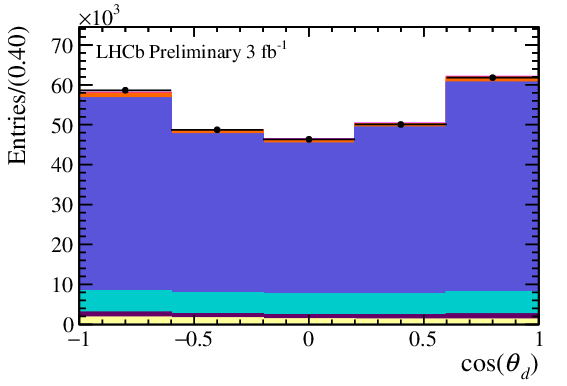
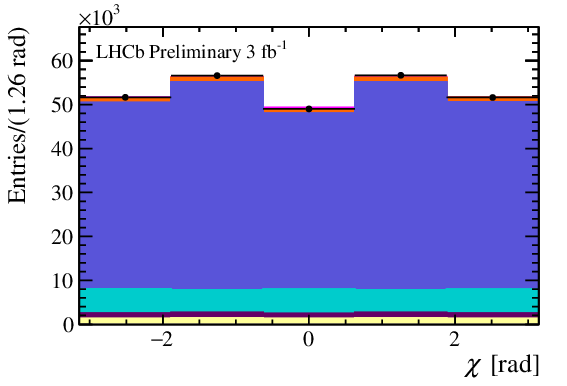
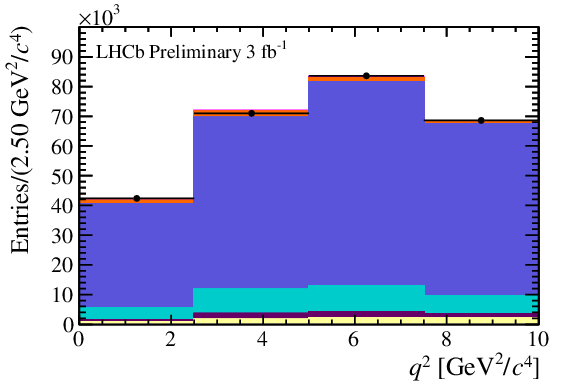
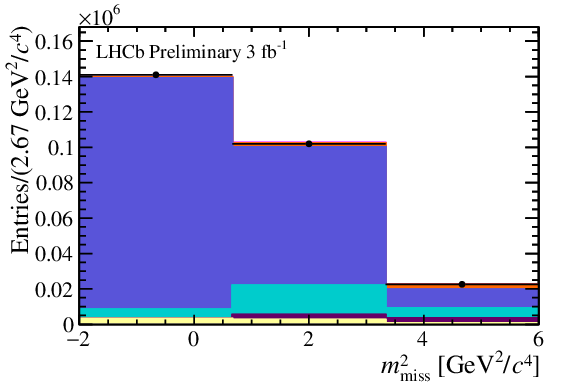
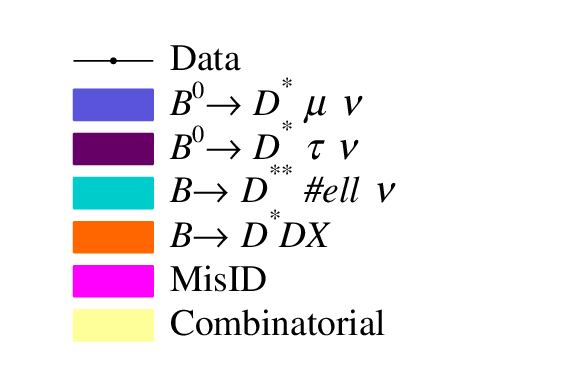
Figure 3: Distributions of decay angles, ∣Vub∣8, and ∣Vub∣9 illustrating fit quality and signal-background discrimination.
Fits employ multiple theoretical parameterizations for hadronic form factors:
- Caprini–Lellouch–Neubert (CLN)
- Boyd–Grinstein–Lebed (BGL)
- Bernlochner–Ligeti–Papucci–Robinson (BLPR)
The parameter values and their uncertainties are determined via binned template fits, with the BIC used to select the optimal truncation order in BGL. Systematic uncertainties are dominated by MC statistics, form factor truncation, and fixed parameter choices.
Results are visualized for ∣Vcb∣0, ∣Vcb∣1, and the helicity form factor ∣Vcb∣2 and compared directly with lattice QCD predictions by HPQCD, Fermilab-MILC, and JLQCD. No significant deviations are observed; compatibility is best with Fermilab-MILC and JLQCD for ∣Vcb∣3.
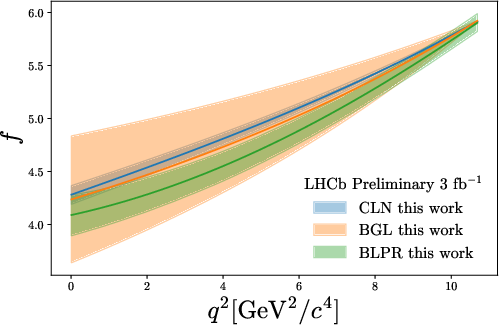
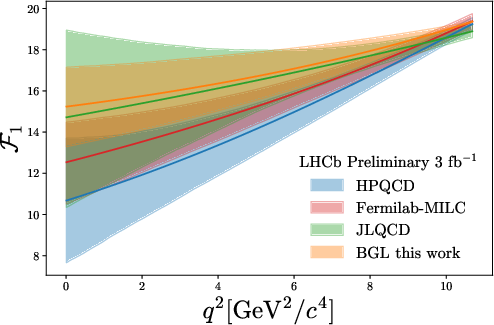
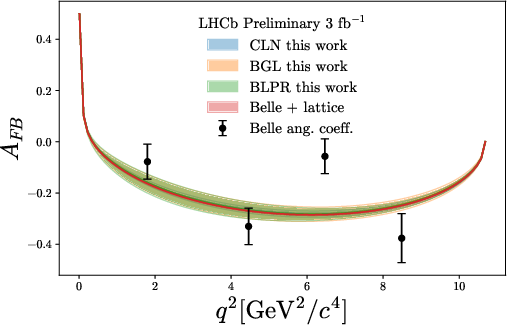
Figure 4: (Left) Comparison of ∣Vcb∣4 using all three parameterizations. (Middle) ∣Vcb∣5 from BGL with overlay of lattice QCD results. (Right) Muon forward-backward asymmetry ∣Vcb∣6 with Belle experiment and BLPR predictions.
The mutual consistency of results from CLN, BGL, and BLPR is notable. Small tensions in ∣Vcb∣7 between CLN and BLPR are within expectations due to differing theoretical assumptions. The forward-backward asymmetry ∣Vcb∣8 is in agreement with Belle measurements and the BLPR fit predictions.
Implications and Outlook
The established level of precision and agreement with lattice QCD and theoretical expectations affirm both the Standard Model description of these semileptonic decays and the robustness of the experimental approach, particularly the background modeling and kinematic reconstruction in a hadronic environment. Model dependence in form-factor extraction remains a significant source of systematic uncertainty; this measurement, by characterizing these directly from LHCb data, will enable future extractions of ∣Vcb∣9 and SM tests with increased reliability.
Improved luminosities anticipated from LHCb upgrades will reduce statistical uncertainties, with projected precisions of Λ→pμ−νˉμ0 on branching ratios. This will sharpen sensitivity not only to LFU-violating effects but also to possible contributions from exotic interactions or non-trivial hadronic dynamics. The techniques established here will be pivotal for future measurements, especially those involving final states with Λ→pμ−νˉμ1 leptons, for which kinematic reconstruction is more complex.
Conclusion
The work provides the world’s most precise measurement of Λ→pμ−νˉμ2 and the first full angular form-factor analysis of Λ→pμ−νˉμ3 decays at LHCb. Both results are in agreement with SM and lattice QCD predictions across multiple parameterizations and exhibit no significant anomalies. These measurements tighten the constraints on possible new physics in semileptonic flavor transitions and improve the determination of fundamental SM parameters. Ongoing and future analyses will benefit from this enhanced methodology and precision, further strengthening or challenging the SM paradigm in the flavor sector.