- The paper presents a novel method using motor current as intrinsic feedback to predict compliance reference positions for dexterous manipulation.
- It employs a sequence modeling pipeline combining joint states, current data, and human teleoperation to achieve reliable contact force estimation.
- Experimental results show significant improvements in task success rates and safety across various manipulation tasks on low-cost robot hands.
Motivation and Background
Compliance is a critical requirement for dexterous manipulation, particularly in scenarios involving fragile or deformable objects, sustained surface contact, or dynamic load adaptation. Traditional approaches rely heavily on tactile and force/torque sensors that, while effective, pose challenges in cost, fragility, calibration, and reduce accessibility for low-cost robot hands. This paper introduces a proprioception-driven manipulation paradigm that leverages motor current and joint state as intrinsic tactile-like signals, eliminating the need for external sensing hardware. Motor current, closely tied to actuator torque, provides real-time contact force, object resistance, and grasp stability indications, forming the foundation for compliance-aware manipulation.
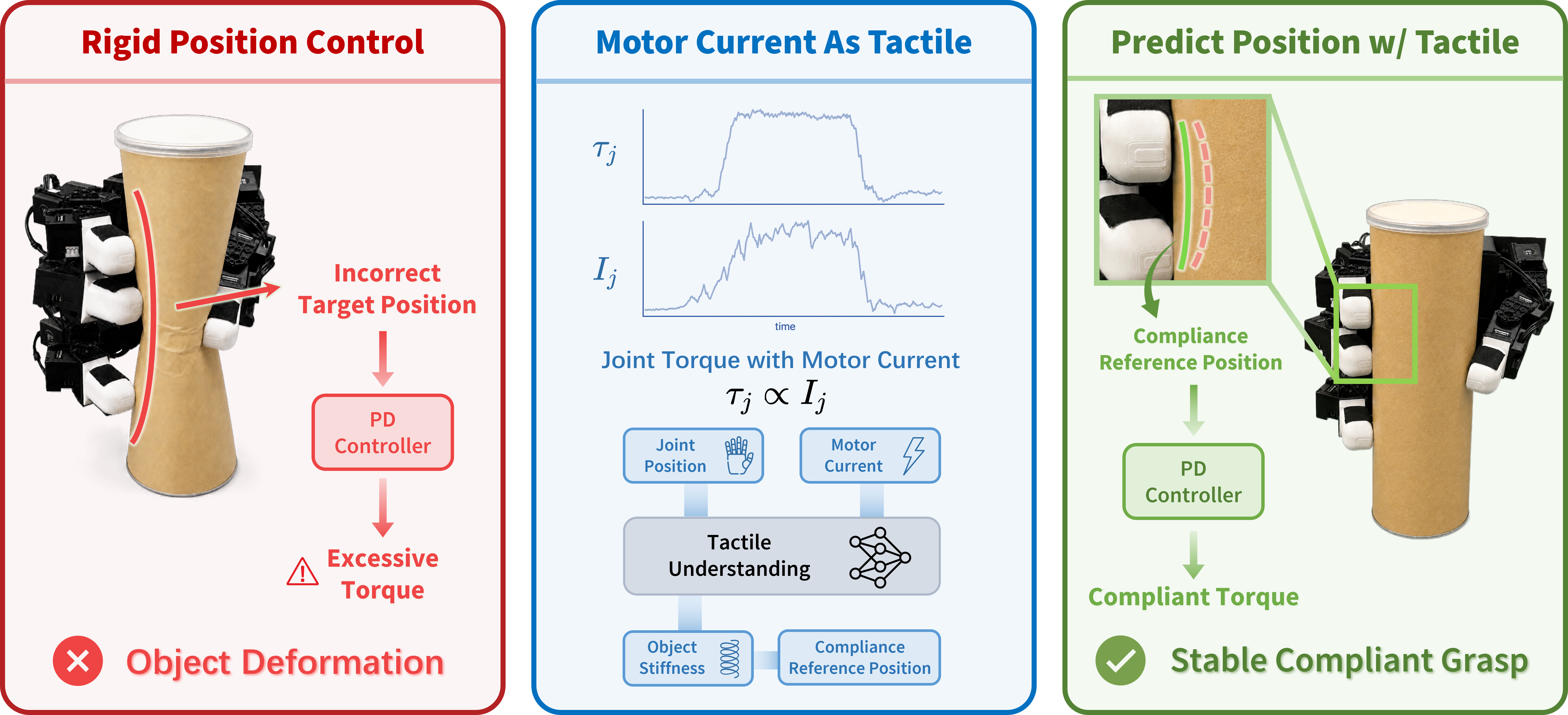
Figure 1: Compliance failures under rigid position control motivate using motor current and joint states for tactile-like feedback to drive compliant grasping without external sensors.
The authors demonstrate, through empirical studies on the Unitree Dex3 and LEAP Hand, that motor current and joint states vary consistently with measured contact force. Regression from motor current and position predicts normal force with high accuracy (RMSEs of 10.09g on Dex3, 17.75g on LEAP Hand, R2 values of 0.99 and 0.95). This substantiates motor current as a non-trivial proxy for contact—and motivates treating it as proprioceptive feedback, not merely as a force estimator.
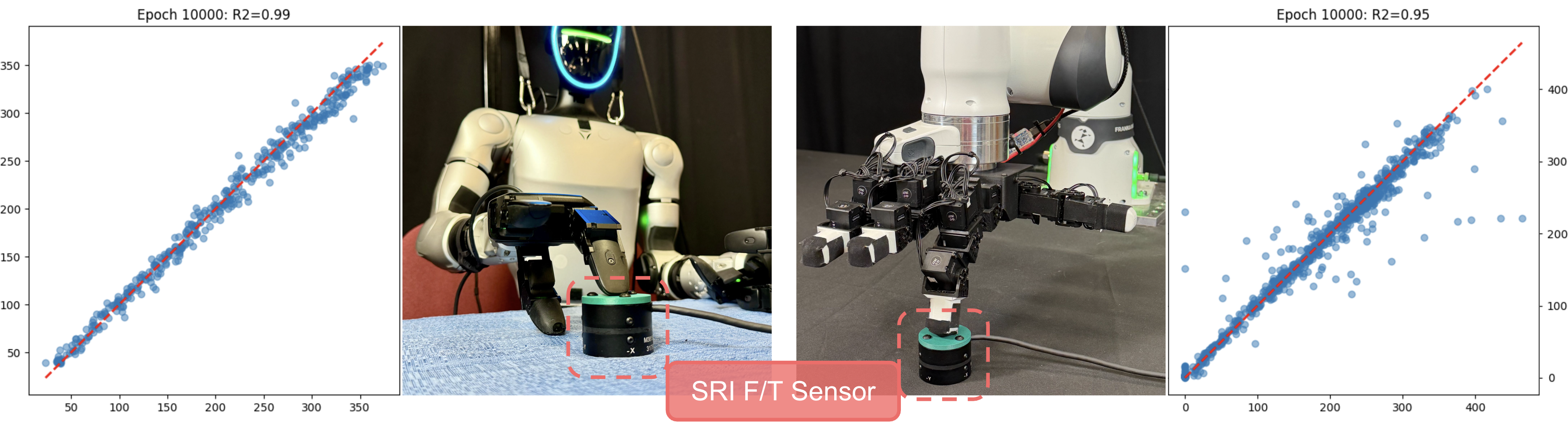
Figure 2: Motor current and joint state measurements correlate reliably with external contact force across diverse hardware.
Compliance Reference Position: Methodology
The proposed framework centers on predicting a compliance reference position (CRP). This is a joint-position target for the standard PD controller, using induced position error to regulate compliant grasping force. Unlike torque-based action spaces, which are incompatible with mainstream teleoperation and behavior cloning pipelines, the CRP provides an adaptive position-based interface suited to contemporary learning and control frameworks.
The data manifold is constructed from human teleoperation demonstrations, coupling user intent velocities (derived from command trajectories) with contact response signals (current changes relative to motion, ΔI/Δq). Demonstrations act as human-in-the-loop closed-loop correction, resulting in CRPs that directly encode task-valid compliance references from proprioceptive feedback.
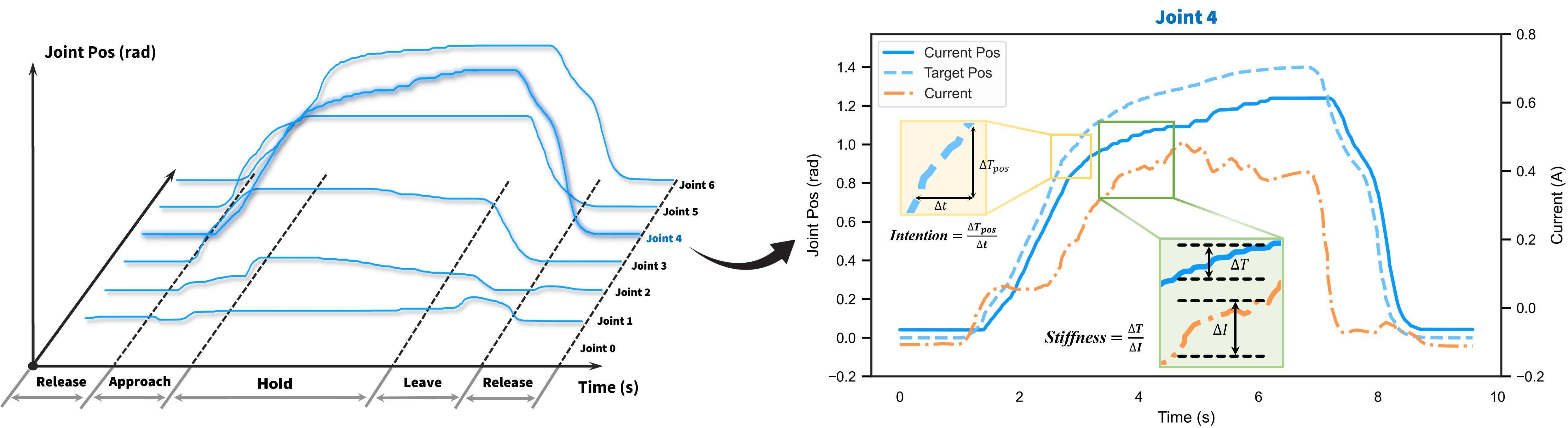
Figure 3: Demonstration manifold highlighting coupling between command velocity and current change, providing rich compliance cues for CRP learning.
Prediction is structured as a sequence modeling pipeline. In teleoperation, the input comprises joint states, raw motor current, and user intent velocity; in policy mode, user intent is replaced by object or goal pose. Training uses mean-squared error loss against demonstrated CRP targets, with an additional auxiliary loss regularizing prediction via offline-smoothed current.
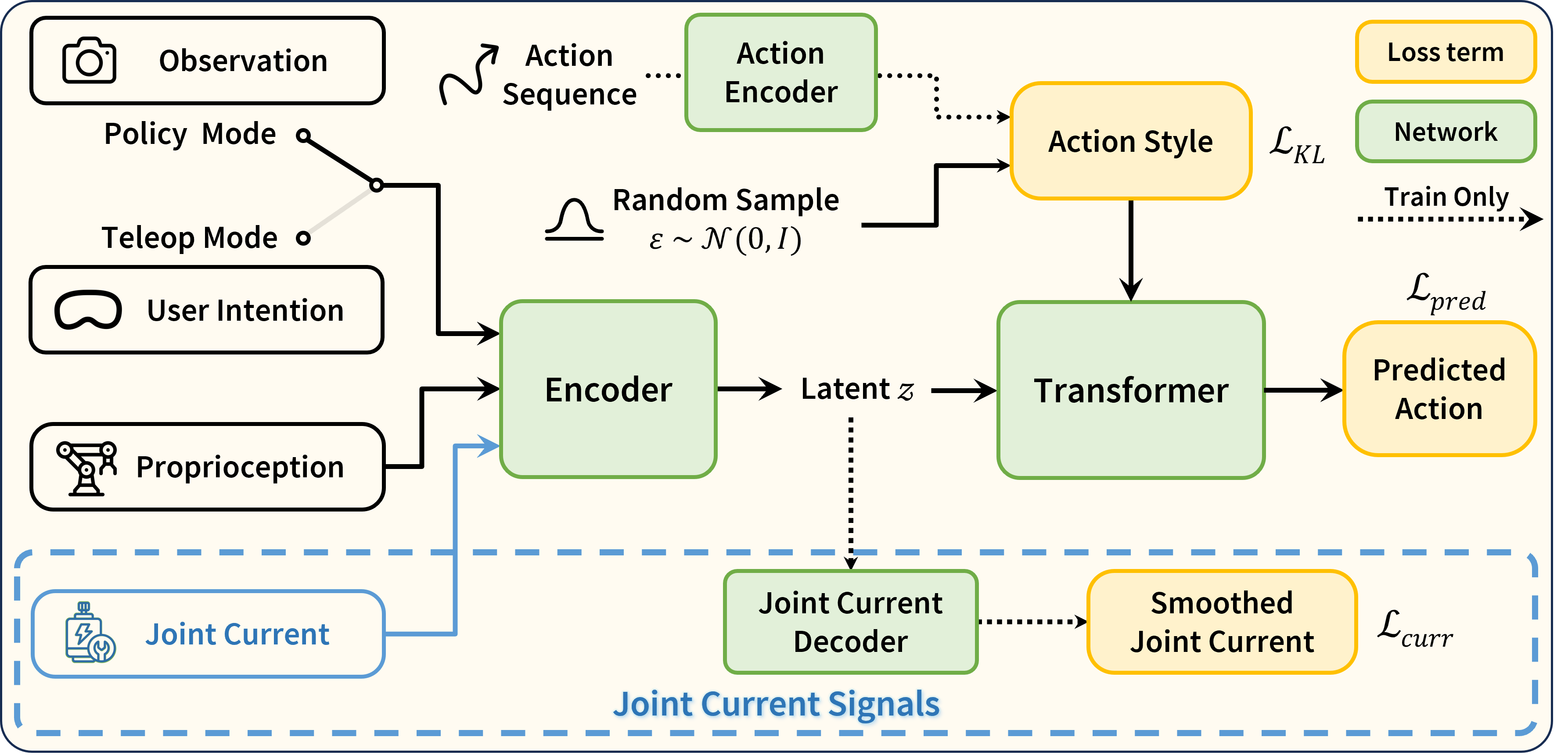
Figure 4: Sequence modeling pipeline for current-conditioned CRP prediction, supporting teleoperation and policy-driven execution.
Object and Task Diversity
The framework is evaluated across tasks requiring compliance: foam-cup stacking, board wiping, single-card picking, and dynamic bottle holding. A diverse object set is used for training, covering a wide range of shapes and stiffness levels, paired with free-space hand-motion trajectories for robust generalization.

Figure 5: Object set sampled for demonstrations covers broad physical interaction modalities, exposing the model to various contact-induced and actuation currents.
Experimental Results: Teleoperation and Policy Learning
Teleoperation
Foam-cup stacking and board wiping tasks show pronounced benefits under current-conditioned CRP prediction. The approach yields 100% success rates for both novice and skilled operators, eradicates deformation failure, reduces completion times, and substantially reduces grasp failure rates compared to baseline retargeting or current-free models. Notably, baseline models that lack motor-current input fail to regulate contact force, often crushing fragile objects or losing surface contact, even with operator correction.
Policy Learning
On dynamic bottle holding, the method demonstrates robust adaptation to load changes, maintaining stable grasp across out-of-distribution loads. Single-card picking tasks benefit from motor-current feedback, improving strict success rate from 55.8% to 76.9% and tolerant success from 65.4% to 90.4%, eliminating excessive normal force failures. These results confirm the efficacy of intrinsic motor signals for dynamic, compliant manipulation without external tactile or force sensors.
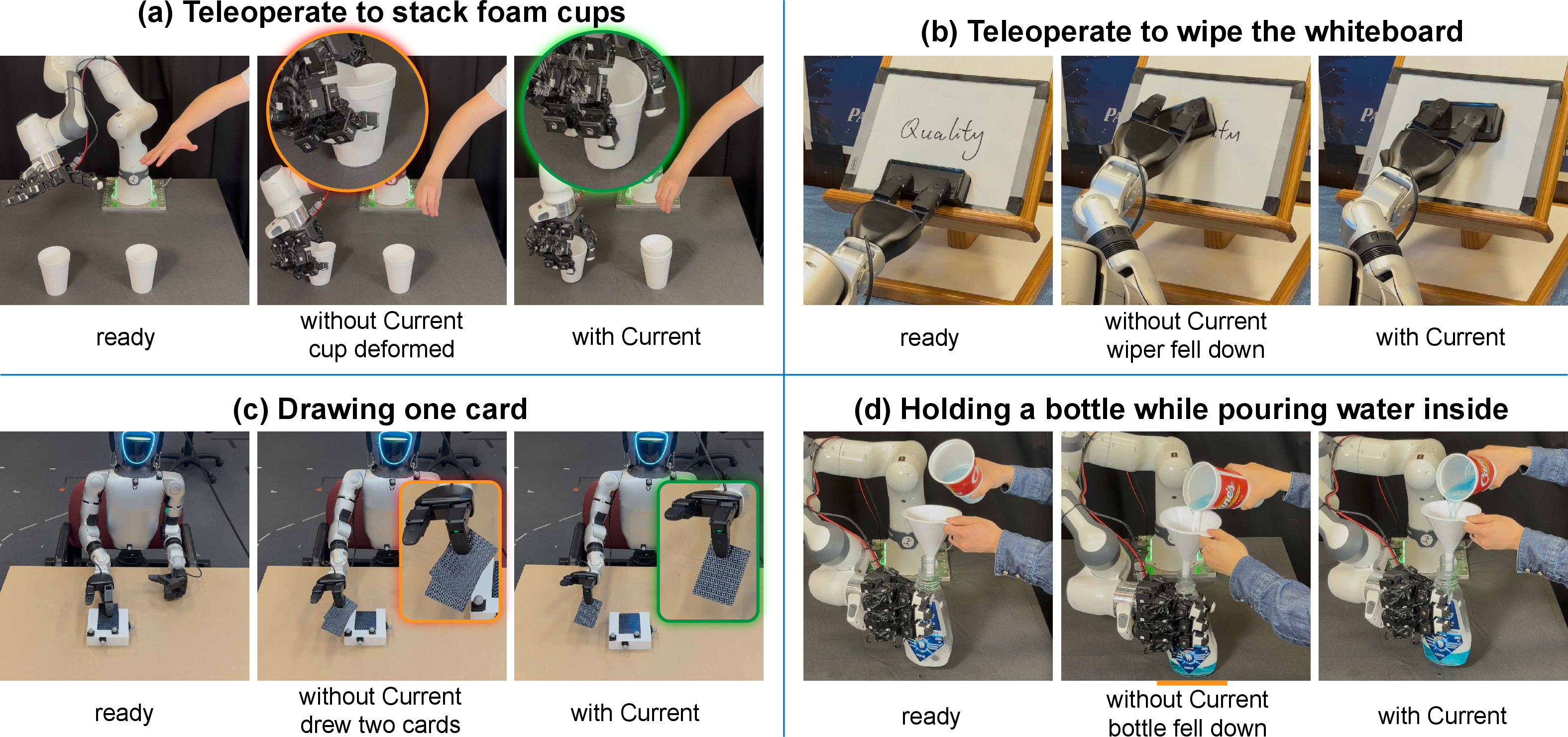
Figure 6: Visual results showing compliant manipulation with motor-current-driven CRPs, preventing cup deformation, maintaining wiping contact, enabling precise card picking, and adapting grasp force under dynamic loading.
Practical, Numerical, and Theoretical Implications
The framework demonstrates tactile-level manipulation using only intrinsic signals, without reliance on explicit wrench estimation, force/torque sensors, or torque-level control. The adoption of CRP as a position-based compliance representation aligns with standard PD-controlled hardware interfaces, broadening applicability to low-cost dexterous hands and mainstream teleoperation/policy pipelines.
The auxiliary loss on smoothed current regularizes latent representations for robustness to sensor noise, preserving responsiveness without incurring phase delay. Numerical results exhibit statistically significant improvements in task completion, safety, and efficiency across hardware and task variations. The approach contradicts the assumption that kinematics and user intent alone suffice for contact-conditioned reference prediction, empirically validating the necessity of current-conditioned proprioceptive feedback.
Limitations and Future Directions
Current-based feedback efficacy is hardware-dependent; transmission design, joint configuration, and sensor quality modulate the informativeness of motor current as a contact signal. For hands lacking informative joints (e.g., abduction/adduction motors), dynamic load adaptation may be compromised. Demonstration quality and task coverage significantly affect CRP supervision. Integration of robust perception for policy learning, exhaustive ablations, and trajectory-level performance analysis are prospective extensions.
The framework's composability with contemporary imitation learning and reinforcement learning approaches suggests potential advances in generalized manipulation policy robustness, dynamic task adaptation, and closed-loop tactile substitution in emerging robotic platforms.
Conclusion
This paper presents a proprioception-driven compliance method wherein motor current and joint states provide tactile-like contact feedback for compliant manipulation. The system learns compliance reference positions directly from human demonstrations, supports seamless teleoperation and policy-driven execution, and demonstrably enhances compliance, safety, and efficiency in contact-rich dexterous tasks on low-cost robot hands. Future exploration should address limitations in hardware dependency, supervisor label optimality, perception integration, and full component ablation to further advance tactile-free manipulation.