- The paper introduces a hybrid normalizing flow surrogate to accurately reproduce high-dimensional, non-Gaussian likelihoods in neutrino experiments.
- It demonstrates superior fidelity and efficiency, achieving a relative effective sample size of 98% compared to Gaussian and MCMC methods.
- The approach enables fast, explicit likelihood evaluations, facilitating joint fits and rigorous uncertainty propagation in oscillation analyses.
Flow-Based Surrogates for High-Dimensional Likelihoods in Experimental Neutrino Physics
Motivation and Problem Statement
Long-baseline neutrino experiments now operate in a regime where systematic uncertainty modeling dominates precision measurement, especially for oscillation parameter inference. Standard practice involves constraining nuisance parameters using near-detector data through likelihood fits. High-dimensional systematic likelihoods in this setting are often non-Gaussian, shaped by non-linear parameter dependencies, physical boundaries, limited-statistics effects, and degeneracies. Classical approaches propagate these constraints via local post-fit Gaussian approximations or Markov Chain Monte Carlo (MCMC) samples, each with significant limitations: Gaussian summations underrepresent complex likelihood features; MCMC samples are not readily evaluable or distributable. Full experiment-specific likelihood implementations are impractically heavy for cross-analysis or joint-fits, especially in global oscillation analysis frameworks. The paper proposes that normalizing flows (NF) can efficiently provide faithful, portable surrogates for these high-dimensional likelihoods, bridging the gap between practical usability and statistical fidelity (2607.03477).
Normalizing Flow Surrogate Architecture
The authors introduce a hybrid normalizing flow architecture tailored for high-dimensional systematic likelihoods. Leveraging domain structure, the parameter space is partitioned into two blocks: a small non-linear block, ηA, capturing non-Gaussian systematic effects, and a large linear block, ηB, representing approximately linear systematics. The flow is architected as:
qNF(ηA,ηB)=qAR(ηA∣ηB)qCL(ηB)
where qAR is a conditional autoregressive rational-quadratic spline flow, and qCL is a coupling-layer-based affine flow. The parameterization exploits efficient invertibility and tractable density evaluation, enabling fast sampling and analytical likelihood representation. The model is initialized using a post-fit Gaussian approximation to provide an initial density proposal.
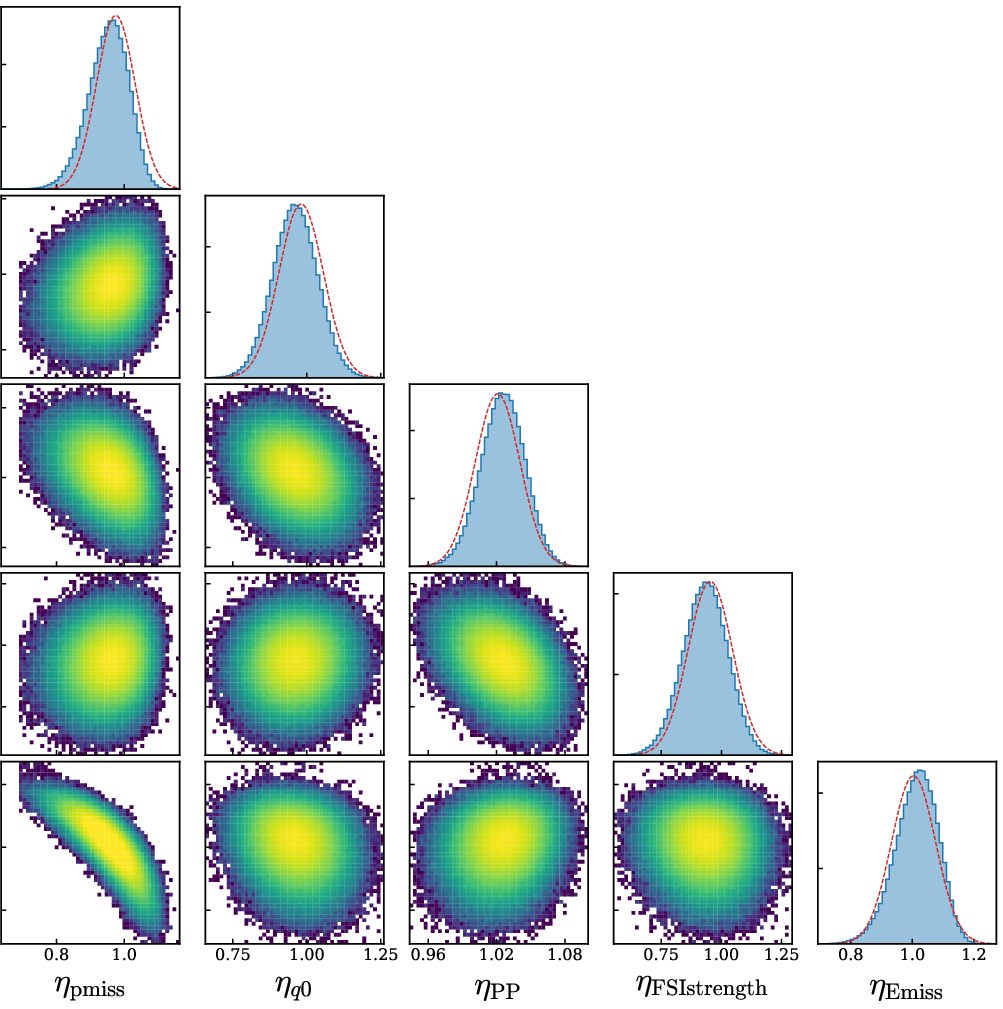
Figure 1: Corner plot of selected non-linear systematic parameters reflecting curved correlations and non-Gaussian confidence regions.
Benchmark Likelihood Construction and Validation
A representative benchmark likelihood replicates the statistical structure of a typical near-detector fit with $110$ parameters, of which $10$ encode explicit non-Gaussianity. Flux-like systematics are modeled linearly; non-linear parameters emulate interaction-model uncertainties via event-by-event weights with a kinematic dependence. The simulation employs NEUT-generated events with detector smearing and topology-based selection, reproducing ND280-like efficiency profiles and binning. Validation is performed using asymptotically exact MCMC sampling as a reference.
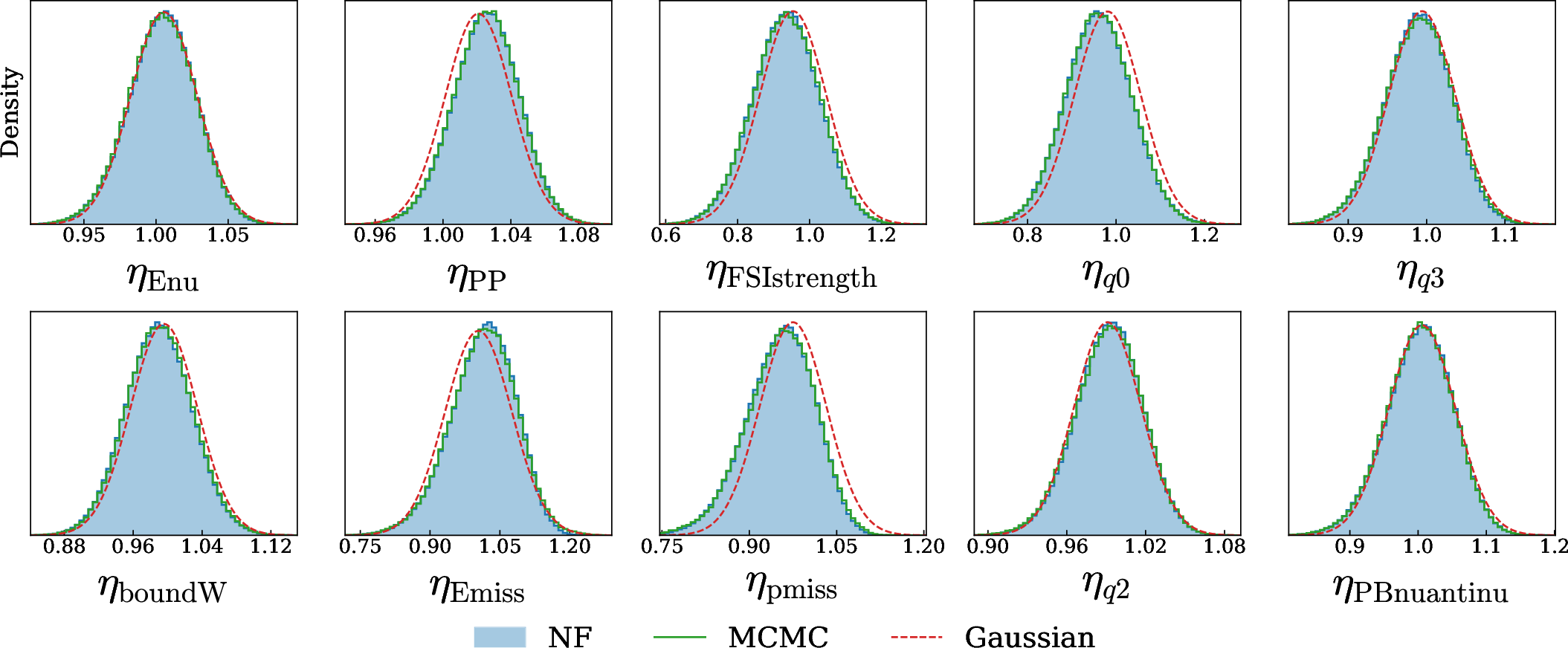
Figure 2: One-dimensional marginals for ten non-linear systematic parameters: NF surrogates precisely match MCMC samples, outperforming the post-fit Gaussian.
The NF surrogate demonstrates high fidelity, particularly in capturing marginal asymmetries and multi-dimensional correlations. Notably, the mass of the distribution is accurately captured, avoiding the bias inherent in local Gaussian approximations that center on the likelihood maximum rather than the bulk probability mass.
Impact on Uncertainty Propagation
Systematic uncertainty propagation to neutrino flux predictions reveals critical differences between surrogates. The NF model yields flux predictions and uncertainty bands almost identical to MCMC reference, deviating by less than 1%. In comparison, the post-fit Gaussian systematically overestimates uncertainty widths by ∼3.5%, a significant error for downstream oscillation parameter inference.
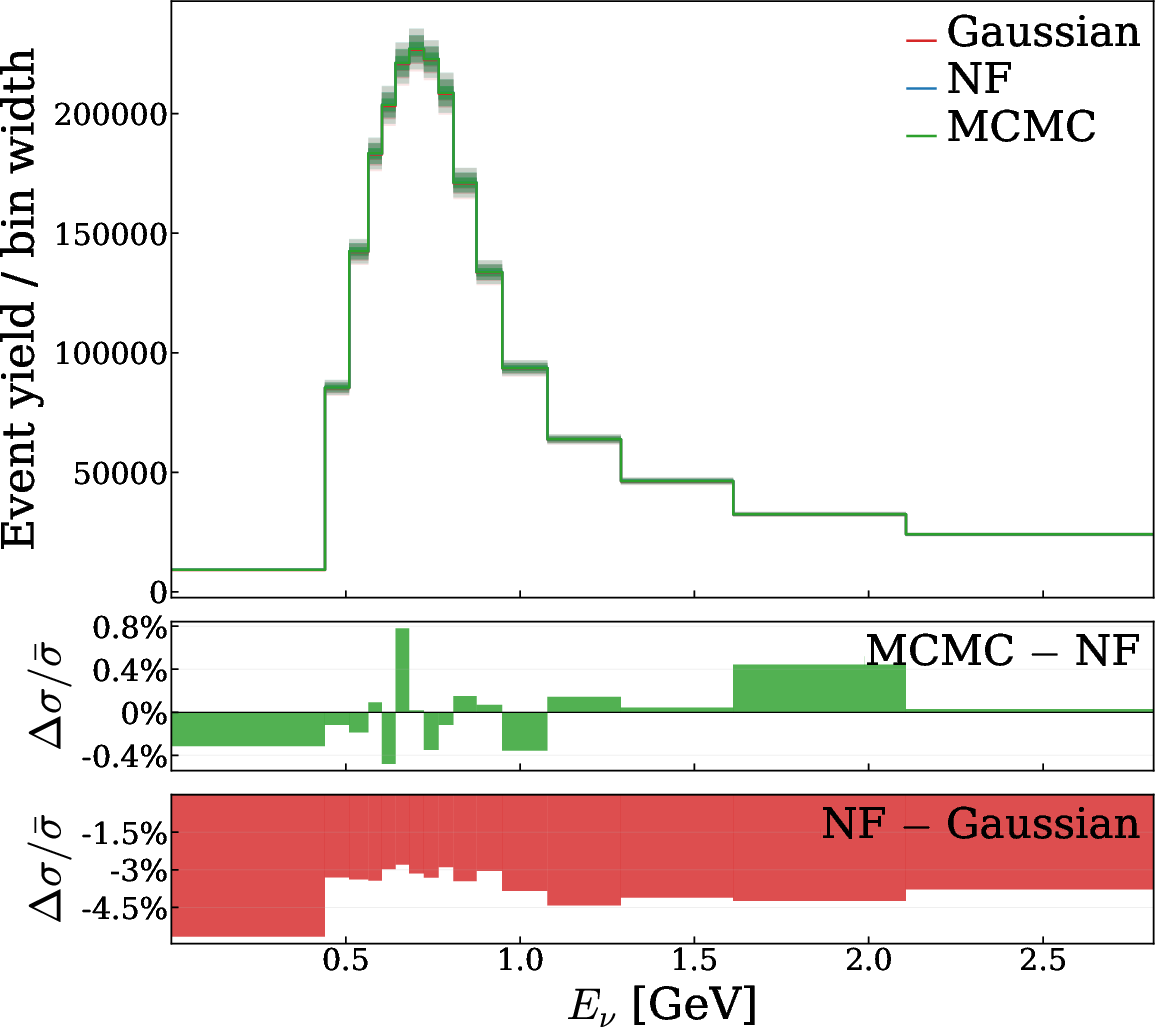
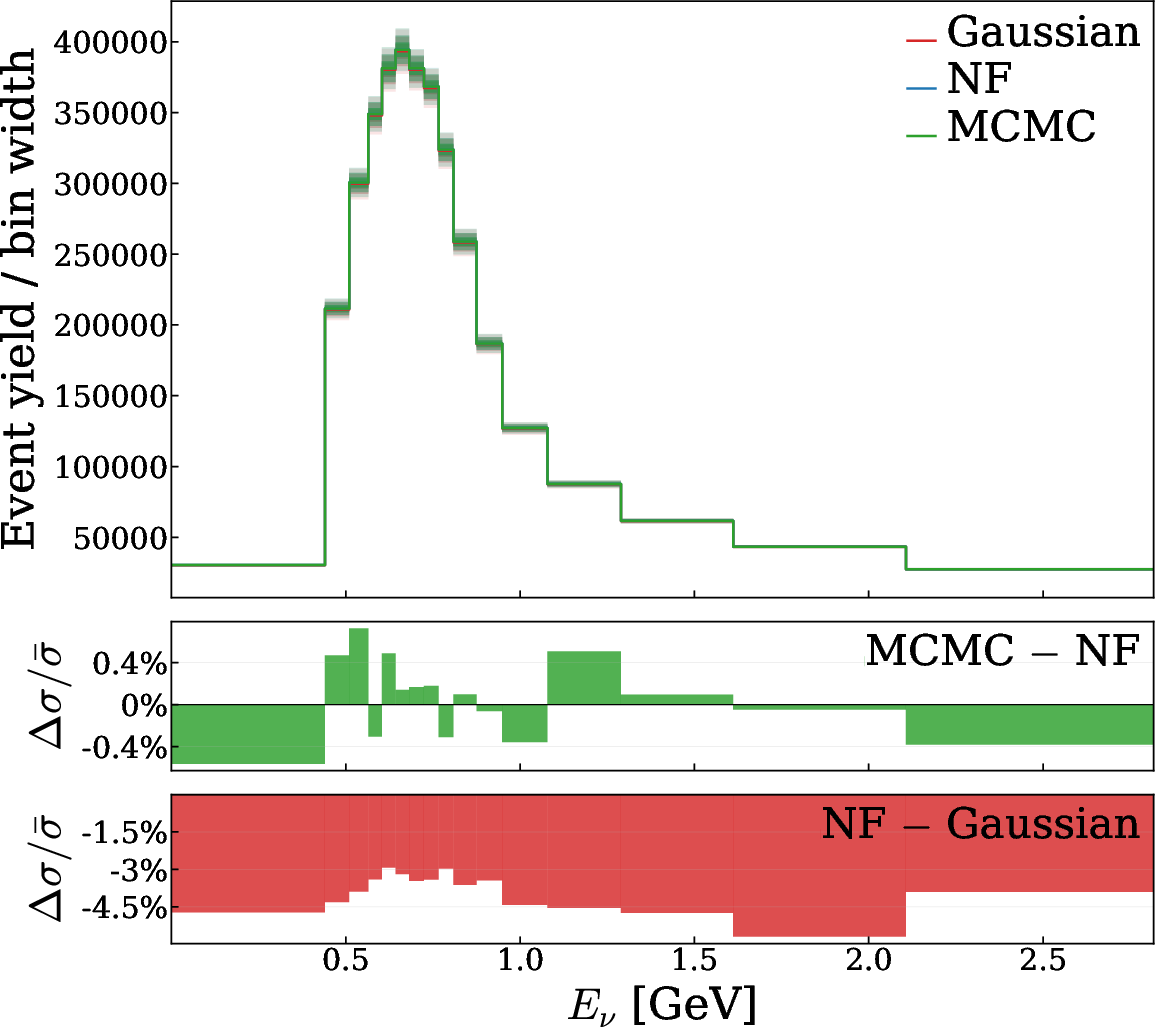
Figure 3: FHC (left) and RHC (right) flux predictions; NF and MCMC uncertainty bands coincide, while Gaussian surrogate overestimates uncertainty.
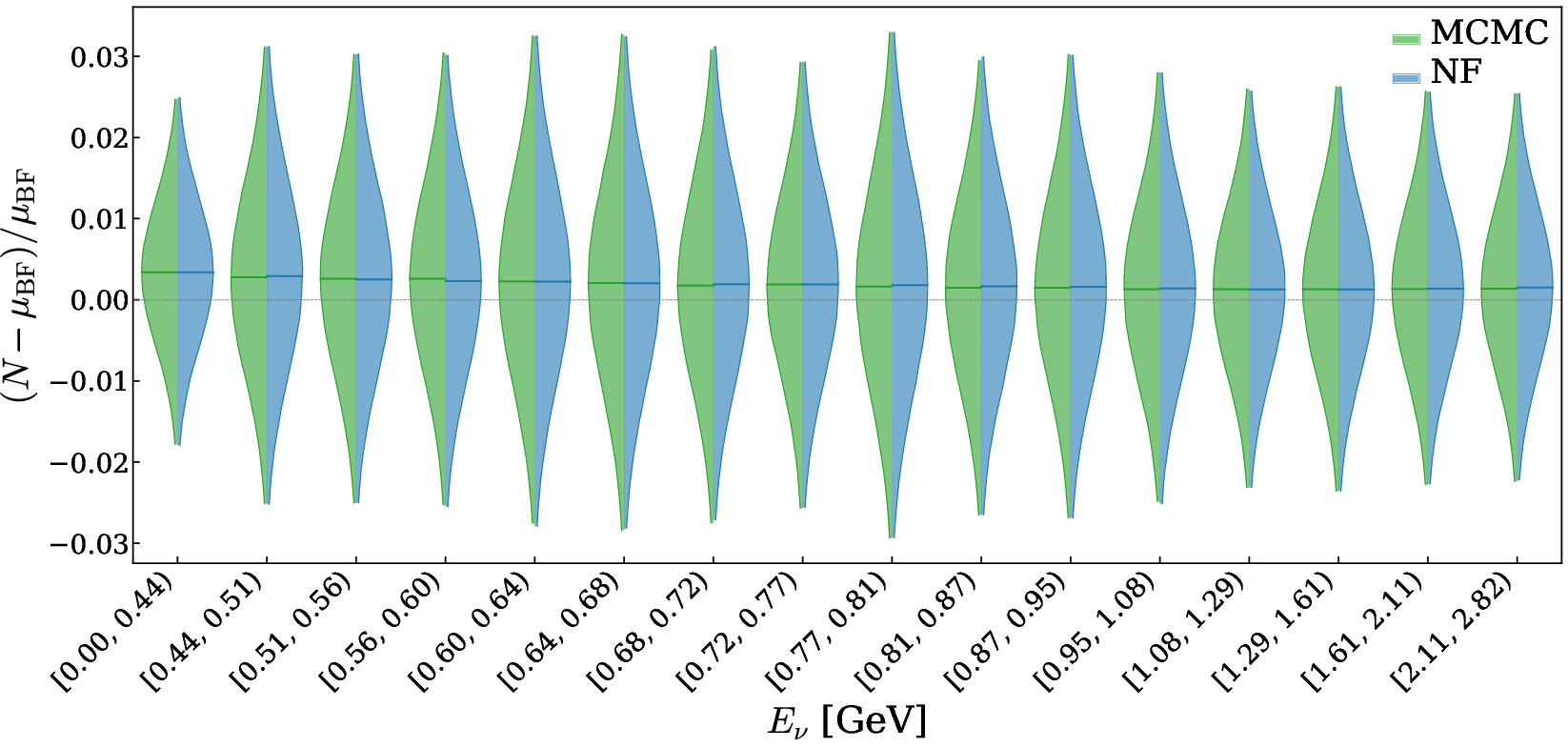
Figure 4: Bin-wise split violin plots of FHC flux predictions; NF and MCMC distributions agree, capturing bias that is missed by the Gaussian.
These results underscore that improper surrogate choices directly affect physical predictions, biasing inference and potentially compromising joint analyses across detectors or experiments.
A salient feature is the computational efficiency: the trained NF surrogate achieves a relative effective sample size (rESS) of 98%, compared to just ηB0 for the Gaussian proposal. Importance-sampling weight distributions are sharply concentrated for NF, enabling rapid and reliable production of systematic throws and flux predictions.
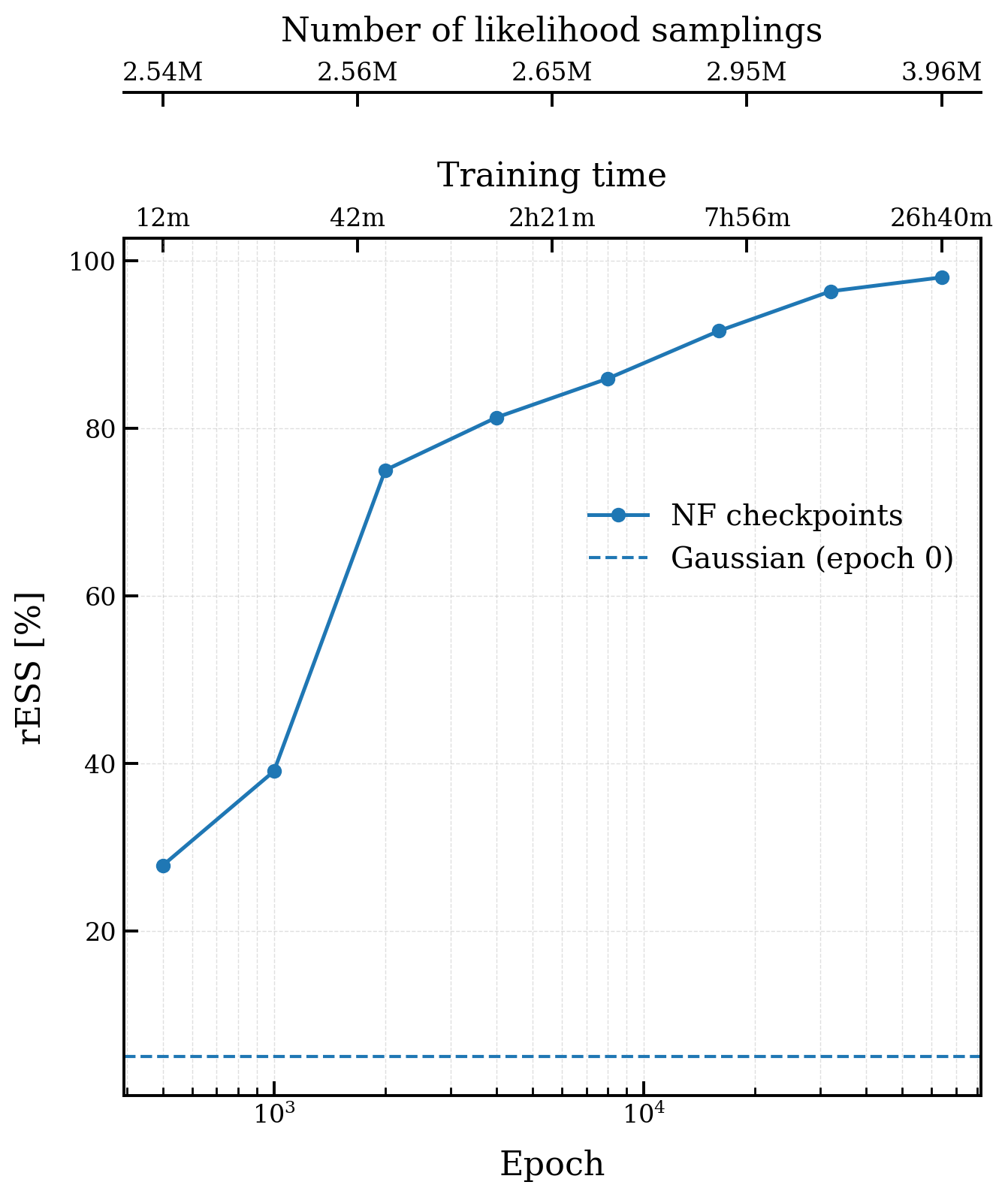
Figure 5: Relative effective sample size improves throughout NF training, plateauing at ηB1.
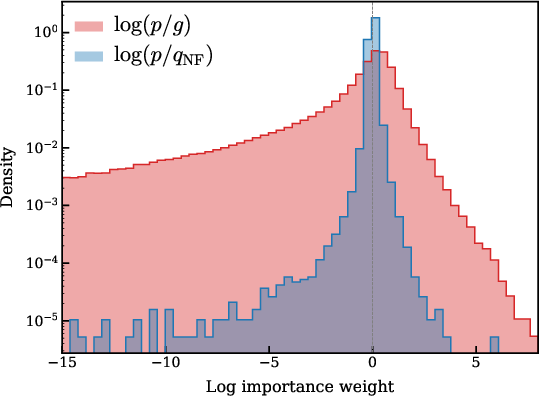
Figure 6: Log-importance weight distributions: Gaussian proposal spans ηB2 orders of magnitude, NF proposal is tightly concentrated.
Sampling and density evaluations are analytical and fast: with ηB3 (non-linear block size), the NF produces up to ηB4 density evaluations per GPU-hour. Even at ηB5, throughput exceeds the likelihood evaluation rates of the original model. Training cost matches a single MCMC run and, importantly, is paid once for a reusable explicit density model.
Practical Implications and Theoretical Significance
The NF surrogate model transforms the output of systematic-constraining fits from local summaries or finite sample chains into explicit, evaluable density models. This provides a statistical object that is efficiently distributable, samplable, and insertable into downstream likelihood functions, supporting joint fits, global combinations, and rigorous uncertainty propagation. The approach preserves complex likelihood structure (skewness, curved correlations, multi-modality), which is essential as analyses across experiments grow in scale and complexity. The architecture and training protocols are robust and scalable, making them suitable for future analyses involving hundreds to thousands of nuisance parameters.
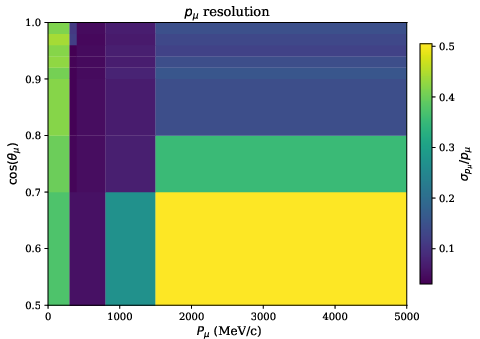
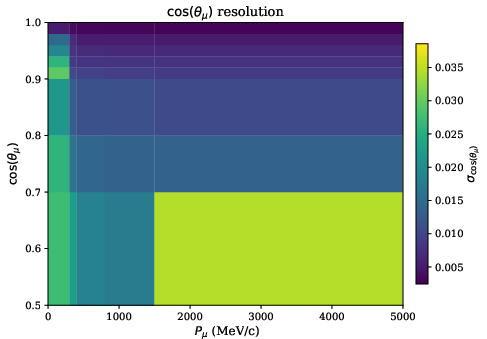
Figure 7: Muon kinematics resolution maps used in benchmark likelihood construction.
Conclusion
The adoption of normalizing flows as surrogates for high-dimensional, non-Gaussian systematic likelihoods in neutrino physics resolves critical limitations in statistical modeling and constraint propagation. The method achieves near-perfect sampling efficiency, accurately reproduces non-Gaussian uncertainty structures, and scales analytically to large parameter spaces. These surrogates enable portable, high-fidelity representations necessary for modern oscillation inference, joint experiment fits, and global combinations. As fit complexity and precision requirements continue to increase, flow-based surrogates are poised to become an indispensable tool for rigorous statistical inference in experimental particle physics.

