- The paper presents a deterministic, moment-based correction (banana contour) for accurately capturing non-Gaussian uncertainties in spaceflight maneuvers.
- It develops analytic quadratic and asymmetry corrections that efficiently enforce geometric constraints while minimizing computational overhead.
- Empirical results demonstrate a 98.35% constraint satisfaction and ΔV reduction, validating the method’s efficiency for real-time autonomous control.
Efficient Non-Gaussian Chance Constraint Methods for Spaceflight Stochastic Nonlinear Problems
Introduction and Context
Spacecraft guidance and control increasingly encounter statistical uncertainty regimes that diverge from Gaussian assumptions, particularly in cislunar and deep-space environments where strong nonlinearities and extended propagation durations result in significant non-Gaussianity of state distributions. Standard Linear Covariance (LinCov) techniques leveraging Gaussian statistics are tractable and widely deployed but become systematically inaccurate for such conditions, undermining robust chance-constrained maneuver design. The paper "An Efficient Non-Gaussian Chance Constraint Method for Stochastic Nonlinear Problems in Spaceflight" (2607.03424) presents a deterministic, moment-based analytic methodology for efficiently certifying probabilistic constraints when uncertainty propagation produces "banana-shaped" (i.e., strongly non-Gaussian) state dispersion—ubiquitous in orbital mechanics under nonlinear evolution.
The central development is an analytic first-order correction to the classical covariance ellipse, directly informed by third- and fourth-order central moments (skewness and kurtosis tensors), leading to a "banana" confidence contour that efficiently captures the dominant geometry of weakly non-Gaussian distributions.
Key steps include:
- Covariance Ellipse Baseline: The classical Mahalanobis distance is used as a reference, parameterizing a confidence ellipse in the principal axes of the 2D covariance submatrix.
- Quadratic Correction Ansatz: The principal axis parameterizations (u^(t), v^(t)) are modified such that significant deviations in the long direction yield a quadratic "bend" in the orthogonal direction, with coefficients derived analytically to minimize mean-square parameterization error as a function of skewness and kurtosis moments.
- Asymmetry Corrections: Long-axis asymmetry is introduced using Cornish-Fisher expansion logic, with angular periodic corrections coupling boundary quantiles to skewness, ensuring that both bending and stretching are represented.
- Resultant Banana Contour: The banana contour is shown to closely approximate the isoprobability boundary in the relevant parameter regime, subsuming Gaussian ellipses as a limiting case.
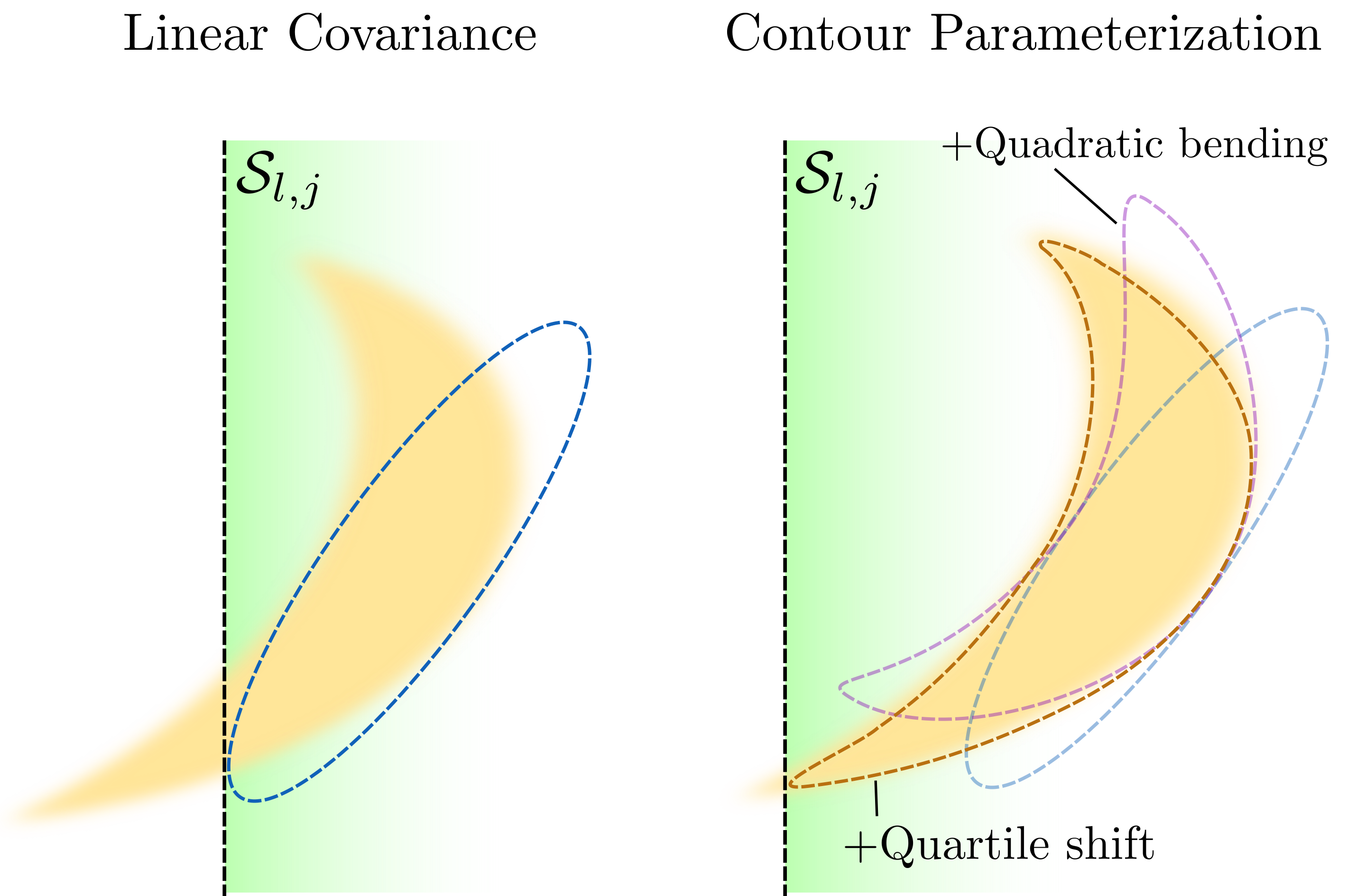
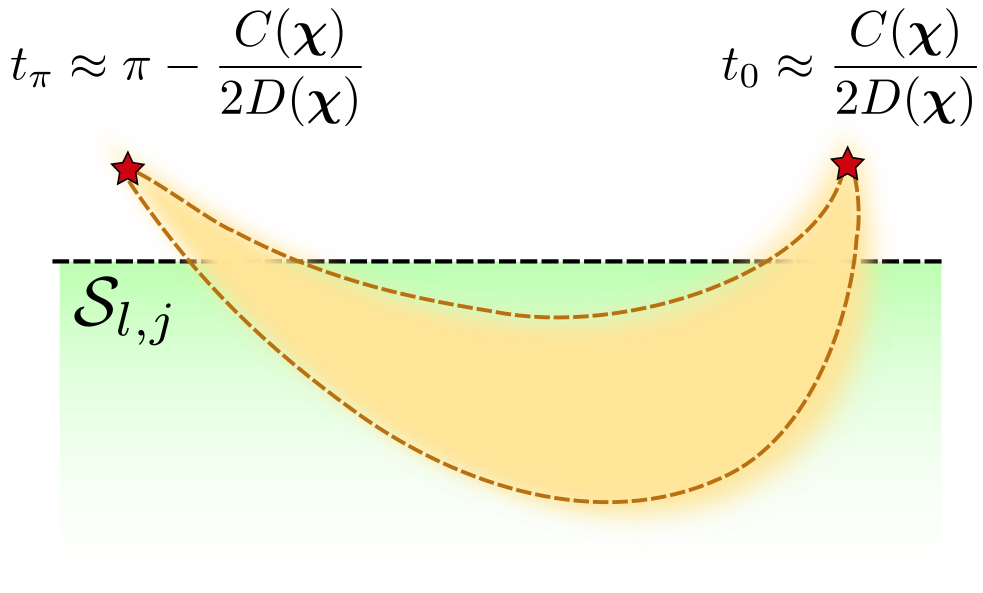
Figure 1: Depiction of the geometric difference between a classical covariance ellipse and the banana confidence boundary under non-Gaussian state dispersion.
This efficient approach avoids Monte Carlo or Gaussian mixture approaches, which are computationally intensive, by leveraging deterministic higher-moment estimation—facilitated via the Conjugate Unscented Transform (CUT), enabling real-time application to stochastic control.
Non-Convex Constraint Enforcement and Surrogate Construction
In practical mission design, chance constraints are often codified as geometric (e.g., half-plane) constraints in state or measurement space. The non-Gaussian banana contour introduces non-convexity and non-smoothness in enforcing the support of these constraints.
- Active-Worst-Angle Reduction: For a given half-plane, maximizing the residual ψ(χ,t) over the banana contour is analytically reduced to a 1D maximization over contour parameter t (or, equivalently, ζ=cost). This decomposition facilitates gradient computation for sequential optimization.
- Tip Switching and Gradient Regularization: Non-smooth optimizer behavior may arise when the constraint is nearly tangent to both ends of the banana ("tip switching"). The paper develops log-sum-exp smoothing surrogates that ensure continuous corrective updates within optimization, with properties demonstrated in both analysis and simulation.
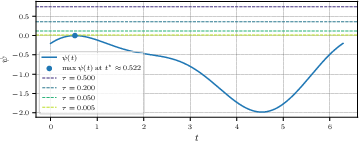
Figure 2: Smooth conservative surrogate approximations of the non-Gaussian support constraint, illustrating tunable conservatism as a function of the smoothing parameter τ.
- Conservative Surrogate Using Log-Integral-Exp: A conservative, arbitrarily tight but smooth upper-bounding surrogate to the exact constraint is constructed by combining a log-integral-exp relaxation and a rigorously derived penalization term. This surrogate is guaranteed to enforce the true chance constraint for any τ>0 and does so with minimal computational overhead.
The result is a robust and differentiable constraint interface, compatible with modern nonlinear optimization routines applicable to guidance, targeting, and onboard autonomy.
Numerical Demonstrations and Empirical Results
Asteroid Orbiter Scenario
Application to a stochastic targeting problem for asteroid reconnaissance demonstrates dramatic accuracy improvements over LinCov. An initial Gaussian distribution evolves into a highly bent, non-Gaussian form due to nonlinear dynamics. Using the banana method, chance constraints on positional keep-out zones are enforced with high-fidelity.
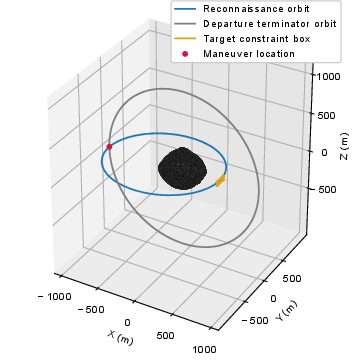
Figure 3: Asteroid maneuver scenario illustrating the geometry of optimal targeting under both Gaussian and non-Gaussian uncertainty propagation.
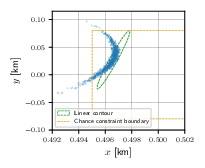
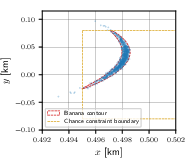
Figure 4: Monte Carlo verification of LinCov and banana policies. The banana contour method achieves 98.35% constraint satisfaction compared to 88.10% for LinCov under a prescribed risk threshold, with no increase in control effort.
Despite the higher complexity of the banana constraint, optimization runtimes remain competitive—order-of-magnitude faster than full Monte Carlo sampling, while providing strong constraint reliability.
Lunar Free-Return (Artemis II-Like) Trajectory Midcourse Correction
A high-fidelity, real-world inspired scenario of stochastic maneuvering for return trajectory correction in a planar Circular Restricted Three-Body Problem (CR3BP) Earth-Moon transfer is examined, targeting entry corridor requirements at Earth atmospheric interface.
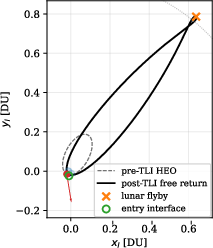
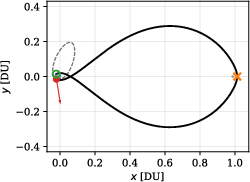
Figure 5: Trajectory geometry for an Artemis II-like free-return scenario in inertial and rotating frames.
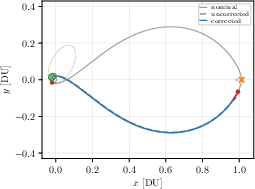
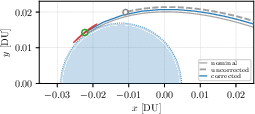
Figure 6: Post-flyby correction using the banana policy, with the final trajectory and 3σ confidence bounds after optimizing for both nominal accuracy and robust constraint satisfaction.
Strong numerical results include:
- The banana policy reduced observed violation rate by 64% relative to LinCov, with a simultaneous 14.4% decrease in maneuver ΔV.
- The coverage of the final state distribution by the analytic banana boundary provided an excellent fit to high-sample MCS outcomes, despite requiring only moment computation rather than full sampling.
- As propagation time diminishes and the distribution becomes more Gaussian (shorter time-to-go, less nonlinearity), the method smoothly converges to the LinCov result, ensuring that unnecessary conservatism is avoided.
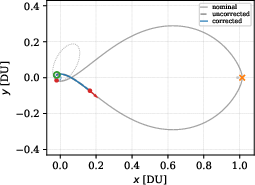
Figure 7: Final maneuver phase verifying corridor constraint satisfaction under banana policy dynamics with Monte Carlo samples and analytic boundaries.
Theoretical and Practical Implications
The study unambiguously demonstrates that moment-informed analytic non-Gaussian boundaries offer a practical middle ground between LinCov/affine Gaussian methods and full-blown Monte Carlo or sampling-based non-Gaussian strategies. The moment closure allows fast, deterministic, and certifiable constraint satisfaction, with computational requirements compatible with onboard optimization for autonomous missions or rapid trade studies. The conservative surrogates guarantee safety even under gradient-based update schemes, resolving a key bottleneck in non-convex constraint management for high-reliability missions.
The results also highlight that the geometry of actual propagated uncertainty in nonlinear orbit dynamics (e.g., "banana" shapes) is straightforwardly tractable when higher-order moments can be efficiently computed, and that traditional reliance on covariance alone is insufficient and sometimes fundamentally unreliable.
Outlook and Future Research
Adoption of deterministic, moment-based non-Gaussian chance constraint enforcement will likely become standard in long-horizon, high-autonomy mission design regimes. Further extensions are anticipated along these axes:
- Generalizing the banana parameterization to higher-dimensional slices for operationally-relevant state spaces (6D or beyond).
- Integration with advanced uncertainty quantification tools such as polynomial chaos expansions and cut-based deterministic sampling for moment estimation in large-scale or real-time environments.
- Deployment in onboard GNC architectures for cislunar, deep-space, or high-stakes proximity operations, displacing Monte Carlo-based certification for real-time constraint management.
- Exploration of robustification strategies to handle strongly multimodal or beyond-weakly-non-Gaussian distributions.
- Synergy with nonlinear feedback and optimal control methods for distribution steering or feedback-corrected uncertainty management.
Conclusion
The deterministic moment-based approach for non-Gaussian chance-constraint enforcement detailed in this work provides efficient, reliable, and mathematically rigorous guarantees for safety-critical spaceflight applications under strongly nonlinear uncertainty propagation (2607.03424). The methodology achieves near-Monte-Carlo verification-level constraint satisfaction at a fraction of the computational cost, retaining full compatibility with sequential or gradient-based optimization, and is readily extensible to future mission architectures confronted by similarly challenging uncertainty regimes.

