- The paper presents the S-ICDF dataset, which uses a physically-grounded, parameterized Sionna simulation to generate 102 distinct interference configurations for robust evaluation.
- It benchmarks both classical direction finding methods (MUSIC, ESPRIT, CAPON) and an ML-based architecture (XceptionTime) using controlled multipath and SNR variations.
- The study highlights near-perfect ML interference recognition, detailed sensitivity analysis, and actionable insights for advancing reproducible RF interference monitoring research.
The S-ICDF Dataset: Large-Scale Sionna-Simulated Interference for Characterization and Direction Finding
Introduction
The S-ICDF (Sionna-Simulated Interference Characterization and Direction Finding) dataset provides a comprehensive synthetic framework for advancing the development and evaluation of ML-based interference monitoring, particularly within GNSS and wireless communications contexts. Its simulation protocol leverages the Sionna library to create a highly parameterizable, physically grounded channel environment, supporting robust benchmarking of both classical and ML-based methods for interference classification, characterization, and DoA estimation in challenging multipath-dominated indoor settings.
Dataset Construction and Coverage
A central feature of S-ICDF is the systematic one-at-a-time (OAT) parameter variation across 102 distinct interference configurations, encompassing diverse waveform types, modulation schemes, spatial layouts, bandwidths, SNRs, antenna array geometries, gain patterns, and multipath conditions. This granular design enables interpretable sensitivity analysis by isolating the effect of each factor on the received signal and downstream inference.
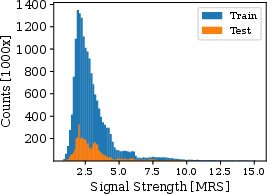
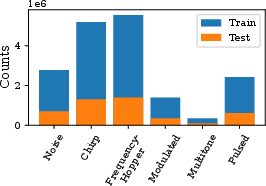
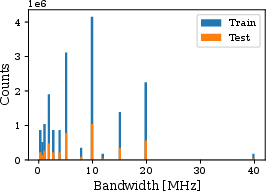
Figure 1: Histograms of S-ICDF signal characteristics, visualizing the distribution of signal strengths, interference types, and bandwidths.
Raw IQ samples are generated for both 2×2 and 8×1 array layouts, supporting both single- and multi-antenna DF paradigms. The simulation reflects a typical industrial indoor scenario, with realistic ray-traced multipath and a moving receiver trajectory for synthetic aperture effects. Each signal class (Noise, Chirp, Frequency Hopper, Modulated, Multitone, Pulsed) is represented via rich parametric sweeps, and SNRs range from –20 to +20 dB, ensuring coverage from severely degraded to nearly ideal regimes.
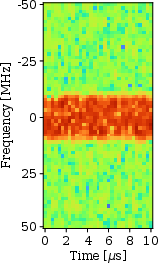
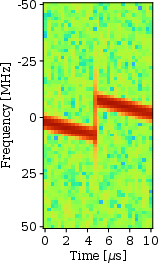
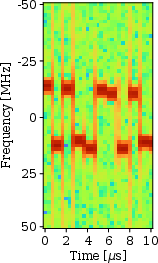
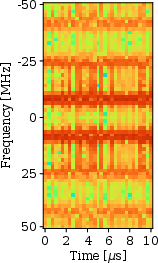
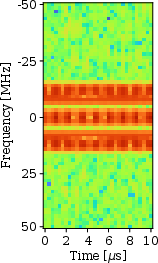
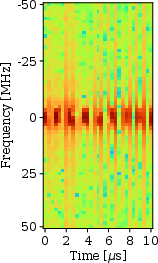
Figure 2: Spectrograms for six primary interference modulation types, illustrating representative time–frequency characteristics present in the dataset.
Benchmark Evaluation Protocol
The S-ICDF dataset facilitates performance benchmarking for both classical DF methods (MUSIC, ESPRIT, CAPON) and an ML-based architecture (XceptionTime). The experimental protocol includes evaluating the impact of signal parameters, environment structure, and antenna setup on DF and classification accuracy, with accuracy and MSE as principal metrics.
The classical DF baselines are run on systematic parameter sweeps, with angular errors aggregated across azimuth and elevation for detailed method comparison. The XceptionTime model is trained end-to-end on the raw IQ time series, performing multi-task learning to simultaneously classify interference type/modulation, estimate signal parameters, and regress DoA and source–receiver distance.
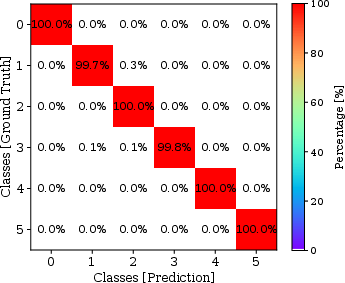
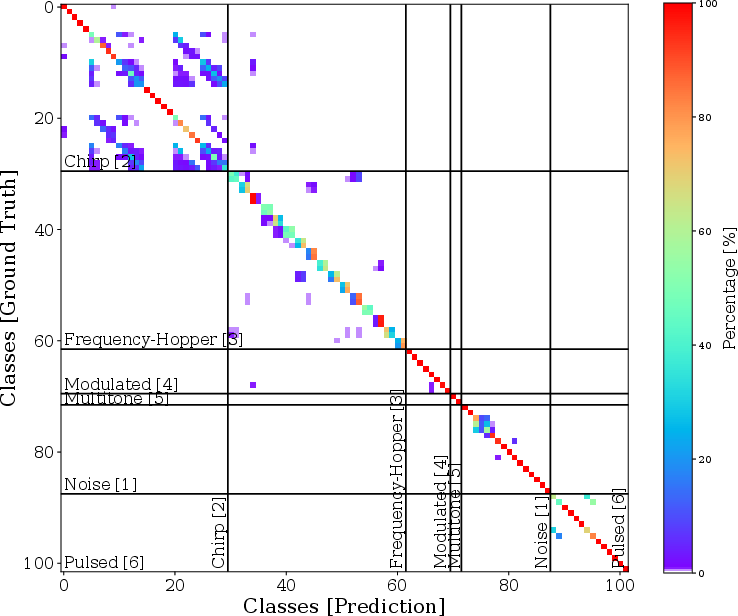
Figure 3: Classification and characterization task evaluation via XceptionTime on raw IQ, highlighting confusion trends and overall high class-level accuracy.
Results: Interference Recognition and DoA Estimation
XceptionTime demonstrates near-perfect macro-level interference recognition (99.89% accuracy) and robust characterization (71.99% accuracy), notably with most errors occurring within interference subtypes or modulation variants rather than across fundamentally different classes. Disambiguation between Chirp and Frequency Hopper types remains challenging at narrow bandwidths due to converging signatures, and similar effects are observed for some modulated/BOC variants.
For DF accuracy, ESPRIT achieves the lowest mean azimuth estimation error (0.78∘) and outperforms MUSIC and CAPON both in terms of stability and average performance for challenging interference types (e.g., Chirp, Modulated). Pulsed interference constitutes the most difficult class, with all classical methods exhibiting elevated error and variance.
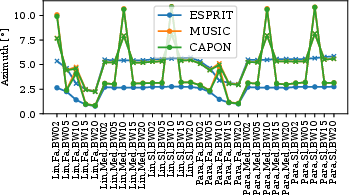
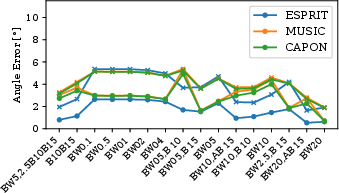
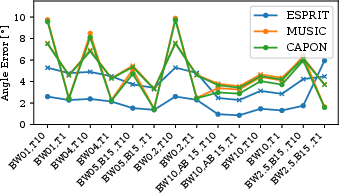
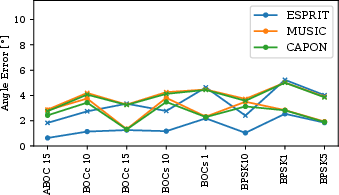
Figure 4: Azimuth and elevation orientation errors (MSE in degrees) for different interference modulations, revealing method sensitivity to waveform type.
SNR effects exhibit clear thresholding: below –8 dB, all classic DF performance rapidly degrades; above –8 dB, angular errors stabilize, being limited by multipath, aperture, and sample effects rather than additive noise.
Antenna configuration analysis demonstrates that modest array geometry changes (e.g., element spacing, pattern response) can induce spatial ambiguities—especially for the 8×1 linear array at half-wavelength spacing, leading to mirrored or aliased DoA estimates. Increasing multipath richness (higher reflection depth) and activating refraction tends to improve spatial discrimination, enhancing the robustness of DF methods.
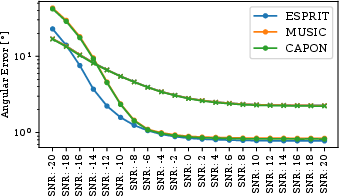
Figure 5: Evaluation of MUSIC, ESPRIT, and CAPON azimuth orientation errors (log-MSE, degrees) across SNR levels, illustrating SNR-limited and environment-limited operating regimes.
The XceptionTime ML backbone delivers a mean error of 1.85∘ (azimuth), 2.33∘ (elevation), and $0.26$ m (distance), demonstrating competitive performance vis-à-vis classical techniques. Importantly, ML performance degrades for specific rare/ambiguous classes and when the receiver–source geometry approaches near-field situations.
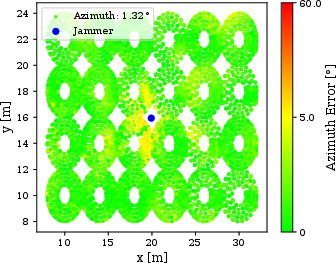
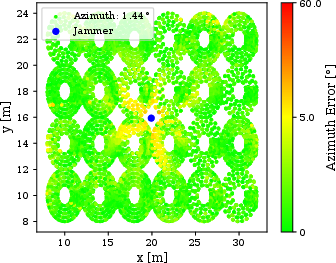
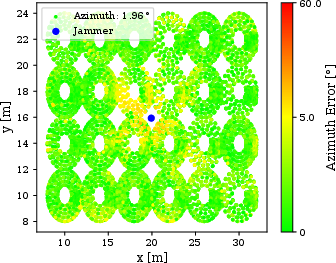
Figure 6: Azimuth prediction error for XceptionTime across receiver trajectories and representative interference types; ML shows lowest error for Chirp and highest for Pulsed/Noise.
Practical and Theoretical Implications
S-ICDF establishes a valuable public benchmark for evaluating interference monitoring solutions, supporting reproducible research and direct method comparison. Its physically-informed parameter coverage enables robust validation of both traditional and contemporary approaches under conditions replicating realistic industrial multipath, mobility, and interference spectra.
For practitioners, S-ICDF supports rapid prototyping and ablation studies where legal or logistical roadblocks prevent real environment jamming/label-rich collection. For theorists and method designers, parameter isolation affords interpretable insight into algorithmic failure modes, sensitivity to array/propagation design, and the bridging of classical and learning-based inference approaches.
The dataset is especially relevant for evaluating multi-task and transfer learning paradigms, ablation of data-augmentation protocols, and domain adaptation pipelines aimed at field deployment under varying site topologies and hardware. The observed method sensitivities point to fruitful directions in robustifying ML against both waveform ambiguity and spatial aliasing, and in leveraging synthetic ‘digital twin’ data for zero-shot or few-shot transfer tasks.
Conclusion
S-ICDF presents a comprehensive, modularly constructed dataset for interference characterization and direction finding, synthesizing rigorous physical simulation and broad parameter diversity. The benchmark results illuminate both the promise and current limitations of classical and ML-based approaches under controlled, challenging conditions. By enabling fine-grained, reproducible, and extensible evaluation, S-ICDF provides a foundation for systematic research progression in RF interference monitoring and robust signal localization.