- The paper introduces the RFSS dataset, a 100k-sample collection of multi-standard RF mixtures with full 3GPP channel and hardware impairments.
- It details a rigorous construction pipeline synthesizing GSM, UMTS, LTE, and NR signals through independent TDL channels and multiple hardware impairment models.
- Benchmarking results reveal superior performance of deep learning models like Conv-TasNet and DPRNN over classical methods in blind RF source separation tasks.
RFSS: A Multi-Standard RF Signal Source Separation Dataset with 3GPP-Standardized Channel and Hardware Impairments
Motivation and Significance
RF source separation underlies critical tasks in modern multi-standard wireless communications, such as flexible receiver design, spectrum monitoring, and co-channel interference mitigation. Coexistence between 2G–5G cellular waveforms in shared or adjacent spectrum creates nontrivial blind mixture scenarios where current receivers and data-driven deep learning (DL) models are fundamentally bottlenecked by the absence of large-scale, realistic, and labeled RF mixture datasets. The "RFSS" dataset addresses this foundational gap by providing a 100,000-example corpus of 3GPP-compliant GSM, UMTS, LTE, and NR signal mixtures, each with ground-truth per-source waveforms and comprehensive channel/hardware impairments. The dataset is designed to support reproducible research in blind RF source separation and benchmarking of classical and DL models under realistic operating and interference conditions.
Dataset Construction and Design
RFSS uniquely synthesizes multi-standard RF mixtures with meticulous compliance to physical-layer specifications from 3GPP TS 45.004 (GSM), TS 25.211 (UMTS), TS 36.211 (LTE), and TS 38.211 (NR). Each sample consists of 2–4 simultaneously active sources, with all permutation combinations represented. Samples are generated at the 30.72 MHz standard clock, ensuring joint spectral containment and comparability.
The construction pipeline (Figure 1) initiates by randomly selecting source standards and, for each source, generating a parameterized waveform. Each waveform then propagates through an independent 3GPP TDL channel (A-E, with random profile selection and Doppler), and is corrupted by five classes of hardware impairments: CFO, I/Q imbalance, phase noise, DC offset, and PA nonlinearity—parameterized strictly according to conformance test limits in 3GPP technical reports. Mixing occurs in one of two regimes: co-channel (all baseband-aligned) or adjacent-channel (frequency-offshifted). Both the mixture and the ground-truth pre-impairment source waveforms are stored in HDF5 format alongside explicit per-sample metadata.
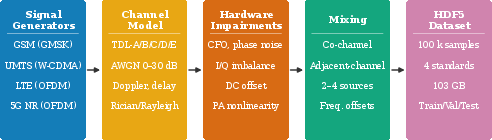
Figure 1: RFSS dataset construction pipeline, illustrating per-source waveform generation, TDL channel modeling, hardware impairment injection, and co-/adjacent-channel mixing.
The dataset composition statistics (Figure 2) reveal an intentional bias toward lower source counts for training stability (49% 2-source, 34% 3-source, 17% 4-source), and approximately equal distribution across co- and adjacent-channel mixtures, with all multi-standard combinations represented.
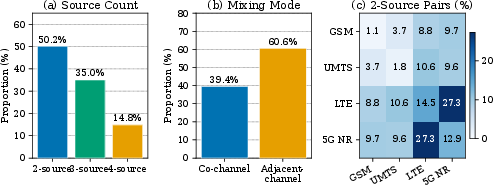
Figure 2: Distribution of source counts and mixing modes, and frequency of standard combinations across the 100,000-sample corpus.
Physical Realism and Source Diversity
RFSS distinguishes itself from earlier synthetic datasets (e.g., RadioML) by implementing full physical-layer fidelity, including constant-envelope GMSK (GSM), Gold-code WCDMA (UMTS), and OFDM variants (LTE/NR), with strict adherence to pulse shaping, scrambling, subcarrier mapping, and cyclic prefix durations specified in released 3GPP documentation.
Spectrograms for canonical single-source signals demonstrate the distinct time-frequency signatures underlying each standard (Figure 3). This spectral heterogeneity forms the basis for source separability—GMSK's narrowband, constant-envelope topology contrasts with the OFDM-wide, high-PAPR structure of LTE/NR, while UMTS exhibits spread-spectrum occupancy.
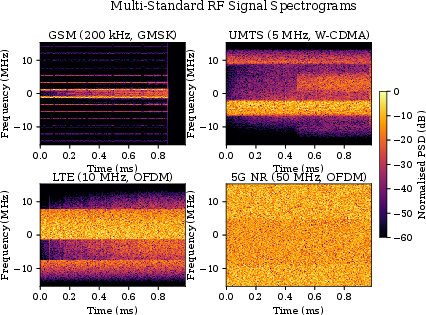
Figure 3: STFT spectrograms of single-source samples for GSM, UMTS, LTE, and 5G NR, highlighting time-frequency separability.
Signal quality metrics (Figure 4) quantify PAPR, power spectral density (PSD), and amplitude (envelope) distributions. GSM shows nearly constant envelope (PAPR ≤ 2 dB) and narrowband PSD; LTE and NR have high PAPR (∼12 dB) with wide rectangular spectra, while amplitude statistics confirm the presence of Rayleigh-like tails for OFDM sources. These signal properties create amplitude and spectral cues that impact both classical and deep neural separation strategies.
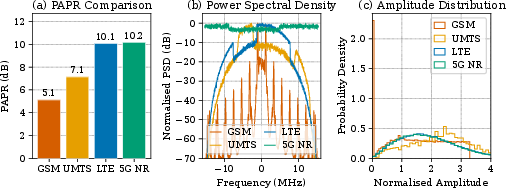
Figure 4: Empirical PAPR, PSD, and amplitude distribution for the four standards, underlining spectral and envelope contrasts available to separation models.
Baseline Methods and Experimental Protocol
RFSS benchmarks five methods across all mixture settings:
- FastICA: Hankel-embedded, permutation-invariant blind separation.
- Frobenius-Norm NMF: Spectral masking in the STFT domain, with per-source Wiener filtering.
- CNN-LSTM: End-to-end encoder-decoder regression (no explicit masking).
- Conv-TasNet: Learned time-domain encoder, TCN-based masking, and decoder.
- DPRNN: Dual-path RNN segmentation, modeling inter- and intra-chunk context for temporal source disaggregation.
All DL models are trained with permutation-invariant loss (PIT) using negative SI-SINR, with strong regularization, short-crop training, and validation-based checkpointing to avoid overfitting. Evaluation is carried out for N=150 (classical) or N=300 (DL) test samples per source count, reporting both overall and strictly co-channel PI-SI-SINR.
Benchmark Results and Analysis
The principal quantitative finding is that Conv-TasNet and DPRNN yield superior source separation, achieving −21.18 dB and −21.31 dB overall PI-SI-SINR, respectively, in 2- and 3-source mixtures, compared to ICA (−34.91 dB) and NMF (−26.07 dB). For strictly co-channel mixtures, Conv-TasNet attains −12.34 dB PI-SI-SINR, corresponding to a 17 dB improvement over ICA and a 4 dB improvement over NMF. The gap between Conv-TasNet and DPRNN is consistently <0.4 dB, indicating that further advances will require domain-specific mechanisms beyond simple architecture scaling.
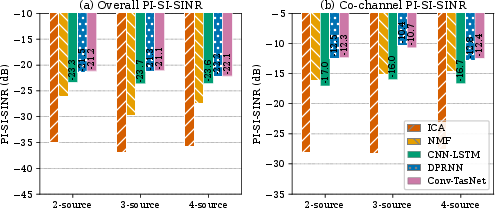
Figure 5: Overall and co-channel PI-SI-SINR for all methods against increasing source count, confirming deep model superiority on challenging mixtures.
Notably, the performance degradation from 2- to 4-source mixtures is modest (∼01 dB for Conv-TasNet), linked to the spectral diversity of possible mixtures and the induced combinatorial permutation difficulty in PIT-based training.
A breakdown by SNR demonstrates monotonic improvement in Conv-TasNet and DPRNN across rising mixture SNR bins (up to 2.3 dB), whereas ICA's performance is SNR-invariant (range ∼13.5 dB), confirming that deep masking models exploit SNR-dependent cues not available to classical methods.
The evaluation protocol exposes an "adjacent-channel penalty" in the absolute PI-SI-SINR score, as ground-truth references are stored pre-frequency-shift while the mixtures are frequency-shifted. This incurs a baseline SI-SINR penalty and suggests that co-channel metrics are currently the most meaningful for head-to-head model comparison. This evaluation-floor artifact motivates a planned update to include post-shifted references.
Implications and Future Directions
RFSS establishes a standardized, physically realistic testbed for the RF signal separation community, paralleling the impact that datasets like WSJ0-2mix had on speech/audio separation research. The substantial improvements delivered by DL models trained end-to-end on permutation-invariant labels—in the presence of true hardware impairments and physical channels—demonstrate that audio-based architectures are adaptable to the RF domain, although they do not yet reach SI-SNR performance observed in speech (typically 8–15 dB for similar tasks).
The near-equivalence between Conv-TasNet and DPRNN in this setting suggests current models capitalize fully on short-term temporal and spectral cues, and that progress beyond ~10 dB SI-SINR in co-channel mixtures is likely gated by physics-specific inductive biases or novel architectural constraints. Remaining gaps in adjacent-channel evaluation, single-antenna only modeling, and the restriction to downlink, narrowband 2–5G standards are acknowledged, with extensions to MIMO mixtures, uplink, and candidate 6G waveforms proposed.
Conclusion
RFSS is a rigorously-designed, large-scale, and open-source RF mixture dataset with full ground-truth disaggregation, providing a foundation for reproducible and scalable research in multi-standard RF source separation. By benchmarking both classical and state-of-the-art deep learning methods, the study quantifies the complexity of real-world mixture separation, normative hardware impairments, and channel diversity, while revealing the limitations of existing architectures and the evaluation pipeline. Anticipated dataset expansions—multi-antenna, wider bandwidth, uplink and 6G support—will enable even more comprehensive analysis and method development for next-generation cognitive and flexible wireless systems.