- The paper establishes pressure-induced structural phase transitions in La2SmNi2O7 that correlate with the emergence of superconductivity.
- High-resolution synchrotron diffraction reveals monoclinic, orthorhombic, and tetragonal phases with subtle oxygen modulations.
- Experimental limits on charge-density-wave signals challenge conventional electron-phonon coupling scenarios in nickelate superconductors.
Structural Evolution and Absence of Displacive Charge-Density Wave in La2SmNi2O7 Under Pressure
Introduction and Motivation
The bilayer Ruddlesden-Popper nickelate La2SmNi2O7 emerges as a pivotal system for investigating high-Tc superconductivity outside cuprate and pnictide classes, especially given the established superconducting phase above 14 GPa with Tc approaching 92 K (2607.03363). Key open questions involve the interplay of lattice symmetry, Ni 3d electronic correlations, and the relevance of density wave instabilities, all within the context of pressure- and chemical-pressure-induced structural transitions. Chemical substitution, notably Sm for La, aims to lower the critical pressure for superconductivity and elucidate the generalized phase diagram, including spin- and charge-density-wave competition and its impact on Cooper pairing.
Ambient-Pressure Structure: Monoclinic Superstructure and Antiferrodistortive Motifs
Synchrotron single-crystal diffraction at ambient pressure and low temperature reveals a monoclinic superstructure, distinct from the previously reported P21/m description. The reconstructed (0kl) plane at 300 K demonstrates weak superlattice reflections at 20, indicative of a doubling of the 21 parameter due to oxygen atom displacements (O4, O5), which alternate between NiO bilayers and yield an antiferrodistortive motif (Figure 1).
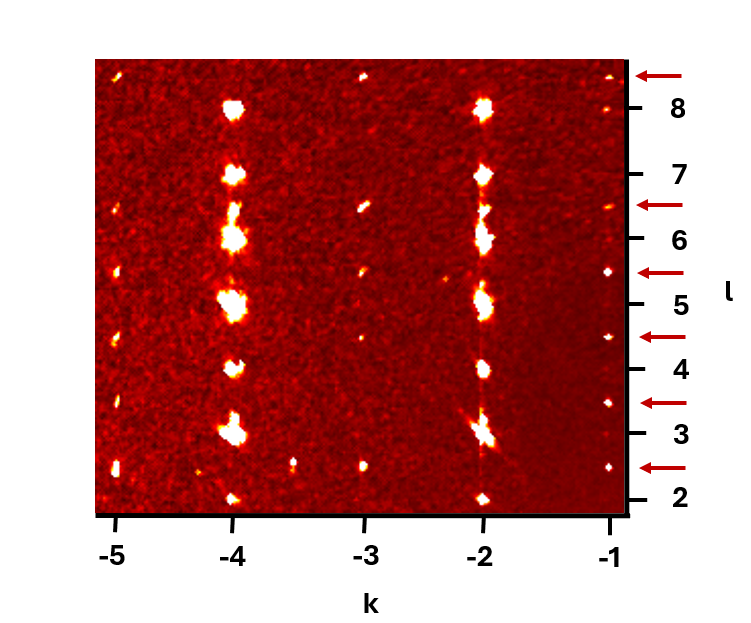
Figure 1: Reconstruction of the reciprocal plane 22 at 300 K, showing weak superlattice reflections at 23 corresponding to the doubling of the 24 parameter.
The refined 25 cell at 15 K and 300 K converges with 26 = 7.61\% and 6.10\% respectively, confirming the structural doubling is not attributable to La/Sm or Ni displacements, but solely due to oxygen modulation. This antiferrodistortive phase has been previously identified in perovskites and predicted in infinite-layer nickelates, significantly impacting the in-plane anisotropy and likely contributing to nematicity in electronic phases (Figure 2).
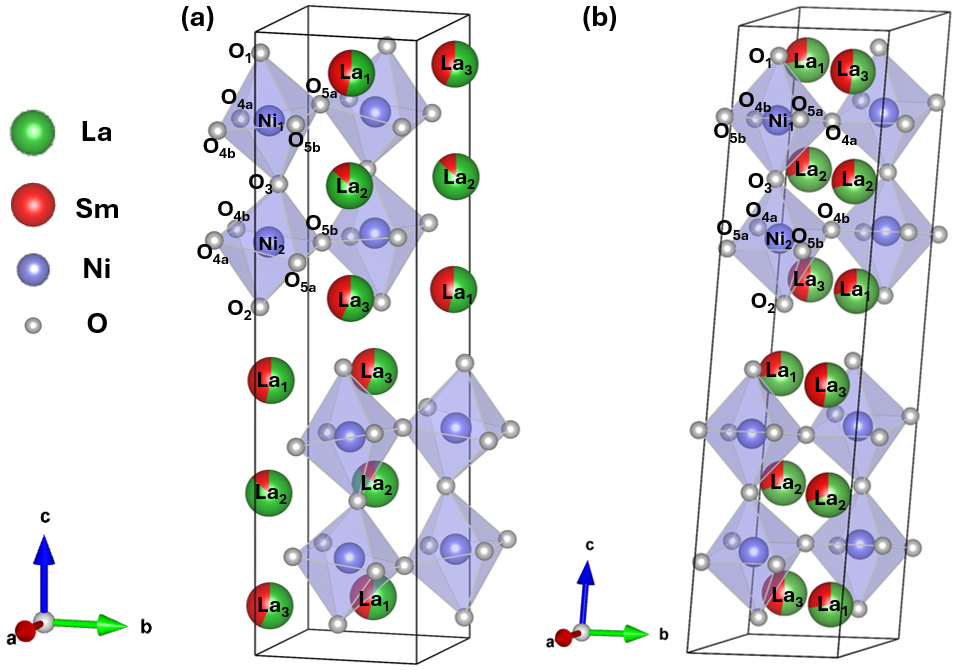
Figure 2: Crystal structures of 27 in pseudo-orthorhombic 28 and monoclinic 29 cells, highlighting NiO70 octahedra and mixed La/Sm occupancies.
Absence of Displacive CDW: Experimental Upper Bound
Systematic search for satellite reflections at 15 K—well below the expected 71 K—fails to reveal any commensurate or incommensurate charge-density-wave signals. The intensity limit imposed by the experiment sets an upper bound for atomic modulations associated with a displacive CDW at only a few thousandths of an \AA, far less than canonical CDW amplitudes (720.05\,\AA). This negates conventional electron-phonon coupling-driven CDW formation or Fermi surface nesting, and suggests either a purely electronic CDW or disorder-induced suppression, in sharp contrast to n=3 RP nickelates where strong SDW/CDW coupling is observed [L4NO, plokhikh2025].
Pressure-Induced Structural Phase Transitions
Powder and single-crystal diffraction as a function of pressure reveal three discrete structural regimes:
- Monoclinic (73): Stable up to 15 GPa, supporting a doubled 74 parameter and antiferrodistortive motif.
- Orthorhombic (75): Emerges abruptly at 15 GPa, verified by extinction rules and inequivalence of (135)/(315) Bragg reflections. The transition is confirmed by a sharp discontinuity in 76 and 77 ratios (Figure 3).
- Tetragonal (78): Onset at 18 GPa, completion at 21 GPa, marked by merging of previously distinct orthorhombic reflections and disappearance of (79 20 21) reflections in the reciprocal space (Figure 4, Figure 5).
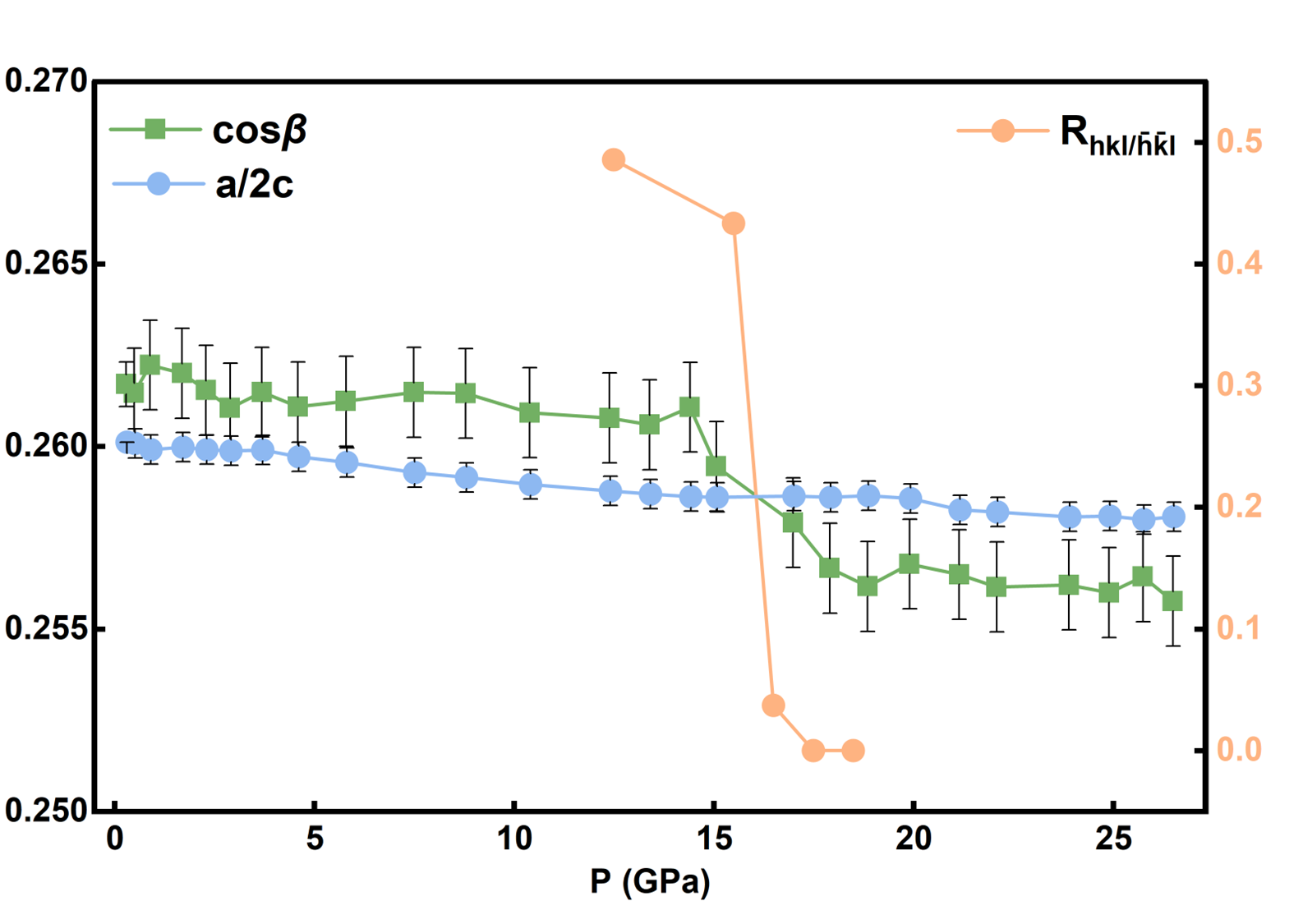
Figure 3: Pressure evolution of (i) the 22 angle, (ii) 23 ratio, and (iii) symmetry-related intensity ratios, marking monoclinic-to-orthorhombic and orthorhombic-to-tetragonal transitions.
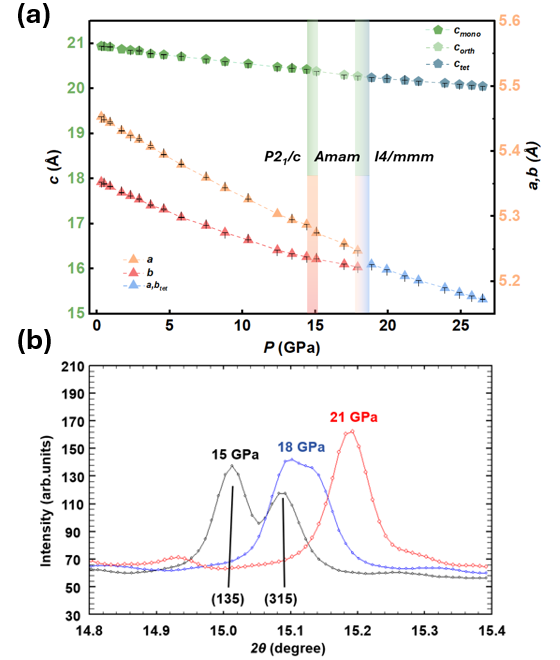
Figure 4: Pressure evolution at room temperature of unit cell parameters and diffractogram merge of (135)/(315) reflections, confirming symmetry transitions.
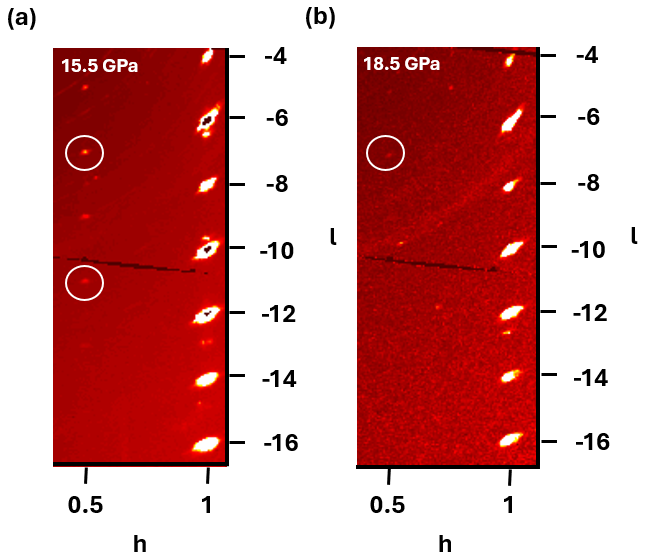
Figure 5: Reconstruction of the (hhl) plane in the 24 tetragonal setting; circles denote (25 26 27) reflections characteristic of orthorhombic phase, disappearing with increasing pressure.
Bulk modulus extracted for La28SmNi29O20 is 21 GPa, closely matching that of pristine La22Ni23O24 (143.6 GPa), indicating isotropic compression despite highly anisotropic, quasi-2D crystal structure.
Correlation with Superconductivity and Theoretical Implications
The onset of the superconducting dome (2515 GPa) aligns precisely with the disappearance of monoclinic symmetry, establishing a robust incompatibility between SC and monoclinic structure. 26 attains its maximum in the tetragonal 27 phase, reciprocal with strictly linear Ni-O-Ni bond angles (28), and maximizing interlayer hybridization—consistent with theoretical predictions that symmetry optimization destabilizes competing density-wave order and enhances SC [Lecherman, ChenLu].
Pressure evolution does not affect the Ni-Ni distance along 29, but the Ni-O-Ni angle approaches 18070, systematically increasing orbital hybridization and driving electronic structure reconfiguration, especially the 71-72 and 73 Ni orbital occupancies pivotal for pairing. Neither the critical pressure nor 74 is significantly lowered by Sm substitution, refuting theoretical predictions of a doubled 75 with full substitution [Pan, Zhong2025].
Practical and Theoretical Implications
High-precision structural characterization across the SC phase boundary enables robust benchmarking of theoretical models and first-principles calculations for Cooper pairing and density-wave competition in RP nickelates. The absence of displacive CDW enforces a reevaluation of the role of electronic correlations and electron-phonon coupling within this class, with the electronic nematicity and antiferrodistortive symmetry breaking offering alternative avenues for emergent phenomena. Notably, chemical pressure (Sm substitution) paradoxically increases the structural transition pressure, in contradiction to intuitive expectations and prior hypotheses.
Conclusion
Single-crystal synchrotron studies establish a revised monoclinic superstructure at ambient pressure, an antiferrodistortive motif, and a sequence of pressure-induced transitions terminating in a tetragonal phase coincident with the maximized 76. No displacive CDW is observed experimentally, setting strict upper bounds on atomic modulations. Structural refinements across the (P,T) phase diagram provide decisive constraints for theoretical models and motivate further exploration into the symmetry-dependent competition between superconductivity and density wave states in bilayer nickelates.