- The paper demonstrates that HI intensity mapping with SKAO constrains H0 to 0.29–0.44 km s⁻¹ Mpc⁻¹, directly competing with Planck CMB results.
- The methodology employs Fisher and Bayesian analyses of the HI power spectrum, BAO, and bispectrum to extract precise cosmological parameters and break key degeneracies.
- The study addresses instrumental and foreground challenges by integrating calibration techniques and cross-correlations with optical surveys like DES and Euclid for enhanced reliability.
Cosmological Constraints from HI Intensity Mapping: Capabilities and Forecasts for the SKAO
Introduction
The redshifted 21 cm line emission from neutral hydrogen (HI) is a powerful probe of large-scale structure (LSS) and its evolution across cosmic time. HI intensity mapping (IM) leverages unresolved, aggregate HI emission from large cosmological volumes rather than targeting individual galaxies, enabling rapid tomographic surveys with low angular but high spectral resolution. This methodology is uniquely poised to deliver constraints on cosmological models, dark energy, primordial non-Gaussianity, and the physics of reionization. The upcoming SKA Observatory (SKAO) will be capable of HI IM over $0 < z < 6$ via SKA-Mid and SKA-Low, maximizing sensitivity to scales that are challenging for optical and near-infrared surveys.
This essay presents an expert summary of the current state-of-the-art in HI intensity mapping for cosmology, emphasizing the formalism, forecasted constraints, and the potential synergy with other cosmic surveys, as detailed in "Cosmology with HI Intensity Mapping" (2607.03259).
Survey Design and Observational Strategy
The baseline SKAO HI IM surveys are designed for broad and deep coverage: SKA-Mid will survey 20,000 deg2 over z=0.35−3 using single-dish mode; SKA-Low will probe $3 < z < 6$ over 100 deg2. Integration times are set to ttot=104 hr (Mid) and 5×10³ hr (Low). The observational paradigm is to maximize cosmic volume mapped per unit time, enabling measurement of modes on the largest linear scales and high redshift resolution, critical for robust constraints on the expansion history and growth of structure.
Instrumental and Foreground Challenges
The cosmological HI signal is faint (∼mK), whereas Galactic and extragalactic foregrounds are four orders of magnitude brighter. Systematic effects—including the frequency-dependent primary beam, gain drift ($1/f$ noise), and ground pickup—complicate separation of the cosmological signal. Blind foreground removal (e.g., PCA), beam and gain calibration, and statistical transfer function corrections are required. Foreground contamination in the so-called "wedge" region of (k⊥,k∥) space is typically excised, sacrificing some large-scale information but improving robustness.
The observed HI power spectrum 20 is modeled as:
21
where 22 is the mean brightness temperature, 23 the HI bias, 24 the growth rate, and 25 the noise. Nonlinearities, Alcock-Paczynski distortion, and instrument systematics are incorporated in realistic forecasts. The degeneracy of 26 and 27 is broken only in the presence of redshift-space distortions or external calibrators.
Forecasts on Cosmological Parameter Constraints
Extensive Fisher and Bayesian analyses yield the following forecasted constraints for the SKAO:
- 28 Measurement: HI IM alone achieves 29 km sz=0.35−30 Mpcz=0.35−31 (pessimistic) and z=0.35−32 km sz=0.35−33 Mpcz=0.35−34 (optimistic), directly competitive with Planck CMB results. When combined with CMB data, the uncertainty tightens to z=0.35−35 km sz=0.35−36 Mpcz=0.35−37, a reduction by more than a factor of three over CMB-only constraints.
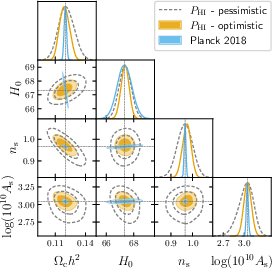
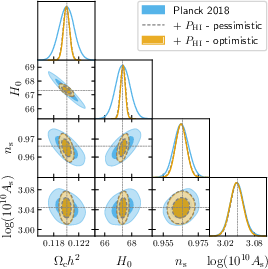
Figure 1: Marginalized cosmological parameter constraints from HI power spectrum measurements alone (left) and in combination with Planck CMB data (right).
- Neutrino Mass: Upper limits of z=0.35−38 (optimistic) and z=0.35−39 (pessimistic) are forecast for HI IM alone, nearly matching Planck's $3 < z < 6$0. Adding Planck data yields $3 < z < 6$1 (optimistic) and $3 < z < 6$2 (pessimistic).
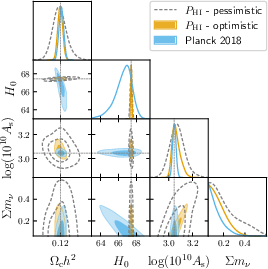
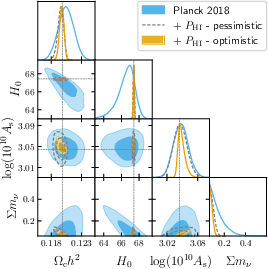
Figure 2: Marginalized parameter posteriors and 2D confidence regions for HI power spectrum constraints on cosmological parameters including $3 < z < 6$3.
- BAO and Distance Scale: The BAO feature is robustly measurable. The uncertainty on the Hubble parameter $3 < z < 6$4 remains at 1-2% for $3 < z < 6$5, competitive with DESI, even under conservative beam uncertainty assumptions.
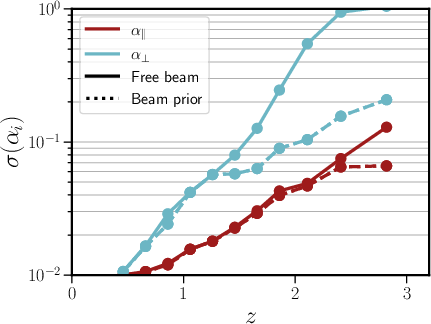
Figure 3: Marginalized forecasted sensitivity of SKAO-MID HI wide survey to the Hubble parameter ($3 < z < 6$6, red) and the comoving angular diameter distance ($3 < z < 6$7, blue), displayed for various beam prior scenarios.
- Ultra-Large Scale Features: The power spectrum turnover is detectable at $3 < z < 6$8 significance, unique to intensity mapping due to the accessible cosmic volume, yielding a $3 < z < 6$9 20 constraint from the turnover alone—independent of the sound horizon scale.
Synergies and Cross-correlation
Statistical and systematic degeneracies inherent to HI IM—such as the temperature-bias degeneracy—are efficiently broken via cross-correlation with optical surveys (e.g., DES, Euclid) and CMB data. Multi-tracer techniques exploit uncorrelated systematics and differential bias to suppress cosmic variance and enhance parameter constraints, especially on primordial non-Gaussianity and growth rate. Forecasts show SKA-Mid x DES cross-correlations enable 21 measurements of photometric redshift scatter and significant improvements on bias parameter recovery.
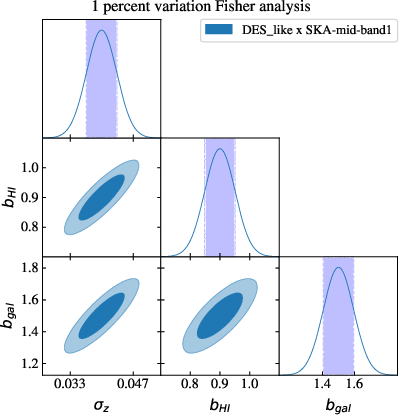
Figure 4: Forecasted 22 and 23 joint constraints on bias and redshift scatter obtained from SKA-Mid/DES cross-correlation.
Higher-order Statistics and Advanced Probes
- Bispectrum: Inclusion of the HI bispectrum, modeled with perturbation theory and RSD effects, extends constraints by breaking parameter degeneracies, especially when combined with CMB priors. While less constraining than the power spectrum alone, the bispectrum enhances robustness to foreground systematics and non-Gaussian cosmological effects.
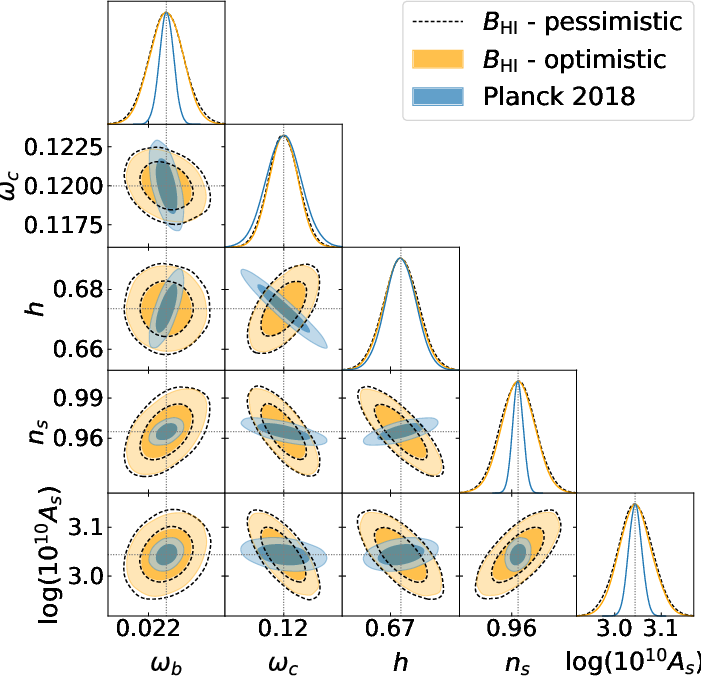
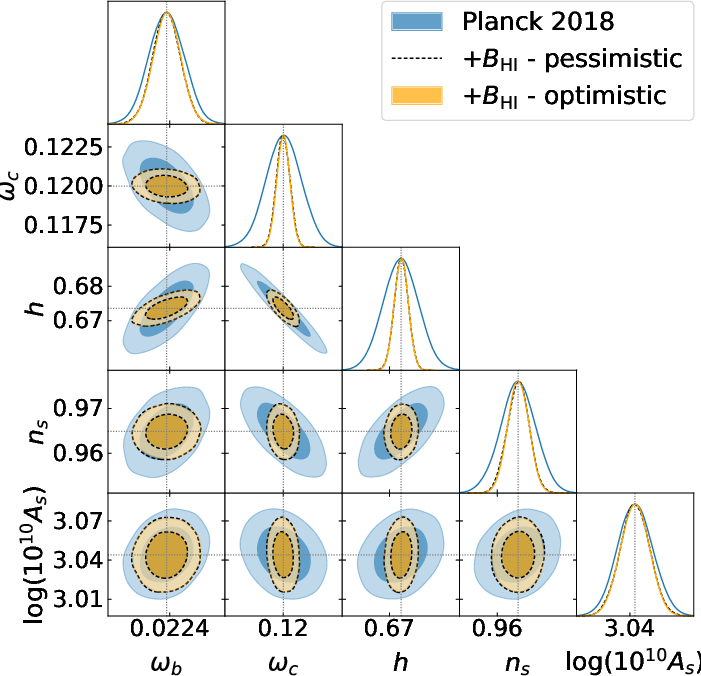
Figure 5: Projected parameter constraints from the HI bispectrum as stand-alone and in combination with CMB (left/right), contrasting optimistic and pessimistic foreground cases.
- Stacking: Emission line stacking is shown to deliver precise constraints on cosmic HI density, with 24 forecast at 25 over 26, enabling extension of emission-based HI measurements to 27, inaccessible to current direct galaxy surveys.
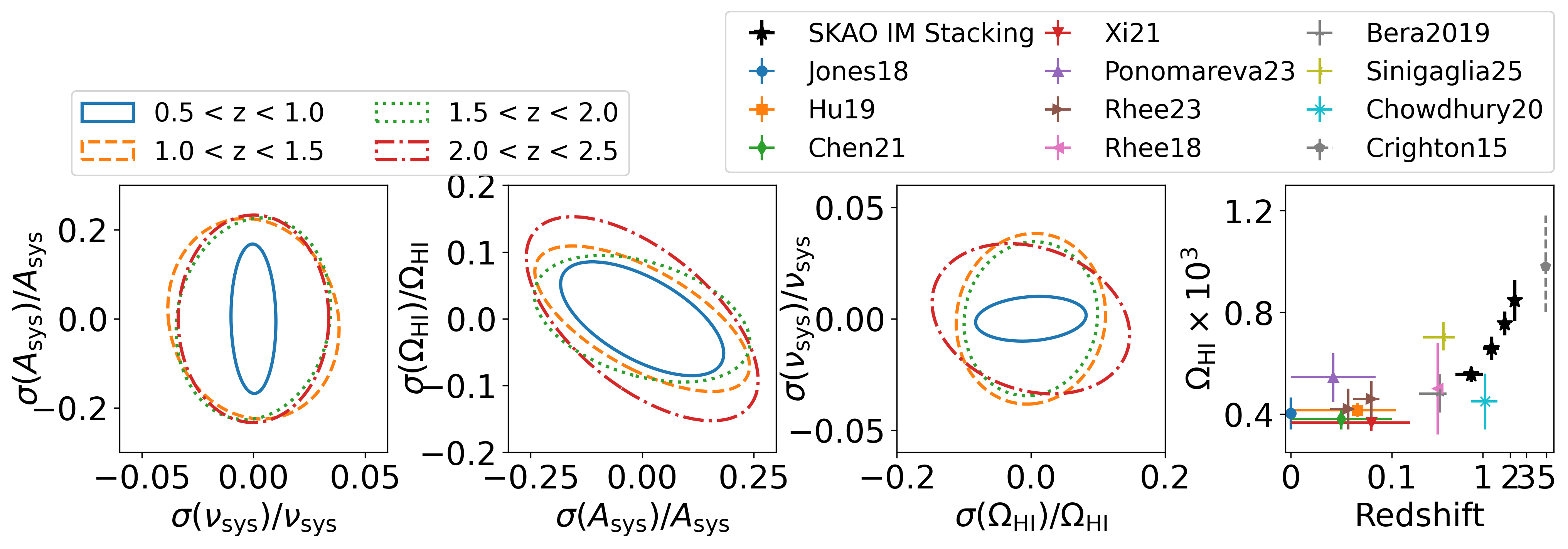
Figure 6: Forecasts for 28 and systematic errors from emission line stacking in SKAO single-dish data, compared to state-of-the-art measurements.
Implications for Cosmology and Astrophysics
The SKAO HI IM surveys will constitute a major advance in cosmic Cartography across 29. Tight constraints on ttot=1040, ttot=1041, primordial physics, and cosmic acceleration parameters are achievable, directly addressing Hubble tension, inflation, neutrino mass, and dark sector models. The ability to access ultra-large volume and high redshift (as well as probing the turnover and BAO independently of optical surveys) is unique. The methodology is fundamentally complementary to optical, CMB, and gravitational wave probes and enables systematic cross-validation against survey-dependent systematics.
Robust mitigation of foregrounds and instrumental systematics remains a formidable challenge, but continuous development of statistical, calibration, and machine learning-based methods is rapidly progressing. The demonstrated capability to exploit synergies and simultaneously constrain systematics and astrophysical nuisance parameters in concert with cosmological signals is essential for reliable future cosmic inference.
Conclusion
HI intensity mapping with the SKAO is expected to deliver competitive cosmological parameter constraints and access to unique large-scale probes beyond the reach of existing and planned optical surveys. Advanced statistical methods and synergistic analyses will provide both legacy constraints and crucial cross-checks for the cosmological model. Full exploitation of the SKAO's potential in HI IM depends on sustained advances in calibration, foreground cleaning, and joint analysis pipelines, all of which are areas of significant ongoing progress (2607.03259).