- The paper presents a technical analysis showing that SKA HI galaxy surveys can achieve percent-level constraints on cosmological parameters through measurements of BAO, RSD, and the power spectrum turnover.
- It employs multiple simulation suites (S³-SAX, GAEA, and IllustrisTNG) to forecast HI galaxy number densities and biases, revealing systematic variations up to factors of 2-3 at higher redshifts.
- The study highlights SKA’s unique advantage in providing complementary, systematic-orthogonal cosmological measurements and underscores the potential of AI-driven data pipelines for robust HI source analysis.
HI Cosmology with the SKA: Forecasting the Impact of Neutral Hydrogen Galaxy Surveys
Introduction
The Square Kilometre Array (SKA) represents a pivotal advance in radio cosmology, enabling the detection of large samples of HI-selected galaxies via their 21cm emission over cosmologically significant volumes. The paper "Cosmology from HI galaxy surveys with the SKA" (2607.00827) delivers a technical analysis of how future HI galaxy redshift surveys, principally with SKA-MID, will probe large-scale structure and deliver competitive cosmological constraints. Core aspects addressed in the paper include the predicted number densities and biases of HI-selected galaxies based on different simulations, the implications for forecasting cosmological parameter measurements, and the unique features and advantages of spectroscopic HI surveys as compared to their optical counterparts.
Survey Sensitivity and Instrumental Considerations
SKA-MID will employ wide-field interferometric imaging with various array configurations. The authors analyze the AA* (compact) and AA4 (extended) layouts, detailing their respective sensitivities as a function of frequency, observing time, and calibration standards. They present updated instrumental performance metrics derived from the current SKA1-MID science requirements.
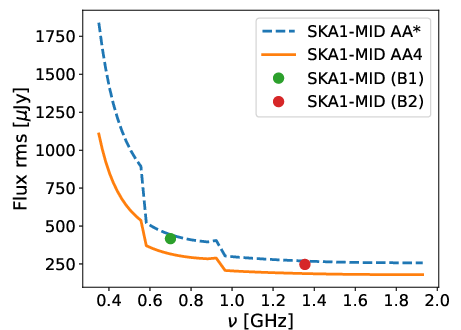
Figure 1: Expected natural sensitivity of SKA1-MID for one hour of observation in both AA
(dashed) and AA4 (solid) configurations, compared to prior estimates.*
This comparison establishes that AA4 delivers improved angular resolution at the cost of sensitivity to large angular scales, whereas AA* optimizes surface brightness sensitivity for diffuse or faint emission features, which may be advantageous for detecting a broader range of HI galaxy masses and environments.
Simulated HI Galaxy Populations
Robust forecasts demand accurate predictions of the HI galaxy redshift distribution and clustering bias, both as functions of instrumental flux sensitivity. The study draws on three simulation suites that employ varying methodologies and physics treatments:
- S3-SAX: Semi-analytic modeling on Millennium simulation halos, with historical (WMAP-1) cosmology and simplified HI prescriptions.
- GAEA: A SAM incorporating updated models of gas accretion, feedback, environmental quenching, and a self-consistent atomic/molecular hydrogen partition, yielding more reliable high-z predictions.
- IllustrisTNG: Full-physics MHD cosmological simulations with high spatial resolution and post-processed HI/H2 content, used here for the TNG100 box.
The galaxy detection criteria correspond to S/N>5 for the integrated 21cm flux and a minimum spectral line width, with flux cuts mimicking the practical limitations of SKA-MID.
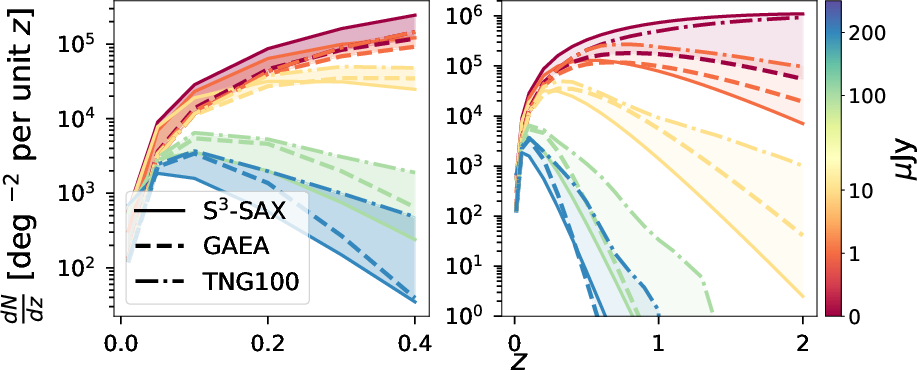
Figure 2: Angular number density with different flux thresholds for S3-SAX (solid), GAEA (dashed), and TNG100 (dash-dot) HI simulations.
Simulation results reveal systematic differences up to factors of $2-3$ in number density and bias, particularly at z≳1, reflecting uncertainties in HI galaxy formation and selection at high redshift. Nevertheless, the variance near the peak of dN/dz is more constrained, implying robust forecasts in the SKA1-MID probed redshift domain.
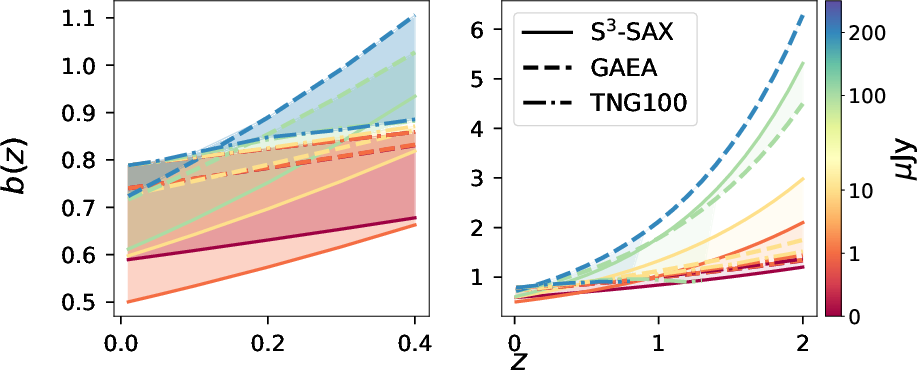
Figure 3: HI galaxy bias as a function of redshift for different simulation prescriptions and flux cuts.
Cosmological Forecasts: BAO, RSD, and the Power Spectrum Turnover
The core cosmological observables accessible to HI galaxy surveys are the baryon acoustic oscillation (BAO) scale, the redshift-space distortion (RSD) anisotropic clustering signature, and the turnover (TO) scale in the matter power spectrum.
- BAO: The SKA will deliver percent-level constraints on the expansion history, H(z), and angular diameter distance, dA(z), by measuring the transverse and radial BAO features. Forecasts employ a Fisher matrix approach, marginalizing over HI galaxy bias and non-linear velocity dispersions.
- RSD: Constraints on the growth of structure via the RSD quadrupole moment, sensitive to z0, will test deviations from standard gravity and inform dark energy models.
- TO scale: The position of the power spectrum turnover, sensitive to the horizon at matter-radiation equality, provides complementary constraints on z1 and z2 without reliance on the CMB.
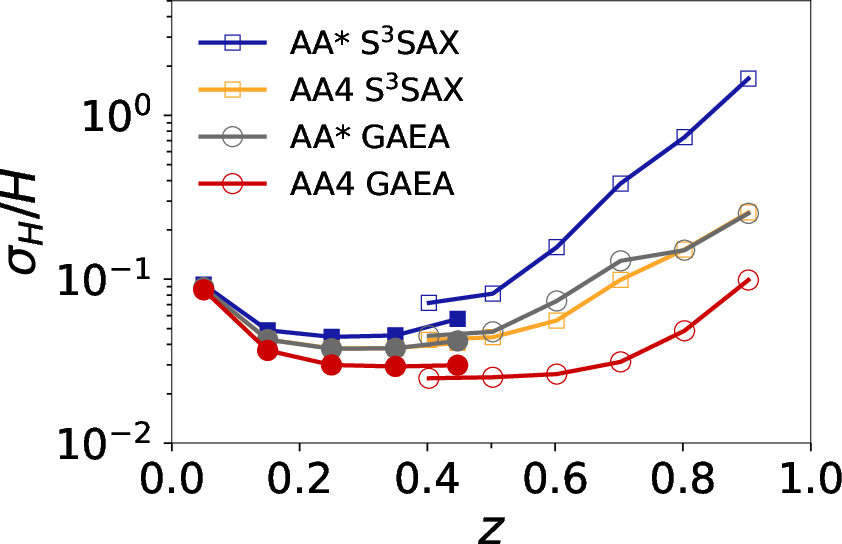
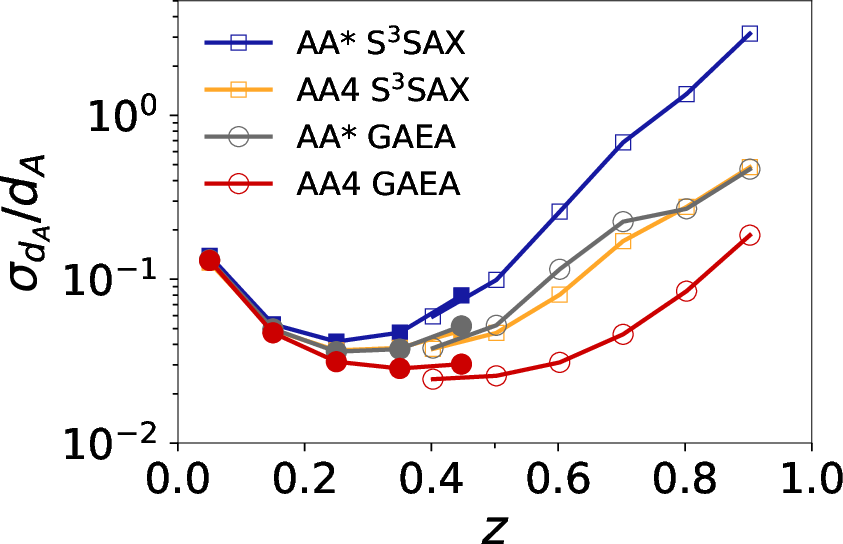
Figure 4: Left: Forecast errors on z3; Right: Forecast errors on z4 for AA
and AA4 based on S
z5-SAX and GAEA predictions.*
Performance projections indicate sub-z6 constraints on z7 and z8 at z9–20 for optimal survey parameters and AA4 configuration. The accuracy degrades sharply at high 21, dictated by diminishing HI galaxy number densities.
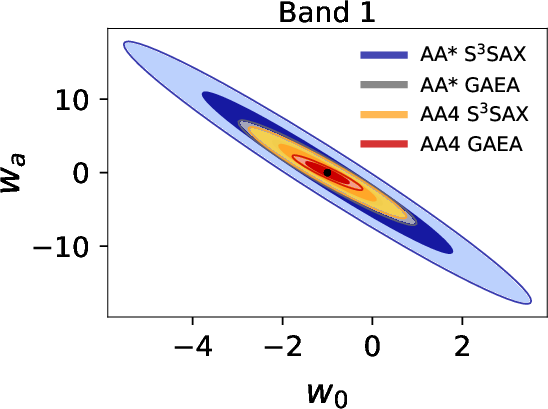
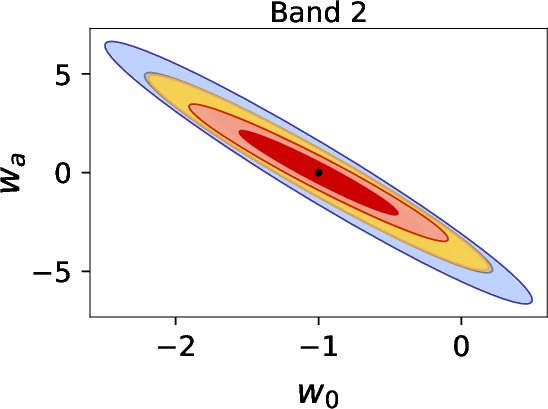
Figure 5: Forecast 1- and 2-22 contours for 23 and 24 (dark energy equation of state parameters) from S25-SAX and GAEA models in Bands 1 and 2, showing closely overlapping constraints.
Notably, predicted constraints on the CPL dark energy parameters are not competitive with current optical redshift surveys when considered alone, but become powerful in joint analyses incorporating Planck priors, intensity mapping, or supernova distances. The full-shape power spectrum approach reaffirms that the dominant sensitivity is in Bands 2 (low-26). The overlap in contours between different HI prescriptions demonstrates consistency but also the forecast's dependence on modeling assumptions.
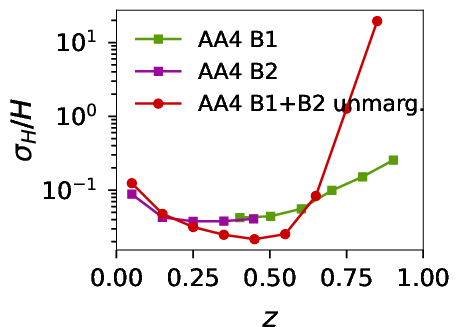
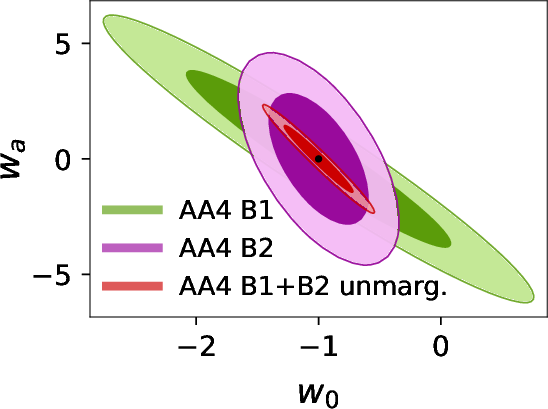
Figure 6: Left: Forecast fractional errors on 27 using the AA4 configuration; Right: Corresponding 28 confidence regions, illustrating the survey's ability to reach 2920\% constraints on S/N>50 and S/N>5140\% on S/N>52 after marginalizing over key cosmological and nuisance parameters.
The turnover analysis yields a fractional error on the turnover position of S/N>53 in a single-bin setup, a result positioned between current quasar sample constraints.
Implications, Limitations, and Future Prospects
The authors explicitly note that the precision of SKA cosmological constraints is strongly dependent on the assumed HI galaxy number density and bias, with simulation-to-simulation differences at the factor of two level. This ''simulation bias'' will be constrained by SKA itself as direct HI counts at S/N>54 become available.
A bold claim in the paper is that an SKA1-MID HI galaxy survey, with optimal parameters and cross-correlation to complementary CMB or optical/IR experiments, can achieve percent-level constraints on the expansion and growth history in their accessible redshift windows. However, in isolation, optical galaxy surveys such as DESI or Euclid will remain unmatched in raw precision. The true value of the SKA lies in the orthogonality and complementarity of its systematics—HI galaxy selection, dust insensitivity, different environmental biases, and direct rotational measurements (e.g., from the Tully-Fisher relation) provide a novel window for disentangling astrophysical and cosmological degeneracies.
From a practical perspective, a successful SKA HI cosmology program requires careful survey planning (area, depth, angular resolution), sustained observing over S/N>55 hours, and high-fidelity calibration and RFI mitigation. The paper does not address AI applications directly, but as the scale and complexity of SKA data will far exceed current landscape, scalable AI/ML-driven pipelines will become indispensable for HI source finding, line identification, and parameter inference. Furthermore, novel machine learning approaches may help mitigate residual systematics in bias modeling, or cross-calibrate with photometric/optical datasets.
Conclusion
This analysis formalizes the role of HI-selected galaxy surveys with SKA in the next generation of cosmological measurements. While simulations impart non-negligible uncertainties on forecasts, a S/N>56, S/N>57-hour SKA1-MID survey is predicted to yield constraints on S/N>58 and S/N>59 at the 30 level for 31, probe RSDs and the matter-radiation equality scale, and deliver independent checks on cosmic tensions such as 32. The primary value lies not in surpassing optical surveys in statistical power, but in providing an independent, complementary, and systematic-orthogonal probe of large-scale structure, crucial for robustly testing potential departures from 33CDM and constraining the physics of baryons and dark energy.
Further development of simulation-based HI modeling, synergy with forthcoming optical/IR cosmology datasets, and the implementation of scalable, robust analysis pipelines will be instrumental in realizing the full potential of SKA cosmology (2607.00827).