- The paper provides a nonperturbative solution for the quantum-corrected radial metric factor using Schwarzian averaging in AdS₂ throats.
- It employs a Mordell-type integral and dual q-series to capture the full modular structure and eliminate spurious confinement artifacts.
- Holographic Wilson-loop observables reveal a transition from Coulomb to algebraic screening, confirming scale-free infrared behavior.
Exact Schwarzian Metric Factor and Holographic Wilson-Loop Screening: An Expert Synthesis
Context and Motivation
This work provides a rigorous, nonperturbative solution for the quantum-corrected radial metric factor h(ζ) induced by Schwarzian averaging in the AdS2 throats of extremal Reissner–Nordström AdS5 black branes. The analysis is performed in the context of holographic Wilson-loop observables, specifically for the computation of heavy quark-antiquark potentials at strong coupling within the AdS/CFT correspondence framework.
In contrast to canonical treatments where quantum corrections are handled via asymptotic expansions near the AdS2 boundary, this paper derives and leverages a fully nonperturbative integral representation of h(ζ) valid at all radial depths. The crux of the advancement is explicit evaluation of this integral as a Mordell-type (Gaussian-coth) object, yielding dual (modular) q-series representations and exposing nonperturbative scales invisible to any finite-order expansion.
The implications are immediate: previously reported signatures of confinement (linear potential, mass gap) obtained from truncated expansions are revealed as artifacts, and the true IR physics is dominantly algebraic screening due to the scale-free semi-local criticality of the AdS2 throat.
Exact Integral Representation and Mordell Structure
The essential result is the reduction of the quantum-averaged radial kernel to
h(ζ)=2(Cζ)2∫0∞dyy3e−(ζ/C)y2coth(πy)
where C denotes the Schwarzian coupling, setting the crossover between classical and quantum regime. The dominant contributions arise from the spectral density of the Schwarzian/JT modes, and the precise behavior of h(ζ) encodes how the effective geometry seen by bulk probes diverges from the classical background.
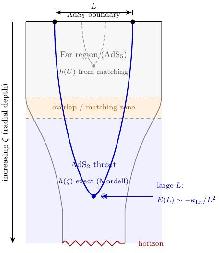
Figure 1: Schematic of the AdS20 radial geometry and string configurations, with the quantum-corrected AdS21 throat (blue), where 22 is governed by the exact integral, and the asymptotic AdS23 region (gray).
Expanding 24 isolates a UV (near-boundary) series with rapidly growing factorial coefficients and a nonperturbative (modular S-dual) contribution 25 that is missed in all truncations. The Mordell identity provides a closed-form evaluation in terms of Appell–Lerch sums and quasi-modular forms, specifically,
26
where 27, 28, 29, and 50 is the weight-2 Eisenstein series. The two 51-channels correspond to expansions valid in opposite regimes, with their relative strength governing modular crossovers of the observables.
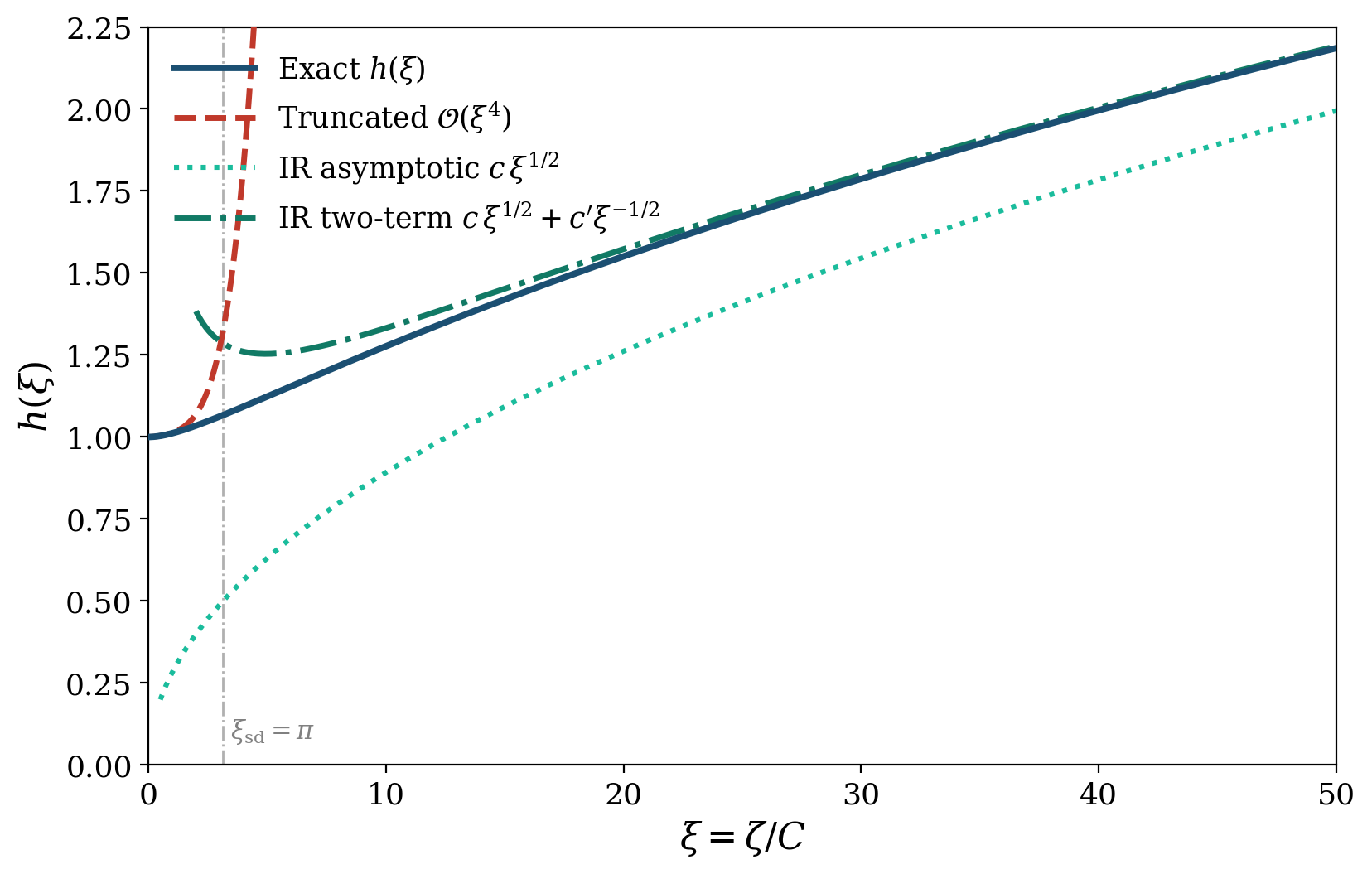
Figure 3: Global profile of 52 (solid) compared with leading truncations and IR asymptotics; the truncated form diverges for 53, while the large-54 behavior is accurately captured by the analytic endpoint expansion.
Asymptotics, Nonperturbative Structure, and Variance
The UV expansion for 55 is asymptotic—not convergent—reflecting its intrinsic Borel-plane singularity structure. The leading IR behavior is 56, resulting in an effective metric factor decaying monotonically with radial depth, and yields an IR potential scaling as 57—algebraic screening rather than exponential Debye or linear confinement.
The variance of the metric kernel is computed exactly using the same machinery, demonstrating that kernel fluctuations become substantial precisely where truncated analyses (which yield spurious confining minima) break down. This non-self-averaging character in the deep throat means that mean geometry computations systematically underestimate the true extent of screening, with all moment-based generalizations remaining strictly monotonically decaying—ruling out genuine minima and mass gaps.
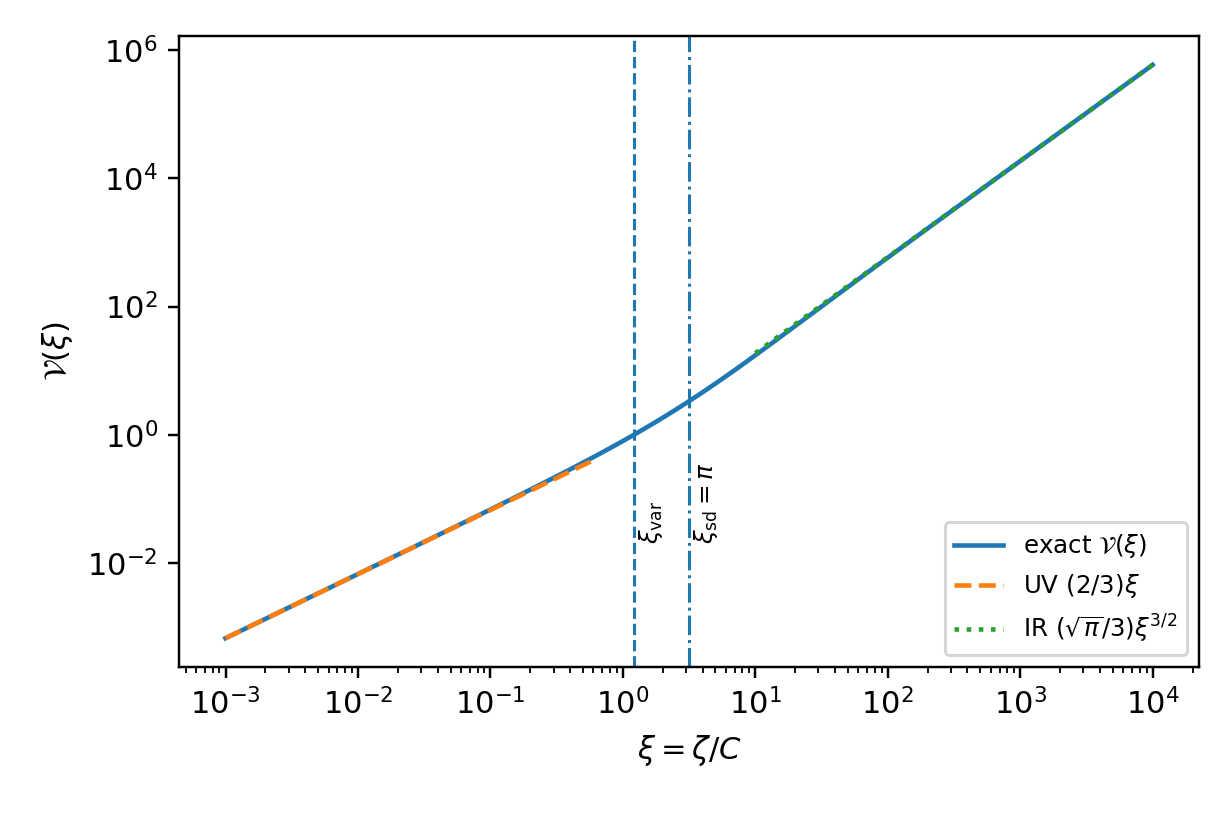
Figure 2: Relative variance 58 of the Schwarzian kernel; variance grows linearly near the boundary, becomes order unity at 59, and dominates at larger depths, marking the breakdown of mean-geometry approximations.
Wilson-Loop Analysis and Screening Law
A central application is to rectangular Wilson-loop correlators. The string worldsheet probes the quantum-corrected geometry by minimizing the Nambu–Goto action in a metric dressed by 20. The parametric dependence between boundary separation 21 and IR depth 22 is found to be 23 for the extremal AdS24 region. This, coupled with 25, produces the energy scaling 26 with exact analytic and numerical coefficients extracted.
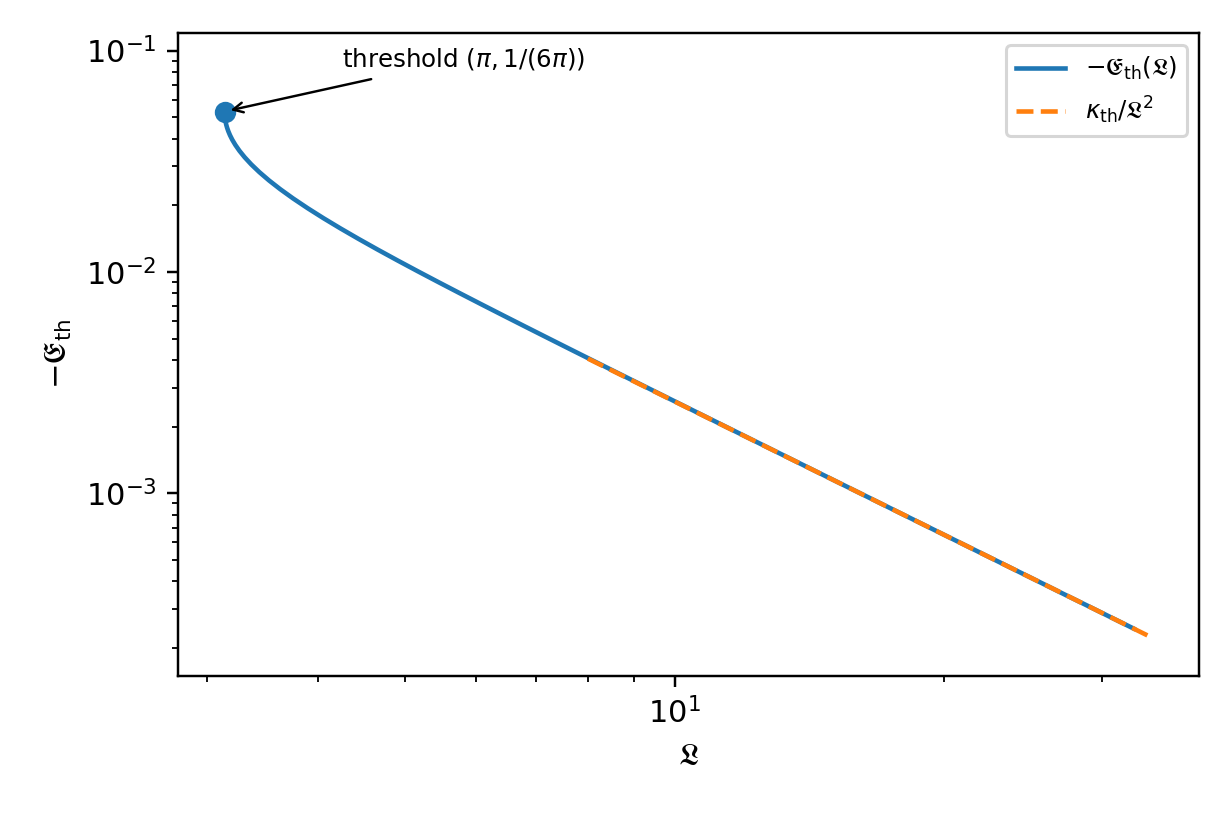
Figure 4: Universal throat screening curve 27; displays transition from quantum threshold at smallest separation (28) to algebraic screening with coefficient 29 at large h(ζ)0.
Comparison of the observable-level force and its local exponent with finite truncation shows convincingly that the apparent linear region is a truncation artifact. The exact solution reveals monotonic crossover from Coulomb (h(ζ)1) to algebraic screening (h(ζ)2), without any plateau or constant-force region.
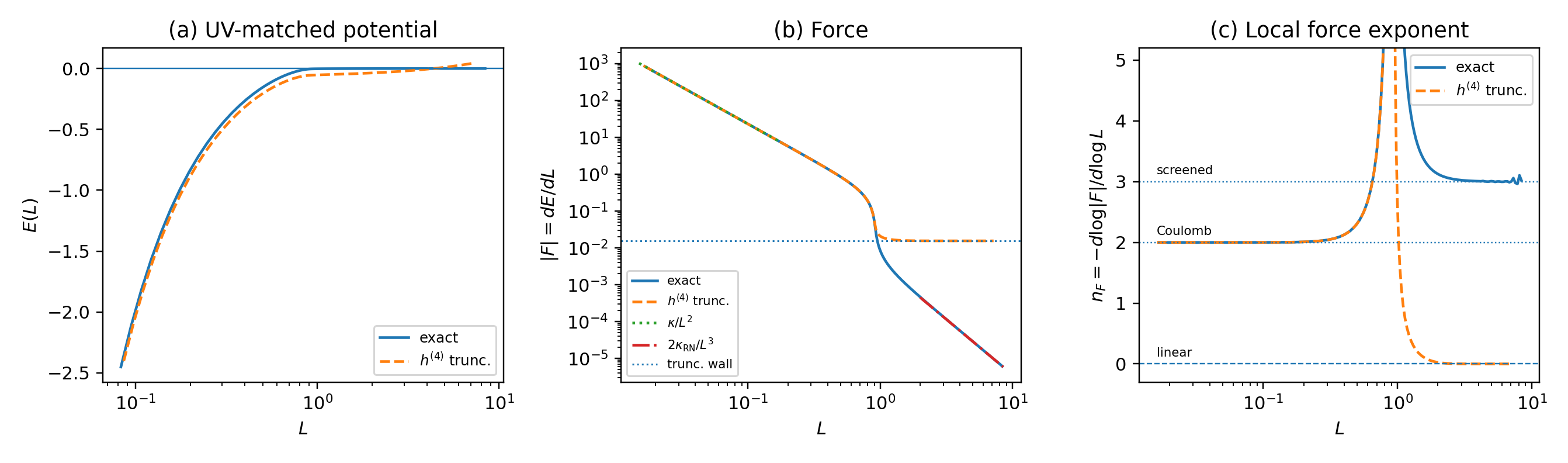
Figure 5: Observable-level comparison of exact and truncated metric factors: while finite expansion produces a false linear plateau (constant force exponent h(ζ)3), the exact solution transitions from Coulomb to screened regime with h(ζ)4 at large h(ζ)5.
Robustness and Modular Crossover Scales
The screening exponent and monotonicity are robust against all moment-based modifications to the metric (i.e., different h(ζ)6 choices in the kernel), and the lack of a finite-depth minimum is established analytically for the entire family. The modular structure imparts a precise scale for crossover between UV and IR regimes, set by the self-dual point h(ζ)7, which maps to a crossover boundary separation h(ζ)8.
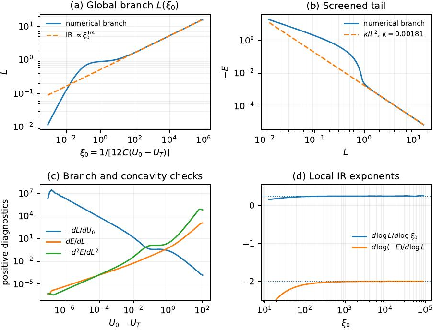
Figure 7: The ratio h(ζ)9 (solid) and its q0 truncation (dashed); the truncation yields a spurious minimum while the exact result decays monotonically, confirming the absence of genuine confinement.
Implications and Outlook
The findings have several immediate implications:
- UV/IR Matching and Holographic Observables: The universal IR algebraic screening is robust, but finer details of the interpolating potential at intermediate distance scales depend on the UV–IR matching prescription. The analytic machinery provided here permits quantitative error bounds (via variance and modular corrections) and invalidates extrapolation of truncated expansions into the IR regime.
- Variance and Non-self-averaging: In the quantum-corrected throat, the geometric averages diverge from typical (quenched) values, indicating a regime of strong sample-to-sample fluctuation, relevant for any probe sensitive to rare events or geometric fluctuations.
- Generalization and Extensions: The Mordell-based formalism and quasi-modular decomposition are extendable to more general conformal dimensions, spatial Wilson loops, finite temperature, and other observables where the Schwarzian kernel plays a role (e.g., transport coefficients, low-q1 shear viscosity).
- String Theoretic Corrections: The qualitative form of IR screening is protected against q2 and worldsheet loop corrections affecting only global coefficients, as the underlying scaling comes directly from the Schwarzian sector and modular completion.
Conclusion
This work delivers a nonperturbative solution for the quantum-corrected metric in the AdSq3 throat, resolving longstanding ambiguities in the infrared behavior of holographic Wilson loops in extremal geometries. The use of Mordell’s integral, modular summation, and analytic control over variance collectively exclude previously conjectured linear regimes and mass gaps, instead establishing universal algebraic screening as the direct manifestation of semi-local criticality in the dual field theory. These results set a new benchmark for systematic, prescription-robust evaluation of quantum-corrected holographic observables and highlight the centrality of modular nonperturbative completions in strongly coupled quantum gravity systems.
References:
- "Exact Schwarzian Metric Factor and Holographic Wilson-Loop Screening" (2607.03120)