- The paper presents a proactive thinking framework that precomputes anticipated dialogue responses, significantly reducing response latency in LLM interactions.
- The methodology leverages anticipated rollout precomputation and speculative continual thinking to balance precomputed reasoning with real-time corrections.
- Empirical findings demonstrate near-complete cache reuse in structured tasks, with up to 97.9% recall in low-entropy scenarios and robust performance across benchmarks.
Proactive Thinking for Real-Time Dialogue: Advancing LLM Responsiveness Without Sacrificing Thoughtfulness
Motivation and Paradigm Differentiation
Current state-of-the-art LLM agents in dialogue follow a reactive thinking paradigm: they wait until a user response is received before engaging in computational deliberation (reasoning traces) prior to generating the next reply. This approach, although suited for high-quality responses, incurs significant latency, especially in reasoning-intensive multi-turn scenarios. In contrast, human interlocutors leverage idle conversational intervals to anticipate and plan future utterances, yielding a fluid, interactive experience.
This paper introduces the shift toward proactive thinking: a framework that enables LLMs to precompute possible reasoning and response elements during conversational downtime, decoupling computational anticipation from immediate user stimuli. The practical aim is to minimize response latency while preserving the depth of reasoning, thus enabling more seamless conversational AI in real-time settings.
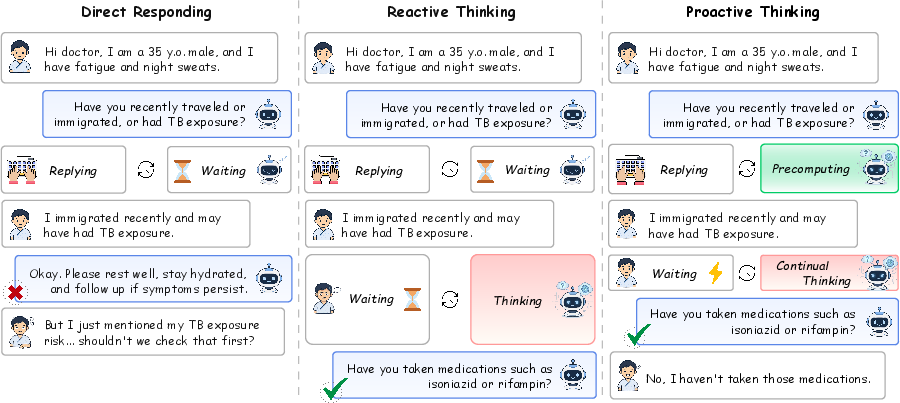
Figure 1: Comparison of direct responding, reactive thinking, and proactive thinking paradigms, highlighting their respective response generation timelines and utilization of idle conversational intervals.
Methodological Contributions
The paper proposes a training-free baseline to operationalize proactive thinking, comprised of two mechanisms:
- Anticipated Rollout Precomputation: During the inter-turn idle interval, the LLM hypothesizes k plausible future user replies using its contextual prediction capacity, and precomputes corresponding reasoning traces and responses ("rollouts") for each. This anticipated cache forms a set of possible reasoning paths, bounded by the available computational window.
- Speculative Continual Thinking: Upon receiving the true user reply, the system selects the most similar hypothesized scenario and applies a modified speculative decoding mechanism for prefix self-verification. Accepted tokens from the precomputed trace are reused; new tokens are generated to repair mismatches via autoregressive continuation. This minimizes unnecessary regeneration and ensures output validity.
The efficacy of this system hinges primarily on the entropy of the user reply distribution and the model’s ability to accurately span likely future states. In structured tasks (e.g., clinical diagnosis), proactive thinking can cover most contingencies; in open-domain, high-entropy exchanges, benefits are attenuated but preserved.
Evaluation Framework and Benchmarks
To robustly evaluate the latency-performance trade-off, the authors introduce time-aware interaction environments by adapting three benchmarks of varying complexity:
- 20 Questions: Deductive reasoning in a constrained space.
- AgentClinic: Clinical dialogue requiring sequential decision-making with diverse, patient-generated responses.
- IN3: Intent understanding in open-ended multi-turn conversation.
Temporal modeling is achieved by standardizing token generation rates and simulating human typing speeds, disentangling hardware-dependent variations from core algorithmic advances. Metrics reported include task accuracy, number of interaction turns, and average response latency per turn.
Empirical Findings and Numerical Results
Across multiple LLMs (Gemma, Qwen, Llama), proactive thinking consistently achieves substantial latency reductions compared to reactive thinking, with negligible or no degradation in task accuracy. Notably, in structured tasks, proactive thinking allows near-complete reuse of precomputed reasoning, virtually eliminating response delay.
Further, latency reduction correlates with the degree to which model-generated hypotheses recall actual user replies, with recall rates approaching 97.9% in 20 Questions and 58.1% in AgentClinic. The gains diminish in open-ended benchmarks, reflecting the entropy-coverage trade-off intrinsic to speculation, yet proactive thinking remains competitive.
Latency remains robust across wide ranges of user typing speeds and LLM token generation rates, demonstrating portability. Increasing the lenience parameter γ in speculative acceptance enables more aggressive reuse of precomputed tokens, further reducing latency without measurable loss in performance—a strong claim of robust parameter insensitivity.
Case studies illustrate that full cache hits yield near-zero generation latency; partial hits are gracefully corrected with minimal regeneration, validating the self-verification mechanism.
Practical and Theoretical Implications
Proactive thinking transforms the operational dynamics of LLM-based dialogue systems, enabling strategic utilization of idle intervals for anticipatory reasoning. Practically, this unlocks deployment in scenarios where low-latency responses are mission-critical (e.g., live consultations, interactive agents for real-time applications).
Theoretically, it motivates research into prediction-conditioned reasoning, user-intent modeling, and reinforcement learning for optimizing anticipatory strategies. Future directions include:
- Enhanced user intent prediction for improved hypothesis accuracy.
- End-to-end RL finetuning of proactive agents, enabling adaptive exploration and efficient rollout selection.
- Integration with incremental processing for streaming modalities (speech/dialogue), expanding utility to continuous, full-duplex settings.
- Extension to broader interactive environments, including real-time strategy and autonomous decision-making.
Conclusion
This work formalizes, implements, and validates the proactive thinking paradigm for LLM dialogue agents, demonstrating its effectiveness in reducing response latency without compromising reasoning quality. The methodology is training-free, adaptable, and robust across task complexities, with performance intimately linked to hypothesis coverage and replay efficiency.
The paradigm invites further exploration in prediction optimization, RL training, and multimodal interaction, promising deeper integration with real-time AI systems and advancing both the research and operational frontiers of conversational intelligence.