- The paper introduces a standardized Real2Sim pipeline for data-driven identification of coupled human-robot interface dynamics in HITL simulations.
- It employs a two-stage calibration process that normalizes harness tightness and uses CMA-ES for precise parameter identification.
- Validation shows the calibrated model accurately replicates gait kinematics, reducing per-user adaptation to only five of twelve parameters.
A Standardized Real2Sim Pipeline for Physical Human-Robot Interaction in Human-in-the-Loop Simulation
Introduction
This work introduces a robust pipeline for identifying the coupled dynamics at the human-robot physical interface, specifically targeting the pelvis--strap interaction in overground mobile balance assistance. Rather than employing heuristic or empirical parameter settings, the proposed pipeline formalizes the parameter identification process using data-driven subject-specific calibration and cross-subject generalizability analysis. The result is a reproducible and standardized approach, supporting high-fidelity human-in-the-loop (HITL) simulations for preclinical verification of robot-assisted gait controllers.
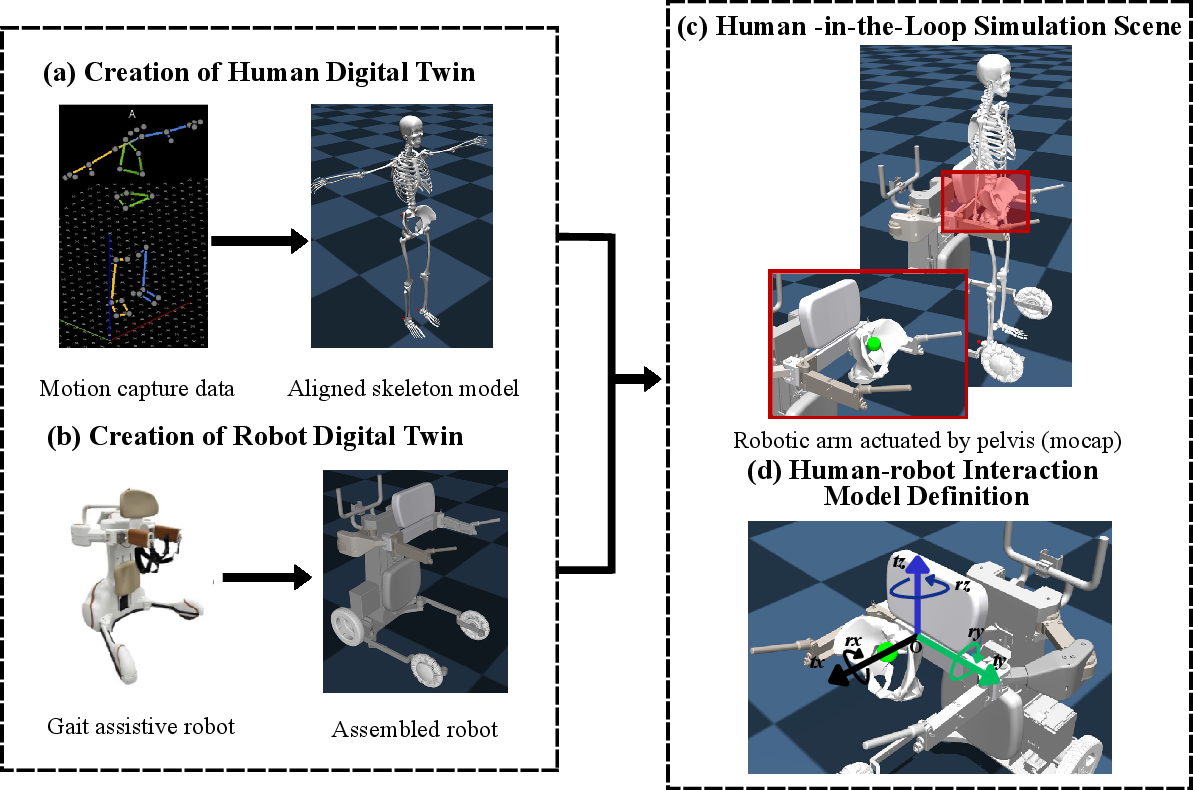
Figure 1: Overview of the HITL simulation environment. The Human Digital Twin, robot digital twin, and pelvis--interface coupling are modeled in MuJoCo.
Framework Overview
The HITL simulation comprises co-simulation of a 27-DoF Human Digital Twin (HDT) and a robot twin, with the pelvis--strap interface modeled as an explicitly parameterized 6-DoF viscoelastic coupling. This model captures the anisotropic, nonlinear, and compliance-dominated nature of the real-world human-robot connection, essential for modulating the emergent coupled gait biomechanics. All components are simulated in MuJoCo, ensuring accurate spatial and temporal dynamics.
Real2Sim Pipeline and Parameter Identification
Tightness Normalization
A key contribution is the normalization of ambiguous subjective harness tightness into a reproducible operating point. By anchoring to each subject's "Safe {content} Comfortable" tightness—quantitatively marked by a critical knee point in maximum pelvic rotation—the approach eliminates confounds arising from anthropometric variation, ensuring consistent conditions for comparative evaluation.
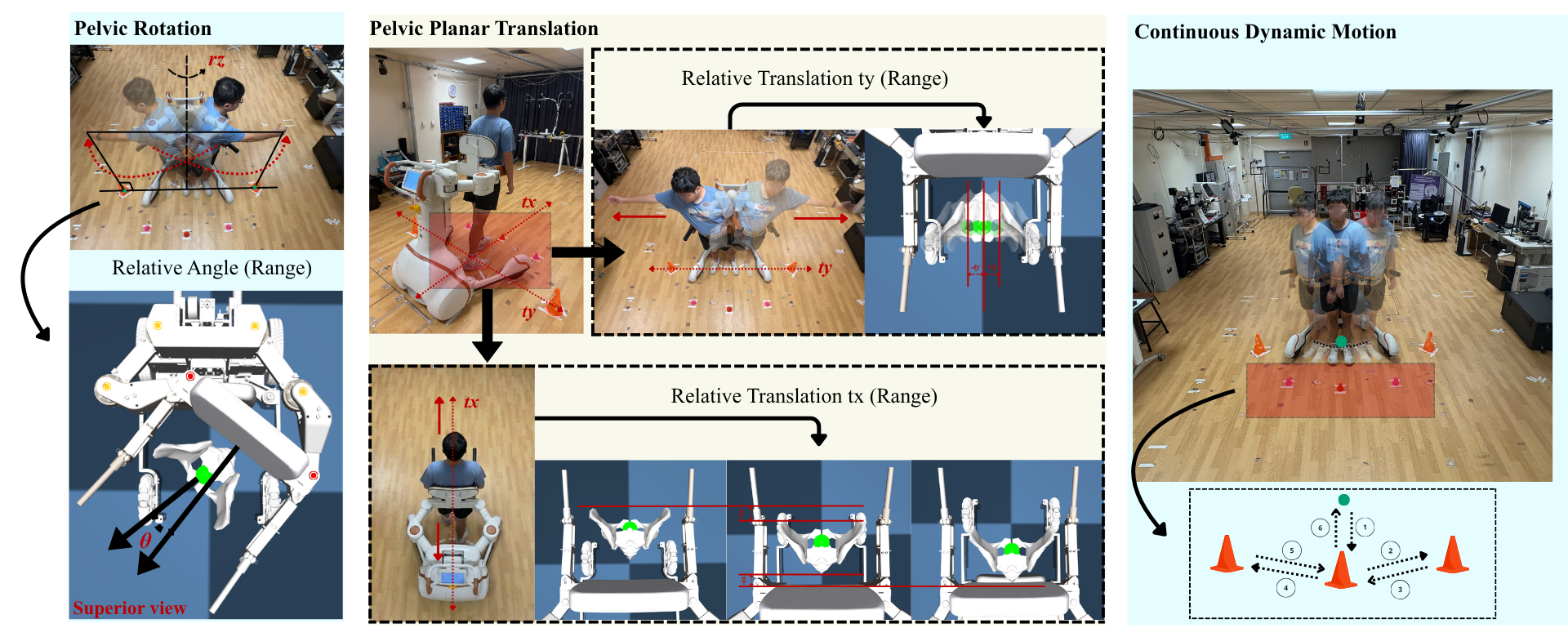
Figure 2: Calibration tasks and marker configuration—maximum pelvic rotation, planar translation, and dynamic motion for parameter excitation; bottom left: Qualisys tracker marker definitions.
Two-Stage Model Calibration
Joint limits are established via observed maximum pelvic excursions for each of the six DOFs; these define the admissible slack in the interface. Subsequently, direction-specific stiffness and damping parameters are identified using the Covariance Matrix Adaptation Evolution Strategy (CMA-ES), minimizing spatiotemporal discrepancies between measured and simulated interface marker trajectories. The identification process enforces search bounds based on biomechanical plausibility and runs in log-space to address variance magnitude.
Shareability and Statistical Analysis
ICC-Based Parameter Classification
A cross-subject analysis on five individuals yields 50 parameter sets per interface direction. Random-effects modeling in log-space, coupled with intraclass correlation coefficient (ICC) estimation and bootstrap CIs, distinguishes parameters that are invariant (material-dominated) from those subject-specific (anthropometry- or physiology-sensitive). Seven of twelve parameters are statistically shareable, while the remainder require personalized or bounded refinement.
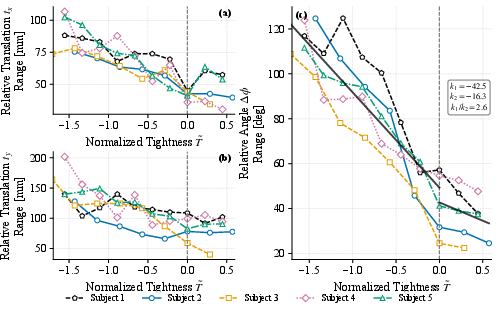
Figure 3: Cross-subject sweep of allowable pelvis-interface motion as a function of normalized strap tightness; the knee point in maximum pelvic rotation robustly identifies the "Safe {content} Comfortable" threshold.
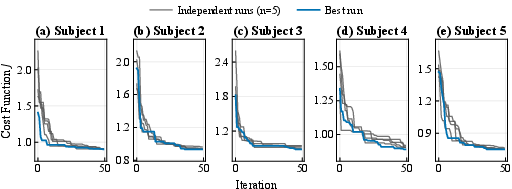
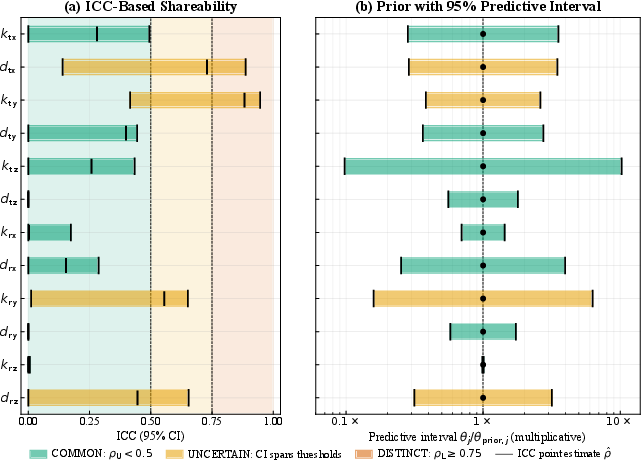
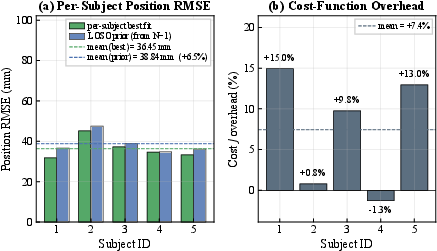
Figure 4: Top: CMA-ES convergence for dynamic calibration; Middle: ICC scores and parameter clustering; Bottom: Leave-one-subject-out validation showing the minimal generalization gap using population priors.
The leave-one-subject-out protocol demonstrates that deploying geometric-mean population priors for the seven shareable parameters, and bounded search for the remainder, incurs only a marginal error increase (mean +6.5% RMSE, +7.4% cost), thereby confirming cross-subject transferability within realistic inter-individual variability.
Validation in Gait Simulation
Interaction Envelope Replication
Validation on an unseen subject demonstrates that only the pipeline-identified parameters replicate both the scale and the lateral dominance (anisotropy) of real interface displacements during robot-assisted walking. Soft settings (low stiffness/damping) allow excessive motion, while stiff, isotropic configurations suppress natural sway and distort kinematics.
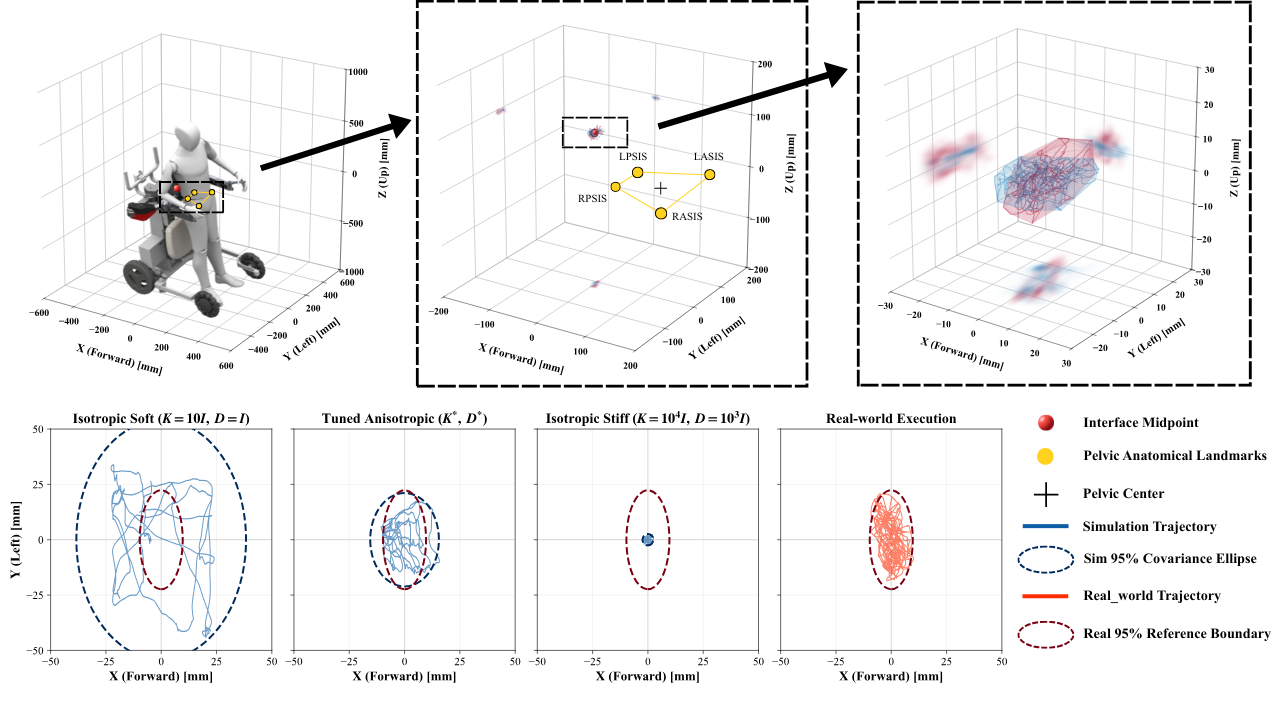
Figure 5: Top: Geometric hierarchy for spatial measurement. Bottom: X-Y plane interface displacement trajectories and confidence ellipses for soft, prior-derived, and stiff parameterizations—the calibrated model replicates the natural interaction boundaries.
Emergent Biomechanical Adaptations
At the joint level, the calibrated interface parameters force the HDT to autonomously reproduce human-typical reductions in sagittal-plane RoM (particularly hip and knee) in response to the constraint during coupled gait. This effect is not captured by naive parameterizations, underlining the necessity for correct identification to ensure biomechanical realism.
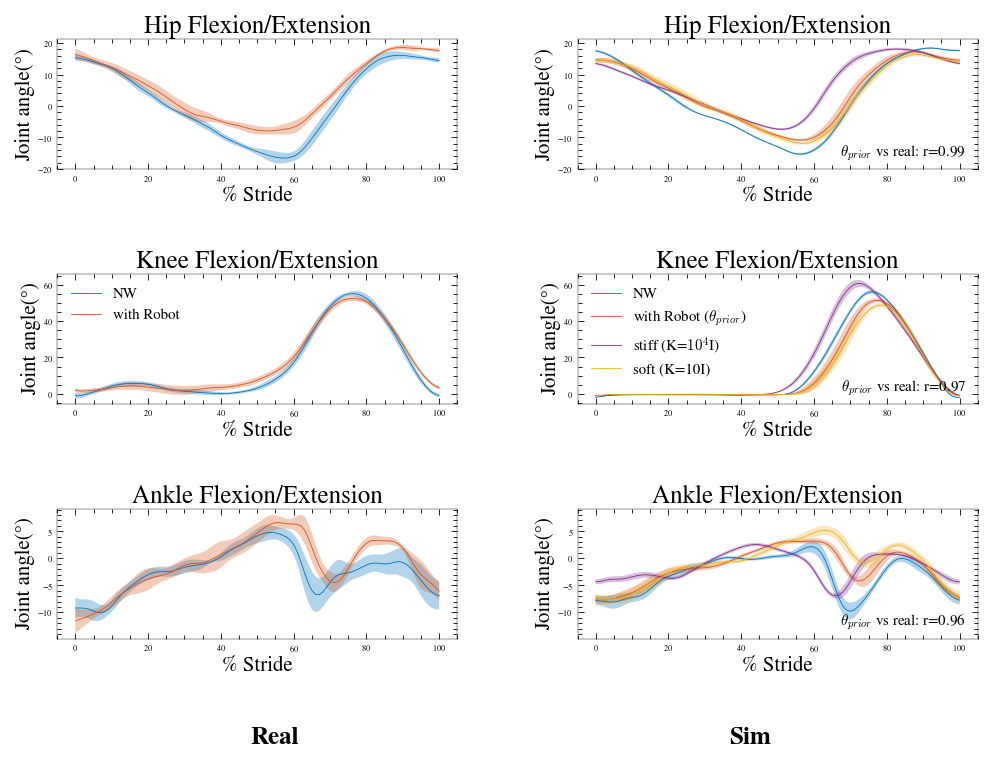
Figure 6: Left (real): Joint-angle trajectories under normal vs. robot-assisted gait; Right (sim): Corresponding HDT trajectories with varied interface impedance, demarcating the predictive capability of the calibrated model.
Implications and Future Directions
By formalizing interface parameter identification and transfer, this pipeline advances HITL simulation fidelity for pHRI research. It offers:
- Quantitative reproducibility of coupled gait dynamics, supporting personalized control design and pre-clinical validation without patient risk.
- Efficient tuning: only five of twelve impedance parameters require per-user adaptation.
- A statistical basis for generalization, enabling principled translation of experimental results between populations.
Practical implications include reducing experimental costs and safety risks for robotic gait-assist technology and standardized benchmarks for future simulation-based assistive robotics. Theoretically, the methodology provides a template for real2sim generalization and parameter identifiability analysis for other human-robot interfaces.
Future directions involve closed-loop robot-aware HDT simulation, direct force-level validation, extension to pathological or elderly populations, and scalable interval-based search for the remaining user-specific parameters.
Conclusion
The paper establishes a data-driven, statistically grounded Real2Sim pipeline for identifying and deploying subject-general and personalized interface parameters in HITL physical human-robot interaction simulation. The approach robustly outperforms heuristic methods, underpinning high-fidelity prediction of dynamic human adaptation and supporting safe, effective, and scalable assistive robotics research and development.