- The paper introduces a novel symmetry-resolved construction for parent Hamiltonians that uniquely select entangled bosonic cat states.
- It details an operator hierarchy that first confines each mode to a coherent-state subspace and then applies symmetry constraints for GHZ, cluster, and W-type configurations.
- The framework maps bosonic resources to encoded qubit stabilizer codes, offering practical design principles for scalable quantum computing.
Symmetry-Resolved Parent Hamiltonians for Entangled Bosonic Cat Resources
Overview and Motivation
The formalism of parent Hamiltonians for entangled bosonic cat states bridges foundational aspects of quantum resource theory, multimode cat state engineering, and encoded qubit architectures. This work introduces a symmetry-resolved construction of positive-semidefinite parent Hamiltonians using oscillator operators, which uniquely select a desired class of entangled cat states—such as GHZ, cluster, and W types—among all multimode oscillator product states. The methodology hierarchically stratifies constraints: a universal branch Hamiltonian confines each mode to a two-branch coherent-state subspace, and subsequent symmetry-resolving terms eliminate degeneracies until only the target entangled state remains as the ground state. This construction elucidates the algebraic structure underlying resource states in modular bosonic architectures and connects the physics of coherent-state stabilization to the language of stabilizer codes.
The parent Hamiltonian for a multimode cat resource is rigorously constructed as follows. For M bosonic modes with annihilation operators aj, the branch Hamiltonian
Hbr=j=1∑M(aj2−α2)†(aj2−α2)
energetically confines the state space of each mode to span{∣+α⟩,∣−α⟩}, forming a 2M-dimensional branch manifold. This manifold is heavily degenerate, encompassing all configurations of coherent amplitudes in the two branches.
Subsequent positive-semidefinite constraints Hμ act within this branch manifold. Each Hμ≥0 is engineered to energetically suppress all states except those possessing specified symmetry or correlation properties (e.g., global GHZ alignment, local cluster correlations, or fixed-defect W configurations). The complete parent Hamiltonian takes the form
Htarget=Hbr+∑μHμ,
with the ground space ⋂μkerHμ∩kerHbr containing only the target resource when the constraints are algebraically complete.
GHZ-Type Cat States
A GHZ-type cat state across M modes is
aj0
Parent Hamiltonian construction involves:
- The branch Hamiltonian, confining each mode.
- An alignment Hamiltonian penalizing anti-aligned branches via
aj1
for a connected graph aj2.
- A parity constraint selecting the even or odd superposition:
aj3
with global parity aj4.
The hierarchy of constraints reduces the aj5 branch degeneracy to two global-aligned states, then to the unique GHZ-cat ground state.
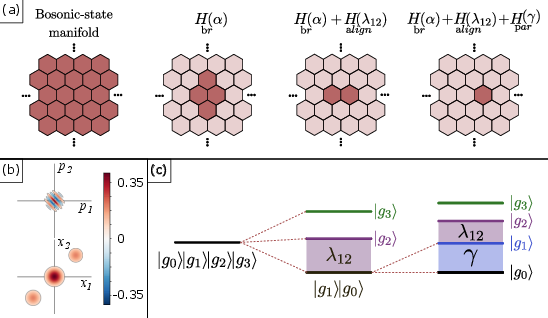
Figure 1: Two-mode GHZ-cat parent-Hamiltonian construction illustrating the successive restriction from all branches to the GHZ superposition via branch, alignment, and parity constraints.
Cluster- and W-Type Cat State Resources
Cluster-type states exploit local graph connectivity, with terms enforcing pairwise constraints and encoded stabilizer-like operators. For the illustrated four-mode “two-qubit” example, operators select pair-aligned branches and then fix the stabilizer sector:
aj6
followed by projectors onto the correct logical sector using effective qubit-like variables.
For W-type resources, the fixed-defect structure is enforced by
aj7
and a mixing Hamiltonian that symmetrizes over defect locations. The structure is fundamentally non-stabilizer: the constraint admits all single-defect branches, and the ground state is selected by symmetric exchange within this manifold.
Encoded Qubit Mapping and Large-Amplitude Limit
The encoded-qubit correspondence becomes exact at large aj8, where aj9 are orthonormal. Within the branch manifold, the parent Hamiltonians become stabilizer Hamiltonians for encoded logical qubits. For example, alignment terms become Ising stabilizers, parity becomes logical Hbr=j=1∑M(aj2−α2)†(aj2−α2)0, and exchange operators become logical Hbr=j=1∑M(aj2−α2)†(aj2−α2)1. This mapping enables direct translation between bosonic-encoded resources and qubit error correction codes, clarifying the mathematical structure underlying recent cat-code quantum computing proposals.
Implications for Physical Implementation
The symmetry-resolved parent-Hamiltonian formalism precisely delineates which constraints must be enforced in hardware—either Hamiltonian (coherent) or through engineered dissipation—for robust quantum resource preparation. The resulting construction is agnostic to implementation, specifying only that the coefficients are positive (energetic penalties). In practical systems, spectral gaps and state lifetimes are governed by the relative constraint strengths.
This hierarchy provides a blueprint for reservoir- and Hamiltonian-engineering of entangled bosonic resources—a task critical for distributed, modular quantum computing architectures. For instance, the branch constraint is naturally dissipative (two-photon pumping), while alignment and symmetry-selecting terms can be coherently mediated or implemented via environment-assisted mechanisms.
Outlook and Future Directions
The construction demonstrates that all algebraically definable entangled bosonic cat resources—regardless of whether they are stabilizer- or exchange-stabilized—can be engineered as unique ground states of symmetry-resolved parent Hamiltonians, provided appropriate constraint completeness. The method applies directly to arbitrary graphs, multimode resources, and generalizations to non-parity branches and multi-photon codewords.
Practically, these results articulate a roadmap for the scalable stabilization of encoded bosonic resources. Theoretically, they clarify the resource structure relevant for measurement-based, modular, and autonomous error-corrected quantum architectures. Open directions include hardware-optimized constraint engineering, stabilization of non-abelian and non-stabilizer resource states, and quantification of resilience against non-idealities (e.g., finite Hbr=j=1∑M(aj2−α2)†(aj2−α2)2 overlap, environmental noise).
Conclusion
The symmetry-resolved parent Hamiltonian framework provides an operator-level methodology for the unique specification and construction of entangled, multimode coherent-state quantum resources. The explicit mapping to encoded qubit stabilizer and exchange Hamiltonians in the large-Hbr=j=1∑M(aj2−α2)†(aj2−α2)3 limit links bosonic-state engineering protocols directly to fault-tolerant logical encodings. These insights facilitate the principled design of modular, robust quantum information platforms based on entangled cat-state resources.
Citation: "Symmetry-Resolved Parent Hamiltonians for Entangled Bosonic Cat Resources" (2607.02997)