Dissipative preparation and stabilization of d-mode multinomial cat states
Published 3 Jul 2026 in quant-ph and cond-mat.mes-hall | (2607.03302v1)
Abstract: Engineering dissipation with tailored steady states has become a powerful approach for preparing and stabilizing quantum states. In this framework, engineered dissipative processes continuously steer a system towards desired target states while suppressing unwanted noise. However, extending this idea to multimode systems is challenging and remains largely unexplored, although this class of states is a powerful resource for quantum sensing and quantum information processing applications. Here, we propose a general method to design the required dissipative processes for the generation of multimode cat states in bosonic systems. We show that the engineered dissipation prepares such states from the vacuum with high fidelity and robustly stabilizes them against decoherence. As a result, their lifetime is extended by several orders of magnitude compared to natural decay times, which in turn enhances their applications in quantum techonologies. We specifically focus on the preparation and stabilization of two-mode binomial cat states and discuss a pathway for the implementation in superconducting circuit. However, our scheme can also scale up to arbitrary d-mode multinomial cat states associated to $\mathfrak{su}(d\ge2)$ algebras, and thus, our scalable framework provides a feasible route towards stabilizing compact nonclassical states.
The paper introduces a dissipative framework that autonomously prepares and stabilizes d-mode multinomial cat states using tailored jump operators.
It employs excitation-number and relative mode coherence stabilization in circuit-QED, achieving high-fidelity state preparation resilient to decoherence.
Scaling analysis reveals that larger cat state sizes extend lifetimes and robustness, underpinning advances in quantum metrology and error correction.
Dissipative Stabilization of Multimode Binomial Cat States in Bosonic Circuits
Introduction and Motivation
The engineering of tailored dissipation to autonomously prepare and stabilize quantum states in open quantum systems has advanced as a key paradigm for quantum information processing and metrology. While single-mode bosonic cat states have been extensively studied and realized, the extension to multimode compact cat states—particularly those with finite support in bosonic Fock space—remains largely unaddressed due to their nontrivial algebraic structure, which precludes standard ladder-operator-based stabilization techniques.
This paper introduces a general dissipative framework for the preparation and robust stabilization of d-mode multinomial cat states, with a primary focus on compact two-mode binomial cat states associated with the su(2) algebra. The proposed approach leverages experimentally accessible nonlinear engineered dissipation in superconducting resonator architectures and demonstrates significant robustness against environmental decoherence, with lifetimes extended by orders of magnitude versus native decay processes. Importantly, the framework generalizes to arbitrary d-mode multinomial cats, enabling scalable access to compact nonclassical bosonic resources.
Distinction Between Compact and Non-Compact Cat States
Compact multinomial cat states in bosonic systems exhibit finite support in excitation number and are tightly connected to finite-dimensional irreducible representations of Lie algebras, such as su(2) and su(d). Unlike the more familiar Schrödinger and pair cat states associated with h(1) and su(1,1)—which are prepared via ladder operators due to their non-compact, infinite-support structure—compact cats cannot be stabilized by single ladder operators. Instead, their stabilization requires enforcing the correct excitation-number manifold (fixed by the Casimir of the algebra) and constraining coherent superpositions consistent with the underlying algebraic structure.
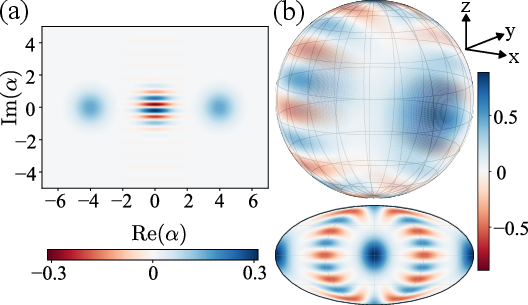
Figure 1: Wigner distributions of (a) a single-mode Schrödinger cat (non-compact), and (b) a two-mode binomial cat state on the spherical phase space, both showing separated peaks and fringe interference indicative of macroscopic coherence.
Dissipative Preparation Protocol
The dissipative preparation of two-mode binomial cat states is formulated in the Lindblad framework with two essential, engineered jump operators:
Excitation number stabilization:
L^1,+(2)=κ1a^†(a^†a^+b^†b^−N)
This operator confines dynamics to the N-excitation manifold, acting as a feedback pump into the desired total excitation sector.
Relative mode coherence stabilization:
L^2(2)=κ2(a^2±b^2)
Quadratic in creation/annihilation, this operator enforces correct phase relations between two-mode branches, eliminating unwanted sign ambiguities and ensuring the presence of nonclassical coherence between well-defined su(2)0 coherent states.
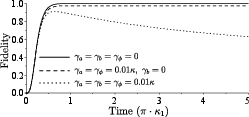
Numerical simulations show high-fidelity preparation from the vacuum, with strong resilience to common noise channels except for phase-flip errors induced specifically by single-photon loss in the su(2)1-mode.
Figure 2: Evolution from vacuum to two-mode binomial cat state under engineered dissipation, demonstrating high-fidelity convergence even in the presence of moderate noise.
Robustness and System Size Scaling
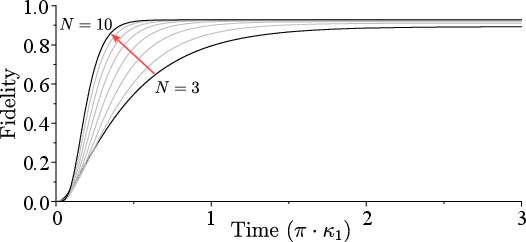
Analysis reveals that increasing the cat state size (su(2)2) enhances both the effective strength of engineered dissipation and the impact of noise. Crucially, the scaling favors stabilization: the norm of the key dissipation operators grows faster than that of the noise, yielding more rapid convergence and longer lifetimes for larger su(2)3. However, in the large-su(2)4 limit, fidelity saturates below unity due to asymptotic scaling equivalence between engineered and noise-induced dissipative effects near the stabilized manifold.
Figure 3: Fidelity trajectories for different su(2)5 under dissipation and noise, showing faster convergence and saturation behavior as su(2)6 increases.
Circuit-QED Implementation
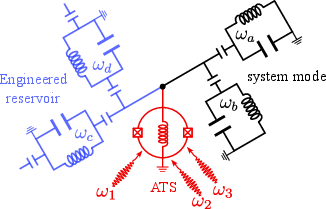
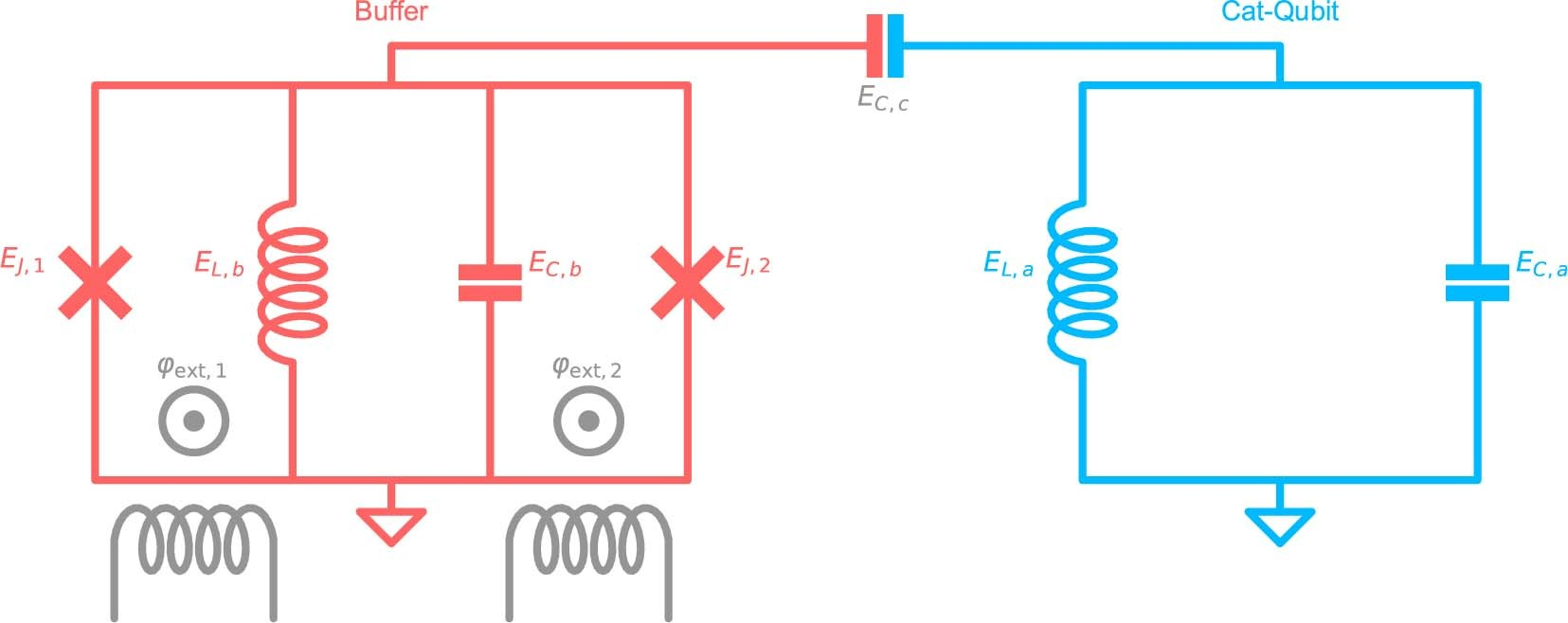
A feasible circuit realization comprises four superconducting LC resonators—two for encoding system modes and two for engineered dissipative environments—interconnected by an asymmetric-threaded-SQUID nonlinear element (ATS). The ATS supports programmable higher-order nonlinearities required for both the pumping and mode-coherence jump operators, activated via multitone external drives. Auxiliary lossy resonators serve as engineered reservoirs, with system-auxiliary couplings mapped to desired effective Lindblad rates by adiabatic elimination.
Figure 4: Circuit schematic—with two encoding resonators, two engineered dissipative environments, and an ATS element mediating the required nonlinear interactions.
Generalization to su(2)7-Mode Multinomial Cat States
The outlined principles extend without greater nonlinear order to multinomial cat states associated with su(2)8 algebras, which have intrinsic multinomial statistics. The general stabilization procedure involves:
A primary jump operator enforcing excitation-number conservation (total Casimir eigenvalue).
Auxiliary jump operators fixing relative coherence between pairs of modes, constructed as generalized linear—or quadratic as needed—combinations of mode lowering operators.
This construction scales in the number of modes without an increase in the required nonlinear interaction order, preserving practical experimental feasibility for higher-dimensional encodings.
Applications: Quantum Metrology and Quantum Error Correction
Quantum Metrology
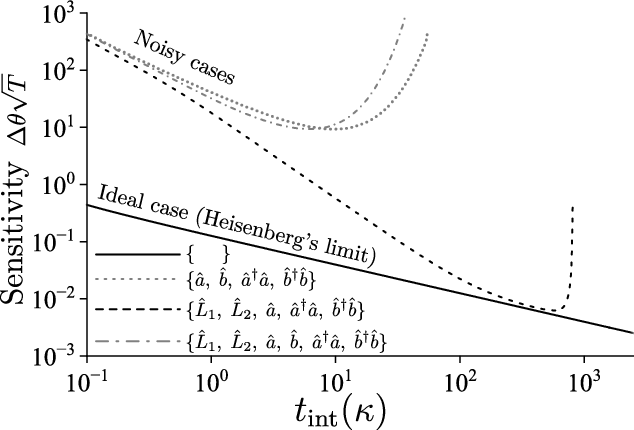
Two-mode binomial cat states maximize the so-called su(2)9-index (d0), enabling Heisenberg-limited parameter estimation in Ramsey-type protocols. Under engineered dissipation, cat state coherence is maintained on timescales vastly exceeding the bare d1 time, and the approach suppresses the usual metrological U-turn behavior caused by decoherence: the optimal interrogation time—the window during which sensitivity improves—can be significantly extended, allowing measurement precision close to the Heisenberg limit.
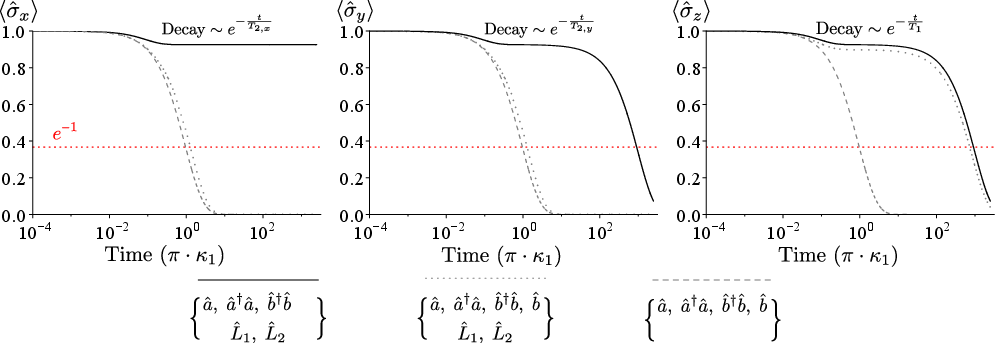
Figure 5: Decay of logical Pauli operators, demonstrating extended coherence and bit-flip lifetimes under dissipation.
Figure 6: Sensitivity scaling in cat-state-based quantum metrology, showing near-Heisenberg-limited performance preserved by engineered dissipation.
Quantum Error Correction
The logical basis encoded in the two-mode binomial manifold allows for bit-flip and phase-flip error analysis. Dissipative stabilization strongly suppresses bit-flip errors, with bit-flip times extended by orders of magnitude, and provides partial protection against phase-flip errors. Importantly, despite multimode encoding (which naively increases the number of possible noise channels), only one dominant error channel remains problematic—mirroring the situation for single-mode cat-encoded qubits but with the advantages of higher-order error correctability due to exact orthogonality in compact cat codes.
Experimental Feasibility
The proposed framework is compatible with current superconducting circuit advances. Experimental parameters—such as dispersive coupling strengths, resonator frequencies, pump configurations, and engineered loss rates—are all accessible within state-of-the-art circuit-QED platforms. Realizations using ATS or SNAIL circuits with parametrically driven nonlinearities, and auxiliary fast-relaxing resonators, are already well established.
Figure 7: Sketch of an experimental ATS element as used in superconducting circuits implementing engineered dissipation.
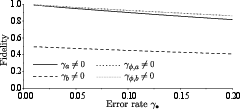
Figure 8: Steady-state fidelity under different noise channels, illustrating how engineered dissipation can maintain high fidelity barring dominant uncorrectable errors.
Conclusion
This work provides a unifying and scalable dissipative engineering protocol for compact multimode binomial cat states. By identifying the algebraic constraints underlying their stabilization and constructing physically realizable Lindblad operators, it enables high-fidelity autonomous preparation and stabilization of nonclassical resources ideally suited for quantum sensing and logical encoding. The framework generalizes to arbitrary multimode cat states without increased nonlinearity requirements, opening a robust route to practical bosonic quantum computing and metrology with engineered compact cat states (2607.03302).