- The paper introduces a two-stage protocol utilizing displaced squeezed states and adaptive homodyne measurements to achieve Heisenberg-limited full-period phase estimation.
- It details a rigorous error analysis via generalized Cramér-Rao bounds that separate local estimation accuracy from overshoot penalties in global localization.
- Optimal energy allocation strategies between coarse global localization and high-precision local estimation are explored for photon budgets up to 25 photons.
Heisenberg-Limited Full-Period Optical Phase Estimation with Displaced Squeezed States and Gaussian Measurements
Introduction and Problem Statement
This work addresses the problem of global phase estimation over the full interval [0,2π) with Heisenberg-limited sensitivity using single-mode Gaussian quantum states and Gaussian measurement protocols under finite energy and squeezing constraints. Unlike scenarios with prior phase information, global estimation must resolve discrete ambiguities generated by probe symmetries, notably the π-periodicity of squeezed vacuum states under homodyne detection. The protocol under study decomposes the estimation into two stages: a global identification stage using displaced squeezed states and heterodyne detection, followed by local high-precision phase estimation using squeezed vacuum states and adaptive homodyne detection.
Two-Stage Gaussian Protocol Design
The proposed estimation architecture is based on a two-stage sequential protocol optimized for a fixed total mean photon number budget. Stage I employs displaced squeezed states, with nonzero displacement to restore global phase identifiability, and heterodyne measurements to localize the unknown phase within a π/2 interval (Figure 1). The displacement is essential, as pure squeezed vacuum states alone cannot resolve the inherent π-ambiguity. Squeezing in this stage enhances information extraction by increasing the curvature of the likelihood at the true phase.
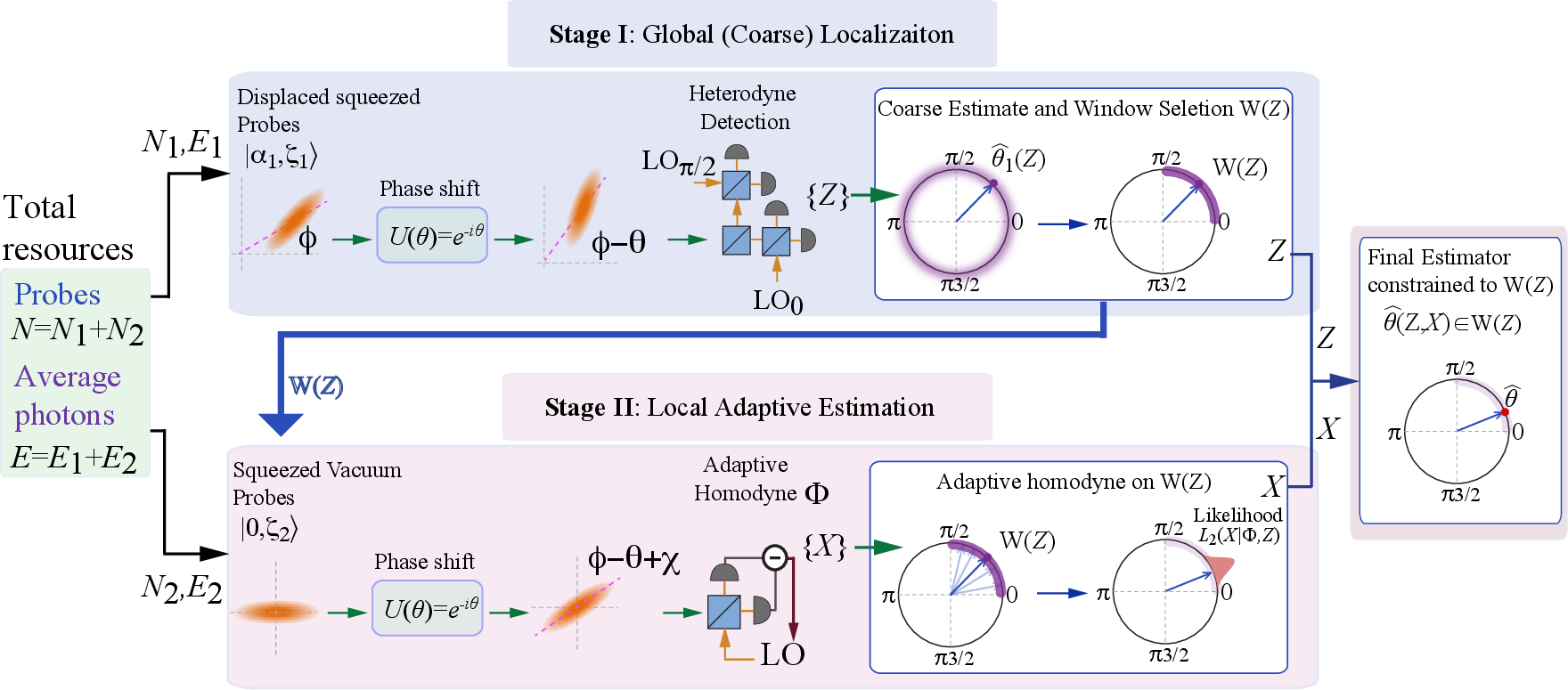
Figure 1: Schematic description of the two-stage estimation protocol, where Stage~I uses displaced squeezed probes and heterodyne measurements for coarse global localization, followed by Stage~II using squeezed-vacuum probes and adaptive homodyne for local high-precision estimation within the selected window.
Subsequently, Stage II allocates the remaining energy to a set of squeezed-vacuum probes, employing adaptive homodyne detection restricted to the window identified in Stage I. The adaptive homodyne protocol targets the local maximum of the Fisher information, and the entire measurement policy in Stage II is conditional on the Stage I localization.
Fundamental Limits: Generalized Cramér-Rao Analysis
A key theoretical contribution is the derivation of generalized Cramér-Rao-type lower bounds, explicitly separating local estimation errors from discrete “overshoot” errors due to the possibility that Stage I localizes the phase outside the true interval. The error decomposition in the generalized bound comprises: (i) the conditional local Fisher information contribution when the true phase is contained in the selected interval, and (ii) an “overshoot” penalty that quantifies the unavoidable error when the selected interval does not contain the true phase. This term is absent in purely local parameter estimation theory and captures the operational cost of full-period estimation under realistic probe symmetries and energy constraints.
The statistical characterization of the Stage I error for coherent states leads to a Rician phase distribution, enabling closed-form evaluation of coverage probability and overshoot cost. Increasing the coherent energy improves coverage of the true phase but competes for resources with Stage II. The coverage properties as a function of the coherent amplitude are shown in Figure 2, including detailed finite-energy corrections beyond the asymptotic, normal regime.
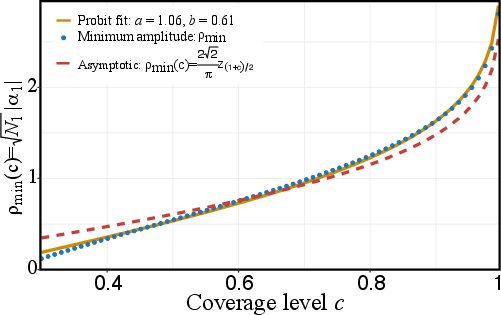
Figure 2: Minimum coherent amplitude required to achieve a target coverage probability c for the initial coarse localization window. Solid and dashed curves compare finite-energy and large-sample normal approximations.
When the Stage I probe is a displaced squeezed state, the local Fisher information (Figure 3) is enhanced relative to the coherent-state benchmark for proper phase alignment, but global identifiability critically depends on maintaining nonzero displacement. Figure 3 illustrates the dependence of both classical and quantum Fisher information on the squeezing parameter and the relative displacement-squeezing phase.
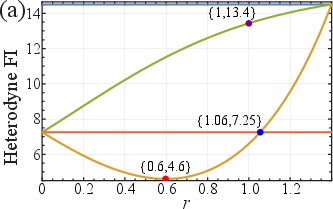
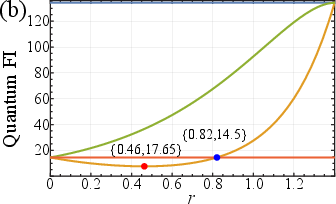
Figure 3: (a) Local Fisher information for heterodyne detection and (b) QFI for displaced squeezed probes, both as a function of squeezing parameter at fixed total energy and for different phase alignments.
Crucially, at fixed single-shot energy, displaced squeezed probes do not yield improved localization cost relative to coherent states when only one probe is used (Figure 4a). However, for fixed per-probe energy and multiple repetitions, moderate squeezing reduces the number of Stage I probes required for a given coverage, i.e., modest squeezing improves the sample complexity but accumulates additional energy cost due to the squeezing term (Figures 4b, 5).
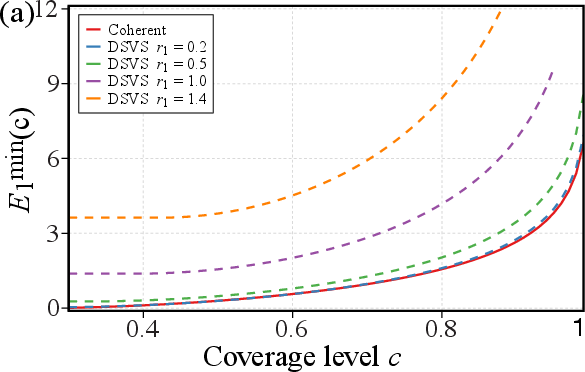
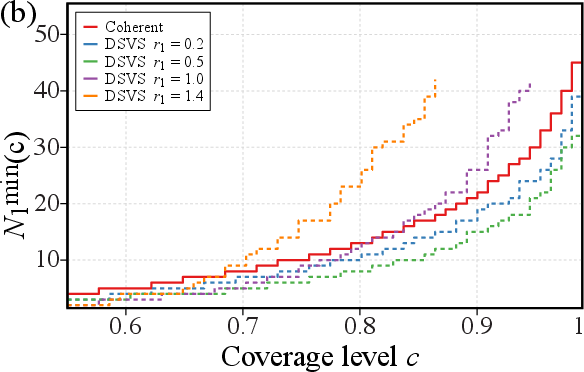
Figure 4: (a) One-probe energy threshold for target coverage probability; (b) sample complexity (number of probes) at fixed amplitude and varying squeezing strength, showing minimum for moderate squeezing.

Figure 5: Total energy required in Stage I to reach a fixed window coverage probability, illustrating that the per-probe squeezing energy dominates for larger r compared to the coherent benchmark.
End-to-End Protocol Optimization and Heisenberg Scaling
The full protocol optimization considers the tradeoff between allocating the energy budget to improved Stage I localization or to increased sensitivity in Stage II. This tradeoff is resolved numerically for various choices of Stage II probe count N2 and total energy. The error lower bounds for the two-stage protocol are compared with the local quantum Fisher information limit obtained by concentrating all energy into a single squeezed-vacuum probe (thus ignoring localization) in Figure 6. Displaced squeezed probes in Stage I outperform coherent states across total energies up to 25 photons and for a wide range of N2, with a multiplicative gap between 3 and 30 relative to the local quantum limit.
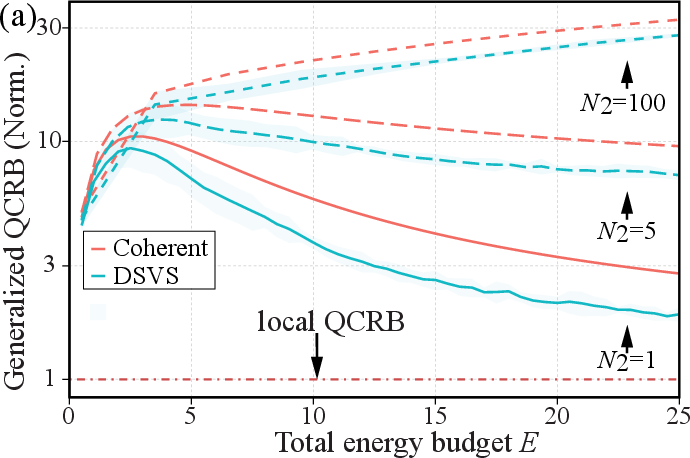
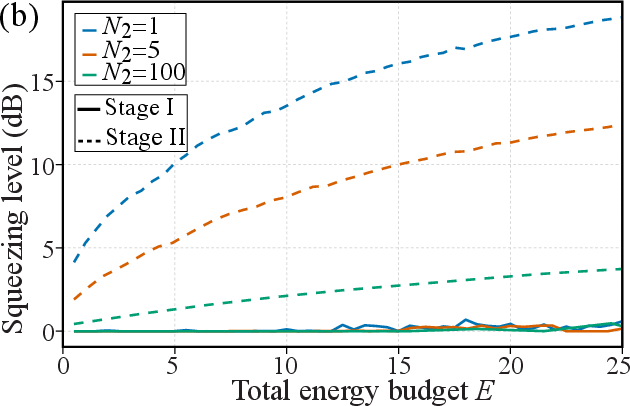
Figure 6: Normalized end-to-end mean squared error for the optimized two-stage protocol, comparing coherent and displaced squeezed states in Stage I under varying N2 and total energy budget.
The analysis reveals that optimal protocols use only moderate squeezing in Stage I, reserving the majority of the squeezing resource for the highly sensitive local estimation step in Stage II (see Figure 6b for the resulting squeezing allocation). Sufficiently high N2 leads to lower per-probe squeezing and maintains compatibility with current experimental devices, while small π0 can approach the best local limits at the expense of high squeezing requirements.
A decomposition of the final error into local and overshoot components, shown in Figure 7, demonstrates that the overshoot penalty becomes the dominant term at high energy when π1 is small, and that displaced squeezing yields superior suppression of rare, large errors due to mislocalization.
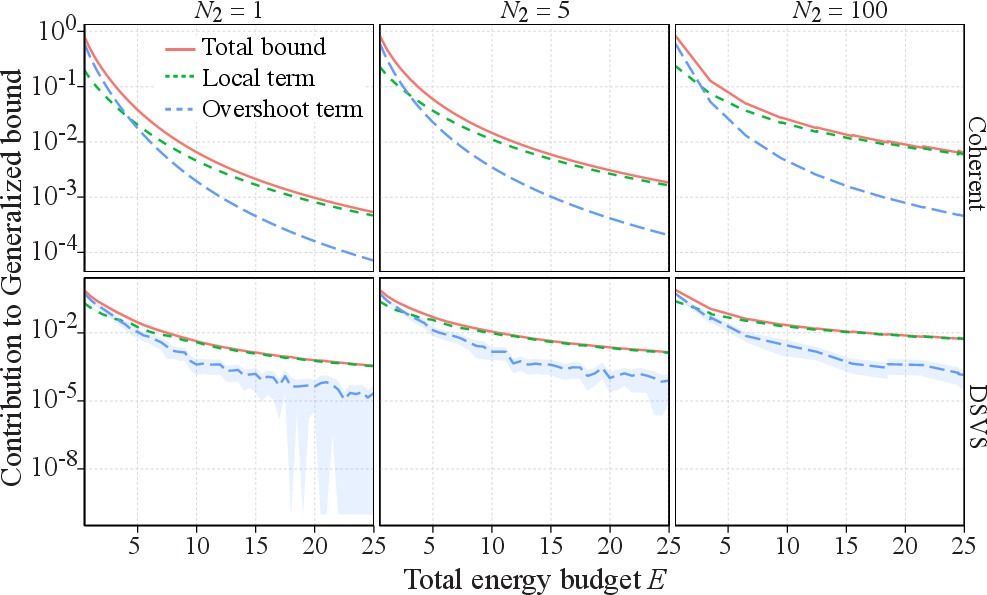
Figure 7: Decomposition of the optimized error bound into local estimation and overshoot penalties for the two-stage protocols as a function of total energy and π2.
Protocol Design Parameters and Practical Considerations
The optimal allocation of number of probes, squeezing parameters, and energy allocation between stages is shown in Figure 8. The results consistently indicate weak squeezing in Stage I and high squeezing allocated to Stage II, subject to the squeezing constraints imposed by the technological platform (e.g., up to 12 dB).
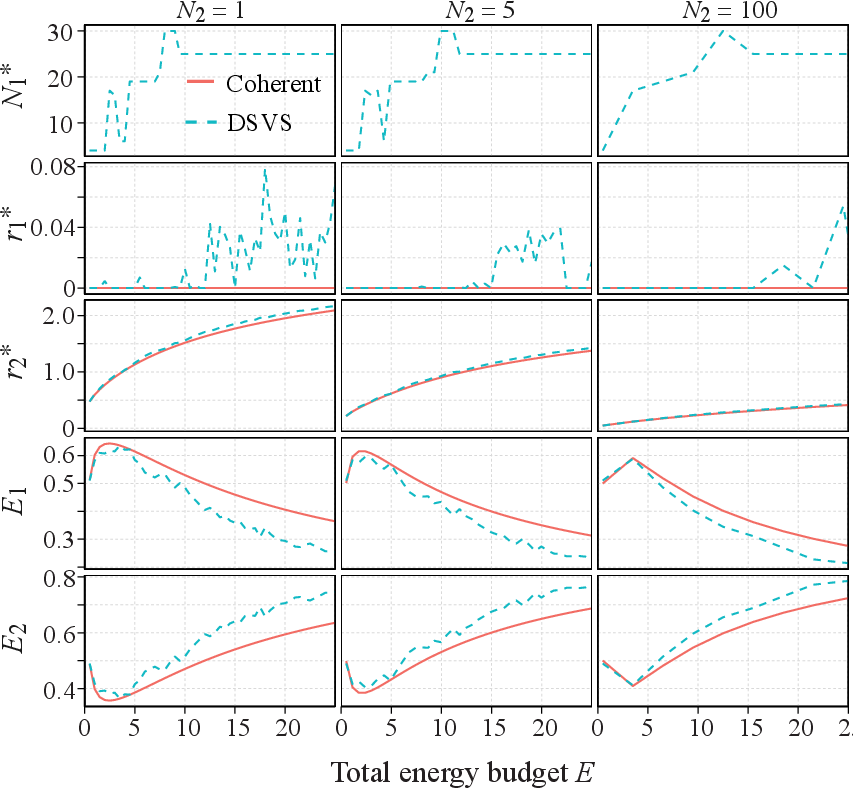
Figure 8: Optimized protocol parameters: sample numbers, squeezing parameters, and energy fractions for Stage I and II as functions of total energy and π3.
The balance between sample complexity and squeezing cost, along with considerations for experimental feasibility (photon budget and achievable squeezing), dictates the optimal protocol parameters.
Implications and Future Directions
The proposed two-stage architecture enables scalable and experimentally accessible full-period optical phase estimation near Heisenberg scaling, providing a clearly defined formalism for the tradeoff between global identifiability and local quantum-enhanced sensitivity. The explicit error bounds quantify the limitations induced by both shot-noise-like global ambiguity and the Heisenberg-limited local regime. The practical regime of total energies up to 25 photons and squeezing up to 12 dB is shown to be close to the optimal Cramér-Rao limit within a multiplicative factor of π4–π5 for the two-stage protocols. No strong contradiction against the claim that modest Stage I squeezing improves protocol performance for fixed photon budget is observed.
This framework can be extended in several directions: comparison with Bayesian or Ziv-Zakai-type bounds, non-asymptotic finite-energy concentration bounds, and adaptation to frequency estimation protocols where phase ambiguities and phase slip errors play analogous roles. Incorporation of additional physical nonidealities, such as loss and finite detector efficiency, will further inform design choices and practical performance.
Conclusion
The analysis demonstrates that Heisenberg-limited full-period optical phase estimation is achievable using two-stage protocols with fixed Gaussian probe families and measurement schemes, provided the resources are carefully allocated to balance global identifiability and local sensitivity. Displaced squeezed states in Stage I offer an operational advantage in terms of overshoot suppression and improved scaling. The explicit decomposition of errors elucidates the necessity for optimizing both global and local aspects of quantum metrological protocols.