Optimized Quantum States for Sensing in the Presence of Loss and Phase Noise
Published 17 Jun 2026 in quant-ph and physics.ins-det | (2606.19649v1)
Abstract: Squeezed vacuum lets gravitational-wave detectors and other quantum sensors surpass the standard quantum limit, and is optimal in the loss-limited regime; phase noise breaks this optimality. Numerically optimizing the quantum Fisher information across the loss and phase-noise landscape, we identify non-Gaussian states that outperform any Gaussian state. These fall into three classes: Fock-like, cubic-phase-like, and states with discrete rotational symmetry. Limiting the average number of photons in the input state to $\bar{n}=5$, with $1-η= 5\%$ photon loss and 200 mrad phase noise, the non-Gaussian advantage reaches up to 2.2 dB. Furthermore, we observe that the non-Gaussian advantage can persist even when the measurement strategy is homodyne detection.
The paper demonstrates that non-Gaussian states outperform Gaussian states in interferometric displacement sensing under combined loss and phase noise.
It numerically optimizes the Quantum Fisher Information to classify optimal state classes, achieving up to 2.2 dB SNR improvement under realistic conditions.
The study emphasizes practical measurement strategies like homodyne and displaced photon-number detections to harness non-Gaussian advantages.
Optimized Non-Gaussian Quantum States for Sensing under Loss and Phase Noise
Overview
This paper addresses quantum metrology in the experimentally relevant regime of finite photon loss and finite phase noise, focusing on interferometric displacement sensing—a paradigm critical to high-precision measurements such as gravitational-wave detection. By numerically optimizing the Quantum Fisher Information (QFI) across this landscape, the authors demonstrate that non-Gaussian states can consistently outperform all Gaussian states (including squeezed vacuum) even when practical measurement strategies are employed. The work systematically classifies the optimal states and quantifies performance benefits, establishing implications for the design and operation of quantum-limited sensors.
Physical Model and Optimization Framework
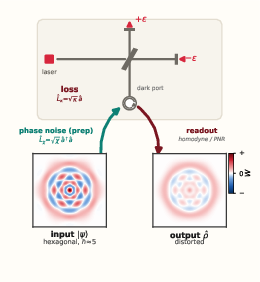
The core task is the estimation of a weak displacement ϵ on an optical probe governed by a Hamiltonian H^=g(a^+a^†), where a^ encodes a field mode at the interferometer’s dark port. The probe is subject to two decoherence channels: amplitude-damping photon loss (L^κ=κa^) and dephasing (phase noise, L^χ=χa^†a^). Phase noise acts during state preparation, while loss occurs during sensing, directly mapping to architectures used in gravitational-wave detectors.
Numerical optimization is carried out on three non-Gaussian superposition ansatze:
All input states are constrained by an average photon number nˉ≤Ntarget, and the optimization maximizes QFI for infinitesimal displacement, accounting for the density matrix evolution via Lindblad dynamics.
Figure 1: Optimized non-Gaussian probe state with discrete rotational symmetry is injected at the dark port; Wigner functions illustrate the input and output state deformation under loss and phase noise.
Classification of Optimal States and Non-Gaussian Advantage
A key finding is that, unlike the purely loss-limited regime where squeezed vacuum is strictly optimal, the presence of significant phase noise breaks this optimality and opens space for non-Gaussian states to provide improved sensitivity. The non-Gaussian states fall into four structural classes: Fock-like, cubic-phase-like, states with discrete rotational symmetry, and other non-Gaussian morphologies.
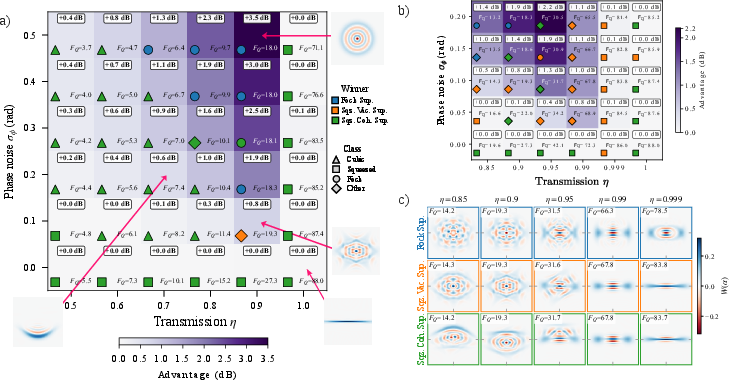
Performance is quantified as the SNR improvement (dB) derived from QFI. For a photon number constraint of nˉ=5, with H^=g(a^+a^†)0 and H^=g(a^+a^†)1 radians, the optimized non-Gaussian states deliver up to 2.2 dB SNR gain relative to the best Gaussian state.
Figure 2: Heatmap of non-Gaussian advantage across the H^=g(a^+a^†)2 grid; marker shape/color denotes state class and ansatz. Regions of optimal non-Gaussianity are clearly delineated.
Distinct regions are observed:
Region I: At zero phase noise (H^=g(a^+a^†)3) or lossless transmission (H^=g(a^+a^†)4), squeezed vacuum (Gaussian) states are optimal.
Region II: At high phase noise and low loss, Fock-like states dominate, leveraging their robustness to dephasing.
Region III: Intermediate regimes favor cubic-phase-like states, which encode displacement in phase-space arcs, balancing sensitivity and resilience to both decoherence mechanisms.
Region IV: For comparable loss and phase noise, hybrid morphologies with discrete rotational symmetry emerge; symmetry order decreases as loss diminishes.
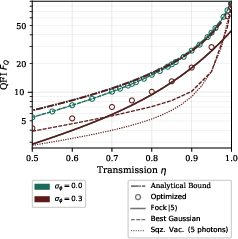
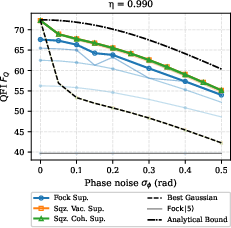
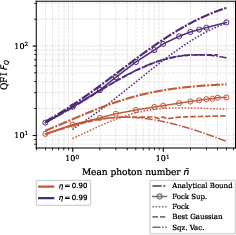
Figure 3: Trends of QFI vs. loss (H^=g(a^+a^†)5), phase noise (H^=g(a^+a^†)6), and photon number (H^=g(a^+a^†)7) for different state classes; markers identify regions where non-Gaussian states most strongly outperform Gaussian baselines.
Trends and Numerical Insights
QFI exhibits a marked dependence on the interplay between loss and dephasing:
As H^=g(a^+a^†)8 increases with fixed H^=g(a^+a^†)9, squeezed vacuum regains optimality, but cubic and Fock superpositions become superior as loss grows and phase noise increases.
At fixed a^0, increasing phase noise leads to non-Gaussian superpositions (especially Fock and cubic-phase) outpacing Gaussian QFI by 1.1 dB or more.
At higher a^1, the advantage of non-Gaussian Fock superpositions persists and grows, e.g., a^2 dB at a^3 under a^4 loss and moderate phase noise.
Optimized states from different ansatze show consistent QFI convergence, confirming the global optimality of found solutions.
Measurement Realism and Classical Fisher Information
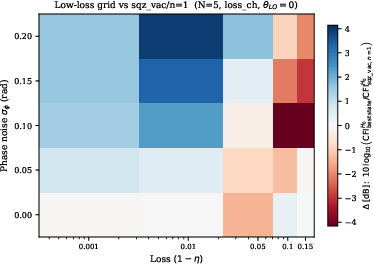
Though QFI prescribes the ultimate limit on displacement sensitivity, realization requires optimal measurements (defined by the SLD), which are not always experimentally feasible. Practical readouts such as photon-number-resolved (PNR), parity, and homodyne detection are analyzed via classical Fisher information (CFI). Homodyne detection, universally accessible, can capture up to 4 dB of the non-Gaussian SNR gain at a^5, notably surpassing the best Gaussian state’s CFI. Displaced PNR measurement strategies unlock even larger advantages (up to 8 dB). However, in certain regimes (especially with rotationally symmetric or higher-order non-Gaussian states), optimality may require more elaborate measurement schemes, a topic for future exploration.
Figure 4: Homodyne CFI advantage of best optimized state over squeezed vacuum, across low-loss grid. Homodyne in some regimes captures nearly the full non-Gaussian gain.
Practical and Theoretical Implications
The study directly informs state design for quantum sensors operating in environments where both loss and dephasing are non-negligible—a scenario common in large-scale interferometry and quantum-limited force sensors. All four optimal state classes highlighted are within reach of contemporary quantum optics: squeezed vacuum superpositions, heralded grid states, and cubic-phase states have been demonstrated on multiple platforms. The broad non-Gaussian advantage implies significant opportunities for improved SNR and, potentially, back-action evasion, which could enable simplifications in interferometer architecture (e.g., obviating frequency-dependent filter cavities).
The theoretical landscape is enriched by the recognition that the optimal probe state forms a Pareto frontier defined by the competing decoherence mechanisms, and that high-dimensional non-Gaussian superpositions can be finely tuned to exploit this balance. At higher photon numbers, non-Gaussian improvement widens, suggesting even greater leverage in future quantum sensor upgrades.
Conclusion
This paper establishes that the optimal quantum states for displacement sensing in interferometers with finite loss and phase noise are generically non-Gaussian, and provides a systematic classification and quantification of their advantages over Gaussian states. The numerical methodology indicates robust convergence and practical measurement accessibility for many cases. The findings motivate continued investigation into advanced quantum state engineering, both theoretically and for operational quantum sensors, charting a path toward higher sensitivities in the decoherence-limited regime.