- The paper introduces behavior-level specification alignment, shifting focus from test-level outcomes to direct behavioral properties for improved LLM code generation.
- It details an iterative process combining structured specification extraction, candidate behavior checking, and targeted repair to refine the generated code.
- Empirical results demonstrate up to 25.3% gains in Pass@1 and a marked reduction in specification-related failures across diverse benchmarks.
Behavior-Level Specification Alignment for Code Generation: An Analysis of "BeSpec"
Introduction
"BeSpec: Behavior-Level Specification Alignment for Code Generation" (2607.02949) introduces a novel, systematic approach for bridging the persistent gap between natural-language intent and accurate code generation using LLMs. The central thesis is that much of the suboptimality observed in LLM-generated programs arises not merely from weak code synthesis but from incorrect or ambiguous specification interpretation. BeSpec advocates for explicit, behavior-level modeling and iterative alignment of the specification, departing from the prevailing paradigm of execution-guided code repair and purely test-level feedback. This essay provides an expert analysis of BeSpec, addressing the method’s unique contributions, empirical evidence, and implications for the field.
Methodological Advances
From Test-Level to Behavior-Level Alignment
The BeSpec pipeline systematically decomposes specification alignment into stages: (1) extracting a structured specification from NL intent, (2) predicting checkable behaviors that capture the intended properties of the correct program, (3) executing candidate implementations on generated probe inputs, and (4) comparing observed versus predicted behaviors to drive targeted specification repair.
This approach marks a clear methodological advance over baselines such as Specine and SpecFix, which operate predominantly at the level of test-case outcomes, relying on pass/fail or example-based signals. Test-level refinement often obfuscates the root cause of failures—since disagreeing outputs could be caused by a variety of underspecified or misunderstood behaviors. BeSpec instead directly targets the locus of ambiguity by associating each misalignment with a concrete behavioral property. The result is higher-fidelity and more localized corrective feedback.
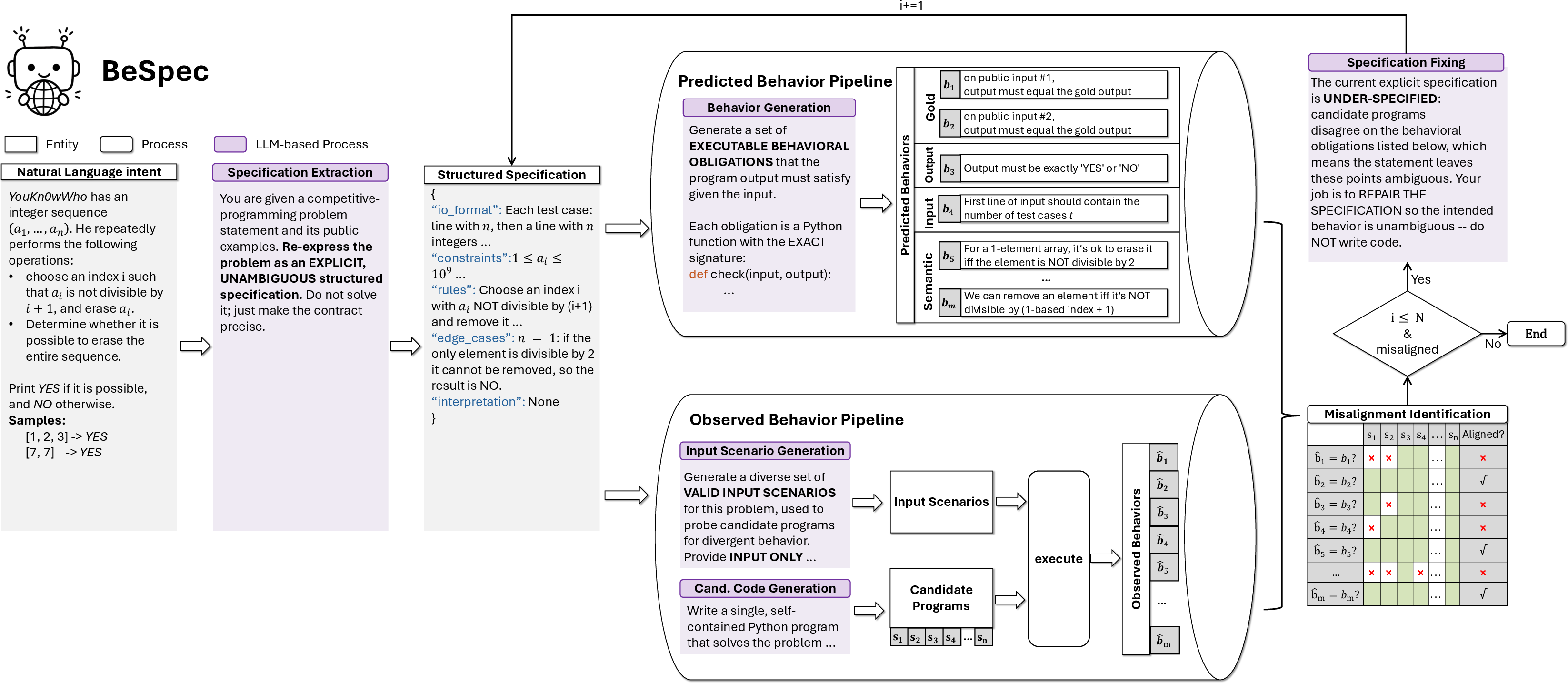
Figure 1: The BeSpec pipeline, illustrating the separation of predicted and observed behavior spaces for precise specification alignment.
Structured Specification and Behavioral Model Construction
Specification extraction in BeSpec involves the explicit codification of input/output format, constraints, correctness rules, edge cases, and disambiguated interpretations. This structured object is refined iteratively using disagreements exposed by a behavioral check matrix, which encodes per-program/behavior consistency.
Predicted behaviors are partitioned into “gold” (direct from examples or required IO pairs), output, input, and semantic properties. Each behavior is realized as a check function over candidate outputs, significantly sharpening the alignment process. The observed behavior pipeline orchestrates the generation of diverse candidate solutions and systematically records program traces on probe scenarios.
Iterative Specification Repair and Behavioral Selection
Disagreement on behaviors (not mere test outcomes) triggers localized repair of the specification object, which in turn serves as the prompt for subsequent code synthesis. The process terminates under early stopping or upon convergence, after which programs are selected not just by test coverage but also by the degree of behavioral concordance. Ties are broken by sample agreement and execution stability metrics, ensuring robust final program selection.
Empirical Results
BeSpec’s efficacy is substantiated via wide-margin improvements in Pass@1 and APR on competition-level benchmarks—CodeContests, xCodeEval, APPS, and the contamination-free LiveCodeBench—across three LLMs, including open-weight (qwen3-coder-30b, glm-4.7-flash) and closed-source (gpt-5-mini) models.
Relative improvements over the strongest baseline range from 8.1% up to 25.3% in Pass@1 and 8.7% to 28.7% in APR. These gains are stable across standard and extended (oracle-enriched) evaluation settings, and maintain significance on LiveCodeBench, mitigating concerns regarding test suite overfitting or benchmark contamination.
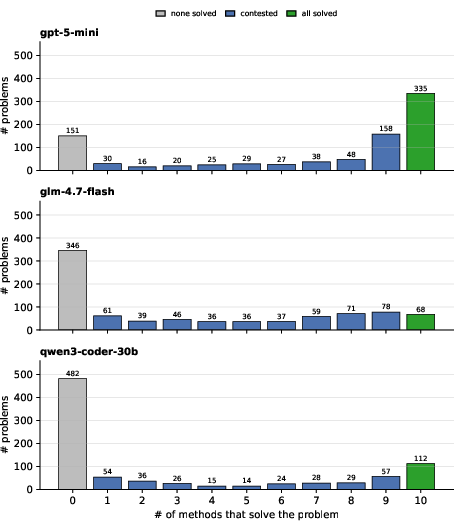
Figure 2: Distribution of problems by the number of methods (including BeSpec and baselines) that successfully solve each instance, highlighting the fraction of hard and easy cases in the benchmark suite.
Failure Mode Decomposition
A rigorous LLM-as-judge analysis reveals that after BeSpec’s specification alignment, the overwhelming majority of residual failures are attributable to algorithmic/implementation errors, not specification weakness: only 52 out of 1,175 BeSpec failures were due to incomplete or incorrect specification refinement, compared to 179 for Specine and 127 for SpecFix.
This exhaustively quantifies that specification misalignment is no longer the dominant failure mode; further improvements will instead require progress in LLM reasoning or algorithmic planning components.
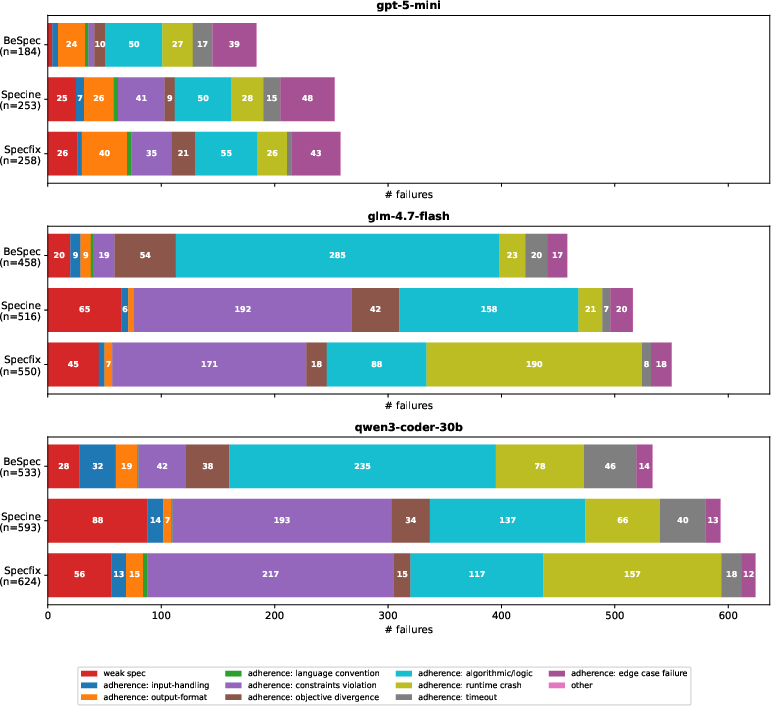
Figure 3: Breakdown of failure modes for BeSpec, Specine, and SpecFix on contested (hard) problems, demonstrating the reduction of specification-related failures in BeSpec.
Ablation Study and Efficiency Analysis
Eliminating the behavioral modeling component from BeSpec results in drastic drops in Pass@1 and APR (up to 59.9% relative), confirming that granular behavior-level specification is central to the observed performance gains. Varying candidate pool size illustrates a practical efficiency-accuracy trade-off, with most improvements saturating at pool sizes ≤10, and token/time budgets remaining acceptable compared to baseline specification alignment methods.
Implications and Future Directions
Theoretical Consequences
BeSpec supplies strong evidence for the thesis that error signals at the behavioral property level are strictly more informative for specification alignment than those at the test or output level. This deepens the understanding of LLM failure sources in code generation and motivates future specification-centric alignment protocols. It also emphasizes the necessity of explicit representation learning not only for code but for underlying behavior models—a shift analogous to world-model-based approaches in RL and program synthesis.
Practical Prospects
The practical implication is that code generation pipelines must now incorporate explicit, structured behavior modeling and iterative intent clarification prior to implementation and repair. The precision and automation with which BeSpec surfaces ambiguities mean it can significantly reduce specification leakage in conversational coding assistants, especially in domains with underspecified or ambiguous requirements. The model-agnostic and systematic nature of BeSpec suggests that it is readily portable to other LLM variants and potential future LLM+tool integration frameworks.
Outlook
Future work will likely expand into joint alignment of specifications, tests, and execution traces—intertwining behavior models with test synthesis and coverage-driven refinement. Integrating richer forms of interactive clarification and uncertainty quantification can further improve the human-AI specification collaboration loop. Additionally, extending behavior-level specification alignment to domains beyond code (e.g., formal methods, planning, and control) is a natural trajectory stemming from BeSpec’s framework.
Conclusion
BeSpec establishes a new state-of-the-art for LLM-driven code generation by operationalizing behavior-level specification alignment. Through explicit behavioral modeling, targeted specification repair, and rigorous selection, BeSpec significantly outperforms both code-only and previous test-level alignment methods. It conclusively shifts the performance bottleneck from specification interpretation to algorithm implementation, thereby refocusing the next phase of LLM code generation research on algorithmic efficiency and adherence, rather than intent grounding.