- The paper introduces a proximal mediation framework that uses proxy variables to address unmeasured treatment-induced confounding.
- It establishes multiple identification strategies via outcome and mediation confounding bridges to allow flexible, robust estimation.
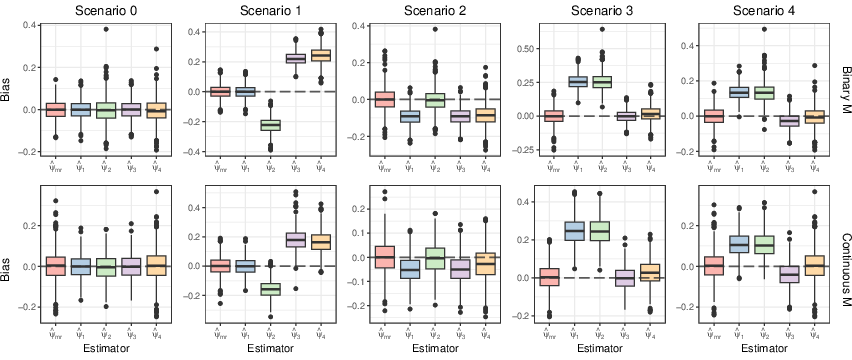
- Simulation and empirical results confirm that the debiased machine learning and multiply robust estimators yield small bias and valid coverage.
The paper addresses the challenge of mediation analysis in the presence of unmeasured treatment-induced confounding. In classical causal mediation analysis, decomposition of the total effect into natural direct and indirect effects (NDE/NIE) requires that all mediator-outcome confounders are pre-treatment and fully observed. However, practical scenarios often violate this, with post-treatment, treatment-induced confounders that may be unmeasured.
Notably, no existing method offers nonparametric identification or consistent estimation of interventional (in)direct effects when treatment-induced confounders are unmeasured. The paper fills this methodological gap by leveraging the proximal causal inference framework—specifically, the use of proxy variables for unobserved confounders.
A stylized causal diagram central to the paper is presented below, highlighting the fundamental structure involving treatment (A), mediator (M), outcome (Y), observed treatment-induced confounders (L), unmeasured treatment-induced confounders (U), and observed covariates (X):
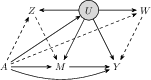
Figure 1: A causal diagram with unmeasured treatment-induced confounder U, with L and X omitted for simplicity.
Proximal Identification of Interventional Effects
The authors formalize the problem as identification and estimation of the functional ψa,a′=E{Y(a,G(a′))}, where M0 denotes a stochastic draw from the mediator distribution under M1. Under standard consistency, positivity, and "latent conditional ignorability" assumptions, interventional effects are identifiable when all confounders are measured. However, with unmeasured treatment-induced confounders, standard identification fails.
To circumvent this, the authors introduce a pair of proxy variables M2 for M3, combined with novel completeness and conditional independence assumptions. The proxies must satisfy:
- M4 (mediator-inducing)
- M5 (outcome-inducing)
Completeness requires the proxies to be sufficiently informative about M6. The identification proceeds via construction of "outcome confounding bridge" (M7) and "mediation confounding bridge" (M8) functions solving conditional moment equations analogous to Fredholm integral equations of the first kind.
Four distinct functional identification strategies are provided, each relying on different sets of nuisance functions; these enable multiple approaches to estimation and robustness via model redundancy.
Semiparametric and Multiply Robust Estimation
The authors derive the efficient influence function (EIF) for the interventional effect under the semiparametric model, employing it to construct estimators with the following properties:
- Multiply robust: Consistent and asymptotically normal if at least one of four collections of nuisance function models is correctly specified. The estimator attains local semiparametric efficiency if all models are correct.
- Debiased machine learning: The orthogonality inherent in the EIF permits integration with minimax learning approaches for solving the bridge equations and general ML-based nuisance estimation. The theoretical results guarantee M9-consistency and asymptotic normality if nuisance estimation rates exceed Y0.
This estimation machinery generalizes conventional methods and significantly extends the proximal inference toolkit to this challenging mediation setting.
Simulation Results
Simulation studies are conducted to assess finite-sample bias, standard errors, and coverage under a range of data-generating mechanisms. Scenarios include correct model specification and scenarios with intentional misspecification of particular sets of nuisance functions.
Key findings include:
Empirical Application: Racial Disparities in Life Satisfaction
The methodology is applied to the 2020 Health and Retirement Study (HRS) to assess causal mediation of racial disparities in life satisfaction by perceived discrimination, with socioeconomic status (SES) acting as a treatment-induced confounder. SES is unobserved but proxied by parental education and (non-housing) wealth variables. Combining the multiply robust and debiased machine learning estimators yields stable, interpretable estimates of interventional direct and indirect effects.
The empirical results show that:
- The interventional indirect effect (i.e., mediation by discrimination) is negative, but modest in size.
- The interventional direct effect (non-discrimination pathways) is strongly negative, implicating substantial residual disparity unaccounted for by discrimination.
These results support targeted interventions on discrimination and illustrate the value of the proposed approach for applied substantive questions involving unmeasured, post-treatment confounding.
Practical and Theoretical Implications
The primary theoretical contribution is formal extension of the proximal identification paradigm from pre-treatment confounding to the more challenging case of unmeasured treatment-induced confounding in mediation analysis. Practically, the methodology provides a robust, multiply robust, semiparametrically efficient framework for estimating interventional effects under realistic scenarios involving latent intermediate variables.
The techniques introduced here generalize standard plug-in/ML approaches and are readily extensible to high-dimensional and nonlinear settings, as evidenced by the empirical application and simulation results.
Future Directions
Several avenues warrant further development:
- Extension to longitudinal data with time-varying treatments, mediators, and confounders.
- Handling of settings with both unmeasured pre-treatment and treatment-induced confounding.
- Formal sensitivity analysis for the validity of proxy variables and exploration of the consequences of proxy assumption violations.
Conclusion
This work rigorously develops a proximal mediation analysis framework that enables identification and efficient estimation of interventional direct and indirect effects in the presence of unmeasured treatment-induced confounding. The results have immediate relevance for applied researchers facing intractable confounding structures and offer a robust foundation for continued methodological development in causal mediation and proximal inference. The multiply robust and debiased ML estimators presented enable practical inference in complex, high-dimensional systems and facilitate rigorous causal mechanism assessment in the biomedical and social sciences.