- The paper proposes a novel approach to isolate indirect effects and address bias from recanting witnesses using proxy variables.
- It employs nested Fredholm integral equations to construct confounding bridge functions under minimal identification assumptions.
- The methodology is validated through quadruply robust, semiparametric, and debiased machine learning estimators ensuring local efficiency.
The paper "Proximal Path-Specific Inference" (2605.09462) addresses the identification and estimation of path-specific causal effects in mediation analysis under scenarios where both recanting witnesses (treatment-induced mediator-outcome confounders) and general unmeasured confounding are present. Traditional approaches to mediation analysis, including natural indirect effects and interventional indirect effects, are heavily reliant on restrictive assumptions such as sequential ignorability or no unmeasured mediator-outcome confounding. These assumptions often fail in epidemiological and social science contexts, particularly when mediators and recanting witnesses are treatment-induced and affected by latent confounders unaccounted for in the observed data.
The primary estimand considered is the mean difference in potential outcomes under an intervention where the mediator M is set according to its counterfactual distribution under A=0 but the recanting witness D follows its natural value under A=1: PAMY=E[Y(1,D(1),M(1,D(1)))]−E[Y(1,D(1),M(0,D(1)))] This estimand isolates the indirect effect through M, holding D fixed, and excludes pathways via recanting witnesses, thus resolving the classical bias from treatment-induced confounding.
The challenge is compounded by latent confounders U affecting A, D, A=00, and A=01 (Figure 1). These confounders invalidate standard identification strategies, necessitating novel methodology capable of robust inference under minimal assumptions.
(Figure 1)
Figure 1: Causal graphs contrasting restricted (A=02 only affecting A=03 and A=04) and generalized (A=05 affecting A=06, A=07, A=08, and A=09) unmeasured confounding structures; the latter captures realistic epidemiologic data-generating mechanisms.
Identification via Proximal Proxy Variables
To address unmeasured confounding, the authors leverage the proximal causal inference framework, utilizing observed covariates as proxy variables for latent confounders. Proxy variables D0 (treatment-inducing) and D1 (outcome-inducing) are selected based on structural criteria: D2 is a cause of D3 associated with D4, D5, D6 only via D7, D8, and D9; A=10 is a cause of A=11 associated with A=12, A=13, A=14 solely via A=15, A=16. This structure is formalized in Assumption 5 and illustrated graphically (Figure 2).
The core identification strategy involves constructing and solving a sequence of nested Fredholm integral equations to obtain confounding bridge functions. Four complementary strategies are developed, relying on outcome or treatment bridge functions or their hybrids. Completeness conditions for proxy variables are required, ensuring that variation in proxies adequately captures the variability in latent confounders.
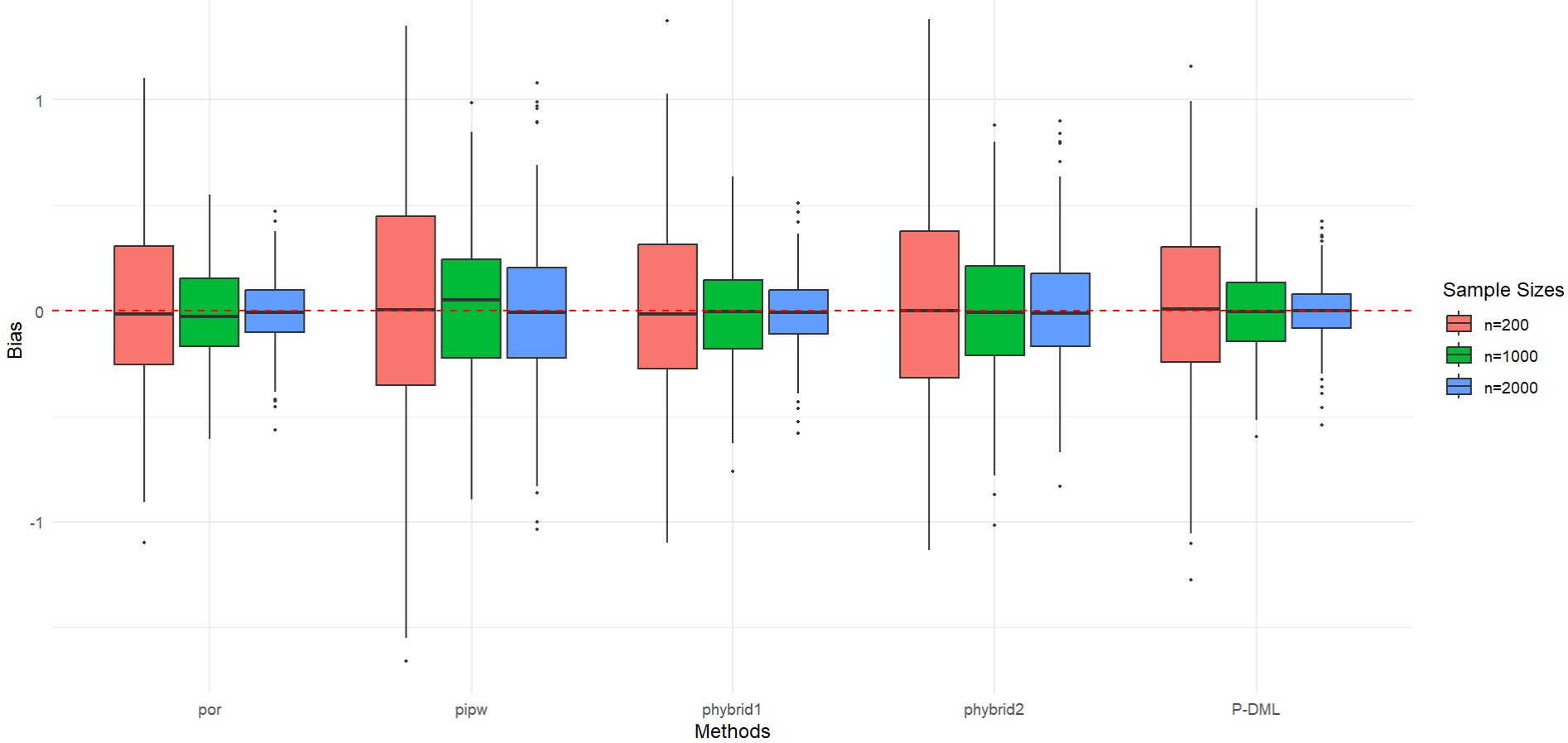
Figure 2: Comparison of bias across sample sizes (n=200, n=1000, n=2000) for estimation methods (por, pipw, phybrid_1, phybrid_2, and P-DML). The dashed red line indicates zero bias.
Semiparametric Estimation and Quadruply Robust Methods
Building upon the identification results, efficient influence functions are derived for the path-specific estimand. The authors develop semiparametric estimators based on these influence functions, yielding the following main features:
- Quadruply Robustness: The estimator remains consistent if any one out of four specified unions of model sets for bridge functions is correctly specified.
- Local Efficiency: When all nuisance models are correctly specified, the estimator achieves the lowest semiparametric variance.
- Neyman Orthogonality: The estimator is insensitive to slow convergence of nuisance function estimators, retaining valid inference under machine learning-based bridge estimation.
The construction of estimators utilizes a sequence of estimating equations rather than explicit regression modeling, thus avoiding standard pitfalls associated with plug-in ML-based mediation estimators and enabling nonparametric learning of high-dimensional nuisance structures.
Debiased Machine Learning Approach
For high-dimensional nuisance parameter settings, the paper introduces a proximal debiased machine learning (P-DML) procedure using cross-fitting and regularized minimax learning in RKHS. The estimator is constructed from empirical averages of the efficient influence function, with foldwise nuisance function estimation employing minimax estimation over conditional moment equations. This procedure achieves A=17-consistency and asymptotic normality under mild regularity conditions, even when nuisance estimates converge at A=18 rates, aligning with contemporary double machine learning theory.
The estimator exhibits low bias and mean squared error across a wide range of simulation scenarios, maintaining accuracy even in settings with severe model misspecification (Figure 2, Table 1). The theoretical guarantees are established via second-order expansions and variance bounds for the efficient influence function.
Empirical Evaluation and Application
Two sets of numerical experiments are presented:
- Semiparametric Simulations: Multiple estimators (P-OR, P-IPW, P-hybridA=19, P-hybridPAMY=E[Y(1,D(1),M(1,D(1)))]−E[Y(1,D(1),M(0,D(1)))]0, P-quadR) are compared under varying model misspecification, confirming robustness claims. P-quadR consistently achieves low bias and nominal coverage when only one model set is correctly specified.
- Nonparametric Simulations: The P-DML estimator is benchmarked against other proximal strategies using RKHS-based regularized minimax learning. P-DML demonstrates superior statistical efficiency and bias control; bias converges quickly with increasing sample size.
The methods are further validated on CDC WONDER Natality data, where path-specific effects of prenatal care on preterm birth mediated by preeclampsia (excluding smoking pathways) are estimated. Proxy variables (marital status and pre-pregnancy hypertension) are selected based on domain considerations. The quadruply robust estimator identifies a small but statistically significant reduction in preterm birth risk specific to the PAMY=E[Y(1,D(1),M(1,D(1)))]−E[Y(1,D(1),M(0,D(1)))]1 pathway, with confidence intervals narrower than those produced by alternative estimators and values consistent with interventional estimates reported previously.
Implications and Future Directions
This research generalizes proximal causal inference approaches to path-specific mediation analysis in the presence of recanting witnesses and pervasive unmeasured confounding. The quadruply robust and debiased machine learning methods substantially relax the required identification assumptions, offering practitioners a principled framework to estimate isolable indirect causal pathways in realistic observational studies.
Theoretically, the framework connects causal mediation, instrumental variable identification, and confounding bridge estimation, and sets the foundation for future work in:
- High-dimensional variable selection for proxy construction
- Extensions to longitudinal and dynamic mediation structures
- Machine learning-based bridge estimation in broader causal architectures
- Applications in genomic, social, and policy research where unmeasured confounding is unavoidable
Conclusion
"Proximal Path-Specific Inference" provides a rigorous methodological foundation for estimating path-specific effects with complex unmeasured confounding and recanting witnesses, leveraging proxy variables and efficient influence function-based estimation. The technical contributions encompass nonparametric identification, quadruply robust estimation, and debiased machine learning, validated by simulations and application to large epidemiological datasets. The practical and theoretical implications are substantial, positioning this framework as a preferred solution for mediation analysis under realistic assumptions in contemporary causal inference.