- The paper establishes a distinct cubic scaling of Einstein ring radii for Ellis-Bronnikov wormholes, contrasting with the square-root scaling for Schwarzschild black holes.
- The paper employs a curved FLRW framework to numerically quantify redshift evolution and curvature-induced deviations in wormhole lensing signatures.
- The paper proposes a model-independent geometric diagnostic using the ratio of Einstein ring radii to robustly distinguish wormholes from black holes.
Distinguishing Wormholes via Einstein Rings and Global Curvature: An Expert Analysis
Introduction
The paper "Distinguishing wormholes via Einstein rings and global curvature" (2607.02889) systematically investigates the weak-field gravitational lensing properties of Ellis-Bronnikov wormholes embedded in a curved Friedmann-Lemaître-Robertson-Walker (FLRW) universe. By deriving the curvature-dependent Einstein ring equation, it highlights a distinct cubic scaling with cosmological distances for wormhole lenses, in contrast to the classical square-root scaling exhibited by Schwarzschild black holes. The analysis explores the implications of this qualitative difference, numerically quantifies observable lensing signatures, and elucidates the role of global spatial curvature as a discriminant in high-precision cosmological regimes.
Wormhole Lensing in a Cosmological Context
The study employs the zero-tidal-force Ellis-Bronnikov wormhole as a toy model for traversable wormholes and embeds it within a curved FLRW cosmology. The local deflection angle for a photon trajectory, evaluated in the weak-field limit, follows α^(ξ)∼πr02/(4ξ2), a significantly steeper dependence on the impact parameter than the 1/ξ scaling of Schwarzschild black holes.
The detailed cosmological lensing formalism utilizes curvature-dependent angular diameter distances, DL, DS, and DLS, as dictated by the spatial curvature parameter Ωk. The resultant weak-field Einstein ring radius equations are:
- Ellis-Bronnikov wormhole: θEWH∝[r02DLS/(DSDL2)]1/3
- Schwarzschild black hole: θEBH∝[MDLS/(DSDL)]1/2
This divergence in scaling sets the foundation for model-independent geometric discrimination.
Redshift Evolution and Curvature Effects
Numerical integrations illustrate the qualitative deviation in the redshift evolution of θE(zL) between wormhole and black hole lenses Figure 1. The wormhole signature exhibits a steeper attenuation with increasing lens redshift due to its stronger distance dependence.
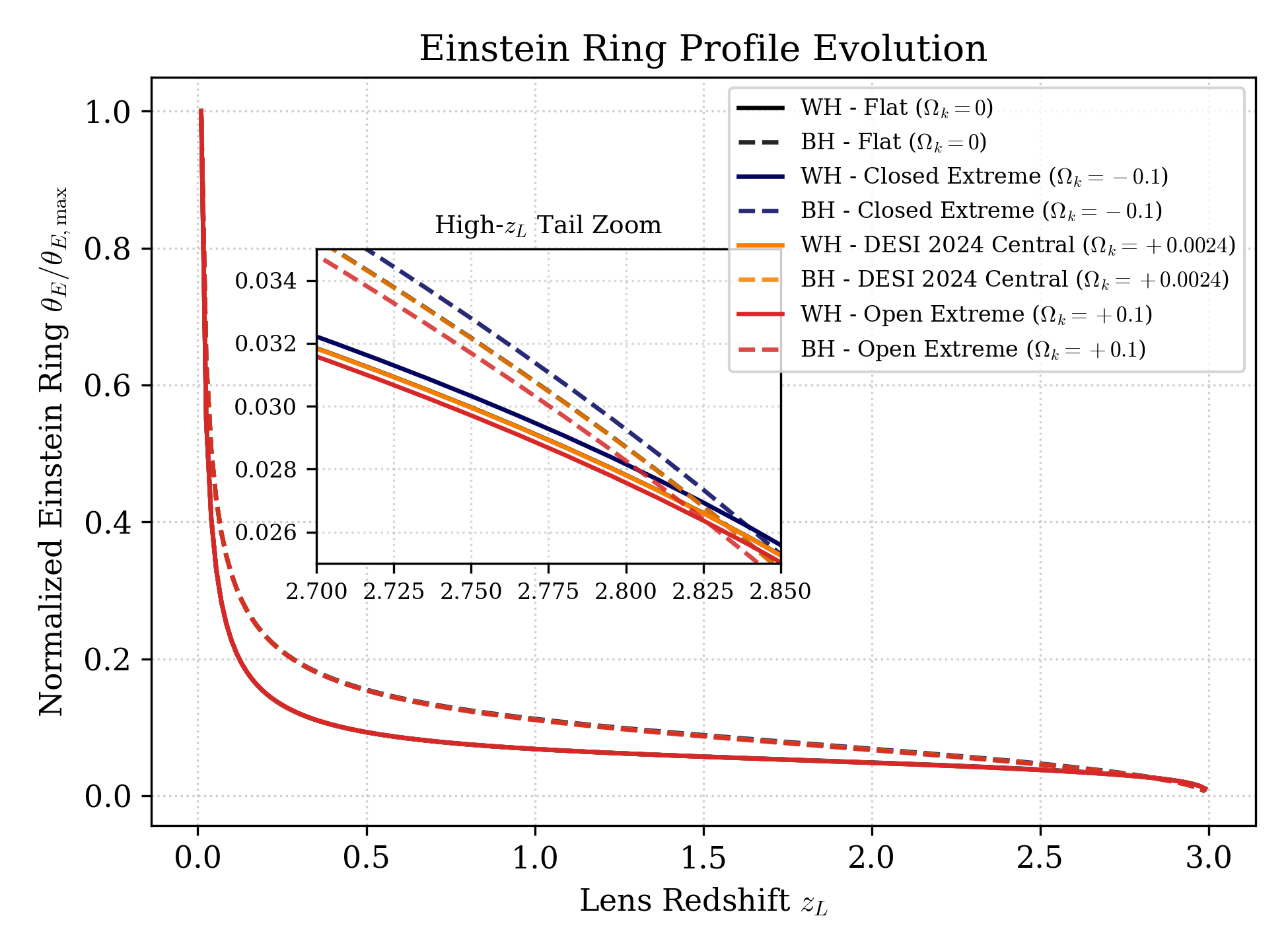
Figure 1: Absolute kinematic profiles of the normalized Einstein ring radius θE/θE,max as a function of lens redshift 1/ξ0 for wormhole (solid lines) and black hole (dashed lines) cases, across spatial curvature scenarios.
To isolate the influence of global cosmological geometry, the paper analyzes the relative deviation of the wormhole Einstein ring, 1/ξ1, across nonzero curvature backgrounds Figure 2. The results show an asymmetric residual effect: closed universes (1/ξ2) induce a relative enhancement, while open universes suppress the lensing signal, with the discrepancy inverts at intermediate redshifts.
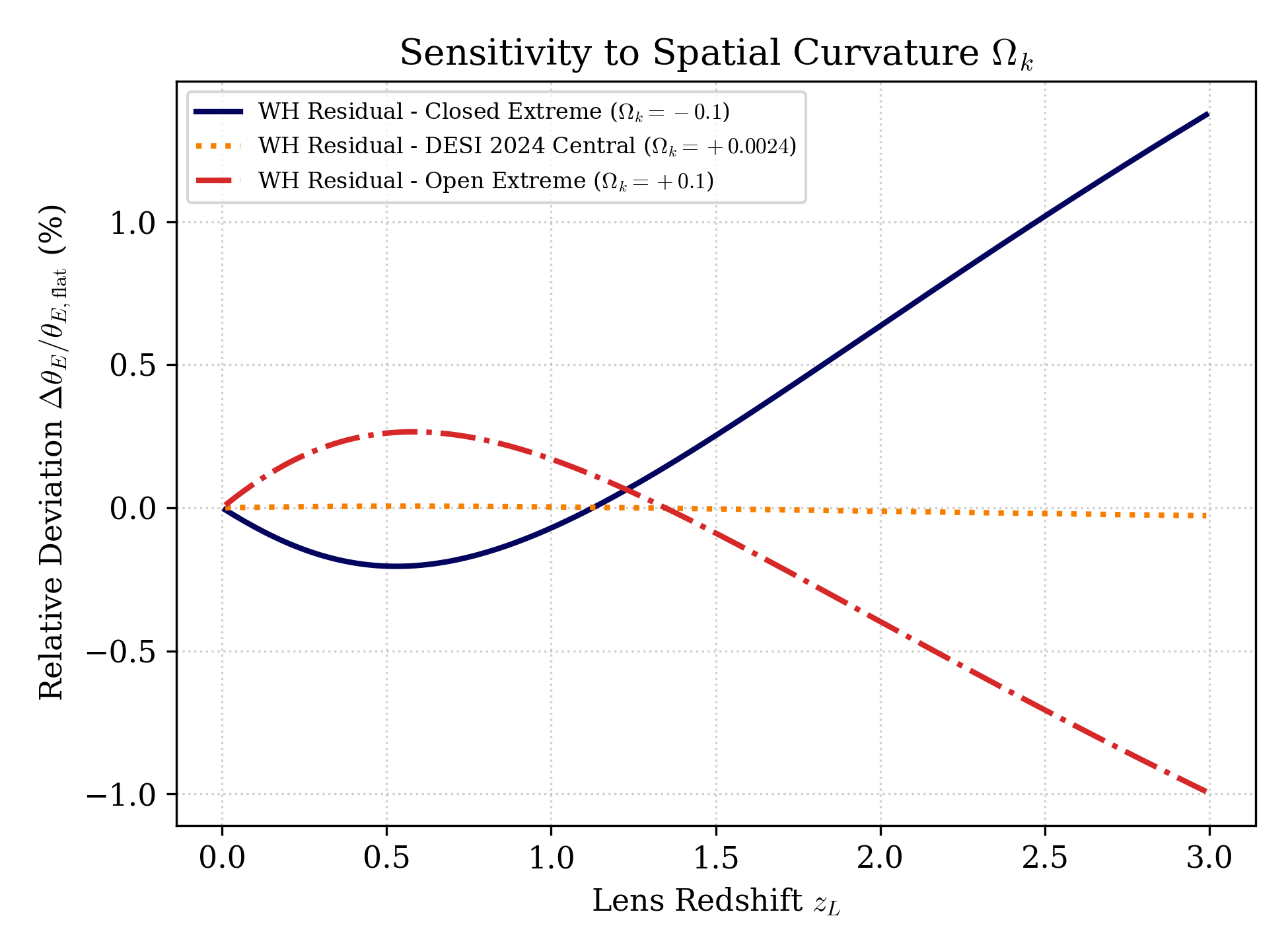
Figure 2: Isolated curvature residuals: the relative deviation in the wormhole Einstein ring radius due to spatial curvature.
Despite DESI 2024 constraints enforcing 1/ξ3, residuals at the 1/ξ4 level remain for high-redshift lenses. These subtle micro-arcsecond effects are relevant for next-generation VLBI surveys.
Model-Independent Geometric Discrimination
A key claim is that the ratio 1/ξ5 is a robust, scale-invariant probe that cleanly separates lens topologies based solely on geometric factors. This ratio develops a deterministic minimum at intermediate redshifts, with its morphology shifting under different curvature backgrounds Figure 3. Intrinsic parameters such as lens mass and throat radius cancel, yielding a geometric "fingerprint" of the lens.
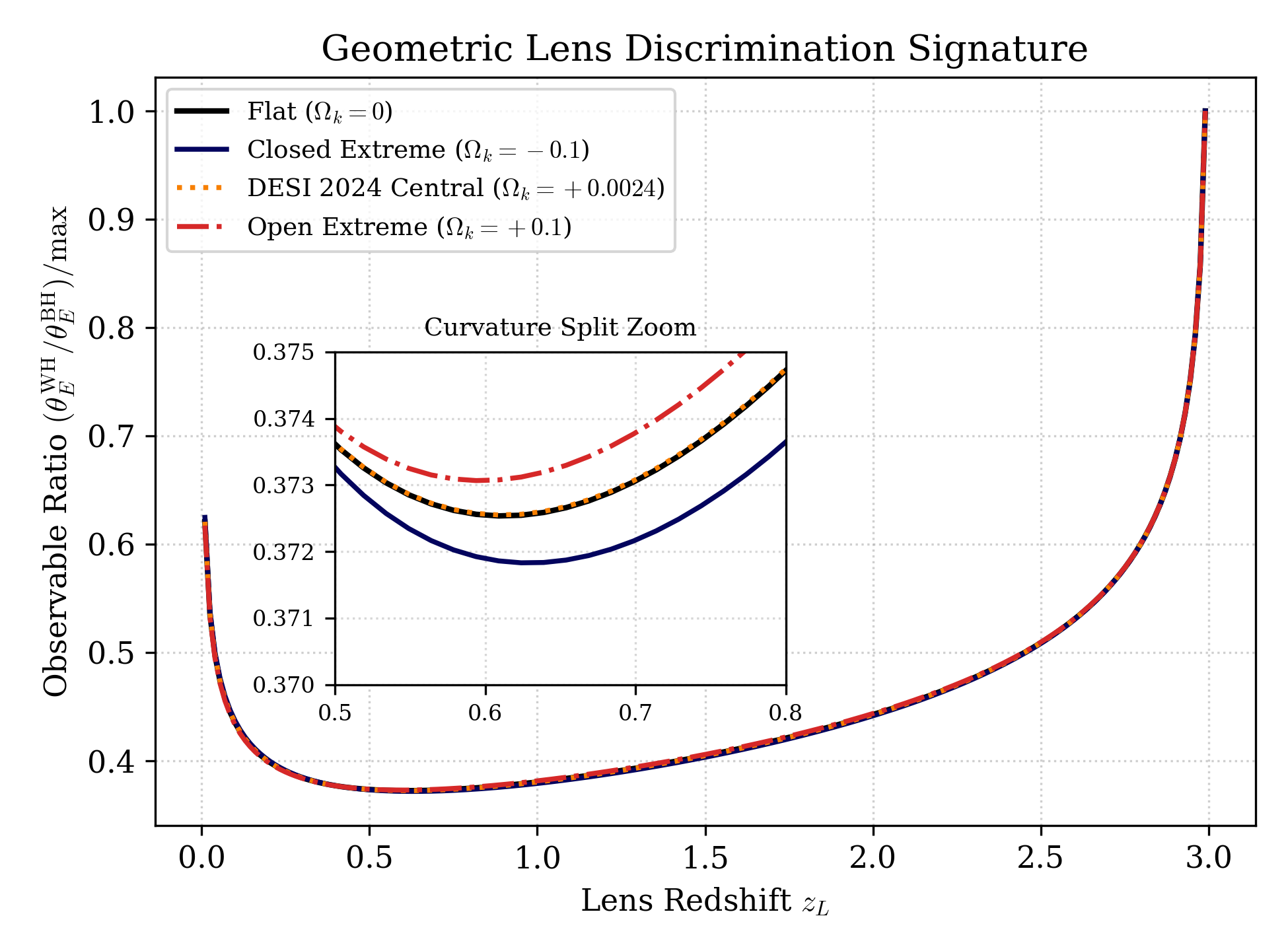
Figure 3: Model-independent lens ratio: the normalized geometric discrimination signature as a function of lens redshift, highlighting the distinct geometric profiles of wormholes and black holes.
Additionally, the evolution of the wormhole Einstein ring profile is shown to be stable under changes in source redshift at low and intermediate lens redshifts; the steep near-field decay remains an intrinsic signature of the wormhole geometry Figure 4.
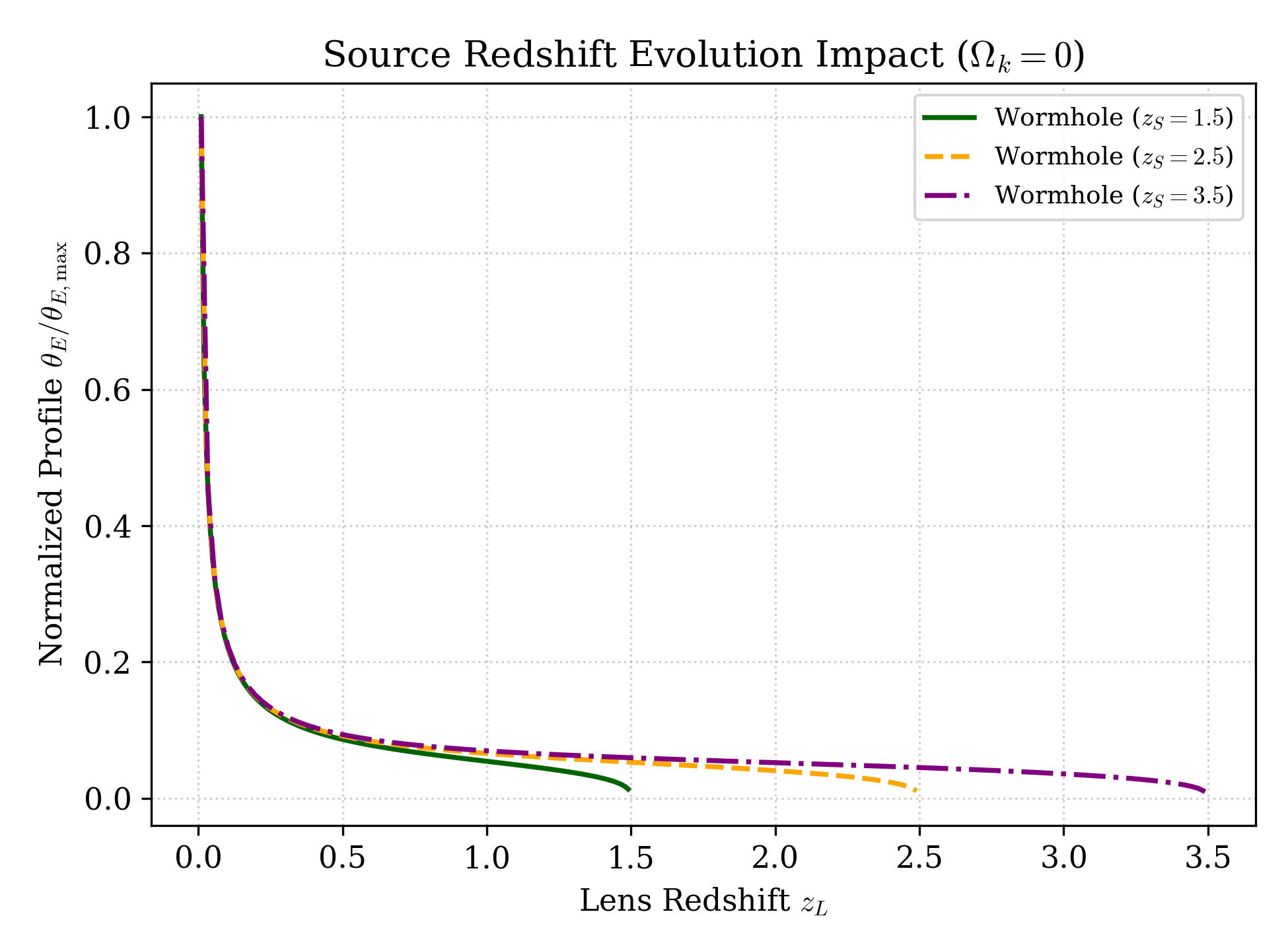
Figure 4: Parametric source boundaries: normalized wormhole Einstein ring profiles for varying source redshifts, demonstrating the insensitivity of the near-field behavior to source location.
Numerical Results and Observational Implications
Strong numerical results include:
- Wormhole lenses are much less efficient, with Einstein ring radii typically suppressed by 3–4 orders of magnitude relative to black holes at equal physical scale.
- For 1/ξ6km (stellar scale), 1/ξ7as (microarcseconds), far below detectability thresholds. For 1/ξ8, 1/ξ9as; for DL0 AU, DL1as, in the range of current and future VLBI-based observatories.
The scaling with cosmological parameters is weak: the geometric discrimination ratio depends on DL2 only as DL3, and on other parameters via their influence on DL4, DL5, and DL6. Thus, even sizeable uncertainty in cosmological constants translates to modest impacts on discrimination performance.
Theoretical and Practical Implications
Theoretically, these results reinforce the notion that global cosmological geometry imprints distinguishable signatures on gravitational lensing observables of exotic objects. The presence of a characteristic DL7-power distance scaling is a direct consequence of the peculiar null geodesic structure in Ellis-Bronnikov spacetime, presenting a direct probe for nontrivial spacetime topologies. Furthermore, the model-independent lens ratio provides a reliable geometric diagnostic tool, resistant to degeneracies in local lens properties.
Practically, while individual stellar-scale wormhole lenses remain out of reach, AU-scale or larger throats (if they exist on cosmological scales) would be amenable to direct detection with ongoing and planned micro-arcsecond interferometric capabilities. The distinct redshift evolution profiles identified here offer a powerful avenue for population-level studies and could act as complementary probes for precision cosmological curvature constraints in deep-field surveys.
Future developments are expected to focus on:
- Extensions to dynamical and non-static wormhole backgrounds.
- Population synthesis models for realistic wormhole distributions.
- Data-driven searches for the predicted redshift-dependent attenuation signatures in forthcoming VLBI and time-domain surveys.
Conclusion
This paper rigorously demonstrates that Ellis-Bronnikov wormholes, when considered as gravitational lenses in a cosmological background, are observationally distinguishable from black holes by both their cubic scaling with cosmological distances and their unique redshift evolution. The geometric discrimination signature, robust under variations in local and cosmological parameters, enables a scale-free probe of spacetime topology and curvature. While wormholes are considerably less efficient gravitational lenses than black holes, macroscopic throat radii could enable detection, especially in VLBI regimes. These findings open new avenues for using precision gravitational lensing as a tool for probing exotic topologies and the global geometry of the universe (2607.02889).