- The paper establishes that quantum coherence in the charger governs both local work extraction and global entanglement, partitioning stored energy into accessible and locked components.
- It demonstrates a precise trade-off between locally extractable ergotropy and globally extractable, correlation-locked work, with analysis validated on qubit and qutrit examples.
- The study reveals that while population-based energy remains robust against dephasing, coherence-dependent energy is more vulnerable to noise channels like depolarization and amplitude damping.
Locally Passive, Globally Charged Quantum Batteries: Structure, Work Extraction, and Robustness
Model Framework and Coherence-Controlled Charging
The work presents an n-level charger–battery quantum model where quantum coherence in the charger dictates both the localization and durability of stored energy in the battery. The system comprises a charger A and a battery B, each with Hilbert space Cn, initialized such that A is prepared in an arbitrary coherent superposition and B in its ground state. The energy ladders are matched, ensuring HA=HB with strictly increasing eigenvalues.
The charging process uses a controlled modular-shift (generalized CNOT for n levels) operation, UCS(n), effecting the transformation ∣j⟩A∣0⟩B↦∣j⟩A∣j⟩B. This operation transforms the charger's coherence into entanglement between A0 and A1, and partitions the deposited energy into locally extractable work (ergotropy) and work "locked" in correlations, accessible only via global operations. For maximal coherence input (equal superposition), the reduced state of the battery becomes maximally mixed and locally passive, with all stored energy correlation-locked and globally extractable.

Figure 1: Model schematic for A2; charging is achieved via a controlled modular shift from a coherent charger into a ground-state battery, generating maximally correlated output with population-based local states and fully charged joint state.
Quantitative Analysis: Ergotropy, Entanglement, and Complementarity
The paper provides a full analytic description of the energy, ergotropy, and entanglement structure following charging. The local ergotropy A3 depends purely on the population inversion of the reduced battery state. In contrast, the global ergotropy A4 exploits correlations and can exceed A5 due to the presence of entanglement, defined as the 'correlation-locked' work (A6). For maximally coherent charging and an equally spaced spectrum, the correlation-locked work saturates A7, with A8 as the initial charger's A9 coherence.
For B0, a precise complementarity exists: the initial coherence budget splits exactly between local ergotropy and nonlocal entanglement, satisfying B1 when the battery is active, emphasizing mutual exclusivity between locally extractable and globally locked work. In higher dimensions, a similar tradeoff applies, though the explicit constraint is dimension dependent.
Robustness to Noise: Population-versus-Coherence Sector Degradation
Robustness of the stored charge is analyzed comprehensively under several canonical noisy channels: dephasing, global depolarization, local (independent) depolarization, and amplitude damping. The primary finding is that local accessibility of work and its robustness are tightly linked: energy stored in populations (locally accessible work) is immune to dephasing and limited only by relaxation (B2 timescale), whereas correlation-locked work is sensitive to both dephasing (B3) and relaxation.
All noise effects are captured by a unified gain–loss "competition algebra":
B4
where B5 and B6 describe channel- and pair-specific coherence suppression and spectral shifts, respectively, and B7 quantify initial coherence. The population sector (work) and coherence sector (entanglement) see independent decay patterns, leading to scenarios in which global and local depolarization have identical impacts on work but distinct entanglement thresholds.
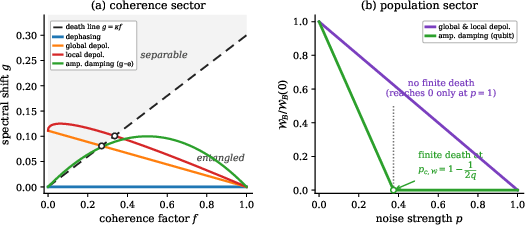
Figure 2: Gain–loss geometry illustrating sector-specific decay; coherence sector (left) highlights channel-dependent trajectories in B8 plane and thresholds for entanglement sudden death, whereas population sector (right) reveals distinct ergotropy retention behaviors.
Practical Realization and Timescale Separation
Mapping to superconducting circuit parameters (e.g., transmons), the analysis demonstrates the operational consequences of different error channels. During idle storage, energy relaxation enforces an energy half-life of B9, which sets the decay of locally accessible energy and work. In contrast, the entanglement and correlation-locked work decay also depend on the shorter Cn0 (pure dephasing) timescale. Explicitly, pure dephasing leaves the population-based energy and ergotropy untouched, while global or local depolarization and amplitude damping introduce varying rates and mechanisms of resource degradation.
The distinction between classical and quantum contributions to the locked work is made precise: dephasing eliminates only the quantum (coherence-based) portion, leaving a classical residue that subsequently decays under relaxation.
Detailed Examples and Theoretical Scope
Explicit analytic examples for Cn1 (qubit) and Cn2 (qutrit) cases are provided, with closed-form expressions for all relevant quantities. The framework contains as special cases models previously studied in the literature (e.g., Bell-diagonal states and two-qubit chargers), but also generalizes to arbitrary Cn3.
The analysis clarifies that operation-dependent accessibility is the critical consideration: locally extractable work is maximized with population-inverted, low-coherence inputs, whereas maximal global work extraction via joint operations utilizes maximal coherence input at the expense of robustness.
Theoretical and Practical Implications
The work establishes a bridge between resource-theoretic measures (coherence, entanglement) and thermodynamic figures of merit (ergotropy, energy retention), showing their inter-convertibility and sector-dependent robustness in the context of a solvable high-dimensional model. The accessibility–robustness correspondence has significant repercussions for the design and operation of quantum batteries: coherence can be leveraged to maximize globally accessible work but at the cost of making the stored charge fragile to dephasing. Applications requiring long-term storage or only local access benefit from minimizing coherence, thereby ensuring Cn4-limited, dephasing-immune energy retention.
The gain–loss algebraic structure enables concise diagnostics and thresholds for sudden death of entanglement and work under arbitrary Cn5 and varied channels. The model suggests directions for experimental benchmarking on near-term quantum hardware.
Conclusion
The analyzed model elucidates the fundamental relationship between the localization of quantum battery charge (population- versus correlation-locked), its extractability under operational constraints, and the robustness of storage to decoherence and relaxation. The results have direct theoretical and operational relevance for quantum energy storage, channel discrimination, and resource optimization. Future extensions could include studying more general and non-Markovian noise, optimizing coherence-to-work conversion under restricted operations, and assessing collective effects beyond the controlled-shift framework.
Reference:
"Locally Passive, Globally Charged Quantum Batteries: Coherence-Controlled Work and the Robustness of the Stored Charge" (2607.02810)

