- The paper introduces a novel quadrotor that achieves omni-directional thrust vectoring using dual-axis gimbaled, coaxial rotors, enabling superhuman maneuverability.
- It employs a generalized geometric controller with L1 adaptive augmentation to guarantee global stability and optimal thrust allocation under disturbances.
- Experimental results validate its extreme maneuverability, precise manipulation, and resilient disturbance rejection in real-world scenarios.
MorphQuad: Morphable Quadrotor for Superhuman Maneuverability, Manipulation, and Resiliency
Introduction and Motivation
MorphQuad introduces a fundamentally new aerial platform that enables extreme maneuverability, omni-directional manipulation, and unprecedented resiliency (MMR) in a compact quadrotor form factor (2607.02764). Contemporary demands in infrastructure maintenance, emergency response, and contact-based inspection increasingly require aerial vehicles that act as dexterous, resilient "flying human hands," able to reach remote locations, manipulate objects in arbitrary orientations, and robustly reject external disturbances. Existing UAV platforms, even those with variable-tilt or omnidirectional designs, suffer from either limited thrust directionality, lack global/robust stability, or present bulkiness and hardware complexity that preclude practical deployment in confined or unstructured environments. MorphQuad addresses all these limitations through a tightly integrated hardware-software co-design, achieving all of the following:
- Vectoring of maximum thrust in any direction: Each of the four rotor systems is mounted on a fully-articulated two-axis gimbal, yielding unrestricted control over the thrust vector per rotor.
- Global stability and singularity-free SE(3) control: The vehicle implements a generalized geometric controller augmented with L1 adaptive augmentation for robust, almost-global trajectory and force/torque tracking, independent of the UAV’s current orientation.
- Compact, standard quadrotor design: The system closely follows industry-standard quadrotor geometry and integrates all autonomy onboard (without reliance on mocap, GPS, or offboard computation), supporting real-world deployments in constrained spaces.
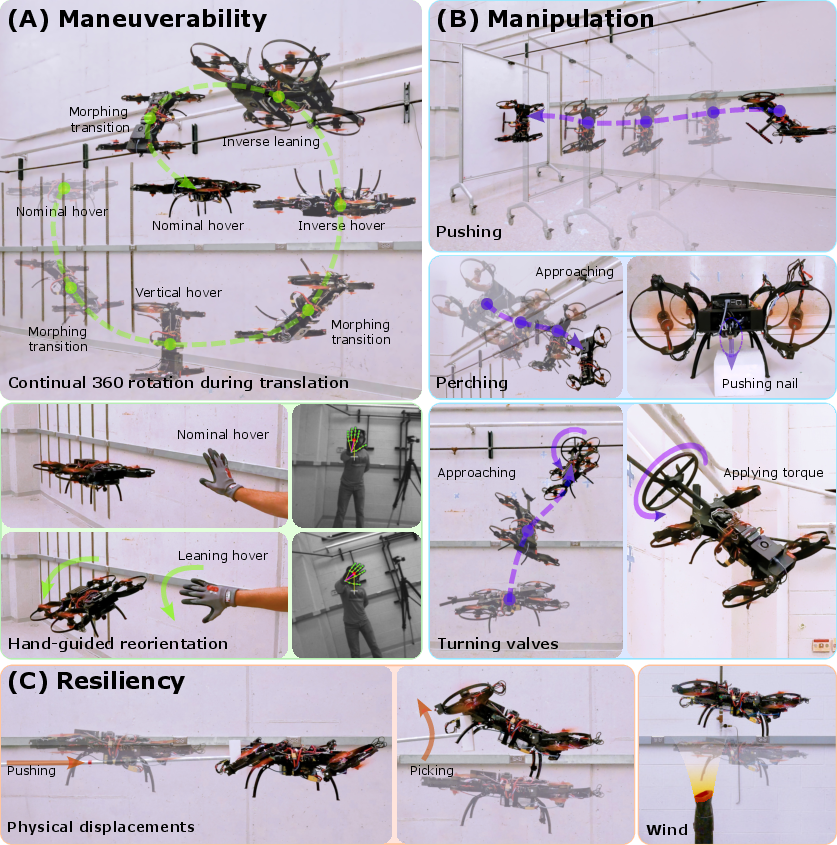
Figure 1: MorphQuad demonstrates extreme maneuverability, manipulation, and resiliency via multi-revolution flight, contact-based tasks, and aggressive disturbance rejection.
System Architecture and Hardware Design
MorphQuad achieves full omnidirectional thrust and torque actuation while preserving a pragmatic quadrotor architecture. Each rotor system comprises a coaxial motor pair (counter-rotating, eliminating gyroscopic and aerodynamic drag torques) mounted on a two-axis gimbal capable of ±1080∘ rotation on both axes. This assembly allows for continuous, arbitrary, and rapid redirection of rotor thrust. Coaxial pairs enable precise, decoupled actuation while minimizing the load on the gimbal servos and decoupling thrust from unwanted precession and drag torques, a significant departure from prior single-propeller tilting-rotor concepts.
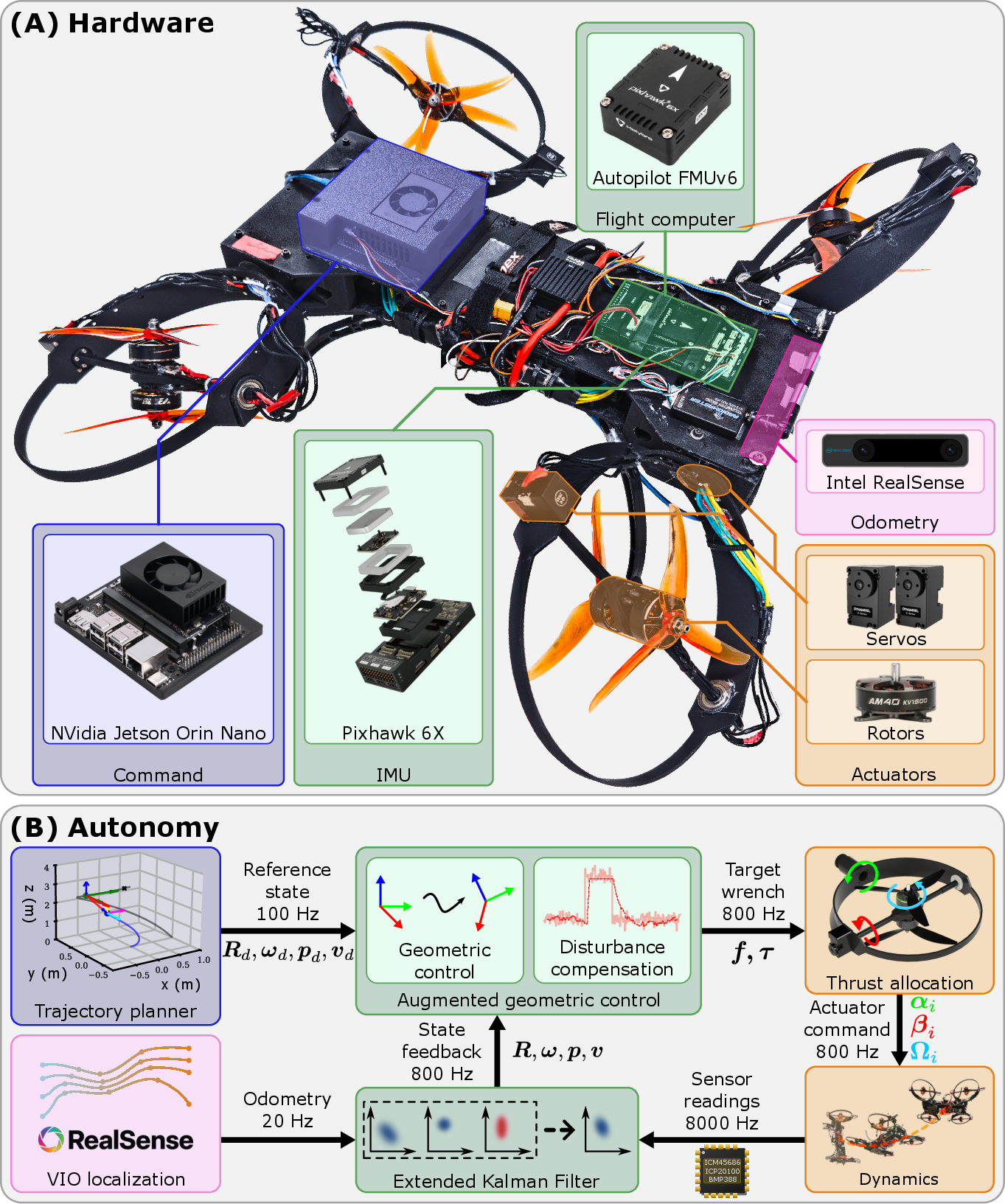
Figure 2: Key MorphQuad hardware components and a color-coded pipeline for fully-onboard autonomy.
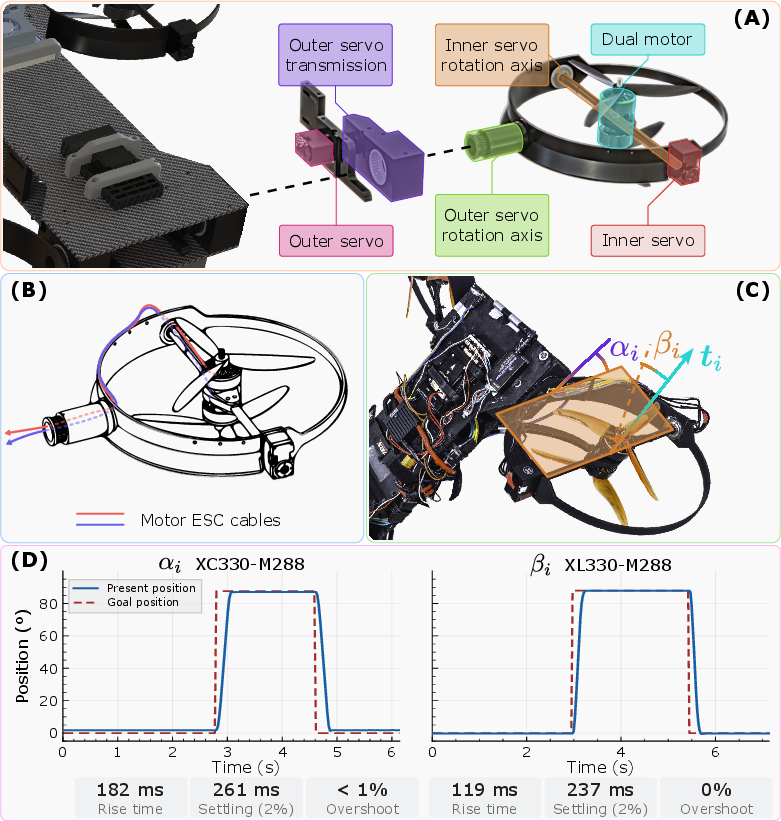
Figure 3: Each rotor system consists of coaxially-paired motors mounted on dual-axis gimbals, providing independent and continuous omni-directional thrust vectoring over multiple revolutions.
The remainder of the platform comprises a lightweight, H-frame dual-plate carbon body, off-the-shelf flight and companion computers (Pixhawk FMUv6x, NVIDIA Jetson Orin Nano), and integrated onboard visual-inertial odometry. All design elements are intentionally standardized and compact to foster direct transferability and field deployment.
Autonomous Control and Thrust Allocation
MorphQuad builds upon geometric control theory, extending classical quadrotor SE(3) trajectory controllers to permit independent force and torque commands in all axes. The generalized geometric controller operates directly on the nonlinear manifold, enabling stable tracking from nearly all initial conditions except a zero-measure singular set. To further guarantee robustness, L1 adaptive augmentation is integrated to reject unmodeled disturbances, as encountered in wind, contact, and ground-effect scenarios.
A critical novel component is the thrust allocation strategy: it solves for the minimal-energy combination of per-rotor thrust vectors (subject to hardware and mechanical constraints) to realize the controller’s desired wrench. The allocation algorithm further exploits the null-space of the actuation mapping to avoid gimbal singularities and inter-rotor downwash interactions—unlike prior approaches, it allows thrust vector cancellation only minimally and only to prevent mechanical interference or singularity, thus maximizing available control authority. Full onboard sensing and processing enable closed-loop execution in GPS-denied, unstructured settings.
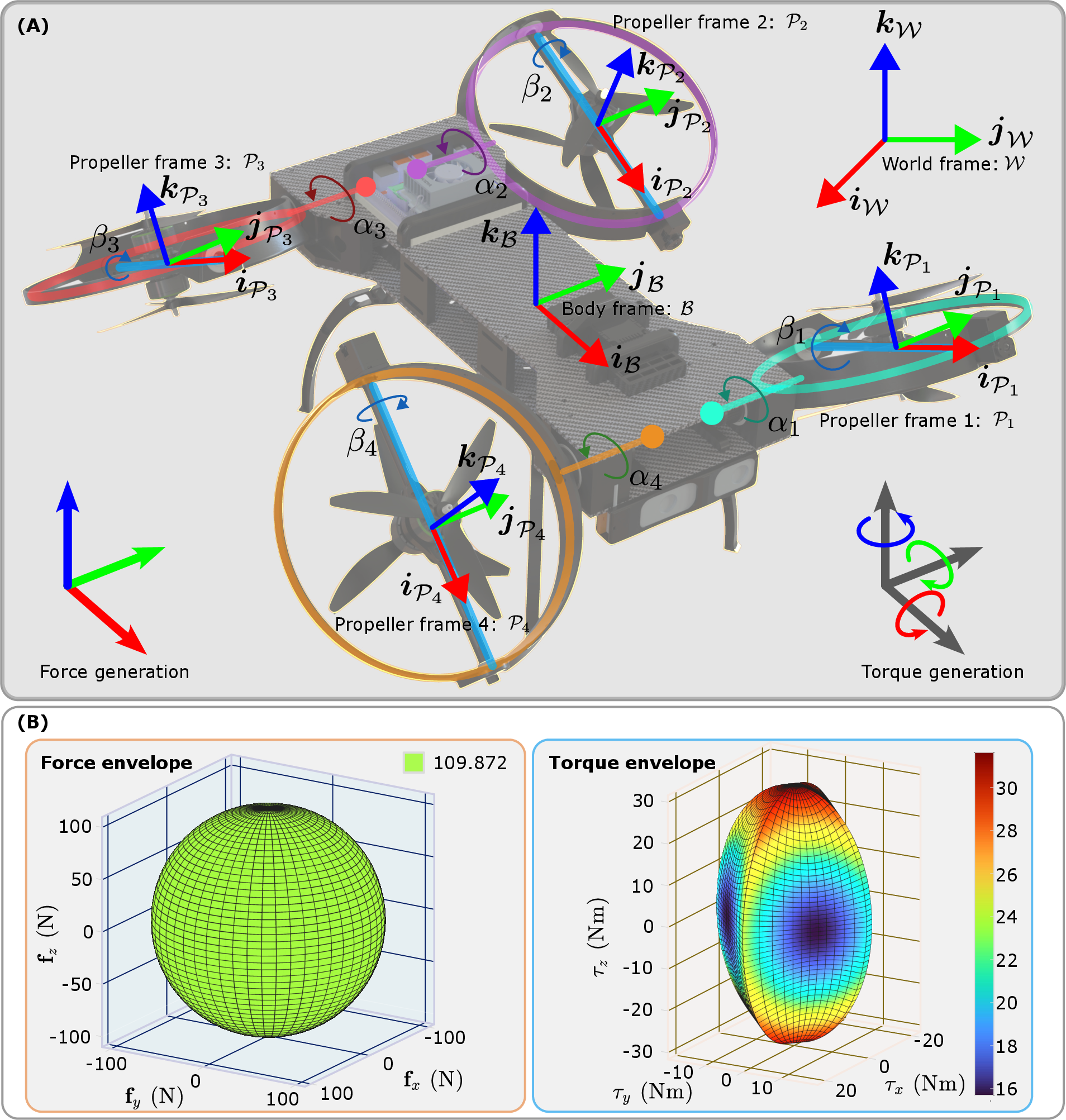
Figure 4: Quadrotor schematic with servo angles and calculated force/torque envelopes for maximum actuation authority.
Experimental Validation
MorphQuad's extraordinary capabilities are empirically established across three experimental domains: maneuverability, manipulation, and resiliency.
Maneuverability
MorphQuad executes aggressive, multi-revolution rotational maneuvers while translating (e.g., 720∘ pitch rotation with simultaneous circular translation around a pipe), maintaining position RMSE below 6 cm and orientation RMSE below 5.5∘ even under collision-constrained conditions. In dynamic pointing tasks, it tracks human hand gestures in real time with position RMSE $5.5$ cm and rapid, independent actuation of roll, pitch, and yaw.
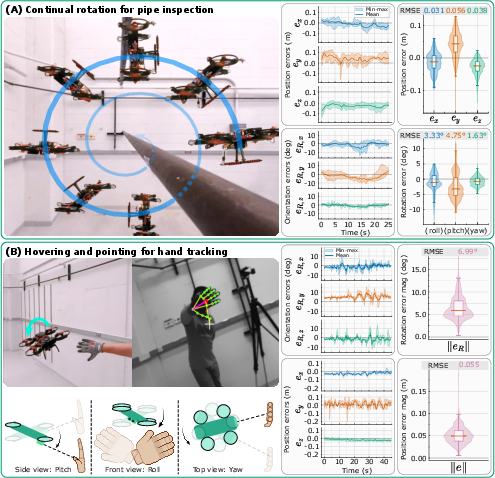
Figure 5: MorphQuad performing 720∘ continual rotation during pipe inspection and hand-tracking while hovering, with independent pointing control.
Manipulation
MorphQuad demonstrates human-comparable force and torque outputs—up to $4.92$ Nm of torque (equivalent to a human wrist) and L10 kg of sustained lateral force. It accomplishes real-world contact tasks including valve turning in arbitrary 3D orientations, wall perching and nail insertion at elevation, and pushing a 30 kg wheeled object during hovering. All manipulations are achieved open-loop, with trajectory planning based purely on pose targets and disturbance rejection handled by the adaptive control layer.
Resiliency
Under severe and asymmetric aerodynamic loads (up to a L11 m/s wind jet directly aimed at a single rotor), MorphQuad holds hover with position RMSE L128 cm along the wind axis and L13 cm orthogonal, and orientation RMSEs L14. The platform is robust to impulsive and sustained physical disturbances, including hammer strikes ("picks") and up to L15 kg of continuous pulling force—demonstrating complete decoupling between translational and rotational disturbance rejection, a long-standing challenge for conventional UAVs.
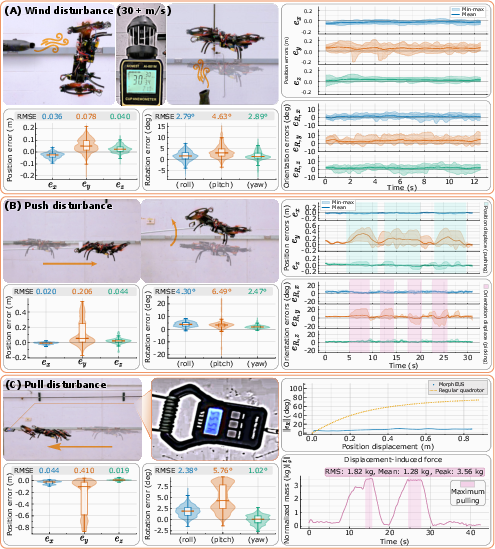
Figure 6: MorphQuad rejects strong wind, impulsive pushes, and sustained tethers during flight, maintaining stability and accuracy across all axes.
Theoretical and Practical Implications
The MorphQuad architecture produces several strong claims, all substantiated by both formal analysis and experimental data:
- Strictly greater attainable wrench space than any prior quadrotor platform, enabling the vehicle to apply maximum thrust and torque along any arbitrary direction at nearly every possible attitude.
- Almost-global exponential stability on L16 for the closed-loop system, rigorously exceeding the domain achievable by standard geometric quadrotor controllers.
- Energy-optimal thrust allocation with provable minimum-norm solutions and explicit null-space exploitation to mitigate all practical limitations from hardware geometry and aerodynamics.
- Full onboard autonomy in real-world, GPS-denied, and unstructured environments, breaking the reliance on laboratory conditions and mocap often seen in previous omnidirectional platforms.
These results imply direct new capabilities for autonomous intervention in inspection, maintenance, and disaster response. The use of a standard compact airframe provides a direct path to broad scalability and cross-application adoption.
Future Directions
Ongoing and future work is anticipated to address:
- Integration of LiDAR-based SLAM and advanced perception for robust operation in low-visibility, cluttered scenes.
- Explicit force-aware closed-loop interaction, employing additional tactile sensors and possibly soft end-effectors for delicate manipulation and compliance.
- Natural language and vision-language-control interfaces (e.g., using VLA models), ultimately extending full foundation-model manipulation paradigms into the aerial domain.
- High-agility and acrobatic behaviors, leveraging model-predictive control, system identification, and INDI for aggressive, high-speed tasks.
Conclusion
MorphQuad constitutes a step-change in the design and control of quadrotor-class UAVs, synthesizing a unique hardware platform and a suite of advanced control and allocation methods to achieve superhuman levels of maneuverability, manipulation, and resiliency. The work broadens both the theoretical envelope and the practical deployment opportunities for multirotor aerial robots, bridging a longstanding gap between laboratory UAV research and field-ready manipulation-capable platforms.

