- The paper rigorously derives the orbital Hall conductivity for both uniform and nonuniform fields using a quantum geometric analysis of Bloch wave functions.
- The paper shows that second-order (q²) corrections are highly sensitive to crystalline anisotropy, with differences exceeding 50% between lattice orientations.
- The paper establishes a mapping between orbital and charge Hall effects, highlighting the roles of orbital Berry curvature and quantum metrics in orbitronics.
Introduction and Motivation
The study explores the intrinsic orbital Hall effect (OHE) in the presence of a spatially nonuniform electric field, establishing an explicit connection between OAM transport and the quantum geometric structure of Bloch wave functions in crystalline solids. While the charge Hall effect and spin Hall effect have critical foundational mappings to Berry curvature and other geometric quantities of Bloch states, the analogous geometric underpinning for orbital Hall transport—specifically under conditions breaking spatial uniformity of the external fields—remains comparatively underdeveloped both theoretically and experimentally.
This work rigorously formulates OAM transport in two-band, inversion- and time-reversal symmetric electronic systems, showing that both the leading (uniform field) and the higher-order (nonuniform field) orbital Hall conductivities are anchored in geometric response functions expressed in terms of the orbital Berry curvature and the quantum metric. The results have wide applicability, especially to two-orbital (px, py) models with anisotropy, and offer critical benchmarks for evaluating OHE in anisotropic crystals and future orbitronics devices.
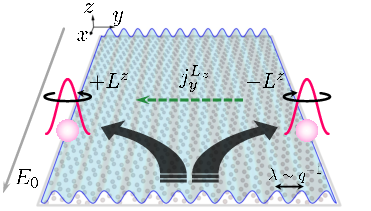
Figure 1: Schematic of the intrinsic orbital Hall effect in a nonuniform electric field. The electric field (x^E0ei(qy−ωt)) varies spatially with a transverse orientation, generating a transverse OAM current jyLz. The self-rotating wave packet encodes nonzero OAM.
Model and Symmetries
The electronic system is described by two orthonormal, time-reversal and inversion-symmetric orbitals (e.g., px, py) on a lattice, neglecting spin and interactions. This reduction ensures that, at the Bloch eigenstate level, diagonal OAM expectation values vanish, and only interband matrix elements contribute to OAM dynamics. The OAM operator in this sector is antisymmetric and purely imaginary, with a structure tied directly to the symmetries of the underlying real orbital basis.
Quantum Geometric Framework
Bloch wave functions are equipped with a quantum metric and a (non-Abelian) Berry connection. In this context:
- Quantum metric gkij quantifies the quantum distance between states neighboring in momentum space.
- Orbital Berry curvature Ωyx,kLz generalizes the charge/spin Hall response to OAM currents.
The charge or OAM response to electric fields with finite spatial modulation q is determined by geometric quantities computed via derivatives of the Bloch functions, emphasizing that the nontrivial topology and geometry in momentum space are the true drivers of transverse transport.
The OAM current response to an electric field with finite wave vector (q) is computed using the Kubo-Greenwood formula. For small py0, the conductivity admits an expansion:
py1
Odd py2 terms vanish due to inversion symmetry. While py3 corresponds to the conventional OHE (uniform field), the leading nonuniform field correction is given by py4.
Crucially, the py5 correction encompasses:
- Quantum-metric contributions (py6),
- Derivatives of the orbital Berry curvature,
- Extended geometric quantities involving higher derivatives and velocity matrix elements.
This formalism yields a term-by-term direct correspondence with the known expressions for intrinsic charge Hall conductivity in nonuniform fields, with charge-related Berry curvatures replaced by their orbital analogues.
Analytical and Numerical Results
Analytical Structure
The zeroth-order (uniform field) orbital Hall conductivity takes the form:
py7
where py8 are Fermi-Dirac occupancies, py9 the electron charge, x^E0ei(qy−ωt)0 the system area, and x^E0ei(qy−ωt)1 is the orbital Berry curvature.
The x^E0ei(qy−ωt)2 correction is:
x^E0ei(qy−ωt)3
where x^E0ei(qy−ωt)4 is the band energy separation, and the remaining terms involve derivatives of velocities and Berry connections. Each geometric structure in the second-order term has a direct analog in the charge Hall effect theory under nonuniform electric fields [kozii2021intrinsic].
Numerical Analysis and Orientation Sensitivity
A minimal tight-binding realization on a square lattice with anisotropic hopping (x^E0ei(qy−ωt)5) demonstrates that the x^E0ei(qy−ωt)6 correction exhibits pronounced sensitivity to sample orientation. Two configurations, related by swapping x^E0ei(qy−ωt)7 and x^E0ei(qy−ωt)8, yield nearly identical x^E0ei(qy−ωt)9 but substantially different jyLz0 over a wide chemical potential range. Quantitatively, the relative difference between jyLz1 for the two orientations exceeds 50%, while the zeroth-order difference is below 10%.
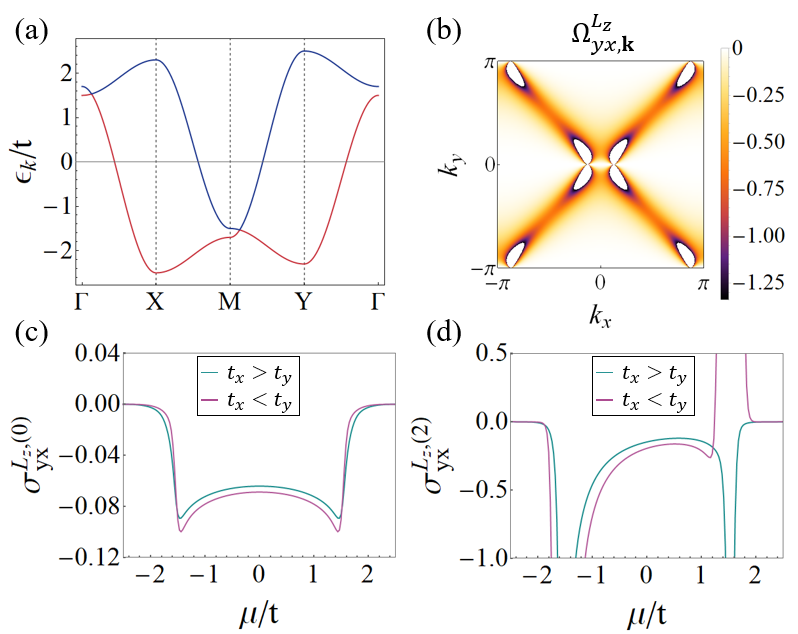
Figure 2: (a) Band structure along high-symmetry lines; (b) orbital Berry curvature distribution in momentum space; (c) chemical potential dependence of jyLz2; (d) chemical potential dependence of jyLz3. Panels (c) and (d) compare two configurations related by jyLz4 lattice rotation, demonstrating the enhanced orientation dependence of the second-order response.
Implications and Outlook
These results reveal that higher-order (nonuniform field) OHE responses provide a direct probe of the quantum geometric tensor and its derivatives. The strong sensitivity of jyLz5 to crystal anisotropy suggests practical routes for distinguishing OAM transport from competing effects experimentally, for instance, by systematic rotation of the sample or modulation of the external field profile.
The formal mapping between charge and orbital (or even spin) Hall conductivities under nonuniform fields, with Berry curvature substitutions, implies a universal quantum geometric structure underlying all such transverse responses. This framework naturally extends to multi-orbital, multi-band systems and could stimulate exploration into magnonic, phononic, and other bosonic analogues where OAM transport is likewise governed by band geometry [go2024magnon, park2020phonon, neumann2020orbital].
Future directions include:
- Investigating the tunability of OHE via geometric engineering in complex crystal structures,
- Exploring the interplay between orbital and spin degrees of freedom when spin-orbit coupling is introduced,
- Extending the formalism to interacting and disordered systems.
Conclusion
This study establishes a comprehensive geometric theory of the intrinsic orbital Hall effect in nonuniform electric fields, rigorously connecting OAM transport to both the orbital Berry curvature and the quantum metric of Bloch bands. The higher-order OHE response is shown to be exceptionally sensitive to crystalline anisotropy, providing a distinct experimental and theoretical signature. The findings position quantum geometry as a central organizing principle in orbital transport phenomena, setting the stage for new developments in orbitronics and quantum materials science.
Reference: "Intrinsic orbital Hall effect in a nonuniform electric field" (2607.02418)