- The paper demonstrates the first positive indication of solar pp neutrino–electron scattering below 165 keV using an upgraded liquid xenon TPC.
- It employs a unified spectral fit combining high- and low-argon background data with precise calibration and robust background modeling.
- Results align with Standard Solar Model predictions, establishing LXe TPCs as effective tools for low-energy neutrino detection and new physics searches.
Measurement of Solar pp Neutrino Flux with PandaX-4T: A Technical Assessment
Introduction
The measurement of solar pp neutrino flux provides a precise probe of solar fusion processes and constitutes a stringent test of the Standard Solar Model (SSM). The pp branch neutrinos are the dominant solar neutrino component, with spectral endpoints well below 420 keV, in a region where experimental backgrounds and detector systematics are challenging. This essay examines the methodology, technical advancements, results, and implications of the PandaX-4T Run 2 solar pp neutrino measurement, which delivers the first indication of solar pp neutrino–electron scattering below a 165 keV electronic-recoil threshold, and demonstrates the potential of liquid xenon (LXe) time projection chambers (TPCs) in low-energy rare event searches (2607.02405).
Detector Upgrades and Experimental Approach
The PandaX-4T detector, situated at China Jinping Underground Laboratory (CJPL-II), implements a dual-phase LXe TPC with a fiducial mass of 1.6 tonnes. Major hardware upgrades before Run 2 included a new cathode, improved linearity of photomultiplier tube (PMT) bases (extending to 40,000 PE), and enhanced PTFE field-cage reflectivity. The digitizer system was upgraded for 14-bit resolution and 500 MS/s sampling, and a large water Cherenkov veto was installed.
The liquid xenon was continuously purified, achieving an electron lifetime of 1.08±0.05 ms, required for full drift-length charge collection. A notable effort was invested in reducing radioactive noble-gas backgrounds: Rn and Ar levels were actively monitored and dramatically reduced via a reversed-mode distillation system, minimizing radioactive backgrounds in the ER (electronic recoil) region of interest.
A significant revision of the data processing chain unified the previously split low- and high-energy pipelines into a single analysis with improved low-energy S1 resolution and S2 pileup rejection. The event selection efficiency was calibrated using 232Th sources and detailed Geant4-based simulation, yielding a total efficiency uncertainty of 6.7%.
The reconstructed energy response was calibrated using monoenergetic peaks across the full energy range, producing a nearly linear response up to 2.6 MeV and supporting robust background and signal modeling.
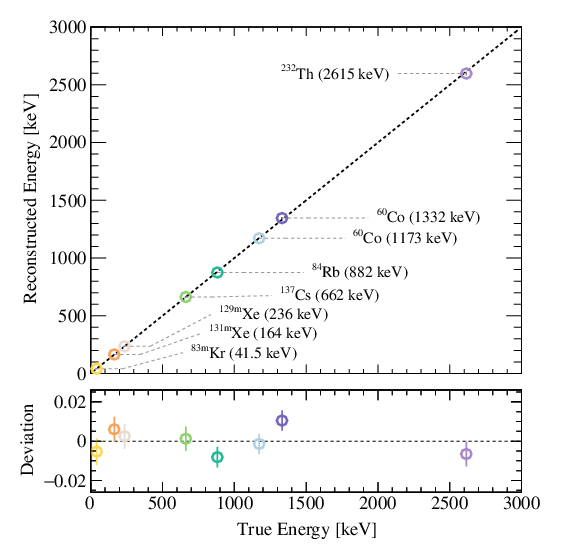
Figure 1: Reconstructed energy linearity and relative deviation across calibration energies in PandaX-4T Run 2, confirming sub-percent nonlinearity throughout the relevant range.
Background Control and Signal Extraction
Low-energy radioactive backgrounds dominate, arising primarily from detector materials, noble-gas impurities (39Ar, pp0Kr, pp1Rn), and xenon isotopes (pp2Xe, pp3Xe, etc). Rigorous offline and real-time gas-assay supported precise modeling of these backgrounds, segregating the data into High-Ar and Low-Ar periods based on argon activity.
Spatial event distributions were tightly controlled using 3D position reconstruction, with a fiducialization strategy that minimized external and boundary-origin backgrounds.
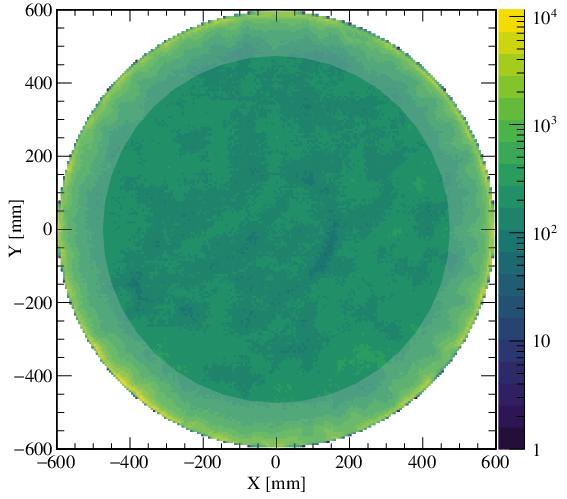
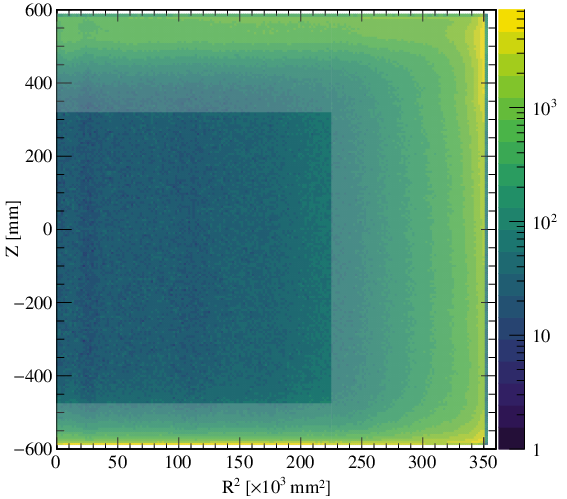
Figure 2: Projected spatial distributions (Y–X and Z–pp4) for the selected physics data, defining the 1.6-tonne fiducial volume.
Solar neutrino spectra (pp5 and pp6Be) were modeled with up-to-date nucleon–electron cross sections, including atomic binding and many-body corrections. The background model involved both external constraints (HPGe radioassay, delayed-coincidence tagging for pp7Kr, RGA for pp8Ar) and floating parameters for dominant internal sources.
A blind, joint spectral fit was performed on the High-Ar and Low-Ar data sets, exploiting a binned likelihood approach with detailed nuisance parameter treatment. The final region of interest was 20–1000 keV over a fiducial mass of pp9 tonnes, yielding pp0 events post-selection.
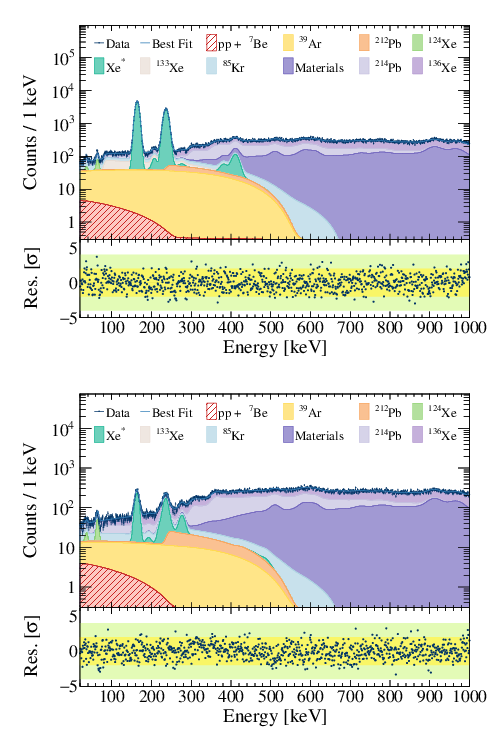
Figure 3: Post-unblinding spectral fits for High-Ar (top) and Low-Ar (bottom) datasets across the 20–1000 keV region, showing data, background, and signal model agreement.
Results
The joint fit yielded a solar pp1+pp2Be normalization of pp3 (relative to the SSM prediction). Isolating the pp4 flux yields
pp5
for Run 2 and
pp6
when combined with Run 0. These results are consistent with SSM expectations within pp7 [e.g., Vinyoles et al. 2017].
The statistical significance for non-zero pp8 flux is pp9, providing the first positive indication for solar pp0 neutrino–electron scattering below 165 keV ER energy. Uncertainties are dominated by degeneracies with pp1Ar and pp2Kr backgrounds, reflecting substantial systematic overlap in the low-energy, featureless part of the spectrum.
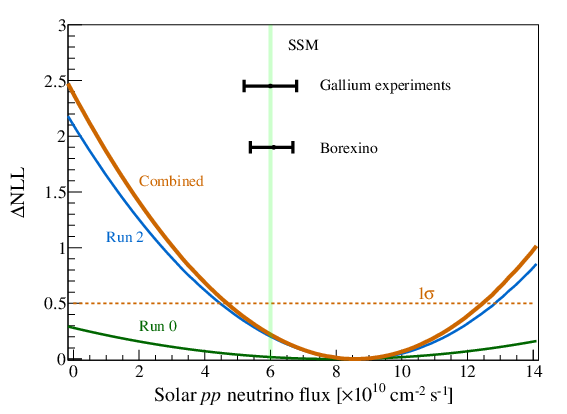
Figure 4: Profile likelihood scan (pp3NLL) versus pp4 neutrino flux, showing best-fit and uncertainty envelope with comparison to SSM and other experimental results.
Discussion and Implications
These results demonstrate the viability of LXe TPCs, originally optimized for dark matter searches, as competitive probes for low-energy solar neutrinos. The achieved energy linearity, background reduction, and analysis methodology establish a path toward precision neutrino measurements in a multi-purpose detector environment.
The primary practical implication is that multi-ton LXe TPCs can complement liquid scintillator and gallium-based measurements, providing independent and cross-checking results with distinct dominant systematics. The achieved pp5 flux precision is systematics-limited, with pp6Ar and pp7Kr degenerate with the signal in spectral fits. Future progress will hinge on further reduction and real-time monitoring of these isotopic backgrounds; distillation, improved gas-assay, and possibly external tagging (as with the active water Cherenkov system) will be pivotal.
Theoretically, an accurate, independent pp8 flux measurement provides input for the SSM solar luminosity constraint and new physics searches (e.g., non-standard neutrino–electron interactions, anomalous electromagnetic moments, sterile admixtures). Exploring even lower energies—beneath existing liquid scintillator thresholds—would allow tests of neutrino oscillation transitions in the vacuum–matter interface region and probe exotic interactions with atomic electrons.
The roadmap outlined for the next-generation PandaX-xT project [PANDA-X:2024dlo] anticipates larger active masses, further background abatement, and increased exposure, promising further reductions in pp9 flux uncertainties and new reach in other rare-event channels.
Conclusion
The PandaX-4T Run 2 solar pp0 neutrino analysis establishes low-background, multi-ton LXe detectors as precision instruments for solar neutrino physics. The reported pp1 flux of pp2 matches SSM predictions and is statistically significant at the pp3 level. Future expansions in target mass and background control will enhance the sensitivity of LXe TPCs, supporting both neutrino physics and searches for physics beyond the Standard Model.