- The paper presents the first experimental upper bounds on the keV thermal solar neutrino flux using xenon-based detectors.
- It employs S2-only analysis to leverage low-threshold electron recoil signals for probing the thermal neutrino spectrum.
- The results have significant implications for dark matter searches and constrain models with nonstandard neutrino production.
Detection Prospects for Thermal Solar Neutrinos With Direct Detection Experiments
Introduction
The paper "Towards the Detection of Thermal Solar Neutrinos" (2606.15904) rigorously investigates the sensitivity of large-scale dark matter (DM) direct detection experiments, particularly xenon-based detectors, to the previously undetected flux of thermal solar neutrinos in the keV regime. These thermal neutrinos, arising predominantly from electroweak pair-production mechanisms in the Sun's plasma (e.g., plasmon decay, bremsstrahlung, and photo-production), occupy a substantial portion of the low-energy solar neutrino spectrum, yet have eluded detection due to insufficient instrument sensitivity at sub-100 keV energies.
Recent advances in DM direct detection—including the deployment of S2-only (ionization-only) analyses with sub-keV thresholds—enable, for the first time, a search for these low-energy neutrino signals through their elastic scattering with target electrons in large exposures. This work establishes the first experimental upper bounds on the thermal solar neutrino flux normalization η, relative to the Standard Solar Model (SSM) prediction, and highlights the capability of next-generation experiments to probe this unexplored neutrino regime.
Kinematics and Detector Sensitivity
Thermal solar neutrinos, with typical energies spanning the sub-keV to tens of keV, are kinematically capable of inducing electron recoil signals within the region of interest (ROI) in modern xenon TPC experiments. The study presents an analysis of available experimental windows for XENONnT and PandaX-4T, compared to the energy distribution for both standard pp-chain and thermal solar neutrinos.
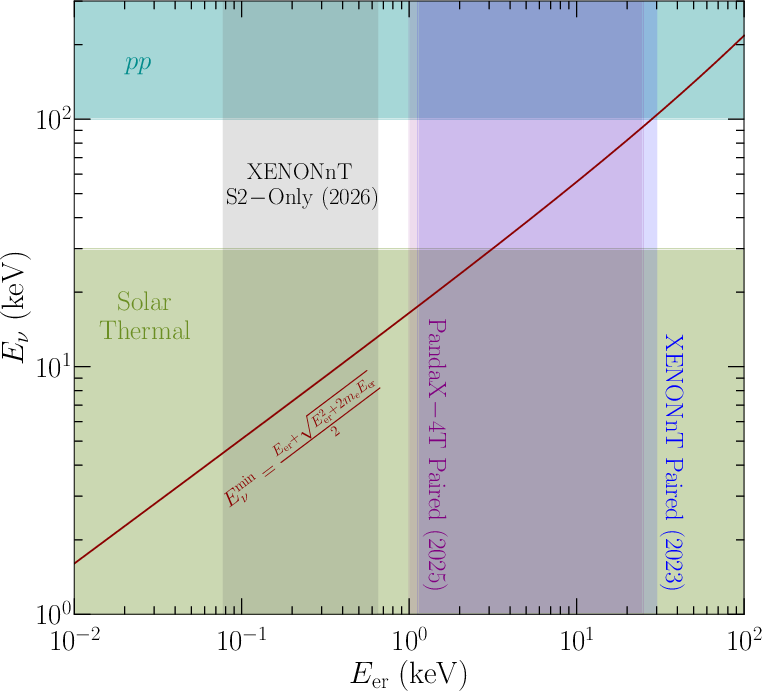
Figure 1: Available kinematical regions of the XENONnT and PandaX-4T experiments, shown alongside the energy ranges for pp and thermal solar neutrinos. The red line indicates the minimum neutrino energy required to produce a given electron recoil energy.
The S2-only analyses, which rely solely on the ionization signal, minimize threshold limitations and effectively extend sensitivity into the sub-keV recoil regime. These analyses are crucial for accessing the peak of the thermal neutrino spectrum and maximizing signal yield.
Theoretical Flux and Astrophysical Constraints
The thermal neutrino flux is calculated by consolidating contributions from plasmon decay, bremsstrahlung, and photo-production, with additional minor components from atomic transitions in heavier elements. The total predicted flux at Earth is Φth≃3.1×106 cm−2s−1, with a spectral peak near 1 keV. The nuclear pp flux is orders of magnitude larger in total but dominates only above ∼3 keV. The uncertainty in the thermal flux normalization due to solar model temperature profiles is quantified to be at the 10–20% level in the ROI.
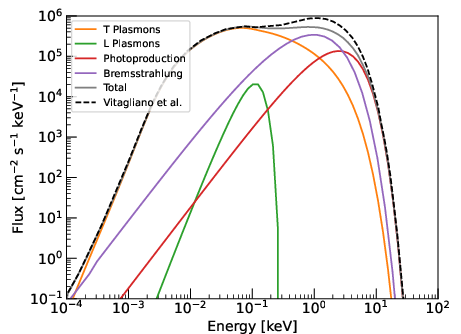
Figure 2: Individual contributions to the thermal solar neutrino flux (plasmon decay, photo-production, bremsstrahlung) compared with the aggregate spectrum. Comparison with earlier calculations illustrates the impact of omitting bound-bound transitions.
This low flux is theoretically constrained by solar energetics: an excessively large η would violate the observed solar luminosity and helioseismological bounds. A purely luminosity-based argument restricts η≲1.1×10⁸, while helioseismic analyses require η≲3×10⁶–1.1×10⁸.
Experimental Analysis and Results
The study derives upper limits on pp0 using binned likelihood analyses of electron recoil data from XENONnT (S2-only and paired), LZ, and PandaX-4T (Run0 and Run1), as well as projected sensitivities for DARWIN/XLZD. The test statistic is constructed from the Poisson likelihood for the number of observed events over expected background and signal as a function of pp1.
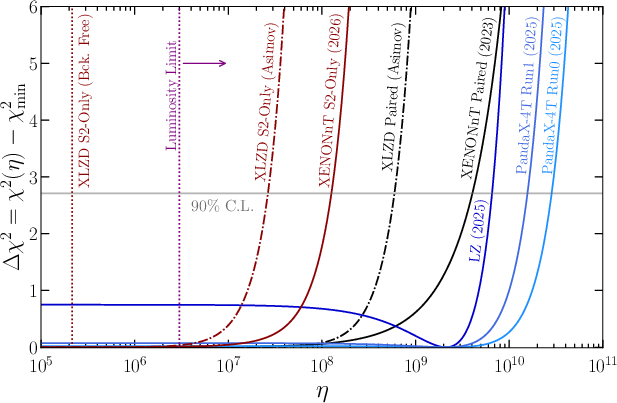
Figure 3: The pp2 profiles for XENONnT, LZ, PandaX-4T, and XLZD as a function of the thermal solar neutrino flux normalization pp3, indicating the pp4 C.L. upper limits for each experiment.
The strongest current limit is set by the XENONnT S2-only dataset, yielding pp5, which is only marginally weaker than the solar luminosity limit. The paired analyses from XENONnT, LZ, and PandaX-4T yield less restrictive bounds due to higher energy thresholds and/or lower exposures. Future XLZD sensitivity projections indicate an accessible range down to pp6 for a 200~t·yr exposure, improving the current limit by nearly an order of magnitude; in the idealized background-free case, the bound could reach as low as pp7.
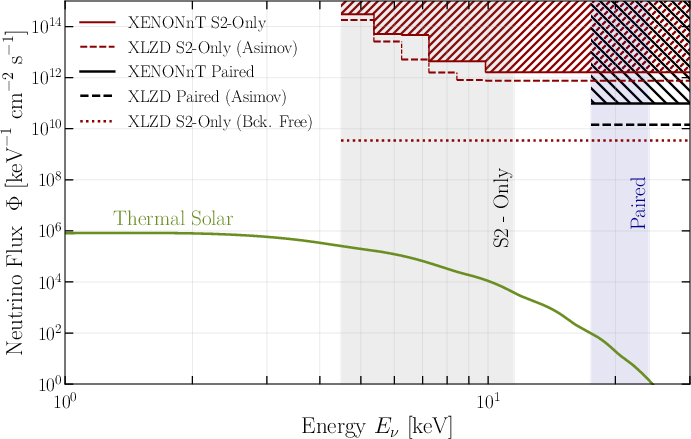
Figure 4: 90% C.L. upper bounds and projected sensitivities on the keV astrophysical neutrino flux, compared with the standard model thermal solar neutrino flux prediction.
The bin-by-bin analysis further localizes the tightest limits to energy regions most sensitive to the expected thermal neutrino recoil spectrum.
Implications for Dark Matter Experiments: The "Neutrino Fog"
The paper underscores the role of the thermal solar neutrino flux as an irreducible background ("neutrino fog") for future light DM-electron scattering searches. For DM masses below pp8100~keV, the overlap between the expected DM recoil spectrum and thermal neutrino recoil spectrum makes progress in sensitivity fundamentally limited by the thermal neutrino background, extending the conventional neutrino floor discussed for pp9-chain solar and atmospheric neutrinos.
Robustness Against Astrophysical Backgrounds
An in-depth assessment demonstrates that other diffuse low-energy neutrino backgrounds (such as the cosmic neutrino background boosted via cosmic-ray interactions) are several orders of magnitude below the thermal solar flux at the keV scale, and thus not relevant for this experimental context.
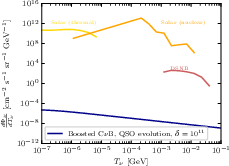
Figure 5: The diffuse boosted cosmic neutrino background (DBCpp0B) flux compared to the thermal solar neutrino flux; the DBCpp1B is subdominant by many orders of magnitude.
Perspectives for New Physics and Solar Model Tests
This search contributes toward constraining new-physics sources of keV-scale neutrinos, such as solar scalar or sterile neutrino decays. For example, the paper explores models where light scalar particles are produced and subsequently decay into neutrinos, potentially providing a flux several orders of magnitude larger than the SM thermal neutrino background in specific scenarios, though still below current experimental sensitivity.
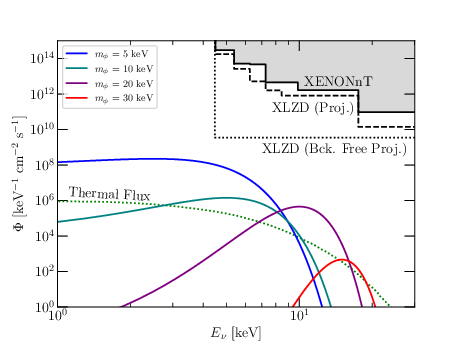
Figure 6: Neutrino flux resulting from the solar emission and subsequent decay of light scalars into neutrinos, compared to the SM thermal solar flux and current/projected experimental limits.
Similarly, decaying keV-scale sterile neutrino dark matter would manifest as an additional signal, the detection of which will depend on the DM density profile assumptions and detector directional sensitivity.
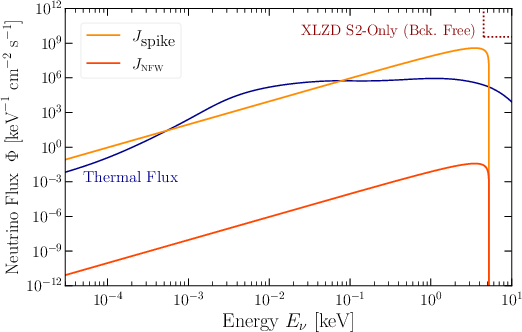
Figure 7: Expected neutrino flux from the decay of keV sterile neutrino DM for fiducial mass and mixing; shown for both standard and "spiked" DM profiles, compared with the SM flux and experimental reach.
More generally, the eventual detection of the thermal solar neutrino flux would establish direct constraints on the solar interior (complementary to helioseismology and nuclear neutrino fluxes), characterize the solar plasma environment, and potentially probe electromagnetic and nonstandard neutrino interactions at low energies.
Conclusion
This work establishes the first direct experimental upper bounds on the flux of thermal solar neutrinos, exploiting low-threshold analyses in modern xenon-based DM detectors. The leading bound from XENONnT S2-only data, pp2, approaches theoretical constraints from solar energetics, while future multi-hundred ton-year exposures in experiments like XLZD have realistic prospects of improving sensitivity by orders of magnitude. These results demonstrate that the detection of the lowest-energy astrophysical neutrinos is imminent, paving the way for novel probes of solar physics, standard and nonstandard neutrino properties, and fundamentally limiting the low-mass frontier of direct DM search programs.