- The paper establishes a rigorous framework using equivariant degree theory to analyze global Hopf bifurcation from consensus to periodic multiconsensus in memory-based MAS.
- It classifies three delay-coupled models—retarded, pseudoneutral, and neutral—each representing distinct mechanisms of agent memory that influence system dynamics.
- Numerical analyses validate symmetry-selected, robust periodic patterns, offering new control-theoretic insights for applications in robotics, economics, and biological systems.
Consensus-Breaking Global Hopf Bifurcation in Memory-Based Multi-Agent Systems
Overview and Motivation
This work establishes a comprehensive and mathematically rigorous framework for understanding symmetry-breaking transitions in multi-agent systems (MAS) with memory-mediated protocols, providing the first systematic analysis of global Hopf bifurcation from consensus to periodic multiconsensus. The dissertation analyzes three major classes of delay-coupled MAS: retarded (with "continuous memory"), pseudoneutral ("trend memory"), and neutral ("momentum memory"), delineated by the position and nature of their delay operators. Equivariant degree theory is central to the analysis, providing topological invariants that both detect and classify bifurcating branches, overcoming classical obstacles due to symmetry-induced eigenvalue multiplicity.
Inspired by rich phenomena in biological, economic, and engineered networks, the study addresses the fundamental dynamical question: what are the patterns and structures that become possible after a consensus state in a symmetric MAS loses stability? The results explain how memory can lead to the spontaneous formation of robust, structured oscillations—corresponding to phenomena such as "dancing drone" formations or economic boom-bust cycles—emerging generically from instability of consensus.
Model Classes and Symmetry Structure
The central MAS models are governed by delay differential equations (DDEs), with the following archetypal forms, each associated with a specific type of agent memory:
- Retarded (Continuous Memory) MAS:
x˙i(t)=−axi(t)−αf(∫01xi(t−s)ds)−hi(x)
The nonlinearity and symmetric coupling hi ensure the system sits naturally in the context of equivariant bifurcation for networks with permutation symmetry.
- Pseudoneutral (Trend Memory) MAS:
dtd[xi−∫0τ1g(xi(t−s))ds]=−axi−αf(∫0τ2xi(t−s)ds)−hi(x)
The trend term models agents sensitive to changes in averaged history, bridging the gap between retarded and fully neutral dynamics.
- Neutral (Momentum Memory) MAS:
dtd[xi(t)−γxi(t−τ1)]=−axi(t)−αf(∫0τ2xi(t−s)ds)−hi(x)
Momentum memory reflects agents that react not just to history but to past rates of change, resulting (in the linear case) in neutral DDEs.
All systems are considered with symmetric topologies (Γ0-equivariance), allowing group-theoretic methods to reveal the landscape of emergent multiconsensus patterns.
Equivariant Degree Theory and Bifurcation Analysis
A major technical innovation is the systematic application of twisted equivariant degree (including the Nussbaum–Sadovskii extension for neutral-type equations) to global symmetric Hopf bifurcation. This resolves several classical issues:
- Multiplicity due to Symmetry: Non-simple eigenvalues, unavoidable in symmetric MAS, make standard center manifold or normal form analysis intractable; equivariant degree theory thrives precisely in such high-multiplicity settings.
- Global Bifurcation and Classification: The degree provides not only existence of bifurcating periodic solutions but also their global continuation and a fine-grained classification according to spatio-temporal symmetries ("twisted orbit types" in the Burnside ring).
- Computation from Spectral Data: For each system, the crossing numbers (calculated from characteristic quasipolynomials) determine not only whether a branch bifurcates but also the symmetries of the resultant periodic motions, via explicit group-theoretic recurrence.
Critical set computation becomes a root-finding problem for transcendental equations (e.g., Figures 4, 9, 13, and 14), identifying all parameter values at which consensus loses stability and periodic branches can arise. The sign of the crossing number, determined through analytic differentiation, immediately yields the direction and persistence of bifurcations (i.e., whether they are global and unbounded).
Strong analytical results are demonstrated numerically using test cases such as octahedral UAV formations and small economic market networks, revealing rich patterns:
- Symmetry-Selected Stable Branches: After consensus destabilizes at critical parameter values, distinct periodic branches emerge, each with unique subgroup symmetries. For instance, in the octahedral UAV example, the three V2-type symmetries correspond to standing, twisted, and traveling wave multiconsensus (Figures 6, 7, 8, and 15), which can be selectively "excited" by perturbing initial conditions appropriately.
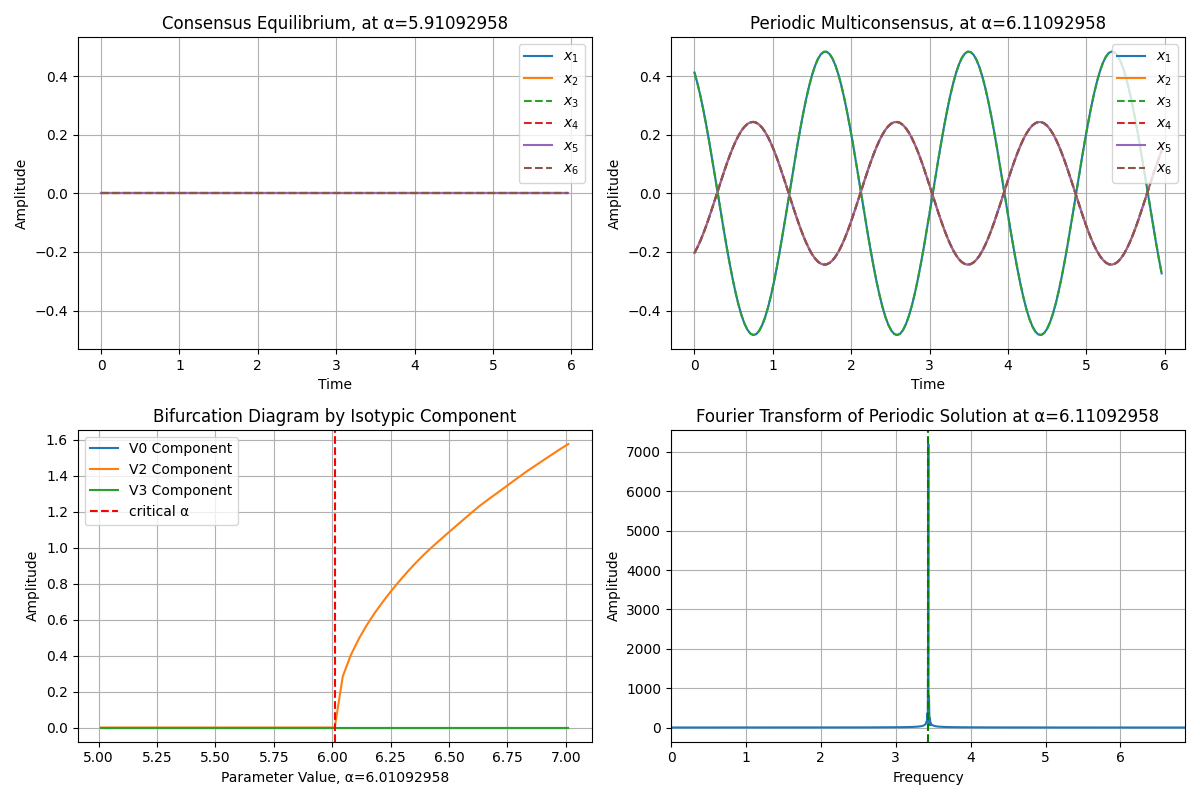
Figure 2: Representative of the standing wave solution type, initialized with a small perturbation in the direction (−1,−1,−1,−1,2,2)T.
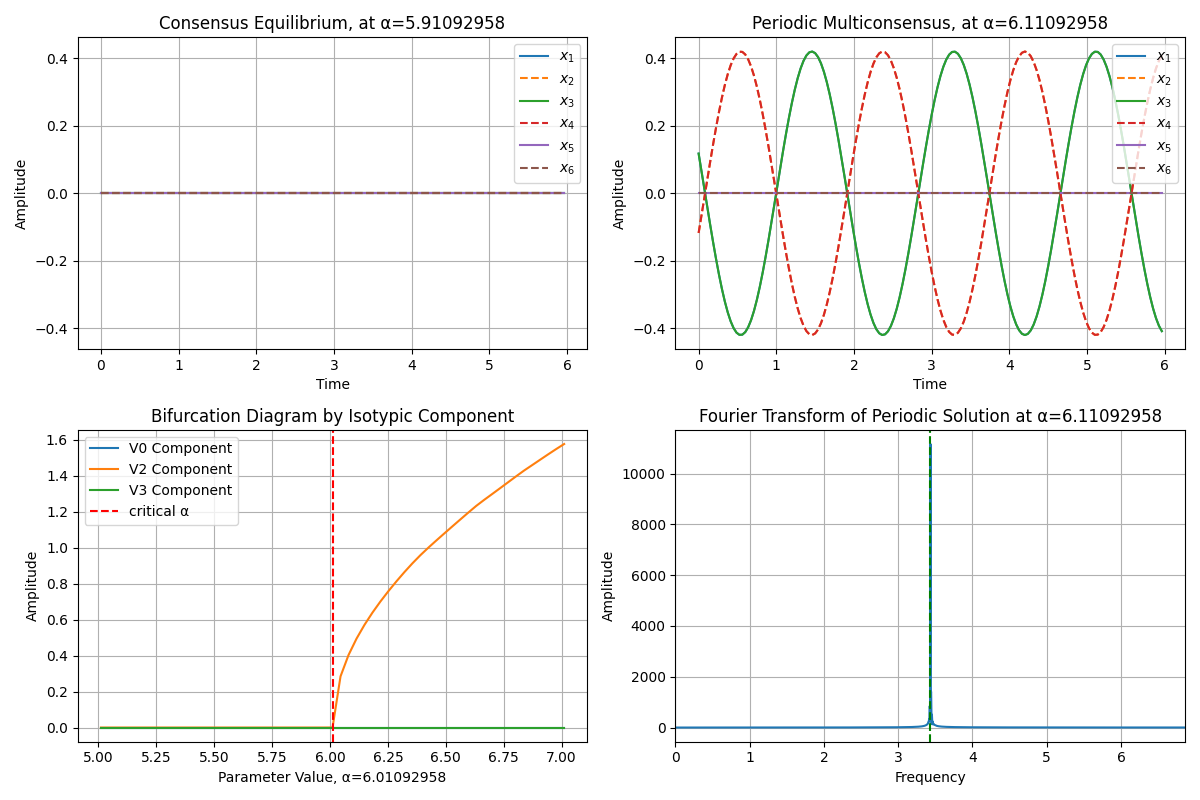
Figure 4: Representative of the twisted wave solution type, initialized with a small perturbation in the direction (−1,0,−1,0,1,1)T.
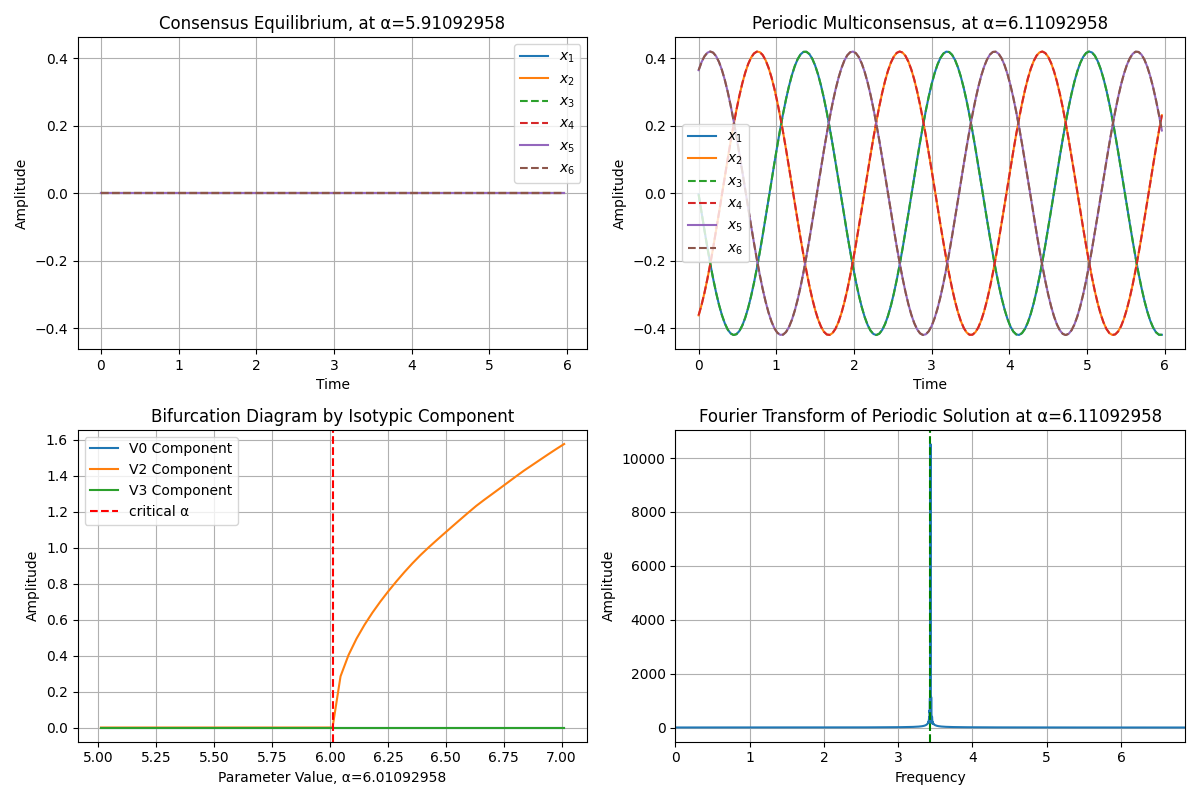
Figure 6: Representative of the standing wave solution type, initialized with a small perturbation in the direction (−0.9,0.6,−0.9,0.6,0.3,0.3)T.
- Parametric Control: The bifurcation parameter (often the gain α of the memory term) allows for precise, real-time switching between stationary consensus and symmetry-selected periodic regimes—a potentially powerful tool for distributed control.
- Robustness and Multistability: For each spatial symmetry, corresponding to maximal orbit types, multiple stable periodic regimes exist and are numerically observed to be robust to perturbations, as predicted by the unbounded branch results.
- Spectral and Branch Structure: Limit frequency diagrams (e.g., Figures 4 and 9), and their dependence on model parameters (Figures 19 and 20), allow explicit tuning and predictability of the oscillatory patterns' temporal properties.
Advanced Phenomena: Double Hopf, Resonances, and Chaos
The study extends beyond primary bifurcations, numerically investigating complex scenarios such as double Hopf points, resonances between modes (Figure 7), and even transitions to chaotic multiconsensus (Figure 8), especially in the neutral-type systems. Here, the presence of riddled basins and the Ruelle–Takens–Newhouse route to chaos are evidenced via numerical measurements (Lyapunov exponents, return maps) and basin structures, indicating that the topological tools forecast a much richer dynamical tapestry than previously appreciated.
Theoretical and Practical Implications
This research represents a significant advancement in the general theory of nonlinear symmetry-breaking in networks, with practical consequences for the design and analysis of robust, adaptable multi-agent collectives. The explicit analysis and classification of post-consensus dynamics provide:
- Control-theoretic design principles for selecting, tuning, and stabilizing complex collective behaviors using a single bifurcation parameter, particularly in formation flight and swarm robotics.
- Analytical tools for economic and biological modeling, explaining the emergence of cycles, coordinated competition, and higher-order cooperativity due to agent memory or adaptation timescales.
- A modular and powerful analytical framework for future analyses of more general networks (arbitrary graphs, time-varying topologies) and generalized agent memories.
Furthermore, the dissertation's methodology highlights how combining group-theoretic topological invariants (degree theory) with careful spectral analysis and numerical simulation yields a robust, scalable toolbox suitable for the analysis of emergent phenomena in high-dimensional complex systems.
Future Directions
Several promising future directions are discussed:
- Extension to heterogeneous, directed, or time-varying topologies, and the impact of asymmetries or heterogeneity on the multiconsensus bifurcation diagram.
- Algorithmic computation of equivariant degrees for large networks, leveraging computer algebra (e.g., GAP) for orbit type decomposition in broad classes of symmetry groups.
- Applications to distributed optimization, real-time control, and neuromorphic or synthetic biological networks, where higher-order memory and delay are intrinsic, and robust consensus-breaking transitions are either desirable or must be mitigated.
Conclusion
The presented analysis rigorously establishes global bifurcation to structured, symmetry-classified, periodic multiconsensus regimes in symmetric multi-agent systems with various forms of agent memory. Through modern equivariant degree theory, this work provides both comprehensive theoretical guarantees and concrete computational strategies for predicting, controlling, and understanding emergent collective dynamics in distributed networks, with immediate applicability in robotics, finance, neuroscience, and beyond (2607.02388).

