- The paper introduces a novel FPGA-based semantic coordination architecture that enforces determinism, auditability, and bounded timing in real-time autonomous systems.
- It maps TB–CSPN coordination semantics onto hardware, ensuring temporal synchronization and strict enforcement of authorization and safety policies.
- The architecture decouples non-deterministic software reasoning from safety-critical hardware guarantees, paving the way for formally verifiable multi-agent systems.
Hardware-Enforced Semantic Coordination in Safety-Critical Real-Time Autonomous Systems
Introduction and Motivation
The increasing integration of agentic AI into autonomous systems presents a dual challenge: enhancing the reasoning power of individual agents while simultaneously ensuring that coordination among heterogeneous components is deterministic, auditable, and strictly bounded in time and logic. The failure modes in safety-critical real-time scenarios, such as autonomous drones or defense platforms, often have less to do with specific reasoning errors and more with unreliable, non-deterministic, and unverifiable coordination at the system-of-systems level. Current coordination mechanisms—based largely on asynchronous messaging, cloud-centric middleware, and software-level APIs—are inherently non-deterministic and difficult to audit or formally verify, particularly under adversarial or resource-constrained conditions.
This work proposes a hardware-enforced semantic coordination architecture, leveraging FPGAs to natively implement selected coordination semantics. The architecture is grounded in the Topic-Based Communication Space Petri Net (TB–CSPN) framework, separating adaptive semantic reasoning (kept in software) from enforceable interaction management (migrated into dedicated hardware logic). The key contribution is the FPGAs’ role—not as accelerators for traditional AI computation, but as deterministic coordination substrates that enforce semantic gating, bounded timing, synchronization, and authorization constraints at the hardware level.
Architectural Overview
The proposed system architecture adopts a vertically stratified model, composed of three logically distinct layers: the semantic reasoning layer, the FPGA-based semantic coordination layer, and the physical safety layer. These layers separate adaptive intelligence from enforced operational guarantees.
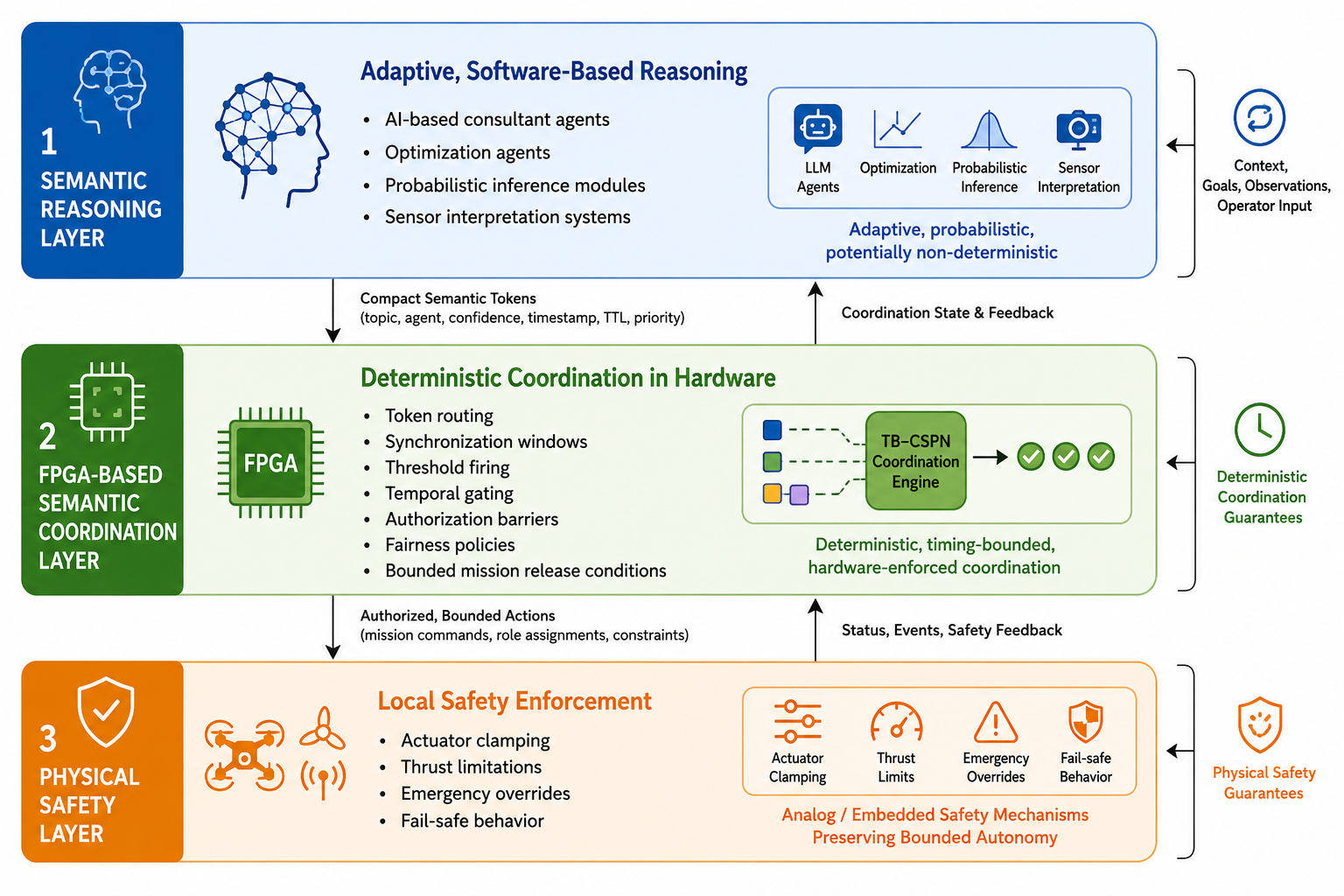
Figure 1: Three-layered architecture illustrating the organized separation between adaptive semantic reasoning, FPGA-enforced semantic coordination, and the physical safety interface.
Semantic Reasoning Layer
This top software layer aggregates traditional and contemporary adaptive modules, such as LLMs, world models, optimization engines, and perception stacks. These modules operate under uncertain and dynamic conditions, making context-dependent inferences and synthesizing candidate mission plans. These components are inherently non-deterministic and probabilistic, supporting adaptive, high-level reasoning but lacking temporal or logical enforcement.
FPGA-Based Semantic Coordination Layer
The central contribution involves mapping TB–CSPN coordination motifs onto FPGA-executable primitives. Instead of using FPGAs for computational speed-up, this layer provides hardware-enforced guarantees for:
- Temporal synchronization
- Semantic gating of communication
- Bounded decision/timing windows
- Enforcement of authorization constraints and operational safety policies
Compact semantic tokens—reduced to indexed metadata: topic, agent identifiers, TTL, confidence, timestamps, and priority—are processed by the FPGA, which executes finite-state Petri-net-like protocols. These protocols encode synchronization barriers, temporal windows, threshold-based transitions, and fairness policies (e.g., round-robin or bounded-starvation schemes), ensuring that coordination semantics are enforced non-bypassably and deterministically.
Physical Safety Layer
The lowest layer implements analog and embedded safety mechanisms, such as actuator clamping, fail-safe overrides, and emergency cut-offs. These mechanisms operate independently of software or FPGA logic, providing a final layer of operational safety in the presence of subsystem degradation, compromised communication, or agent failure.
Design and Implementation Challenges
Semantic Token Compactification
Given hardware constraints, only essential semantic attributes (e.g., topic, agent, confidence, TTL, priority) can reside in tokens processed by the FPGA. Richer semantic payloads stay in external software, demanding careful co-design of token interfaces to avoid loss of crucial contextual information required for correct coordination.
Ordering, Fairness, and Scheduling
TB–CSPN tokens exhibit semantic differentiation; thus, scheduling and routing policies on the FPGA may affect system-level semantics. Fairness properties must be carefully engineered to prevent starvation or undue prioritization, while maintaining bounded temporal windows for decisions.
Temporal Coordination
All critical transitions at the hardware coordination layer must be temporally well-defined, supporting explicit validity intervals, deadline semantics, and real-time synchronization. The FPGA must maintain precise timing logic for token expiry, synchronization, and gating, which is non-trivial under dynamically changing system topologies.
Dynamic Reconfiguration
In practical deployments, agents and mission objectives may change at runtime, requiring FPGA-level support for dynamic reconfiguration of coordination structures. Future implementations must address how to adapt coordination primitives without losing formal safety guarantees.
Theoretical and Practical Implications
By relocating enforcement of bounded coordination from software to hardware primitives, the architecture addresses gaps in deterministic auditability, real-time response, and non-bypassable safety. This paradigm enables new capabilities in mission- and safety-critical applications, especially where system behavior must be formally verified, such as:
- Coordinated drone swarms under adversarial jamming or network partitioning
- Edge-based defense automation platforms
- Emergency management (e.g., search-and-rescue) with heterogeneous semi-autonomous teams
- Distributed energy/grid systems demanding millisecond-level coordination robustness
The architecture is designed for scenarios where bounded autonomy, liveness, and operational auditability must coexist with the flexibility of advanced AI reasoning. There is a clear decoupling between the indeterminacy of semantic processing and the determinism of safety-relevant coordination.
Research Roadmap and Future Work
Current work emphasizes architectural positioning and conceptual modeling, without presenting FPGA prototype results or empirical benchmarks. An explicit research agenda is articulated:
- Formal specification of hardware-enforced Petri-net-based token protocols for coordination
- Synthesis, verification, and validation of FPGA coordination modules
- Real-world evaluation in domains with heterogeneous agents, stringent timing, and safety constraints
- Development of adaptive coordination semantics that permit bounded reconfiguration under disruption, while strictly preserving hardware-level enforcement and auditability
A salient open challenge remains in balancing hardware-level determinism with ongoing adaptive mission reconfiguration, especially in adversarial or degraded conditions. Mechanisms to propagate fault or stress signals from analog safety barriers back to the hardware/software coordination layer, triggering system-wide behavioral adaptation, are prioritized for further exploration.
Conclusion
The work contributes a clearly scoped architectural and conceptual advance, arguing for a shift from software-mediated orchestration to hardware-enforced semantic coordination in safety-critical, real-time autonomous systems. By leveraging TB–CSPN semantics and hardware primitives for deterministic enforcement, this approach offers a pathway to more auditable, verifiable, and operationally safe multi-agent AI deployments, particularly as agentic autonomy pervades high-stakes applications. Future research will need to resolve challenges of compact token design, dynamic adaptation, and formal correctness verification as agentic AI architectures become ever more embedded and mission-critical.
Reference:
"Hardware-Enforced Semantic Coordination for Safety-Critical Real-Time Autonomous Systems" (2607.02376)