- The paper presents GAP-GDRNet, which integrates an AFR module and PGSA mechanism to capture both global structure and local cues for improved monocular 6D pose estimation.
- It leverages a synthetic dataset of 50,000 labeled images, achieving significant improvements with a rotation error of 1.96° and 95.16% [email protected] m accuracy.
- Ablative studies demonstrate that geometry-aware attention modules boost performance under challenging conditions while maintaining real-time efficiency.
GAP-GDRNet: Geometry-Aware Monocular Visual Pose Sensing for Spacecraft
Introduction and Motivation
Monocular 6D pose estimation for non-cooperative spacecraft is central to autonomous rendezvous, proximity operation, and on-orbit servicing. The unique challenges in spacecraft imagery—low-texture panels, thin appendages, strong lighting variability, and occlusion—demand robust dense geometric reasoning from single-view RGB. Traditional geometry-guided direct regression frameworks such as GDR-Net provide a baseline; however, their ability to capture the crucial global structure and granular local cues in spacecraft imagery is limited by conventional feature learning and local geometric token processing. The GAP-GDRNet architecture addresses these bottlenecks by introducing an attention-based feature refinement (AFR) module and a patch-level geometric self-attention (PGSA) mechanism, systematically enhancing geometry-aware feature extraction and patch interaction in monocular spacecraft pose estimation.
Synthetic Spacecraft Dataset and Variational Coverage
GAP-GDRNet leverages a comprehensive, synthetically rendered dataset to facilitate supervised geometric learning, given the scarcity of pixel-level labeled real spacecraft images. The dataset comprises 50,000 images derived from a single normalized spacecraft CAD model under randomized pose, illumination, occlusion, and background configurations. Each sample includes not only RGB and bounding box but also precise camera intrinsics, dense 2D–3D correspondence maps, visible-region masks, and 6D pose labels. Scene factor stratification in train-validation-test splitting ensures non-trivial generalization to held-out combinations, emulating realistic domain variation.
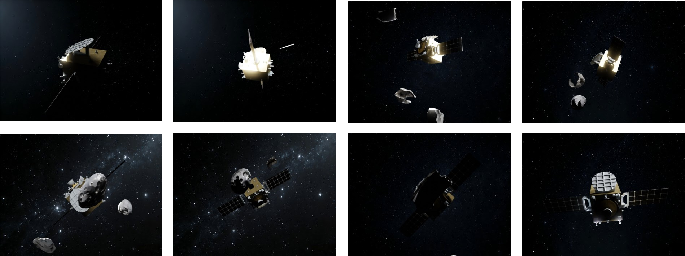
Figure 1: Samples showcase controlled viewpoint, scale, occlusion, lighting, and complex/non-Earth backgrounds in synthetic spacecraft rendering.
Architecture Overview
GAP-GDRNet is a multi-stage, geometry-guided regression pipeline. Its core design preserves GDR-Net's input-output compatibility, processing a cropped RoI patch via a ConvNeXt backbone, followed by an attention-enriched decoder. The refined feature map is subsequently used to predict dense model-coordinates, masks, and surface region attributes. These outputs, concatenated with spatial RoI encoding, feed into an enhanced Patch-PnP head equipped with PGSA, culminating in direct regression of pose parameters within the camera frame.
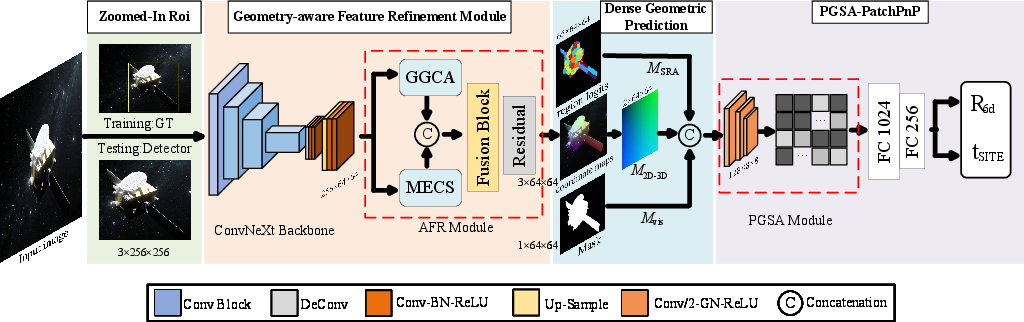
Figure 2: GAP-GDRNet framework: RoI input, ConvNeXt backbone, attention-based feature refinement, dense geometric prediction, and PGSA Patch-PnP regression.
Feature Refinement via Attention (AFR)
AFR is interposed between the ConvNeXt decoder and the geometric prediction heads, providing two parallel mechanisms: (1) global grouped coordinate attention (GGCA) for long-range spatial dependencies, and (2) median-enhanced local feature selection (MECS) for channel and spatial granularity.
GGCA performs channel grouping with directional pooling, extracting structured positional priors relevant for spacecraft large-scale layout and primary axes.
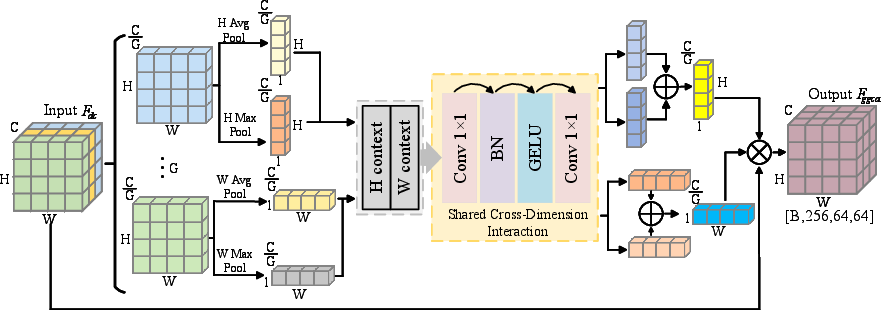
Figure 3: GGCA: Channel grouping, directional pooling, and cross-dimensional interaction enhance global geometric cues.
MECS combines max, median, and mean pooling for robust channel-wise filtering, followed by multi-scale spatial attention that accentuates object boundaries and weak-texture cues critical for dense coordinate prediction.
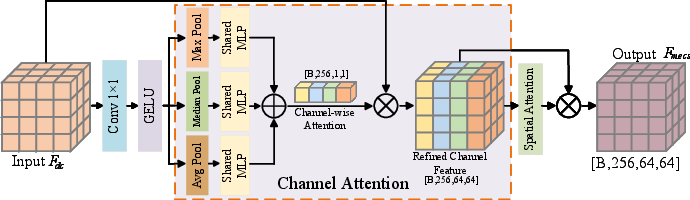
Figure 4: MECS: Combined channel pooling and spatial attention yields robust local geometric cues.
The outputs of GGCA and MECS are fused and added residually to the decoded feature, modulating initial feature responses toward geometry-critical structures without destabilizing network initialization.
Patch-Level Geometric Self-Attention (PGSA)
Patch-PnP in GDR-Net aggregates geometric evidence by extracting and flattening patch-wise features pre-regression. PGSA enhances this by introducing local patch encoding via stride-2 convolutions, resulting in a 128-channel 8×8 patch grid. Each patch is treated as a geometric token, with learnable positional encoding and multi-head self-attention facilitating cross-patch interaction, especially for spatially disjoint but semantically coupled structures (e.g., solar panel tips and main body corners).
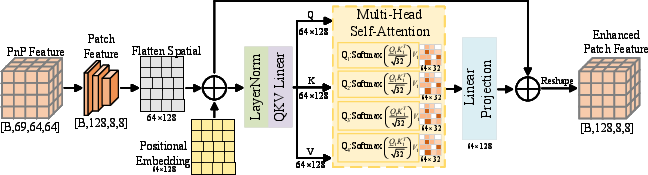
Figure 5: PGSA module: Patch creation, position encoding, multi-head self-attention, and residual fusion prior to pose regression.
Experimental Evaluation
Primary Benchmark: Synthetic Spacecraft Dataset
On the held-out spacecraft test set, GAP-GDRNet achieves a rotation error of 1.96∘, translation error of 0.0165 m, and 95.16% ADD@0.02 m accuracy, surpassing the reproduced GDR-Net baseline by 3.88 percentage points ADD and reducing rotation error by 1.16°. GAP-GDRNet achieves 35.97 FPS pose inference, retaining practical efficiency. ZebraPose, MRC-Net, and SurfEmb trail in both accuracy and speed under uniform detector setup, hardware, and input normalization.
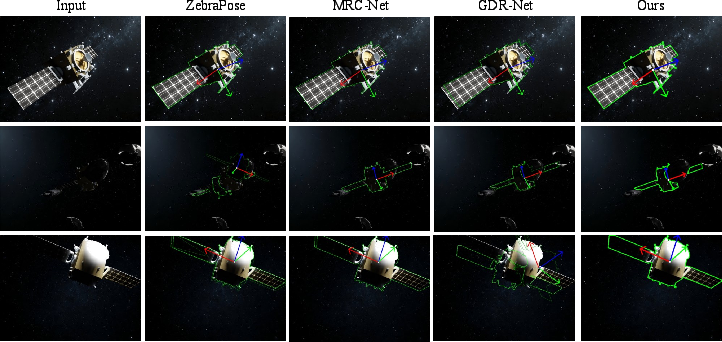
Figure 6: Pose projection quality for ZebraPose, MRC-Net, GDR-Net, and GAP-GDRNet under various visual perturbations.
Ablative Analysis
Backbone replacement (ResNet-34 → ConvNeXt) is responsible for modest accuracy gains. Isolated insertion of GGCA, MECS, and PGSA further improves each error metric, with the full AFR (GGCA+MECS) and PGSA combination yielding the strongest results. Notably, AFR alone imparts larger robustness improvements under weak illumination, strong shadows, heavy occlusion, or cluttered backgrounds — scenarios mimicking harsh space conditions.
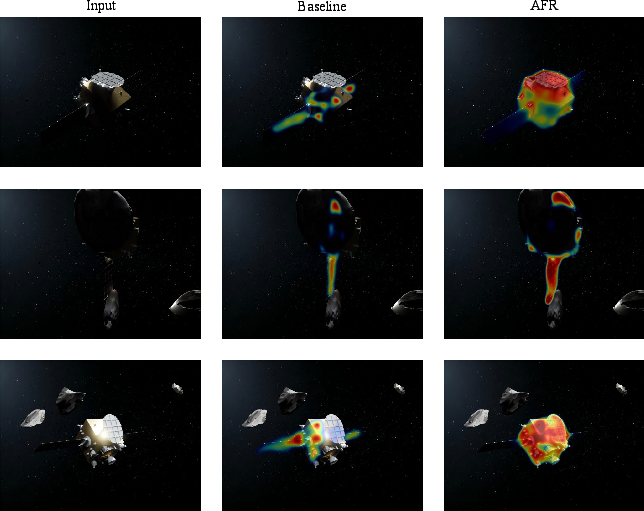
Figure 7: AFR amplifies target body and boundary activation versus baseline (no AFR) in feature norm visualization.
Factor-Wise Robustness
GAP-GDRNet consistently outperforms all baselines across rendering factor subgroups. The additive margin in [email protected] m is largest for challenging conditions (e.g., +4.99 pp under heavy occlusion, +4.50 pp for cluttered backgrounds), underscoring its geometry-aware attention modules' utility under compounded visual ambiguity.
Generalization to Public Benchmarks
On T-LESS and LM-O, which feature textureless and occluded non-spacecraft objects, GAP-GDRNet achieves gains of 6.8 and 3.1 percentage points BOP-AR over GDR-Net, confirming the transferability of its architectural improvements to diverse monocular pose sensing tasks.
Theoretical and Practical Implications
The modular refinement of local-global features (via GGCA/MECS-AFR) and structured cross-patch reasoning (via PGSA) demonstrate a measurable advantage in geometry-heavy, texture-weak pose estimation from RGB. The findings imply that monocular systems can be made robust to the severe information gaps prevalent in spaceborne vision—without reliance on candidate depth or explicit point correspondence voting—via principled, learned geometric attention. Practically, these advances can inform next-generation autonomous rendezvous modules as well as robotics domains requiring single-view geometric awareness under domain shift. The architecture maintains efficiency suitable for real-time deployment on modern hardware.
Outlook and Future Directions in AI
Key limitations are the synthetic-only data regime and evaluation restricted to a single spacecraft model. Future research trajectories include scaling GAP-GDRNet to multi-target, multi-domain settings (generalizing to distributions of spacecraft morphologies and real imagery), sim-to-real transfer with adversarial or domain adaptation methods, and extension to unsupervised or weakly supervised geometry learning under label sparsity. Furthermore, ablation of attention module architectural variants and progressive sparsification for embedded deployment remain unexplored.
Conclusion
GAP-GDRNet delineates a path forward in geometry-aware monocular pose estimation for challenging, real-world-relevant scenarios. By explicitly addressing both global structural layout and subtle, locally distributed cues—integrated via differentiable, attention-driven mechanisms—the method advances the state of the art in synthetic spacecraft pose sensing and exhibits principled generalization to challenging, textureless, and occluded object datasets. Its modular enhancements offer a blueprint for robust monocular geometric perception, with potential extensions across robotics, autonomous vehicles, and space situational awareness domains.