- The paper introduces a novel BAW delay-line architecture that encodes 2048 Ising spins with 15-bit resolution to solve NP-hard problems.
- It benchmarks the system against leading classical algorithms, achieving MAX-CUT solutions within 93%-95% of the best energies and projecting sub-millisecond performance.
- The study demonstrates robust results in complex NP-complete tasks such as number partitioning and Sudoku, highlighting scalable, energy-efficient hardware design.
Introduction
The paper "A 2048-spin bulk acoustic wave Ising machine for number partitioning and Sudoku" (2607.02112) presents an experimental implementation of a time-multiplexed Ising machine using bulk acoustic wave (BAW) delay lines. This hardware-based approach is positioned as an alternative to photonic coherent Ising machines (CIMs), aiming to overcome their drawbacks related to thermal instability, large footprint, high cost, and power consumption. The system demonstrates all-to-all connectivity, 15-bit coupling resolution, and the capacity to encode and solve combinatorial optimization problems of significant scale and complexity—including MAX-CUT, number partitioning, and Sudoku.
System Architecture
The BAWIM utilizes two daisy-chained quartz BAW delay lines at a central frequency of 20.5 MHz, supporting the circulation of 2048 microwave pulses—each encoding an Ising spin via binary phase. Essential subsystems include a phase-sensitive amplifier (PSA) for enforcing bistable phase states, linear amplifiers for signal gain recovery, an FPGA-based measurement and feedback block (MFB) for dynamic pulse coupling computation, and a one-hot encoding scheme in the case of constraint satisfaction problems. Circuit requirements are governed by Barkhausen stability, addressed through feedback gain/phase engineering and precise analog components configured for RF pulse routing and phase detection.
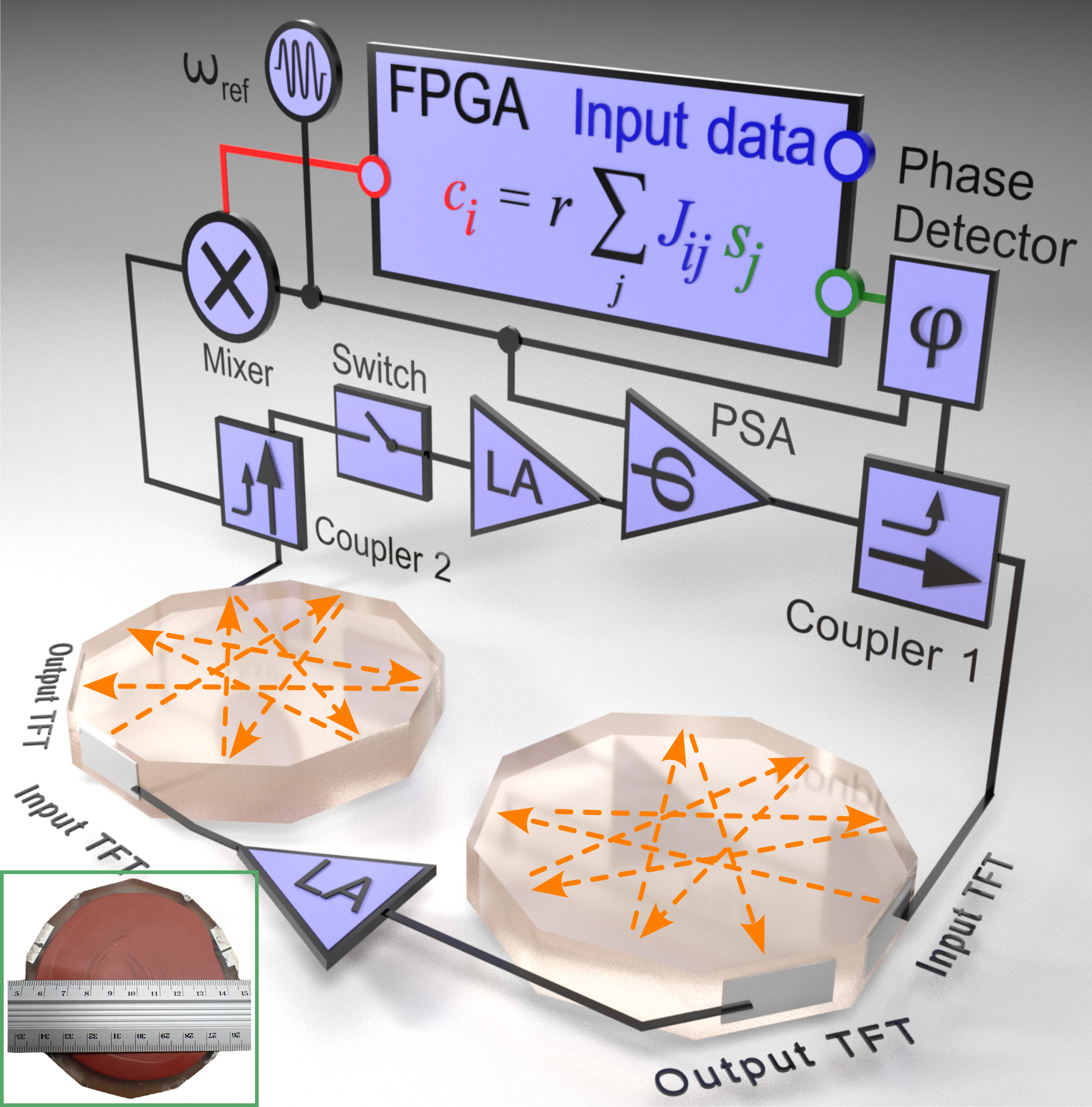
Figure 1: Schematic of the BAWIM architecture featuring daisy-chained BAW delay lines, a parametric PSA, linear amplifiers, an FPGA-based measurement-and-feedback path, and pulse transducers for spin excitation and measurement.
The physical realization achieves 2048 active spins, with experimental outputs and coupling strengths programmable to 15-bit precision—critical for mapping arbitrary Ising Hamiltonians.
The authors evaluate BAWIM primarily using large-scale MAX-CUT instances (e.g., 2048-spin, 10% edge density, >200k weighted edges), number partitioning, and Sudoku. The evaluation focuses on energy relaxation dynamics, optimum-finding reliability, and time-to-target metrics, benchmarking against the Heated Ballistic Simulated Bifurcation (HbSB) algorithm, a state-of-the-art classical approach within this domain.
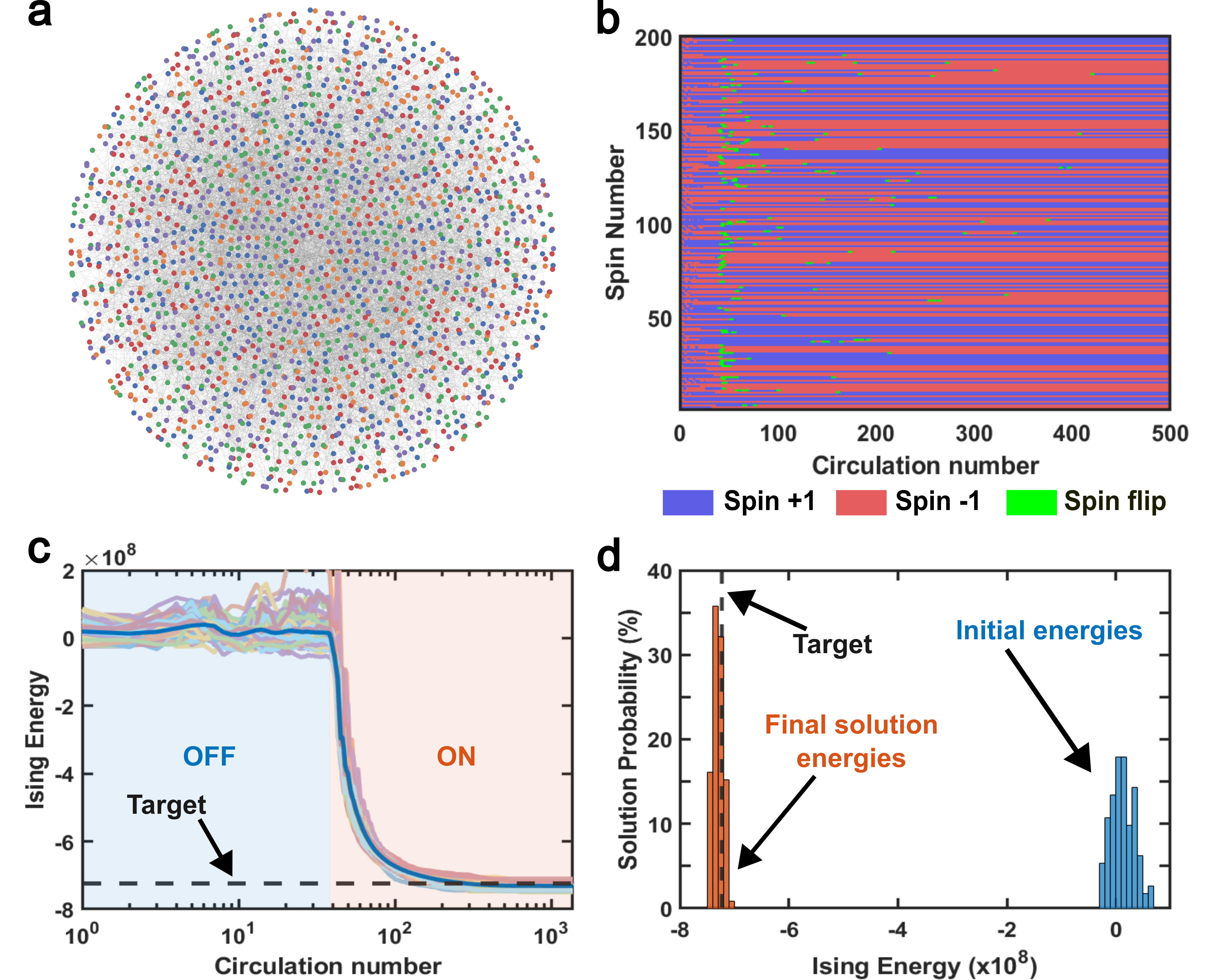
Figure 2: Solution process for a 2048-spin MAX-CUT instance, showing graph connectivity, early spin dynamics, energy trajectory, and runwise energy distribution.
- For MAX-CUT on a 2048-spin instance, BAWIM consistently achieves solutions with Ising energies within 93%−95% of the best found by HbSB, with MAX-CUT scores exceeding 99% of optimal for dense graphs.
- Time-to-target for achieving 90% of HbSB's best energy is 341 ms; the system demonstrates reliability across 100+ repeated runs, with deterministic turn-on/off cycling and robust decay enabling statistical performance evaluation.
- By exploiting higher-frequency BAW components (~16.4 GHz vs 20.5 MHz), extrapolated solution times contract to sub-millisecond scales, at least two orders of magnitude below contemporary CIMs for similar problem sizes.
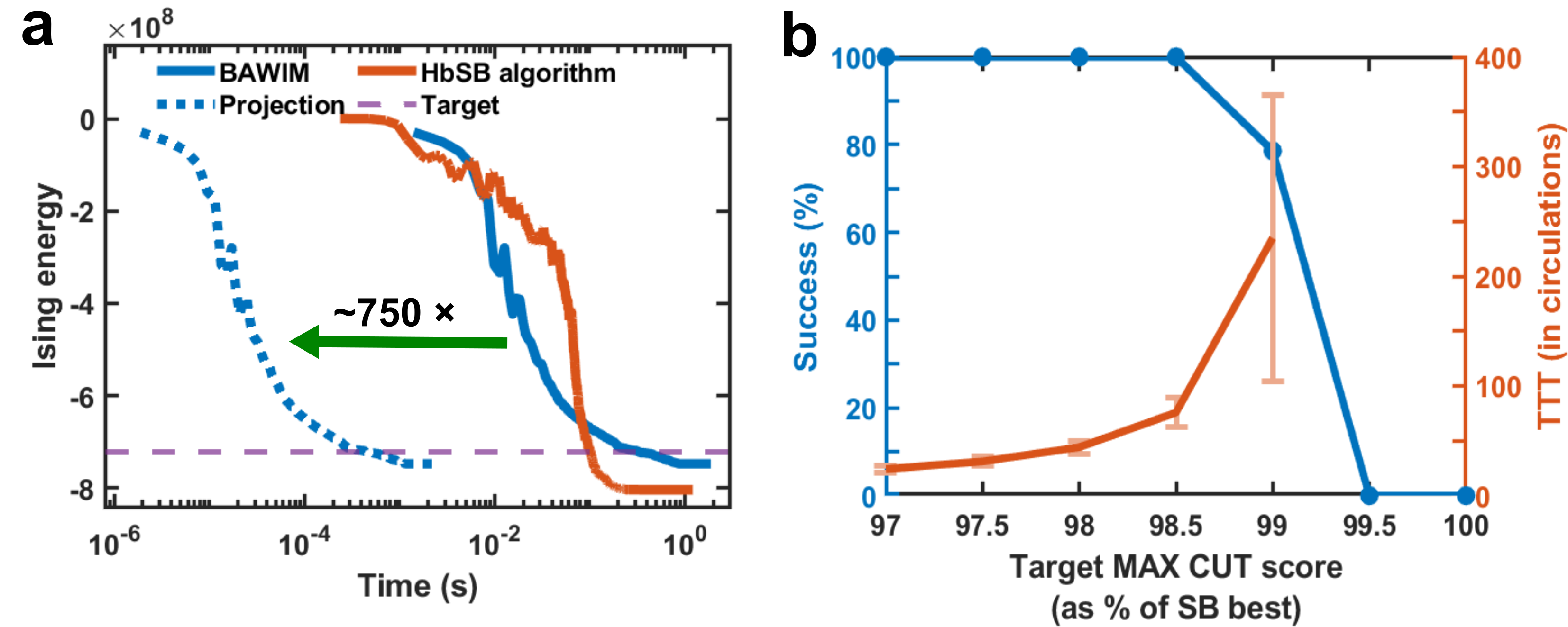
Figure 3: BAWIM vs. HbSB: Energy minimization dynamics, success rate, and time-to-target statistics for MAX-CUT, alongside projected performance at higher carrier frequencies.
Edge density analysis reveals improved time-to-target and higher success rates as connectivity increases, with ≈97% success for fully connected graphs.
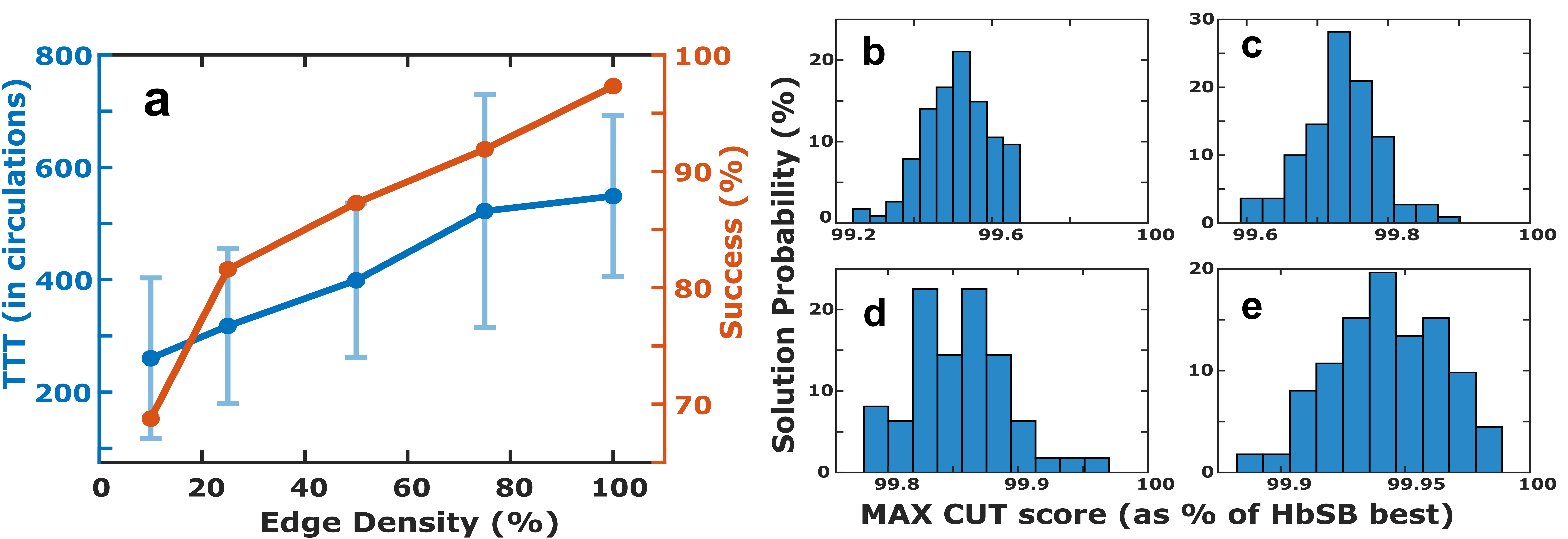
Figure 4: Time-to-solution and success rate as a function of edge density, plus solution probability histograms for 25%, 50%, 75%, and 100% connectivity.
Complex Optimization Problems: Number Partitioning and Sudoku
A notable contribution is the application of BAWIM to non-trivial, NP-complete problems.
- Number Partitioning Problem (NPP): The system encodes integer sets of sizes up to 2048, representing cut minimization as all-to-all interacting spins. Across multiple instances, BAWIM achieves 100% success for approximate solutions (<0.1% partition difference), significantly outperforming HbSB even for large N.
- Sudoku: Using one-hot encoding over 81×9=729 spins, BAWIM realizes valid solutions for NP-complete Sudoku instances. While near-optimal Ising energy states persistently correspond to invalid solutions (rule violations), ground-state convergence reliably yields correct completions, something HbSB fails to achieve.
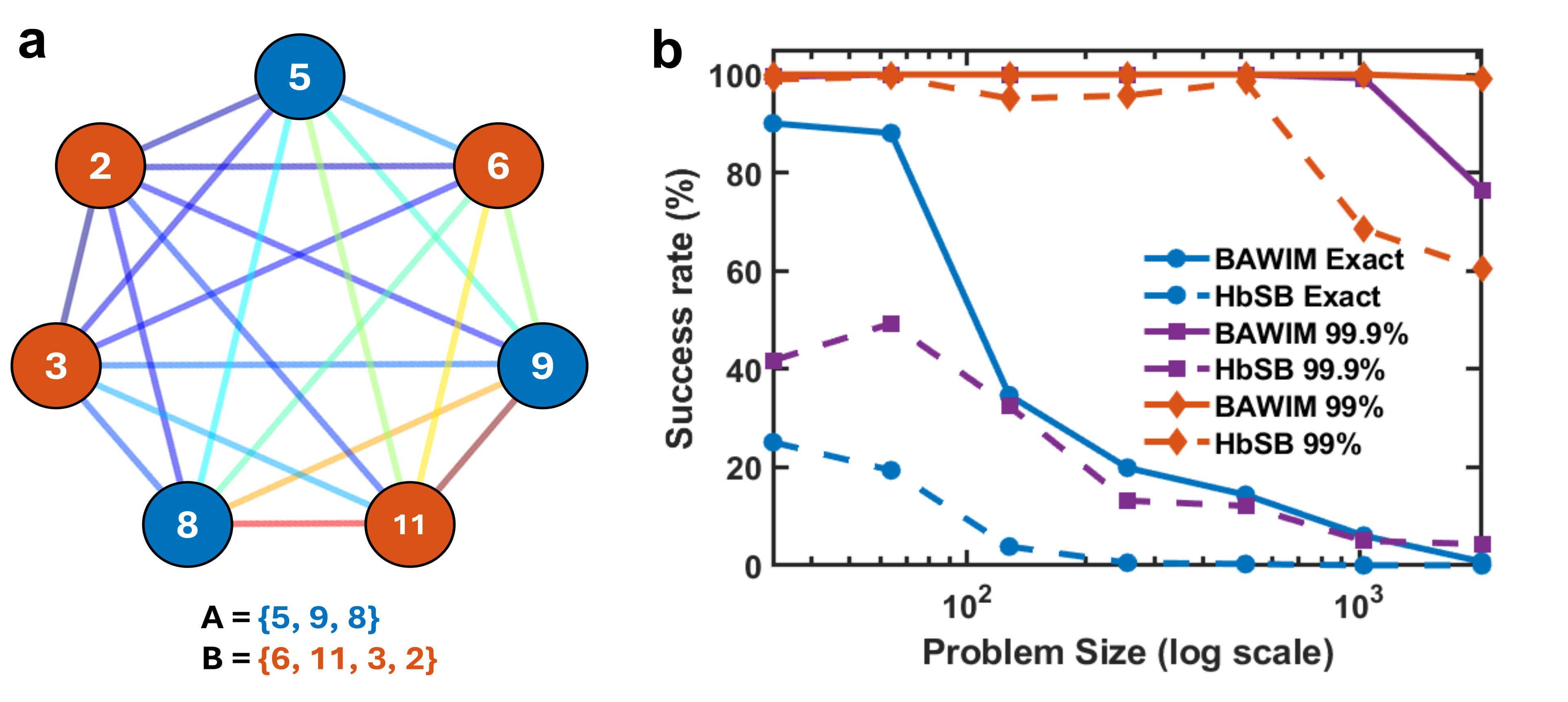
Figure 5: Graph representation and comparative success rates for BAWIM and HbSB on the number partitioning problem as a function of instance size and solution tolerance.
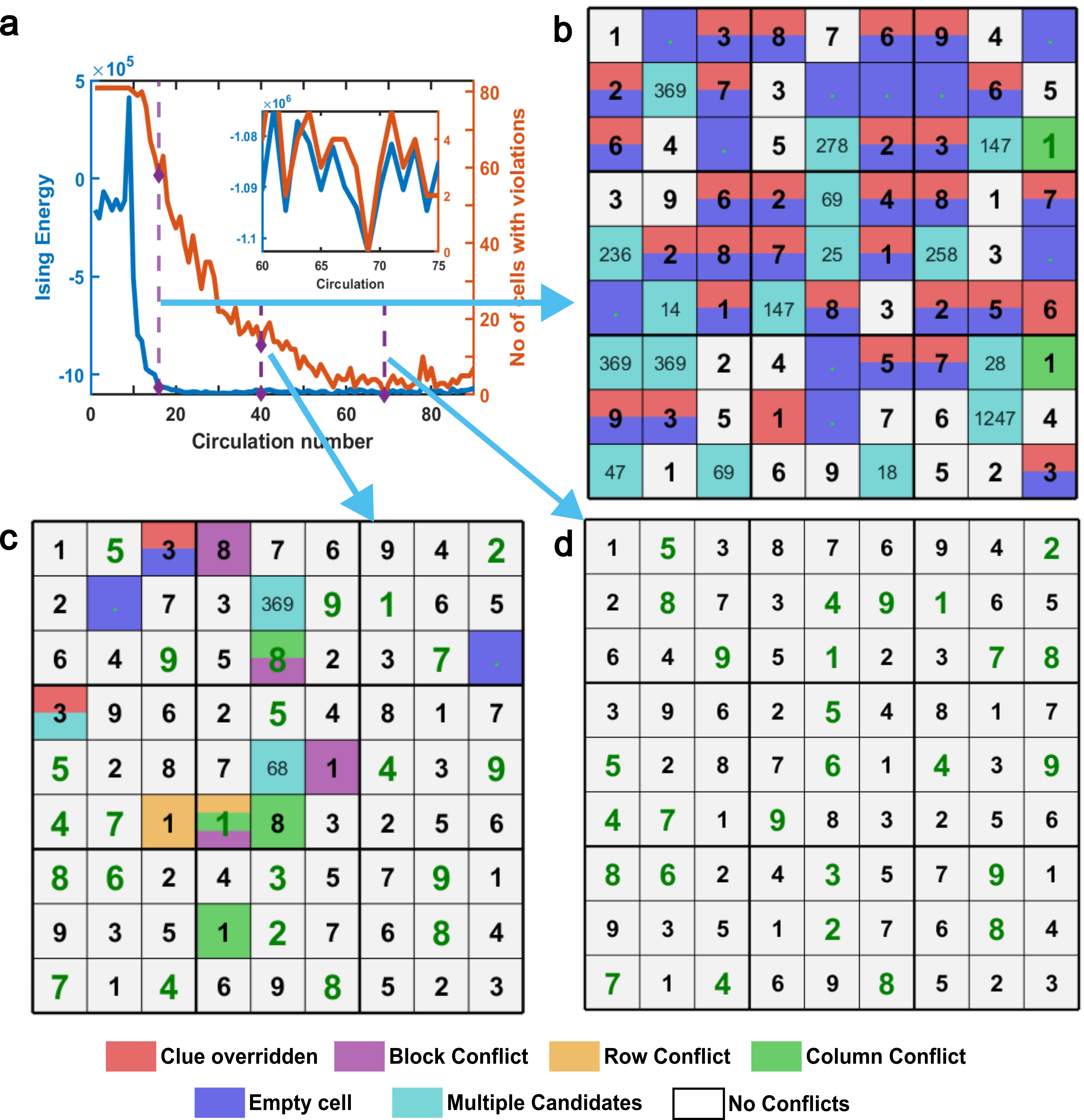
Figure 6: BAWIM Sudoku solution trajectory: Ising energy and rule violation evolution, with selected puzzle configurations tracking progress toward correct completion.
Advantages Over Photonic Coherent Ising Machines
BAWIM offers several key technical and operational advantages relative to large-scale CIMs:
- Thermal Stability: Measured phase accumulation temperature coefficient is >104× better than CIMs, negating the need for extreme environmental control.
- Spin Utilization: Nearly all RF pulses act as functional spins; no auxiliary or post-selection losses as in CIMs.
- Spin Duty Cycle and System Efficiency: Higher utilization (50% duty cycle, six carrier cycles per spin vs. thousands for CIMs).
- Power Consumption: Total system power down to 5.9 W using low-power amplifiers, contrasted with the high energy and cooling demands in photonic approaches.
- Programmability: Direct FPGA control allows dense, high-precision, all-to-all couplings without the architectural constraints of fiber delay and pump scheduling.
- Scalability Prospects: Carrier frequency and pulse period can be further engineered to support larger spin arrays and faster dynamics.
Implications and Future Developments
The BAWIM system advances physical annealers by demonstrating robust, energy-efficient combinatorial optimization at the 2k-spin scale, with strong performance on NP-hard and NP-complete problems. Its architecture is inherently scalable via BAW device fabrication advances and higher frequency operation, with clear paths to ms or sub-ms solution times. System programmability enables versatility across both optimization and constraint satisfaction domains. The machine's characteristics, including orders-of-magnitude improvement in thermal tolerance and substantially reduced complexity, indicate a commercially viable route for analog computational devices in practical settings unconstrained by laboratory setups.
In theoretical terms, the device provides a platform for exploring dissipative, feedback-driven non-equilibrium annealing regimes and for assessing analog hardware's comparative resource efficiency versus digital simulation (HbSB, simulated annealing) and quantum annealing.
Immediate extensions include integration with advanced FPGA logic for more sophisticated control, mapping of larger/higher-precision optimization instances, and applications to other classes of constraint-based inference.
Conclusion
The work demonstrates a robust, thermally stable, and scalable solid-state Ising machine based on bulk acoustic wave delay lines, achieving all-to-all, high-resolution coupling among 2048 spins. BAWIM matches or surpasses leading classical and photonic Ising machines in both combinatorial optimization and constraint satisfaction tasks, achieving high solution quality in practical runtimes and with minimal hardware complexity. The architecture's efficiency, scalability, and operational resilience provide a compelling case for further investigation and deployment in real-world NP-class problem domains.

