- The paper introduces a novel classification and construction framework for open-boundary integrable quantum circuits using Yang-Baxter and reflection algebras.
- It establishes explicit minimal depth circuit architectures and boundary gate classifications that enable accurate spectral analysis and efficient simulation.
- Rigorous numerical evidence demonstrates that unique bulk gate activation yields isospectral circuits across diverse geometries, paving the way for advanced quantum hardware benchmarks.
Open-Boundary Integrable Quantum Circuits with Arbitrary Geometries: A Technical Overview
The paper "Open-boundary integrable quantum circuits with different geometries" (2607.02093) provides a comprehensive framework for the construction, classification, and analysis of integrable quantum circuits with open boundary conditions and arbitrary gate arrangements. Emphasizing models built from Yang-Baxter solutions and their boundary analogs, the work generalizes transfer-matrix-based integrable circuit constructions to encompass both difference and non-difference form R-matrices and a wide class of circuit geometries. Notably, the authors introduce new boundary gate classifications and minimal depth circuit constructs, providing critical tools for spectral analysis, simulation, and benchmarking in quantum information and integrable systems.
Yang-Baxter Integrability and Boundary Reflection
At the mathematical core, integrability in quantum circuits requires the existence of commuting families of transfer matrices, which generate a tower of conserved quantities. For open boundary systems, this demands solutions to both the bulk Yang-Baxter equation (YBE) for R-matrices and the boundary YBE (BYBE), or reflection equations, for K-matrices acting at the circuit edges. The transfer matrix construction, encapsulating these ingredients, underpins the evolution operators in these quantum circuits:
- Bulk integrability: Gates correspond to R-matrices, either of difference form (R(u,v)=R(u−v)) or the more general non-difference form (R(u,v)=R(u−v)).
- Boundary conditions: KR(u) and KL(u) matrices encode reflection at circuit boundaries and must satisfy reflection algebra compatibility with R.
General Construction of Open-Boundary Integrable Circuits
The principal innovation is a classification of integrable quantum circuits allowing arbitrary configurations of local gate placements, characterized by the positions of “inhomogeneity” parameters in the transfer matrix. The canonical construction proceeds as follows:
- Transfer matrix with inhomogeneities: Each site j is assigned an inhomogeneity R0, generically either R1 or R2, and potentially additional parameters (e.g., R3).
- Geometric mapping: Circuit geometry (i.e., gate placement and sequencing) is fully determined by the vector R4 enumerating the positions of R5 (or, more generally, R6 and other types) inhomogeneities.
- General mapping: Closed-form circuit expressions are derived for any given R7, covering both even and odd system sizes and arbitrary inhomogeneity type counts.
When only R8 and R9 appear, the construction reduces to circuits where each gate K0 (associated with K1) appears exactly once per nearest-neighbor pair per period. The circuit operator K2 can always be written as an ordered product of bulk and boundary gates, with the explicit mapping determined by K3.

Figure 1: Brickwork circuit of length K4, bottom-to-top time. Orange marks the K5 inhomogeneity sites, capturing general mapping of inhomogeneities to gate piles.
Circuit Equivalence, Spectral Structure, and Minimal Depth
A rigorous analysis establishes that all such circuits in which each bulk gate acts uniquely on each nearest-neighbor pair are isospectral—i.e., they share an identical spectrum, although their eigenvectors may differ up to similarity transformations involving only the bulk gates within an equivalence class defined by K6, the count of K7 inhomogeneities. Transformation between different equivalence classes (distinct K8) generally demands operators involving boundary gates as well.
Strong numerical evidence supports the conjecture that all circuits meeting these criteria (unique gate placement, Yang-Baxter and reflection algebra satisfied) are integrable, i.e., possess sufficient commuting conserved charges irrespective of geometry.
Within each class, the authors systematize the search for minimal depth circuit realizations—those with the lowest possible number of sequential gate layers for a given equivalence class. Minimal depth representatives exhibit a structure comprising “staircase” boundaries and a central brickwork region. Remarkably, for circuits depending only on K9 and R0, the strictly minimal achievable depth is always R1; with more types, the minimal depth increases (see below).
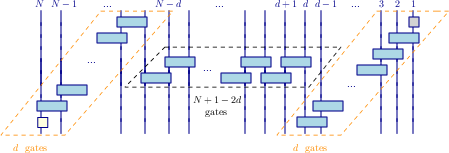
Figure 2: Quantum circuit with odd R2, minimal depth R3, illustrating left/right staircase and mid-brickwork structure.
Beyond Binary Inhomogeneities: Circuits with More Types
Introducing additional inhomogeneity types (notably R4) enlarges the space of possible circuit geometries and necessitates more complex minimal depth analysis. The findings include:
- With three inhomogeneities (R5), the minimal achievable circuit depth increases to R6.
- There exist multiple inequivalent geometries attaining this depth for a fixed system size, parameterizable by the count and positioning of each inhomogeneity type.
- The notion of effective minimal depth is introduced in circuits where new inhomogeneity types are restricted to edge neighborhoods, effectively enlarging boundary gates and leaving the central region “brickwork-like”.

Figure 3: Quantum gates dependent on R7 and a new inhomogeneity R8, expanding circuit designations for higher minimal depth classes.
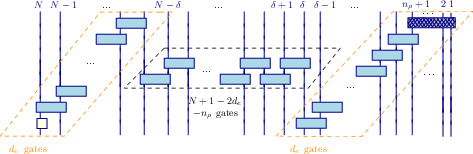
Figure 4: General R9-site circuit for odd R(u,v)=R(u−v)0; even case differs only in left staircase gate count.
Explicit classification and tabulation are provided for the number of independent minimal depth geometries as a function of inhomogeneity class count R(u,v)=R(u−v)1.
Comprehensive Boundary Gate Classification for Qubit Circuits
Explicit solutions are derived for all R(u,v)=R(u−v)2 R(u,v)=R(u−v)3-matrices up to 8-vertex type (capturing all Hermitian 2-qubit Hamiltonians up to integrability-preserving transformations), including non-difference form cases. The classification of right and left R(u,v)=R(u−v)4-matrices is extended by solving the Sklyanin reflection algebra via:
- Ansatz-based and Abel’s method approaches for ordinary differential equations arising in BYBE.
- Construction of explicit families for the XXX, XXZ, and XYZ R(u,v)=R(u−v)5-matrices as benchmarks.
- Complete or partial solution sets for new 6-vertex B and 8-vertex B non-difference form classes, with explicit parameter mappings for all boundary gate types admitting reflection algebra solutions.
These results provide critical boundary gate libraries for constructing and simulating quantum circuits of arbitrary integrable geometries on finite-dimensional lattices, especially relevant for hydrodynamic studies and quantum hardware benchmarking.
Implications, Theoretical and Practical
This classification provides a foundational framework for:
- Benchmarking quantum hardware: Circuits of known integrability serve as ideal error-mitigating benchmarks due to their abundance of conserved quantities and well-characterized spectrum.
- Algorithmic utility: Minimal depth integrable circuits can be employed for efficient state preparation, simulation of integrable quantum systems, and variational algorithm design.
- Hydrodynamics and quantum transport: Arbitrary circuit geometries enable systematic exploration of the role of spatial and temporal arrangement in non-equilibrium steady states, transport coefficients, and correlation function dynamics beyond the scope of standard brickwork circuits.
- Extensions: The analysis immediately generalizes to higher-dimensional local Hilbert spaces, non-unitary/correlated dissipative dynamics (via non-unitary R(u,v)=R(u−v)6-matrices), and performance evaluation of quantum algorithms via integrable Trotterization.
Theoretical conjectures remain—for instance, an analytic, model-independent proof of the integrability of all circuits where each bulk gate acts only once per period remains open, as does the characterization of non-Yang-Baxter based mechanisms of integrability in such circuits.
Conclusion
This work establishes a comprehensive, algorithmic approach for the design, classification, and analysis of integrable quantum circuits with open boundaries and arbitrary geometries. Through both constructive algorithms and explicit boundary solution catalogs, it sets the stage for future advances in quantum simulation, theoretical study of integrability structures, and the intersection of quantum information and condensed matter theory.
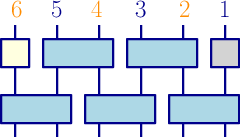
Figure 5: Brickwork circuit of length R(u,v)=R(u−v)7, bottom-to-top time flow; contrasting even-length and odd-length brickwork architectures within the general geometric mapping.