- The paper demonstrates that integrating squeezed ultra-cold BECs in a cavity QED setup achieves graviton population inversion via engineered phonon squeezing.
- It derives a Lindblad master equation that clearly outlines the conditions for exponential graviton gain and provides analytical expressions for graviton number evolution.
- Numerical estimates indicate that realistic laboratory parameters with moderate squeezing can yield observable graviton emission, challenging prior skepticism on graviton detection.
Introduction and Theoretical Background
The work "Towards graviton lasing from squeezed ultra-cold systems" (2607.02068) presents an explicit proposal for realizing a graviton laser—an amplified, coherent source of gravitons—by leveraging population inversion in a squeezed Bose-Einstein condensate (BEC) within a cavity QED setup. Building on prior results establishing graviton detection via quantum electromagnetic-gravitational coupling (Sen, 13 Apr 2026), the authors derive the Lindblad master equation governing graviton number evolution and identify rigorous conditions for achieving and sustaining graviton population inversion. The implications directly address longstanding skepticism on detectable single-graviton events [Dyson] by proposing the generation of coherent, observable graviton beams.
Model Hamiltonian and Master Equation Derivation
The foundational system consists of charged harmonic oscillators in a dynamical EM field, subject to gravitational perturbations. The interaction is encapsulated in a trilinear Hamiltonian,
H^int=−mm0ghqpp^h⊗A^⊗ξ^,
where p^h is the graviton mode momentum operator, A^ the photon field operator, and ξ^ the detector’s degree of freedom. The full system dynamics are then described by the Lindblad-type master equation for the reduced graviton density matrix (post-Markovian, Born approximations and photonic/detector tracing).
Crucially, under the resonance condition ω0=ω+ωP, terms governing stimulated emission and absorption of gravitons appear, allowing for explicit analytical expressions for the time evolution of the graviton number operator nG(t). The population inversion threshold is derived: graviton lasing (exponential gain in nG) occurs when the effective occupation number of the detector N outpaces the mean photon number nP.
The manuscript demonstrates that, in realistic two-level detector models, population inversion is unachievable merely via electromagnetic pumping due to energetic and occupation constraints. However, leveraging ultra-cold atoms—specifically BECs—with engineered phonon squeezing yields a robust route to inversion. The squeezing parameter r, phase p^h0, and atomic population p^h1 result in a determinable effective occupation p^h2, dependent also on the squeezing angle p^h3: p^h4
This configuration permits straightforward population inversion, particularly for accessible experimental parameters (p^h5, modest p^h6), without resorting to three-level atomic schemes.
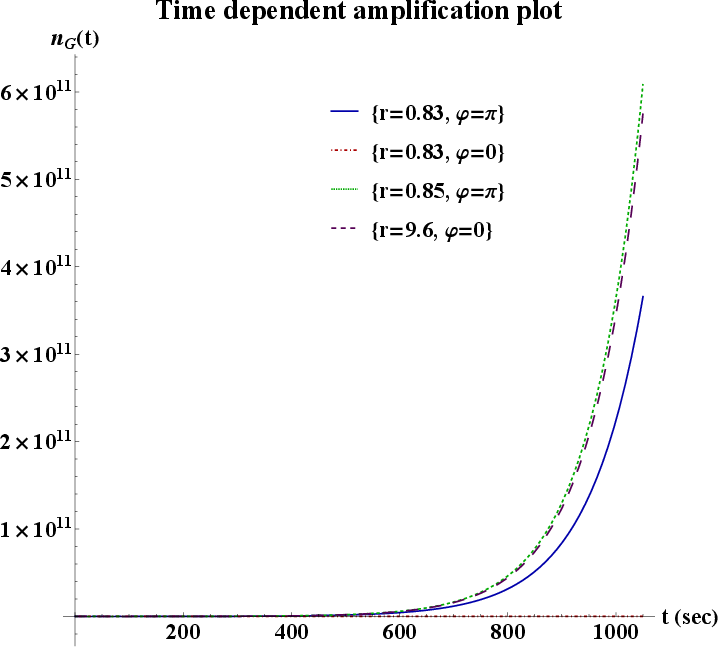
Figure 1: Time-dependent expectation value p^h7 showing exponential graviton number growth under increasing phonon squeezing and tuned p^h8.
Numerical estimates, using typical laboratory values for the oscillator mass p^h9, cavity volume A^0, timing A^1, and resonance frequencies (A^2, A^3, A^4 in the kHz regime), yield a graviton emission rate A^5 Hz. Gain is ultimately tunable via both squeezing A^6 and A^7.
Experimental Feasibility and Scheme
An explicit experimental protocol is proposed: an ultra-cold bosonic system (BEC or liquid A^8He) is trapped, its atoms outcoupled as a coherent matter wave and illuminated with resonant electromagnetic excitation. The system passes into an optical cavity where further manipulation (e.g., laser cooling, squeezing) allows controlled population inversion and subsequent deexcitation, emitting correlated photons and gravitons. The design integrates reflecting coatings and EM polarizers to filter photonic signals and maximize graviton coherence, exploiting the exponential scaling of graviton output with both atom number and squeezing.
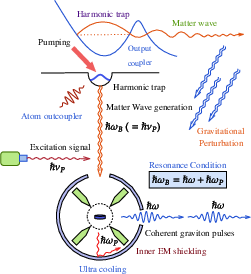
Figure 2: Schematic of the proposed graviton laser assembly featuring cavity QED with ultra-cold bosonic matter, phonon squeezing, and signal output configuration.
The analysis details parameter regimes, noting the necessity of high phonon squeezing (A^9 for large ξ^0 or modest ξ^1 for large ξ^2) and suggests adaptations with existing atom-optics techniques.
Astrophysical Context: Graviton Lasing in Nature
The theoretical framework implies that natural graviton lasing may occur in astrophysical environments, particularly in neutron star binaries—where extremely dense, highly degenerate matter could establish gigantic effective ξ^3 and ξ^4. The orbital excitation and deexcitation processes could produce macroscopically coherent graviton emission, manifest as strong, coherent gravitational waves.
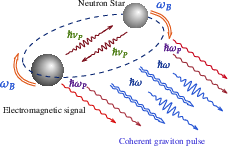
Figure 3: Conceptual diagram of graviton lasing within a binary neutron star system, highlighting excitation and emission pathways.
Such a scenario presents not only a concrete physical context for the graviton laser mechanism but also suggests that observed coherent gravitational wave signals may have a quantum-lasing origin.
Theoretical and Practical Implications
This analysis establishes specific, testable conditions for observing and generating graviton lasing, aligning quantum optics with quantum gravity phenomenology. The strongest numerical claim is the feasibility of achieving population inversion with laboratory BEC atom numbers and moderate squeezing, resulting in detectable graviton current under realistic timescales. Contradicting the general skepticism that population inversion (and therefore lasing) is unattainable in bosonic two-level systems, the results here demonstrate that squeezing provides a robust alternative to multi-level schemes.
A practical detection of coherent graviton emission would constitute direct evidence for the quantum nature of the gravitational field and the existence of gravitons. On the theoretical front, the mechanism offers new avenues for quantum information transfer and metrology using gravitational degrees of freedom.
Future Directions
Future work should focus on dynamic feedback protocols (making ξ^5 time-dependent), refined cavity QED engineering, and adaptation to alternative highly degenerate systems (e.g., neutron star matter analogs). Full quantum modeling of astrophysical processes within this framework could potentially reinterpret classes of gravitational wave signals. Integration with tabletop quantum gravity experiments could bridge the gap to actual graviton detection.
Conclusion
This paper rigorously details how squeezed ultra-cold bosonic systems under appropriate resonance and population conditions can serve as a viable platform for graviton lasing. The results provide a formal route to surpassing previously identified barriers to graviton detection, both in terrestrial laboratories and astrophysical contexts, leveraging well-established quantum optical control and atom manipulation methods to probe one of the deepest outstanding questions in fundamental physics.

