Reflecting Gravitons: The Graviton Laser and the Gertsenshtein effect
Published 13 May 2026 in gr-qc and hep-th | (2605.14050v1)
Abstract: Graviton lasers have been considered in the past, \cite{gl}, but practical terrestrial implementations appear infeasible. The absence of any known mechanism to reflect gravitons means that it remains unclear how a graviton beam could be directed repeatedly through a putative lasing medium. Astrophysical graviton lasing is still a possibilty as circular graviton orbits around blackholes afford the possibility of an arbitrarily long path length through the lasing medium of ultra-light dark matter \cite{bhgl,nhaxs}. In this essay, we consider the possibility of a graviton laser that could be constructed in a laboratory setting. The graviton lasing medium could be one of many possible gravitating systems, of which we give three possible examples. We calculate the possibility of reflecting the gravitons by using the conversion of gravitons into photons in an external magnetic field, the Gertsenshtein effect, \cite{Gertsenshtein1962}. We may convert the gravitons to photons, then reflect the photons, then reconvert the photons into gravitons via the same effect, and then pass them through the graviton lasing medium. With an identical apparatus on the other side, we can essentially extend the path length of the gravitons through the lasing medium as arbitrarily long as desired.
The paper introduces a lab graviton laser concept by leveraging the Gertsenshtein effect to recirculate gravitons via photon conversion.
It details a quantum lasing medium using ultracold neutrons and other systems that create the necessary population inversion for gravitational transitions.
The analysis highlights the universal, mass-independent Planck area cross-section for graviton interactions, which constrains the achievable amplification gain.
Laboratory Graviton Lasing via the Gertsenshtein Effect: Feasibility and Theoretical Foundations
Introduction
This essay reviews the proposal and theoretical framework presented in "Reflecting Gravitons: The Graviton Laser and the Gertsenshtein effect" (2605.14050) for constructing a laboratory-scale graviton laser. The paper addresses the central technological bottleneck of stimulated graviton emission—the absence of a method to reflect and recirculate coherent graviton beams through a lasing medium. By leveraging the Gertsenshtein effect, which enables graviton-photon interconversion in external electromagnetic fields, the authors argue that one can indirectly “reflect” gravitons via conversion to photons, optical reflection, and reconversion, thereby enabling multiple passes through the lasing medium and significantly increasing effective gain.
The Graviton Lasing Medium
The graviton laser requires a quantum mechanical medium that exhibits population inversion with respect to gravitational transitions. The original neutronic realization considers ultracold neutrons in quantized gravitational states above a tabletop, as in the Q-bounce experiment. The lasing mechanism is analogous to photon lasers: excited neutrons decay via emission of quadrupolar gravitons, and in the presence of a population inversion, stimulated graviton emission leads to coherent beam amplification. The concept generalizes to other quantum gravitational systems, including macroscopic mechanical oscillators such as LIGO’s mirrors in near-ground-state quantum superposition and hypothetical ultra-light dark matter around black holes.
The universality of the graviton absorption cross-section, found to be proportional only to the Planck area σ∼ℏG/c3, irrespective of constituent masses or specific system, underpins the generality of the lasing scenario. Explicitly, for quantum bouncers, the cross section is
σ=(c3ℏG)(αn′−αn)664π2,
where αn are the Airy zeroes governing the state transitions. This mass-independent Planckian scaling is also observed for gravitational atoms comprised of dark matter bound to black holes, reinforcing the robustness of the result.
Graviton Reflection via the Gertsenshtein Effect
The critical technological challenge for a graviton laser is the absence of any natural or material mirror: gravitons weakly interact and cannot be reflected electromagnetically or otherwise. The paper’s essential proposal is to deploy the Gertsenshtein effect—graviton-photon interconversion in a transverse magnetic field—as a conversion-then-reflection-then-reconversion protocol.
The mechanism naturally follows from the structure of the Einstein-Maxwell Lagrangian, where an external constant Fμν0 induces mixing of the graviton and photon propagating eigenstates:
Lint=2κ(hμνFμ0αfνα−41hμμF0αβfαβ).
A graviton in a mode ∣ψ⟩ entering a magnetic field region of length L will, upon traversal, emerge as a superposition of graviton and photon states, with conversion amplitude ∝sin(αL/c). The key parameter
α=2κB0q(Mq+1)Nq,
depends on the gravitational coupling, field strength, graviton wavenumber, and occupation numbers.
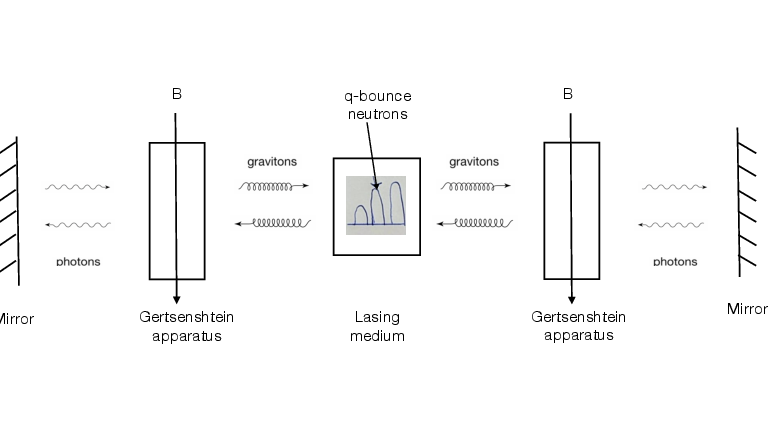
Figure 1: Schematic of the graviton-photon laser, utilizing the Gertsenshtein effect for interconversion and optical recirculation through the lasing medium.
For realistic terrestrial parameters (B∼100 T, σ=(c3ℏG)(αn′−αn)664π2,0 corresponding to σ=(c3ℏG)(αn′−αn)664π2,1 nm, σ=(c3ℏG)(αn′−αn)664π2,2 m), single-particle conversion is highly suppressed due to the smallness of σ=(c3ℏG)(αn′−αn)664π2,3. However, for intense coherent states with large occupation numbers, or astrophysical field strengths (e.g. magnetars, σ=(c3ℏG)(αn′−αn)664π2,4 T), the conversion probability can become appreciable. Importantly, any non-converted graviton fraction is irreversibly lost from the optical cavity, reducing effective amplification.
Lasing Gain, Path Length, and Practical Constraints
In conventional lasers, high gain is achieved either through high site density or repetitive traversal. For gravitons, the universal Planckian cross-section implies minuscule gain per length unless compensated by multiple passes or extremely high site densities. The Gertsenshtein-reflection protocol enables engineering a Fabry-Perot analog for gravitons, allowing the graviton beam (converted to photons for reflection) to traverse the lasing medium many times, thereby accumulating amplification.
The net round-trip gain is curtailed by
Losses in conversion efficiency at each interface (dependent on σ=(c3ℏG)(αn′−αn)664π2,5),
Absorption or scattering in the apparatus,
Practical challenges in achieving sufficient occupation number to offset the gravitational coupling suppression,
Magnetic field engineering and photon “clean-up” to maintain mode purity and prevent backconversion in the wrong direction.
The gain per pass remains essentially negligible in terrestrial conditions except for extreme occupation numbers, but is theoretically unsuppressed for astrophysical-flux scenarios (e.g. σ=(c3ℏG)(αn′−αn)664π2,6 gravitons generated in black hole mergers, yielding fluxes at Earth of σ=(c3ℏG)(αn′−αn)664π2,7/mσ=(c3ℏG)(αn′−αn)664π2,8).
Theoretical Implications and Prospects
The analysis supports the universal, mass-independent Planck scale cross-section for graviton-stimulated transitions, dictated by the equivalence principle and observed across disparate quantum gravitational systems. This exerts a profound constraint on laboratory graviton amplification: barring unforeseen means to circumvent the Planck scale, practical amplification necessitates nontrivial engineering of the occupation statistics and the exploitation of extreme astrophysical parameters.
The Gertsenshtein effect offers a mechanistically plausible, if technologically demanding, path to effective graviton recirculation. While current terrestrial feasibility remains extremely limited, the protocol closes a fundamental conceptual gap—demonstrating that graviton “mirrors” are not prohibited by first principles, but their efficacy is bounded by conversion probabilities and occupation number scaling.
(Figure 1) captures the apparatus concept, integrating a lasing medium (e.g. quantized ultracold neutron system), Gertsenshtein region for graviton-photon conversion, and photon reflection stage before reconversion and recirculation.
Conclusion
The paper establishes a theoretically consistent method for achieving graviton recirculation in a laboratory scenario by exploiting graviton-photon interconversion in external magnetic fields (Gertsenshtein effect) and completing the reflection step in the electromagnetic sector. The key theoretical result is the universality of the Planck area cross section for graviton interactions, which strongly bounds gain in all realizations but does not make laboratory amplification strictly impossible in principle. The feasibility of graviton lasing in terrestrial settings is contingent on dramatic advances in magnetic field engineering, population inversion, and occupation control. Astrophysical implementations and large-scale coherent sources remain more realistic venues for this paradigm. Future progress could arise from quantum engineering of macroscopic oscillators or exploitation of natural high-flux graviton sources in conjunction with electromagnetic conversion. The graviton laser proposal thus delineates the interface of quantum gravity, laboratory physics, and gravitational wave astronomy, and motivates further investigation of graviton-matter and graviton-photon couplings both theoretically and experimentally.
“Emergent Mind helps me see which AI papers have caught fire online.”
Philip
Creator, AI Explained on YouTube
Sign up for free to explore the frontiers of research
Discover trending papers, chat with arXiv, and track the latest research shaping the future of science and technology.Discover trending papers, chat with arXiv, and more.