- The paper presents a protocol-level attack, known as the Zaitsev machine, that extracts about 70% of sifted key bits while introducing only a 5.6% quantum bit error rate.
- The attack exploits adversarial control over the measurement device by injecting auxiliary photons and using post-selection to bypass expected security tradeoffs.
- The findings challenge current MDI-QKD security proofs, urging revisions to adversarial models and stricter control over internal measurement processes.
Critical Analysis of "Hacking measurement-device-independent quantum key distribution" (2607.01989)
Introduction
The examined work assesses the foundational assumptions of the measurement-device-independent quantum key distribution (MDI-QKD) protocol, which was initially postulated to overcome vulnerabilities associated with single-photon detectors. The authors present a theoretically sound attack, compatible with the standard MDI-QKD adversarial model, that exploits degrees of freedom available to an active adversary controlling the measurement device ("Charlie"). The attack allows the adversary to extract significant information about the secret key with only a modest increase in quantum bit error rate (QBER), without being contingent on device imperfections. This analysis provides a systematic exposition of the attack mechanism, its ramifications for the MDI-QKD security proofs, and the boundaries of protocol trust assumptions.
MDI-QKD Protocol Foundations and Adversarial Model
The MDI-QKD protocol functions by having two trusted parties, Alice and Bob, independently prepare single-photon states in one of two mutually unbiased bases—typically the rectilinear (H, V) and diagonal (D, A) polarization states—before transmitting them to the untrusted node Charlie. Charlie is permitted, per the protocol, to be fully adversarial. Bell-state measurements are performed, announcing only those coincidence outcomes corresponding to distinguishable Bell states (Ψ− and Ψ+) (Figure 1).
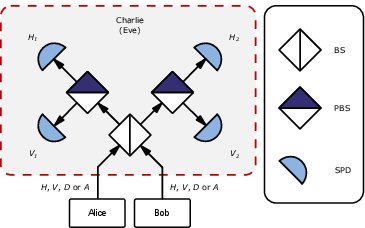
Figure 1: Schematic of the MDI-QKD protocol, highlighting the adversarial measurement node architecture.
The classical sifting procedure follows, where incompatible basis choices are discarded, and bit flips are applied to synchronize the raw key bits between Alice and Bob based on the measurement outcomes and basis information. Security is then sought in the information-theoretic sense, relying on the inability of the adversary to extract information beyond the disturbance-induced error.
Attack Mechanism: Zaitsev Machine and Post-Selection
Instead of exploiting side-channels or physical imperfections, the authors' attack (termed the Zaitsev machine) is a protocol-level manipulation that leverages the full physical latitude permitted of Charlie. By augmenting the system with auxiliary photons of known polarization—injecting four photons in total—the adversary enhances the outcome space far beyond that possible for a standard two-photon Bell measurement. This is operationalized with photon-number-resolving detectors and a suite of standard linear optical elements (Figure 2).
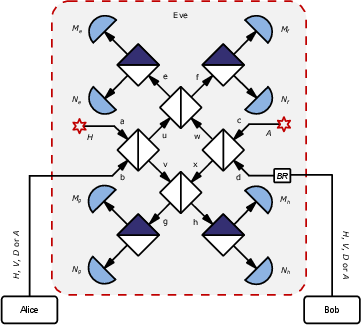
Figure 2: Zaitsev machine: the practical layout for adversarial post-selection using auxiliary photons and photon-number-resolving detection.
The attack proceeds as follows:
- Adversarial outcome selection: The eavesdropper (Eve/Charlie) arbitrarily selects which Bell outcome to "emulate" (Ψ− or Ψ+).
- Conditional bit rotation: Bob's incoming photon is subjected to a basis-altering transformation (distinct for each Bell state emulation) without disturbing Alice's.
- Auxiliary photon injection: Eve introduces two known photons into separate input modes, increasing measurement dimensionality.
- Post-selection on detection signatures: The adversary announces successful events only for a small subset of measurement outcomes—those that are maximally informative regarding the pre-announced basis choice.
- Basis-dependent bit inference: After Alice and Bob's basis announcement, Eve can, for each accepted event, infer the raw key bit with high probability, exploiting symmetries and basis rotations (Figure 3).

Figure 3: The intermediate measurement basis (interbasis) enabling optimal eavesdropper bit-discrimination across both Z and X bases.
Numerical Results
The authors calculate that with this approach, Eve acquires information about roughly 70% of the sifted key bits, while only introducing a QBER of approximately 5.6%. The key quantities derived from the explicit Fock-state evolution through the Zaitsev machine and subsequent projection onto allowed detection events are:
- Eve's bit identification probability: V0 69.4%
- QBER induced: V1 5.6%
- Fraction of key events Eve must discard to avoid higher error: acceptance rate drops from the honest 50% to roughly 7% of events.
These results place the attack well below the theoretical QKD error threshold (V211%) and within the field where legacy security analyses would still expect positive key rates.
Discussion: Security Proof Shortcomings and Practical Realizations
A key insight is that MDI-QKD security proofs—although formulated under an untrusted relay paradigm—implicitly assume the adversary can do no more than apply allowed quantum operations on the incoming states, often limited to "coherent attacks." The proposed attack, however, leverages adversarial control over the measurement device's physical implementation, producing effective measurement outcomes unanticipated by the original security model.
Crucially, this attack is not implementation-dependent: it does not exploit physical flaws but the protocol structure itself. By selectively post-selecting events with maximal information-content and discarding all others, Eve bypasses the standard information-disturbance tradeoff. The resulting reduction in key-generation rate serves as a detectable (but not inherently inescapable) byproduct, which is, in practice, potentially masked by realistic channel attenuation.
Furthermore, the only countermeasure that fundamentally impedes this attack involves either (i) increasing trust in the measurement device—thus violating the MDI paradigm, or (ii) modifying protocol assumptions to constrain internal measurement-device operations, for instance, by requiring stricter interface or randomness certification of the measurement process.
Monitoring statistics of rejected events is shown to be insufficient for robust detection, as Eve can symmetrize attack variants to erase any non-uniform statistical artifacts.
Theoretical and Practical Implications
The findings demonstrate that protocol security in QKD is contingent not merely on formal statistical security proofs but on the completeness of the underlying adversarial model. Any "device independence" guaranteed solely through external interface assumptions is vulnerable if internal operations are not adequately delimited.
Practically, the demonstrated attack compels a re-examination of MDI-QKD deployments for high-assurance applications, particularly in network architectures where optical relays are physically exposed to adversarial manipulation. The attack's modest QBER and substantial information gain indicate that finite-key analysis and composable security must explicitly address post-selection strategies and internal measurement augmentation.
Theoretically, generalizations of this approach to allow more auxiliary photons or adaptive strategies may further close the information-disturbance gap. It remains an open research direction to determine optimal adversarial strategies under physical and operational constraints and to update QKD security definitions accordingly.
Conclusion
The proposed attack fundamentally challenges whether "measurement-device-independence" is realized in current QKD protocols absent physical enforcement of trusted measurement boundaries. Achieving truly robust security will require either revised security models that explicitly constrain adversarial device implementations, or external trust mechanisms that diminish the value of measurement-device independence. This work establishes an imperative to rigorously align QKD security analyses with the strongest physically admissible adversarial capabilities and to design protocols that survive adversarial control of both interfaces and internal measurement processes.

