NeoMap: Training-free Novel-View Synthesis from Single Images and Videos
Abstract: We study the challenging problem of novel view video synthesis from single images or monocular videos. Existing methods, which operate under the assumption that pre-trained video models lack native novel view synthesis capability and enforce view alignment via camera conditioning, task-specific fine-tuning, or stepwise hard denoising guidance, often suffer from artifacts and compromised global scene consistency. In this paper, we introduce NeoMap, a novel training-free framework designed to locate high-fidelity, view-consistent novel view solutions from general pre-trained video models. The key to our approach is the core insight that promising novel view solutions are inherently encoded within the natural video data manifold learned by pre-trained models, and the core challenge is simply to locate this optimal solution. We solve this via our core mechanism: convergent manifold alternating projection iterations that optimize the initial noise. Extensive experiments demonstrate that NeoMap significantly outperforms all existing methods across 3 standard novel view synthesis benchmarks, including the challenging Tanks-and-Temples, LLFF and DAVIS datasets, achieving state-of-the-art generation fidelity and top-tier view consistency.
Paper Prompts
Sign up for free to create and run prompts on this paper using GPT-5.
Top Community Prompts
Explain it Like I'm 14
What is this paper about?
This paper is about making new camera views of a scene from just one photo or a regular video. Imagine you have a single picture of a room and you want to see what it looks like if you move the camera to the left or step forward. That’s called “novel view synthesis.” The authors introduce a method called NeoMap that does this without training a new model. Instead, it cleverly uses an existing, powerful video generator to find a result that both looks real and matches the requested camera movement.
What questions are the researchers asking?
- Can we create new, realistic camera views from a single image or a normal (one‑camera) video, without training a special model?
- Can we do it in a way that keeps the whole scene consistent, even in parts that weren’t visible before?
- Is it possible that the “right answer” already exists inside what a big pre‑trained video model can produce—and we just need to find it?
How does their method work?
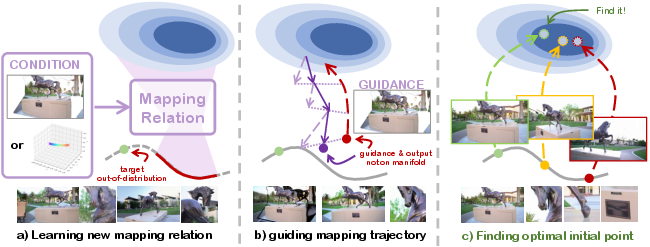
Think of a big video generator like a music playlist with millions of realistic “tracks.” If you tune the dial (the “noise seed”) just right, you get the exact “song” (video) you want. NeoMap’s idea: the correct new view is already somewhere in what this model can generate. The challenge is to tune the dial to the right spot.
Here’s the plan, in simple steps.
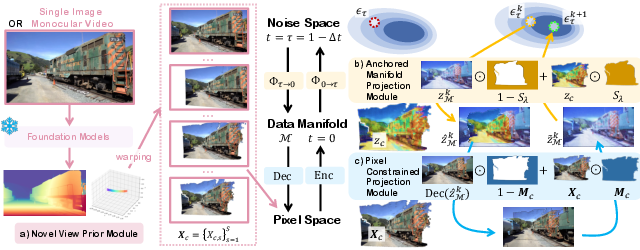
Step 1: Build a rough guess of the new view
- The method first estimates the scene’s depth (how far things are) and the camera’s position/movement from the input image or video.
- It then “warps” the original picture into the new camera angle. This gives a rough preview: some parts look okay, but hidden areas become holes, and depth errors cause glitches.
This rough preview is a useful guide, but it isn’t clean or complete.
Step 2: Anchored Manifold Projection (AMP) — make it look real, without forgetting what we know
- The video generator has a “world of realistic videos” it knows how to produce (the data manifold). NeoMap takes the rough preview and nudges it toward that world so missing regions can be “hallucinated” plausibly (filled in in a realistic way).
- But we don’t want to lose the trustworthy parts from the rough preview (the bits we actually saw). So NeoMap compares the new guess with the rough preview and keeps the parts that agree, while letting the model improve the parts that look wrong.
Think of it like asking a skilled artist to finish a sketch: “Keep the lines that are clearly correct; fix the messy areas.”
Step 3: Pixel‑Constrained Projection (PCP) — lock in the exact geometry
- Some blending in the model’s hidden space can cause “bleeding” (shapes drift or smear).
- To fix this, NeoMap goes back to actual pixels and forces the visible parts (the ones we’re sure about) to match the warped preview exactly, using a visibility mask. That way, the geometry we know stays locked, while the model fills in the rest.
This is like placing a transparent stencil over the drawing: inside the cutouts, the lines must match exactly; outside, the artist is free to make it look natural.
Alternate between the two until they agree
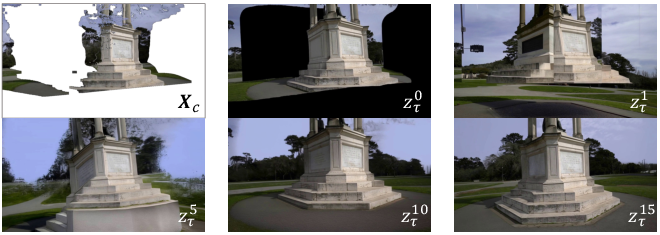
- NeoMap ping‑pongs between “make it realistic” (AMP) and “lock the geometry” (PCP). Each step corrects what the other might have loosened.
- Repeating this “alternating projection” gradually lands on a version that is both realistic and correctly aligned to the new camera view.
Keep the camera on track early
- Early steps in video generation decide the big picture (layout, camera motion).
- To avoid drifting off‑track, NeoMap briefly re‑anchors the process in those early steps, then lets the model complete the fine details.
What did they test and find?
The authors tested NeoMap on three standard benchmarks:
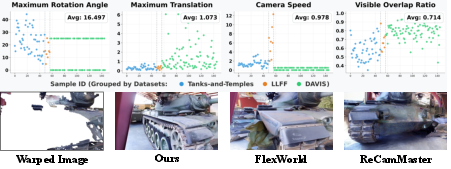
- Tanks and Temples (indoor/outdoor scenes with big camera moves)
- LLFF (forward‑facing scenes with challenging details)
- DAVIS (dynamic videos with moving objects)
Results:
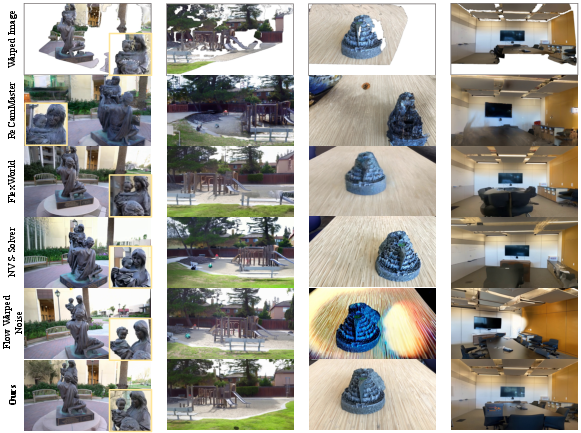
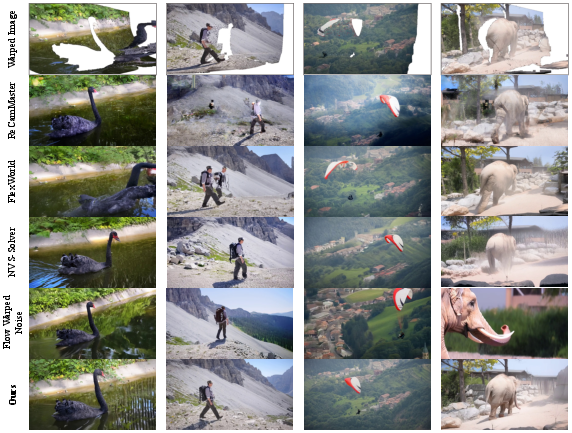
- NeoMap produced sharper, more realistic frames with fewer artifacts than competing methods.
- It kept the camera motion accurate and the scene consistent, even in tricky dynamic scenes.
- It beat or matched state‑of‑the‑art methods across many measures of visual quality and camera accuracy, without any extra training.
In short: it looks better and stays better aligned, especially in the hard parts most methods struggle with (holes from occlusion, depth mistakes, and moving objects).
Why does this matter?
- Better AR/VR: You can move your viewpoint smoothly from limited input.
- Faster 3D/4D content creation: Creators don’t need to collect tons of images or train special models.
- Robotics and perception: A robot could imagine new angles from a single view to plan safer paths.
- Video editing and storytelling: Directors can “re‑shoot” a scene from new angles with minimal data.
Because NeoMap is training‑free, it’s easier and cheaper to use. It’s a practical step toward reliable, realistic view changes from minimal input.
Key terms made simple
- Novel View Synthesis (NVS): Making a picture or video from a new camera angle using limited input (like one photo).
- Depth and Camera Pose: Depth is how far things are; camera pose is where the camera is and where it’s pointing.
- Noise Seed (Initial Noise): A random starting code that the video model turns into a finished video; picking the right seed “tunes in” the video you want.
- Data Manifold: The set of all videos the model considers “realistic.” Staying on it avoids weird artifacts.
- Alternating Projections: Repeatedly applying two rules (make it realistic; lock the geometry) until both are satisfied.
Knowledge Gaps
Knowledge gaps, limitations, and open questions
Below is a single, concise list of what remains missing, uncertain, or unexplored in the paper, phrased to guide future research:
- Theoretical guarantees of convergence: Alternating projections are performed onto two highly non-convex sets (the learned video data manifold and the NVS constraint set), with only approximate projections (one-step Euler flow, VAE encode/decode, hard masking). The paper asserts convergence (Appendix A) but does not rigorously characterize conditions, error bounds, or basins of attraction under these approximations.
- Validity of the core manifold assumption: The approach assumes that a high-quality, view-consistent solution exists within the pretrained model’s output manifold for any input/target pose. There is no criterion to detect when the manifold lacks such a solution (e.g., rare object categories, extreme camera motions, out-of-domain scenes), nor a fallback strategy.
- Generality across model backbones and sampling regimes: Experiments use Wan2.2-I2V-A14B with a deterministic ODE solver (UNIPC). It is unclear how well NeoMap transfers to:
- Other video backbones (e.g., Stable Video Diffusion variants, CogVideoX, HunyuanVideo, VideoCrafter2).
- Stochastic SDE-based samplers, classifier-free guidance, or different ODE solvers and schedules.
- Different VAEs or latent compression ratios.
- Sensitivity to key hyperparameters and automatic tuning: Only limited ablations are provided for the number of alternating iterations K and the similarity threshold λ. The method does not study sensitivity to:
- The near-noise timestep τ (and Δt) and its impact on stability/quality.
- The amount of Gaussian noise injected per AMP iteration.
- Solver step counts and step sizes during projection and final generation.
- There is no mechanism for data-driven or adaptive per-scene hyperparameter selection.
- Stability across random seeds and run-to-run variance: AMP explicitly injects random Gaussian noise each iteration, yet the paper does not report variance across seeds, failure rates, or confidence intervals.
- Robustness to depth/pose estimation errors: The pipeline depends on VGGT/VIPE (and COLMAP calibration for TNT) for depth and camera. The sensitivity of NeoMap to:
- Scale drift, pose bias, depth noise, and rolling-shutter effects.
- Nonrigid motion and inaccurate motion segmentation in dynamic scenes.
- is not systematically analyzed.
- Visibility mask quality and blending artifacts: PCP uses a binary visibility mask for hard pixel-space overwrites. The method does not investigate:
- Soft/confidence-weighted masks to handle depth uncertainty and silhouette boundaries.
- Edge-aware/anti-aliased blending to reduce seams.
- Temporal consistency of masks and flicker at mask boundaries.
- Temporal coherence analysis: While FVD is reported on DAVIS, the paper does not quantify temporal flicker, boundary popping, or long-horizon consistency for static datasets, nor study how PCP’s hard constraints affect temporal stability.
- Camera accuracy evaluation protocol: The paper reports ATE/RPE for generated videos but does not specify how camera poses are extracted from outputs, how scale is handled, or how estimator error affects the metrics. Potential biases from using the same or similar estimators for both inputs and outputs are not examined.
- Compute/memory cost and scalability: There is no reporting of runtime, GPU memory, or latency. The cost of K alternating projections (with repeated VAE encode/decode and flow steps) plus 15 denoising steps is unclear. Scalability to higher resolutions (e.g., 4K), longer sequences, and resource-constrained settings is not evaluated.
- Performance under extreme viewpoint changes and large disocclusions: Although qualitative results are shown, the method is not quantitatively stress-tested on extreme camera motions that induce large disoccluded regions, nor are failure cases analyzed.
- Identity and fine-structure preservation: The paper does not assess preservation of human identity, small/thin structures, or high-frequency textures in hallucinated regions (e.g., with identity metrics or fine-detail benchmarks).
- Multi-view inputs and fusion: The method targets single-image or monocular video. How to extend the projections to fuse multiple reference views (and how that affects the mask/AMP/PCP design) is not explored.
- Interaction with text or other conditions: Many video generators are text-conditioned; the paper does not study how text prompts, style controls, or additional conditions interact with NeoMap, nor whether conditioning can aid hallucination in unseen regions.
- Similarity metric and masking strategy: AMP uses latent cosine similarity with a hard threshold to decide which regions to “trust.” Alternatives (e.g., soft weights, uncertainty-aware masks, cross-attention saliency, multi-scale features) and their impact on quality and stability are not investigated.
- Projection operator design: AMP uses a one-step large-stride Euler approximation; higher-order or multi-step projections could reduce integration error. The trade-offs between stronger projections, cost, and quality have not been studied.
- Re-anchoring schedule and adaptivity: Trajectory re-anchoring is applied for a fixed number of early denoising steps (3 by default). There is no adaptive scheme to detect and correct drift when it occurs, nor an analysis of scene-dependent schedules.
- VAE dependence: PCP relies on repeated VAE encode/decode, which introduces compression artifacts and potential temporal inconsistencies. The impact of VAE quality, alternative VAEs, or image-space operations that avoid repeated compression is not quantified.
- Benchmark selection and bias: TNT evaluation filters out scenes with “totally unconstrained views,” potentially biasing comparisons away from the hardest cases. Broader benchmarks (with uncurated trajectories, indoor/outdoor diversity, extreme motions) are not included.
- Baseline fairness and comparability: Some baselines are adapted to the Wan backbone, while others use their native backbones/training. The influence of backbone capacity, training data, and conditioning differences on comparative results is not disentangled.
- Failure detection and remedial strategies: The method lacks a criterion to detect when alternating projections diverge or settle into implausible solutions, and it provides no remedial actions (e.g., adjust τ, K, λ, or switch to different constraints).
- Physical/multiview consistency: Beyond pixel masking, there is no explicit enforcement or evaluation of consistent 3D geometry (e.g., epipolar constraints, multiview photometric consistency, depth coherence across frames/views).
- Applicability to downstream/real-time applications: The paper does not evaluate suitability for AR/VR or robotics (latency, determinism, reliability), nor consider how to bound hallucinations for safety-critical use cases.
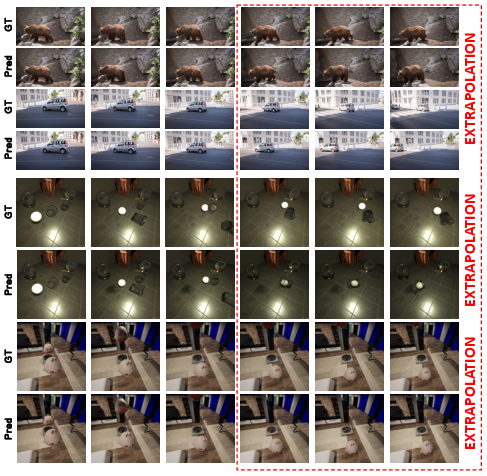
- Extent of generalization beyond NVS: The future extrapolation demo is qualitative only; the method’s effectiveness on related tasks (e.g., long-horizon prediction, video completion) lacks quantitative benchmarks and comparisons.
- Reproducibility constraints: Although code is promised, dependence on Wan2.2 (and third-party depth/pose models) may limit reproducibility. The paper does not specify model licenses, versions, or checkpoints required to replicate results.
Practical Applications
Practical Applications of NeoMap
Below we translate the paper’s findings, methods, and innovations into concrete applications. Each item indicates sectors, suggested tools/workflows, and key assumptions/dependencies that affect feasibility.
Immediate Applications
- Bold virtual camera moves and re-framing for post-production — sectors: media/entertainment, software
- What: Generate smooth dolly, crane, and orbit shots from a single plate or monocular b‑roll without model fine-tuning.
- Tools/workflows: NeoMap as an Adobe After Effects/Nuke/Premiere/DaVinci Resolve plug-in; batch CLI service wrapping VGGT/VIPE for depth/pose and Wan-based video model; “camera path from 3D gizmo” UI.
- Assumptions/dependencies: High-quality depth/pose for the shot; scenes consistent with the video model’s training distribution; GPU with sufficient VRAM; licensing for pre-trained video model (e.g., Wan2.x).
- Rapid AR/VR environment prototyping from a single image — sectors: AR/VR, gaming, software
- What: Turn mood boards or concept art frames into short fly-throughs to preview spatial layouts.
- Tools/workflows: Unity/Unreal editor extension that sends stills to a NeoMap microservice; camera path authoring with spline tools.
- Assumptions/dependencies: Naturalistic textures favored; large occlusions are hallucinated plausibly but not ground-truth; not a substitute for 3D assets in production.
- E-commerce “3D-like” product spins and parallax animations — sectors: retail/marketing, web
- What: Create multi-angle promos from a single product photo or short clip.
- Tools/workflows: Shopify/Magento plugin; WebGL/Three.js viewer for interactive playback; CDN microservice for batch processing.
- Assumptions/dependencies: Clean background and distinct object boundaries help depth estimation; reflective/transparent items may require careful art direction.
- Real estate and architecture previews from minimal capture — sectors: real estate/AEC, proptech
- What: Produce walk-throughs or orbit views from a short phone video or a few photographs.
- Tools/workflows: Mobile capture app that estimates depth/pose on-device or in-cloud; web viewer embedding; “auto-path” presets (walk-in, orbit, dolly).
- Assumptions/dependencies: Indoor lighting and repeating textures can challenge monocular depth; not a replacement for as-built scans; disclose generative hallucinations.
- Social media 3D photo and cinematic parallax effects — sectors: consumer apps
- What: One-tap “make it 3D” for stills; dolly-zoom, table-top orbit, or push-in effects.
- Tools/workflows: iOS/Android SDK; preset motion library; on-device lightweight inference with server fallback.
- Assumptions/dependencies: Mobile-grade depth can be noisy; privacy-friendly handling of user images; compute constraints may require reduced resolution.
- Sports and news replays with mild viewpoint shifts — sectors: broadcast, live media
- What: Enhance replays with subtle virtual camera offsets for clarity without multi-camera rigs.
- Tools/workflows: OB truck plug-in to process key clips; operator UI to sketch desired camera move.
- Assumptions/dependencies: Keep viewpoint shifts small to avoid hallucinations of unseen action; depth on fast motion is harder—use selectively.
- Robotics/computer vision data augmentation (monocular) — sectors: robotics, autonomy, academia
- What: Synthesize adjacent views from monocular footage for training robust perception models.
- Tools/workflows: PyTorch dataset transform; ROS node that generates auxiliary viewpoints per frame; curriculum with controlled camera deltas.
- Assumptions/dependencies: Use for non-safety-critical pre-training/augmentation; validate domain shifts; limit to small baselines to avoid label drift.
- Benchmarking and method studies in vision and graphics — sectors: academia
- What: Use NeoMap as a strong training-free baseline for novel-view video generation; analyze AMP/PCP alternating projections.
- Tools/workflows: Reproducible evaluation on TNT, LLFF, DAVIS; ablation harness for iteration count K, similarity threshold λ, re-anchoring steps.
- Assumptions/dependencies: Open-source code availability; consistent camera scale alignment; standardized metrics (FID/FVD/CLIP-S/ATE/RPE).
- Video-to-video future extrapolation previews — sectors: media, research
- What: Predict a few plausible future frames conditioned on observed frames to aid editing/storyboarding.
- Tools/workflows: Timeline tool that marks visible frames vs. future frames; render multiple extrapolations for selection.
- Assumptions/dependencies: Not a forecasting oracle; moving objects are hallucinated from learned priors—use as creative aid, not analytics.
- Cultural heritage and education visualizations — sectors: culture/education
- What: Turn archival photos into gentle viewpoint variations for exhibits and explorable lessons.
- Tools/workflows: Museum kiosk player with “micro-parallax” controls; educator tool to predefine safe camera moves.
- Assumptions/dependencies: Hallucinations must be clearly labeled; conservative viewpoint ranges to avoid historical misrepresentation.
Long-Term Applications
- Real-time AR glasses and mobile on-device view synthesis — sectors: AR wearables, mobile silicon
- What: Live, low-latency parallax and reframing of the user’s monocular stream for telepresence and accessibility.
- Tools/workflows: Hardware-accelerated VAE/flow models; fused SLAM + NeoMap pipeline; partial precomputation for recurring scenes.
- Assumptions/dependencies: Model compression/distillation; reliable, low-power depth/pose; privacy/security guarantees.
- Free-viewpoint video for live broadcast from sparse cameras — sectors: broadcast/sports
- What: Generate convincing virtual camera angles from a handful of monocular cameras instead of dense arrays.
- Tools/workflows: Multi-feed synchronization; cross-view depth fusion; real-time AMP/PCP variants with safety rails for artifact detection.
- Assumptions/dependencies: High framerate, low latency inference; strict quality gating; small-to-moderate viewpoint changes.
- Robotics navigation and planning with imagined occluded views — sectors: robotics, autonomy, industrial
- What: Use synthesized adjacent viewpoints to probe occlusions, improve mapping, and stress-test planners.
- Tools/workflows: “Imagination module” in the perception stack; simulator-in-the-loop evaluation; learn-to-trust scoring of synthesized pixels.
- Assumptions/dependencies: Not for direct decision-making without uncertainty modeling; requires calibration with ground-truth sensors; safety certification.
- Monocular-to-digital-twin bootstrapping — sectors: manufacturing, facilities, smart cities
- What: Accelerate digital twin creation from existing CCTV/inspection videos before precise scans are available.
- Tools/workflows: Pipeline that turns archives into exploratory fly-throughs to plan scanning; human-in-the-loop QA.
- Assumptions/dependencies: Use as a planning/preview step only; high-fidelity geometry still needs LiDAR/photogrammetry.
- Integration with 3DGS/NeRF for hybrid 3D reconstruction — sectors: 3D/graphics, research
- What: Use NeoMap outputs to fill occlusions and regularize 3D reconstructions from sparse inputs.
- Tools/workflows: Alternating optimization between synthesis (NeoMap) and reconstruction (NeRF/GS); confidence masks for synthesized pixels.
- Assumptions/dependencies: Explicit uncertainty propagation; risk of biasing reconstructions if hallucinations are trusted blindly.
- Standard feature: “Generative camera control” in NLEs and mobile editors — sectors: software, consumer apps
- What: Make 3D reframing and smooth virtual camera moves a default editing primitive.
- Tools/workflows: Auto-camera suggestions; safety sliders for “hallucination extent”; artifact heatmaps.
- Assumptions/dependencies: Broad device support; UX for disclosure and artifact awareness; content provenance integration.
- Telemedicine/endoscopy viewpoint hallucination for training and planning — sectors: healthcare
- What: Augment training videos with plausible unseen angles for educational exploration.
- Tools/workflows: Simulator overlay in surgical training; side-by-side real vs. synthesized comparisons.
- Assumptions/dependencies: Domain-specific depth/pose models; rigorous clinical validation; never used for diagnosis/real-time guidance without approvals.
- Policy and standards for synthetic camera motion disclosure — sectors: policy, media governance
- What: Establish guidelines to label and watermark generative viewpoint changes in journalism and advertising.
- Tools/workflows: Built-in provenance (e.g., C2PA); tamper-evident logs of camera paths and AMP/PCP parameters; QA checklists.
- Assumptions/dependencies: Cross-industry adoption; clear definitions of acceptable use; compatibility with platform policies.
- Large-scale dataset generation for 4D modeling and training — sectors: AI research, simulation
- What: Produce diverse novel-view clips from limited monocular datasets for training camera-aware video models.
- Tools/workflows: Data engine with parameter sweeps over camera paths, iteration counts K, thresholds λ; filtering by ATE/RPE and perceptual metrics.
- Assumptions/dependencies: Prevent feedback loops (train-on-synthesized data drift); require quality gates and diversity controls.
- Multimodal extensions (audio-visual camera-aware generation) — sectors: media tech, R&D
- What: Couple synthesized camera motions with physically consistent audio spatialization and Foley.
- Tools/workflows: Joint audio-visual flow models; audio panning tied to virtual camera trajectory.
- Assumptions/dependencies: New multimodal training or adaptation; evaluation protocols for cross-modal realism.
Cross-cutting assumptions and dependencies
- Depth/pose quality: NeoMap relies on monocular depth and camera estimation (e.g., VGGT/VIPE); severe errors reduce geometric fidelity.
- Domain fit: Performance is best on scenes within the pre-trained video model’s manifold; highly unusual domains (medical, scientific imagery) require adaptation.
- Compute: Typical runs need modern GPUs; latency and resolution scale with denoising steps and AMP/PCP iterations.
- Legal/ethical: Respect IP of source images/videos; disclose generative content; avoid safety-critical use without robust uncertainty handling and validation.
- Provenance: Consider embedding metadata/watermarks to mark synthesized views and camera trajectories.
Glossary
- Absolute Trajectory Error (ATE): A metric that measures the absolute difference between estimated and ground-truth camera trajectories. "we report Absolute Trajectory Error (ATE) and Relative Pose Error for translation (RPE-T) and rotation (RPE-R)."
- Alternating Projections onto Sets: An iterative method that projects a point back and forth between constraint sets to converge to their intersection. "Our proposed pipeline can be theoretically formulated as Alternating Projections onto Sets."
- Anchored Manifold Projection (AMP): A module that pushes latents toward the natural video manifold while anchoring reliable regions to priors. "we propose the Anchored Manifold Projection (AMP) module as the first component of our alternating projection framework."
- Auxiliary Trajectory Re-anchoring: A strategy applied during early denoising steps to prevent integration drift and maintain camera alignment. "Auxiliary Trajectory Re-anchoring"
- Camera extrinsics: External camera parameters (rotation and translation) that define the camera’s pose in the world. "primarily focused on incorporating camera extrinsics directly into the generation process"
- CLIP Similarity (CLIP-S): A measure of semantic alignment between generated images and references using CLIP embeddings. "including PSNR, SSIM, LPIPS, Frechet Image Distance (FID), Frechet Video Distance (FVD), and CLIP Similarity (CLIP-S), respectively."
- COLMAP: A structure-from-motion and multi-view stereo pipeline used for camera calibration and reconstruction. "we use VGGT with calibration by COLMAP to recover camera trajectories."
- Data manifold: The low-dimensional set in latent space representing valid natural videos learned by the model. "All semantically valid natural videos are mapped to a smooth low-dimensional data manifold "
- Deterministic flow-based video generation models: Generative methods that map noise to data via deterministically integrated vector fields. "Our framework is compatible with deterministic flow-based video generation models, including Flow Matching and Probability Flow ODE (PF-ODE)."
- Euler approximation: A numerical method using a single large step to approximate ODE integration. "we employ a one-step large-stride Euler approximation of the generative reverse flow"
- Flow Matching: A training objective that learns continuous flows mapping noise to data distributions. "including Flow Matching and Probability Flow ODE (PF-ODE)"
- Forward (noising) flow: The mapping that moves data latents toward noise as time increases. "Forward (noising) flow: maps a data latent to a noised code as time "
- Frechet Image Distance (FID): A perceptual quality metric comparing feature distributions of generated and real images. "Frechet Image Distance (FID)"
- Frechet Video Distance (FVD): A metric evaluating visual quality and temporal coherence by comparing video feature distributions. "Frechet Video Distance (FVD)"
- Latent blending: Mixing latent representations to combine priors and manifold projections. "Latent blending inevitably induces spatial bleeding and global structural shifts"
- Latent space: The compressed representation space produced by the VAE where generation and editing operate. "A pre-trained video Variational Autoencoder (VAE) maps an input video to a low-dimensional latent space "
- Ordinary Differential Equation (ODE): A differential equation governing the continuous flow from noise to data in flow-based models. "following the Ordinary Differential Equation (ODE):"
- Optical flow: The per-pixel motion field between frames, used to warp noise or features over time. "according to optical flow inherently establishes robust temporal consistency"
- Out-of-distribution (OOD): Latent codes or samples that fall outside the learned manifold and yield invalid content. "out-of-distribution (OOD) codes lie outside and produce invalid content."
- Pixel-Constrained Projection (PCP): A module that enforces strict geometric constraints by blending in pixel space using visibility masks. "Pixel-Constrained Projection (PCP) module"
- Probability Flow ODE (PF-ODE): The deterministic ODE counterpart to diffusion SDEs, mapping noise to data along probability flow. "Probability Flow ODE (PF-ODE)"
- Relative Pose Error (RPE-R): A rotation-specific metric of relative camera pose accuracy between consecutive frames. "Relative Pose Error for translation (RPE-T) and rotation (RPE-R)"
- Relative Pose Error (RPE-T): A translation-specific metric of relative camera pose accuracy between consecutive frames. "Relative Pose Error for translation (RPE-T) and rotation (RPE-R)"
- SE(3): The Lie group of 3D rigid transformations (rotations and translations) used to represent camera poses. ""
- Spatial-temporal prior: Learned model knowledge capturing consistent structure across space and time. "the model naturally leverages its learned spatial-temporal prior to broadcast the information"
- Variational Autoencoder (VAE): A generative encoder–decoder model that maps videos to and from a latent space. "A pre-trained video Variational Autoencoder (VAE) maps an input video"
- Vector field: The time-dependent function defining the velocity of latent states under the flow. "Flow-based video generation models learn a continuous vector field governing latent code evolution"
- Visibility mask: A binary map indicating pixels reliably visible after warping, used to constrain blending. "along with a binary visibility mask "
- Warping operator: A function that projects source content to target views using depth and camera poses. "we use a warping operator to project the source video content"
Collections
Sign up for free to add this paper to one or more collections.