- The paper reveals that steering vectors effectively control global stylistic traits while struggling with nuanced expressions.
- It employs a paired data extraction method and evaluates various compositional strategies to examine trait-specific activation differences.
- Findings indicate that task transfer and multi-trait composition significantly degrade output coherence and expressibility, highlighting scalability challenges.
Limits of Steering Vectors for Preference-Aligned Generation in LLMs
Introduction
Steering vectors, constructed as activation-space directions within transformer-based LLMs, have gained adoption as a lightweight, training-free mechanism for achieving controlled text generation, offering a compelling alternative to weight finetuning and prompting strategies. While prior work has demonstrated steering for isolated traits and behaviors, the boundaries of this approach—particularly its extensibility across diverse user preferences, transferability across tasks, and ability to compose multiple stylistic constraints—remain underexplored. The paper “On the Limits of Steering Vectors for Preference-Aligned Generation” (2607.01802) delivers a systematic analysis along these dimensions using the PLUME benchmark for writing personalization.
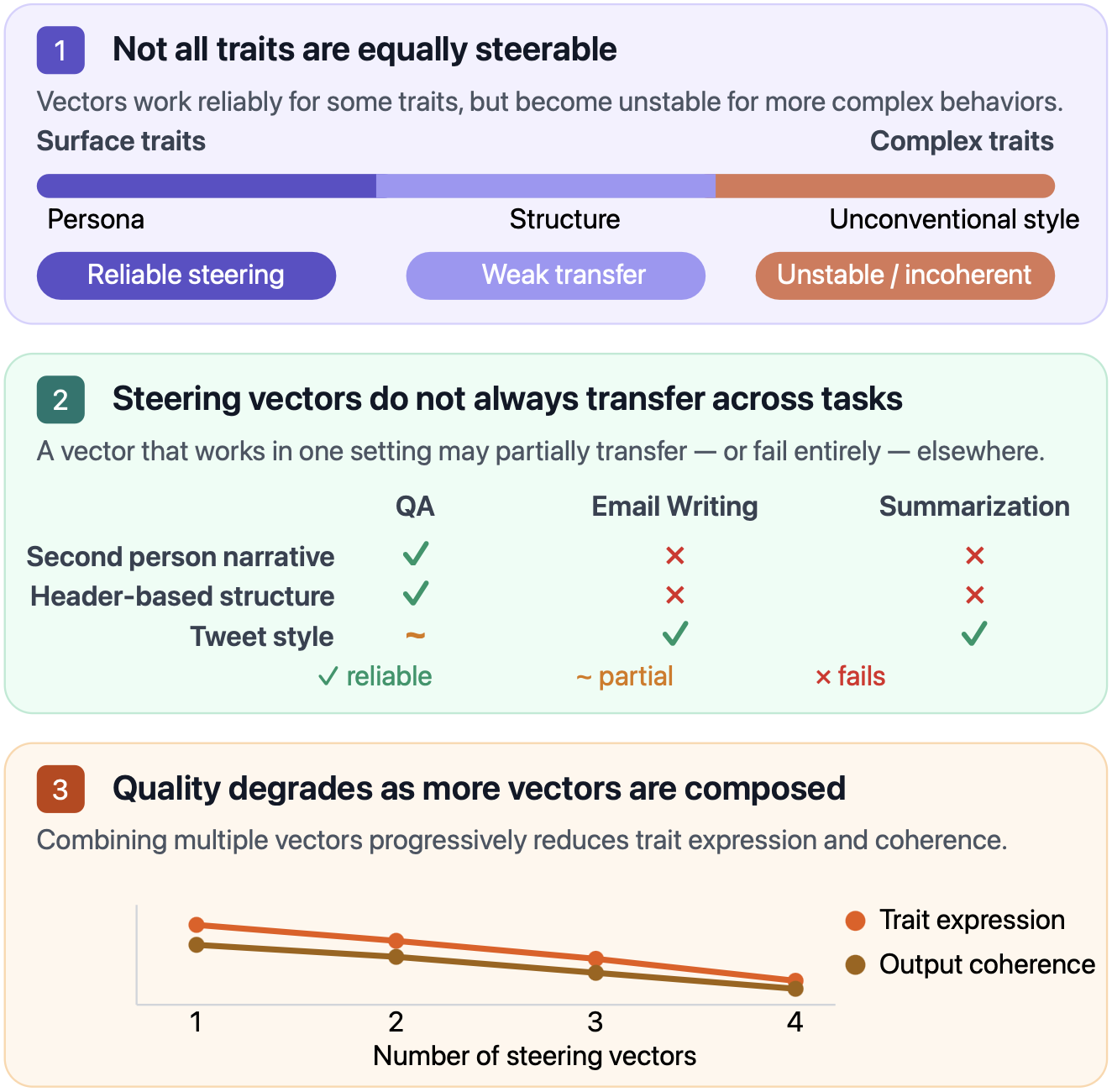
Figure 1: A systematic study of limitations for steering vectors, varying trait types, tasks, and the number of simultaneously applied steering vectors.
Extraction and Methodology of Steering Vectors
The steering vector method employed in the study follows the PersonaVectors paradigm [chen2025personavectorsmonitoringcontrolling], comprising four steps: paired data generation for trait elicitation and suppression, extraction of trait-specific activation differences at chosen transformer layers, application of these vectors at inference, and exploration of composition methods for multi-trait interventions.
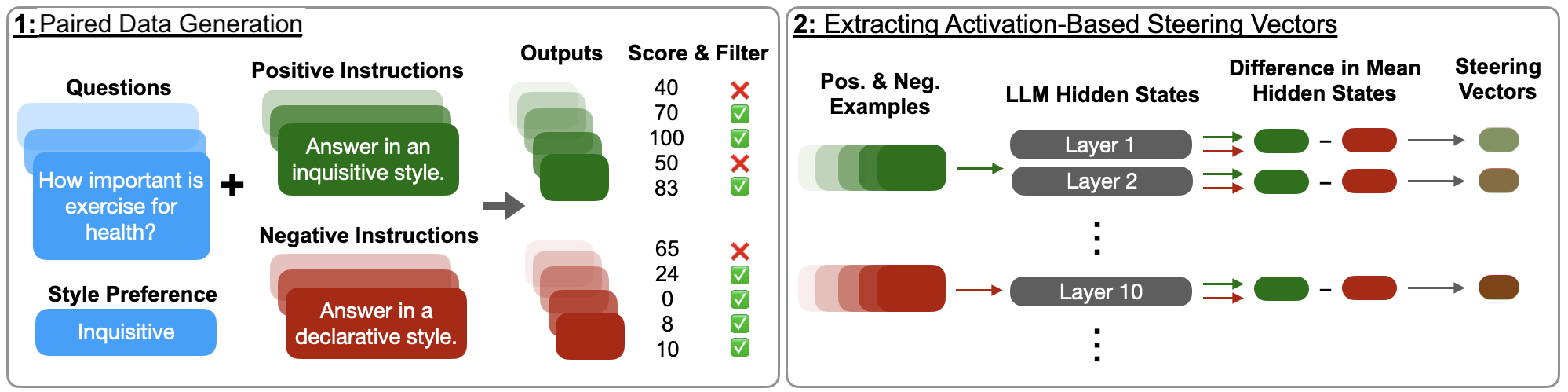
Figure 2: Extraction pipeline for steering vectors by generating positive and negative samples for a stylistic trait and calculating layer-wise activation differences.
Steering vectors vk(l) for trait k at layer l are computed as the difference in mean hidden states between positive and negative examples. The vectors are inserted into the model’s residual stream during inference, modulated by layer and coefficient hyperparameters that are tuned for a coherence-expression tradeoff. For composing multiple traits, orthogonalization, different-layer insertion, tuned mean, and unit norm averaging strategies are evaluated.
The evaluation protocol leverages two open-source models (Qwen2.5-7B-Instruct, Llama3.1-8B-Instruct), measuring trait expression and coherence via LLM-as-a-judge (GPT-4o, GPT-4.1-mini), and focuses on both trait-specific extraction tasks as well as transfer to more realistic downstream settings (summarization and email-writing) in PLUME.
Trait Controllability: Expressibility and Model-Dependence
Steering vector efficacy is highly trait and context-dependent. Traits that affect global structure (e.g., list formatting, formal tone, rhetorical questions) are consistently expressive and yield coherent generations for both Qwen and Llama models. In contrast, more localized or unconventional stylistic traits (e.g., rhyming, conditional expressions, third-person narrative) show weak controllability—either producing low expression of the intended style, or degrading output coherence.
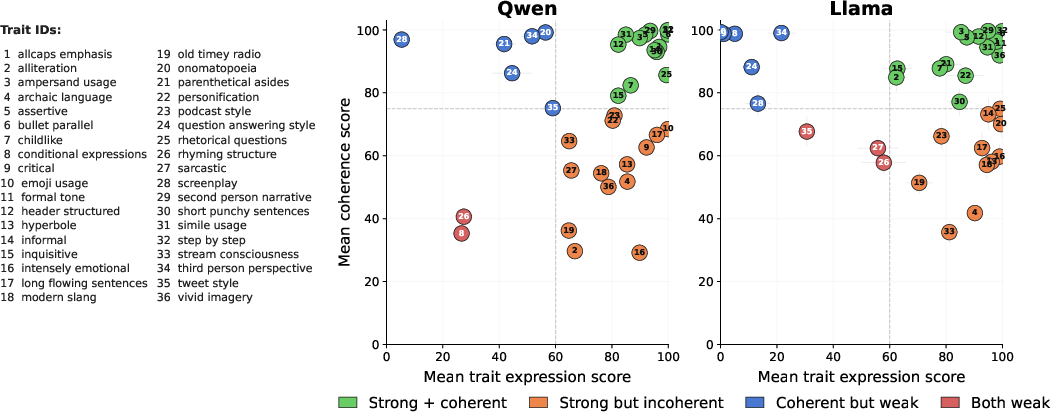
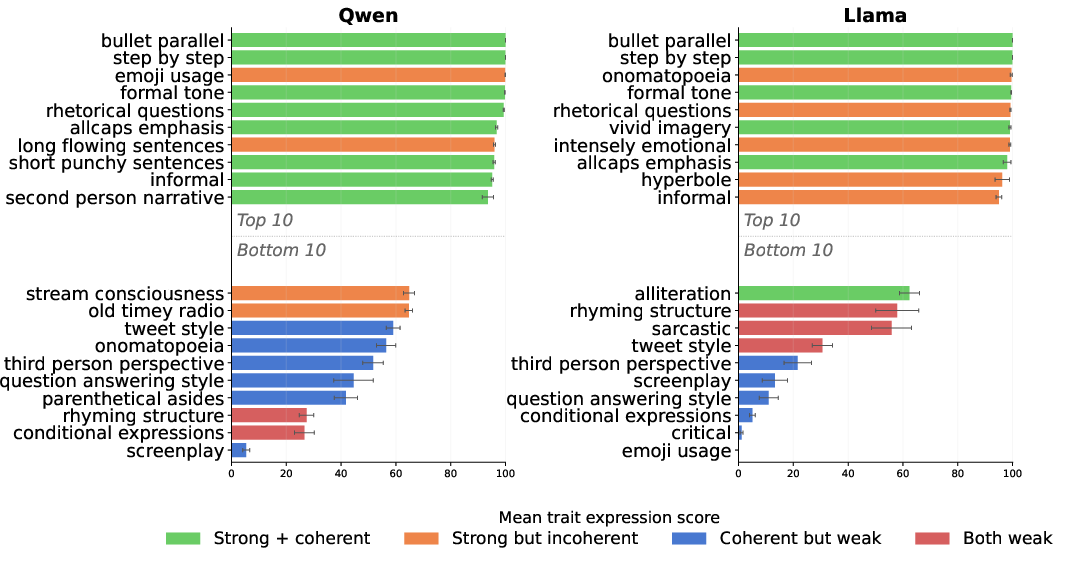
Figure 3: Substantial variance of steering effectiveness across stylistic traits—global structural traits perform best, while many nuanced styles induce incoherence or negligible expression.
The observed divergence between models for certain traits (e.g., emoji usage for Qwen, onomatopoeia for Llama) indicates that model inductive bias and pretraining distribution play a critical role in steerability ceilings.
Task Transfer: Generality and Fragility of Steering
A central finding is that steering vector effectiveness often fails to generalize: vectors tuned and extracted in instruction-focused settings exhibit notable drops in trait expression when applied to downstream writing tasks (summarization, email generation) with their own distinct content demands and narrative constraints. The degradation is most pronounced in summarization, corroborating that trait steering interacts non-trivially with genre naturalness and the prevalence of a style in the target data.
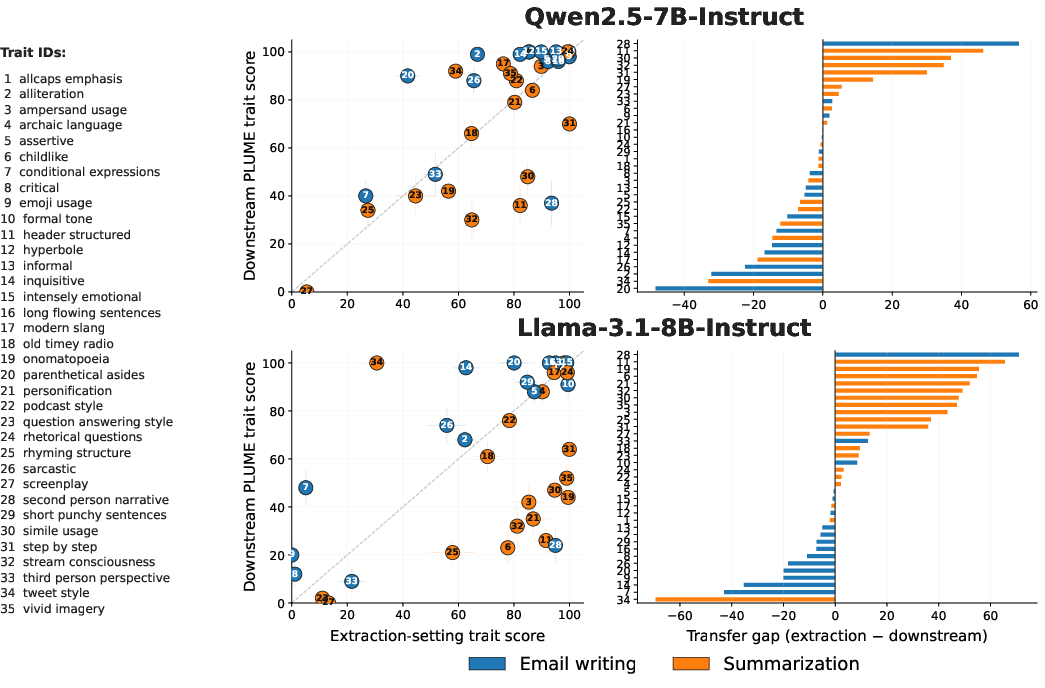
Figure 4: Divergence in steering performance between extraction and downstream settings, quantified as gaps in trait expression scores (positive—stronger in extraction, negative—stronger in downstream tasks).
Such transfer failures evidence that steering vectors, while capturing interpretable activation geometry for certain traits in isolation, encode both trait and task/context-specific directions. This raises concerns for their use as general-purpose alignment probes or interventions.
Multi-Trait Composition: Expressibility-Coherence Tradeoff
When combining multiple steering vectors, all tested composition methods exhibit significant declines in average trait expression, with output coherence also dropping as the number of combined traits increases. The only class of methods that consistently retains acceptable coherence—in particular, unit norm averaging at higher layers—do so at the cost of further reducing trait distinctiveness, and may induce imbalance between simultaneously steered traits.
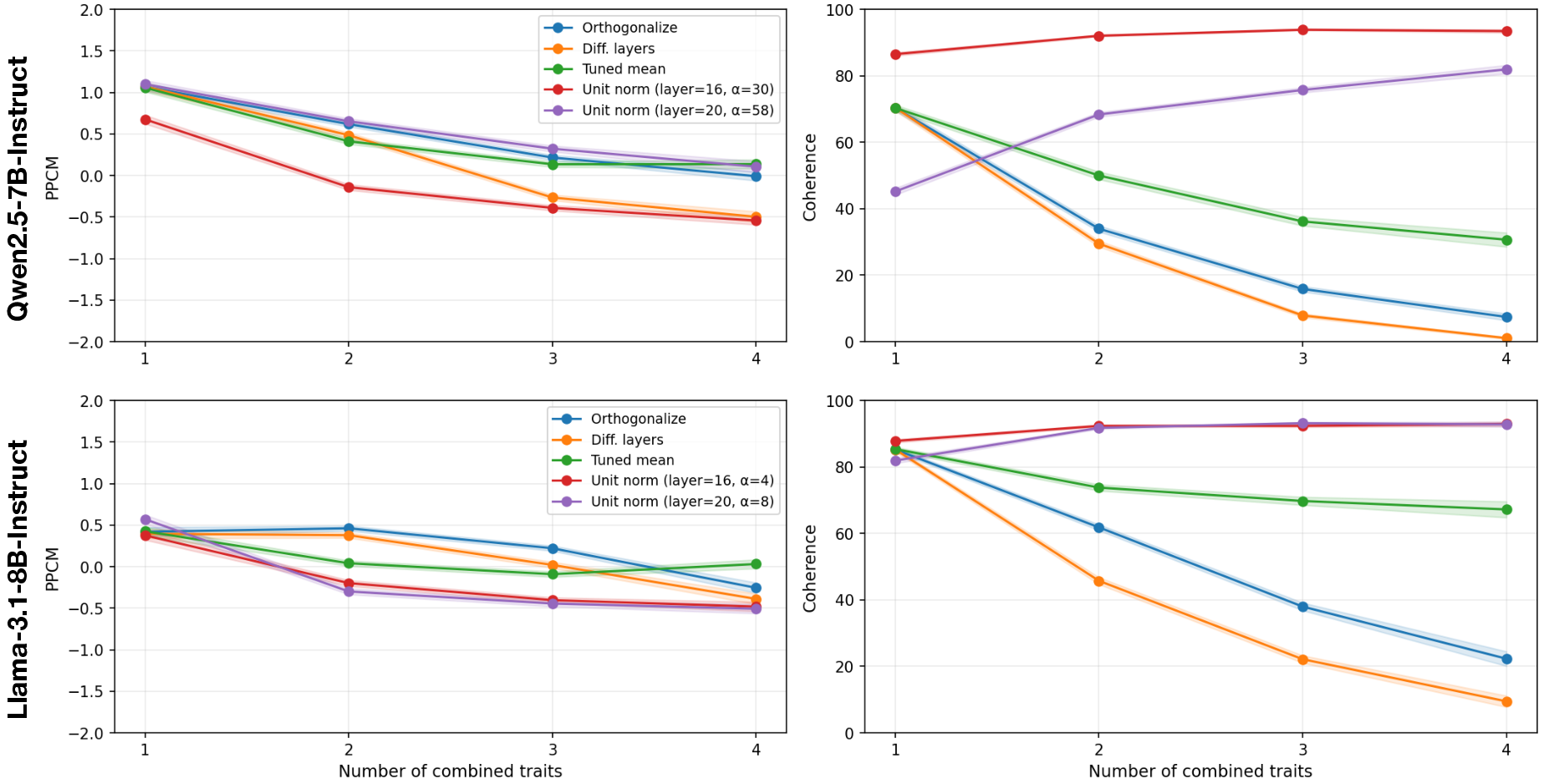
Figure 5: Multi-trait steering degrades both expressibility (PPCM) and coherence non-linearly as the number of traits increases; unit norm approaches control incoherence but require aggressive hyperparameter tuning for balance.
The study demonstrates no universal solution: different combination approaches entail different tradeoffs, and trait expression often saturates or collapses with three or more traits. Moreover, the optimal α parameter for balancing expression and coherence is not only trait- and model-specific but also scales with the number of composed vectors—enforcing a growing hyperparameter and layer-selection burden.
Implications and Future Directions
The analysis exposes a series of limits on the flexibility and reliability of steering vectors as a paradigm for in-context, interpretable, and modular behavioral control in LLMs:
- Expressibility Bounds: Only certain stylistic or globally-structured traits are robustly steerable, with model biases setting hard limits on achievable control for nuanced styles.
- Task Generalization: Steering vector efficacy is often tightly tied to the data and prompt distribution used for extraction, hindering zero-shot transferability to realistic, downstream settings—an important consideration for alignment and diagnostic workflows.
- Scalability: As the number of simultaneously imposed preferences grows, both expressibility and output coherence suffer, and application requires substantial per-setting and per-trait hyperparameter tuning.
Practically, these observations question the suitability of steering vectors as a catch-all method for preference-aligned generation or as a foundation for trustworthy alignment indicators. Theoretically, the fragility of steering-based control spotlights the entanglement between high-level user preferences and distributed model representations, and suggests that training-time alignment or hybrid approaches will likely remain necessary for scalable, robust controllability.
Future work should investigate hybrid or hierarchical representation engineering (e.g., disentangling trait-agnostic and trait-specific subspaces), deeper causal analysis of activation directions, automated tuning for scalable multi-trait composition, and the interplay of activation steering with larger, more capable model families.
Conclusion
The paper substantiates clear boundaries to the utility of steering vectors in aligning LLM outputs for complex or personalized stylistic intents. Trait expressibility varies widely; transfer across tasks is unreliable; and scalable composition incurs substantial costs in coherence and expressibility, demanding non-trivial engineering for each application. As a result, activation steering, while valuable for narrow, interpretable interventions, faces structural limits as a general-purpose alignment lever for open-ended, user-driven language generation (2607.01802).