- The paper introduces a dual-supervision pipeline where a hindsight speaker generates trajectory-matched instructions, effectively bridging the semantic gap in on-policy VLN training.
- It leverages expert-in-context LVLM generation and trajectory-instruction alignment weighting to filter noise and improve sample efficiency.
- Experimental results on R2R-CE and RxR-CE benchmarks demonstrate significant gains in success rate and path efficiency compared to baseline methods.
Hindsight-Based Semantic Supervision in Vision-Language Navigation: A Technical Synthesis of Phi-Nav
Training robust agents capable of Vision-Language Navigation (VLN) in complex, previously unseen environments remains a foundational challenge in embodied AI. The principal objective in VLN is to ground natural language instructions in visual experience, enabling an agent to traverse a 3D world following free-form, human-provided directions. Contemporary advances leverage on-policy exploration strategies, such as Scheduled Sampling and DAgger, which mitigate exposure bias by encouraging the agent to act under its own policy and recover from errors. However, as agent trajectories deviate from optimal expert demonstrations, a mismatch arises: the original instruction no longer reflects the semantics of the actual, agent-executed visual stream. This split between supervision and exploration restricts learning, especially for off-manifold, error-prone agent behaviors, thus constraining both effective robustness and sample efficiency.
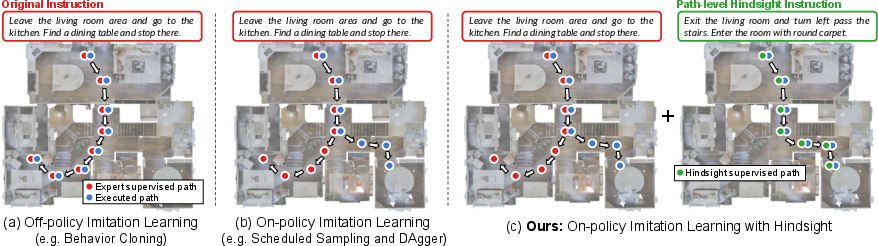
Figure 1: A conceptual comparison of VLN training strategies. Phi-Nav exploits path-level hindsight relabeling to convert off-expert exploration into aligned supervision, unlike prior approaches which ignore or mismodel these off-policy regions.
Phi-Nav (Φ-Nav) is introduced precisely to fill this semantic supervision gap, recasting all agent experiences—even those far from the expert path—into dense, instructional training signals. At its core, Φ-Nav operationalizes a dual-supervision, three-stage pipeline: (1) agent performs on-policy exploration with expert action feedback, (2) a large vision-LLM (LVLM)-based Hindsight Speaker retrospectively generates a trajectory-matched instruction, and (3) the agent undergoes secondary imitation conditioned on this new, trajectory-aligned instruction. This process transforms each exploration into a linguistically supervised episode, closing the semantic chasm inherent in on-policy VLN training.
Methodology
On-Policy Exploration and the Supervision Gap
The standard VLN setup features an agent policy πθ(at∣vt,I) mapping visual observations vt and instruction I to actions at. On-policy strategies (e.g., scheduled sampling or DAgger) alternate between expert and agent actions, gradually exposing the policy to a diverse state distribution. However, when the agent’s action diverges from the expert, the resulting trajectory τ is no longer described by the original instruction IE, leading to a semantic misalignment (illustrated in Figure 1). This undermines the quality and density of supervision for, often crucial, exploratory states.
Hindsight Supervision via Path-Level Instruction Generation
Phi-Nav circumvents this by repurposing each exploratory rollout. The pipeline is as follows:
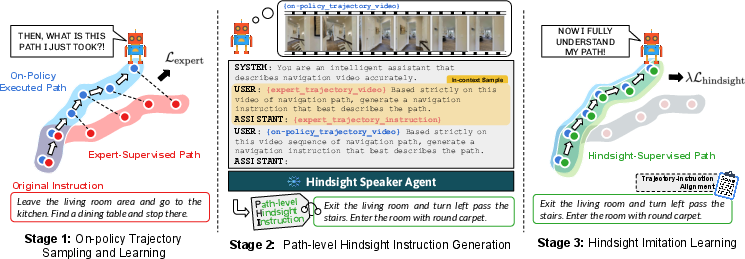
Figure 2: An overview of the Phi-Nav pipeline, including trajectory sampling, path-level hindsight instruction generation via LVLM, and retrospective imitation learning with alignment weighting.
- On-policy Trajectory Sampling: The agent executes its current policy, while action choices are corrected towards the expert via cross-entropy minimization on expert paths.
- Hindsight Speaker Agent (HSA): Post-hoc, a pre-trained multimodal LVLM generates a path-level, instruction that reflects the visual observations in τ. Notably, the approach leverages expert-in-context learning: generation is conditioned on an exemplar (offline expert trajectory and instruction) to regularize the style, flow, and fidelity to the dataset’s distribution.
- Dual-Supervision Optimization: The policy is updated on the hindsight-generated trajectory-instruction pair, but modulated by a trajectory-instruction alignment weight, ensuring that only semantically faithful, well-grounded relabelings drive learning.
Key innovations include the trajectory-instruction alignment weighting—a metric computed online per episode using hierarchical CLIP-based similarity (both coarse global visual-text and fine-grained landmark-word matching), which penalizes noisy or unfaithful LVLM generations, a critical concern for open-ended language generation in unstructured navigation tasks.
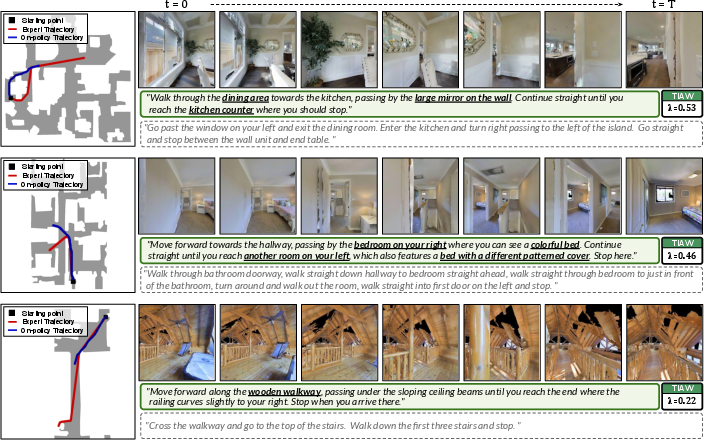
Figure 3: Examples of trajectory–instruction pairs, highlighting alignment between generated hindsight instructions and visual landmarks encountered during exploration.
Optimization Objective
At each iteration, the total loss is a convex combination of traditional expert imitation loss and the alignment-weighted hindsight imitation loss:
L=Lexpert+λLhindsight
where Φ0 is dynamically set per episode based on the trajectory-instruction alignment score. This guarantees that only high-fidelity, semantically matched hindsight instructions boost policy learning, while unreliable ones exert minimal influence.
Experimental Evaluation
Benchmarks and Metrics
Phi-Nav is evaluated on R2R-CE and RxR-CE, two representative VLN benchmarks differing in language complexity and trajectory horizon. Standard navigation metrics—Navigation Error (NE), Success Rate (SR), Oracle Success Rate (OSR), Success weighted by Path Length (SPL), and Dynamic Time Warping (nDTW, SDTW)—quantify both navigational and grounding performance, with additional BLEU and ROUGE-L metrics for instruction generation quality.
Main Results
Phi-Nav consistently demonstrates absolute improvements over strong on-policy baselines across metrics and splits, especially notable in sample-constrained settings. Specifically, in DAgger-trained settings (CMA-D and CMA-D-PM-Aug), Phi-Nav achieves up to +1.98% SR gain on the val-unseen split for R2R-CE. In scheduled sampling settings (ETPNav), integration of Phi-Nav upgrades SR by +5.37% and SPL by +3.59%, surpassing concurrent state-of-the-art methods including g3D-LF.
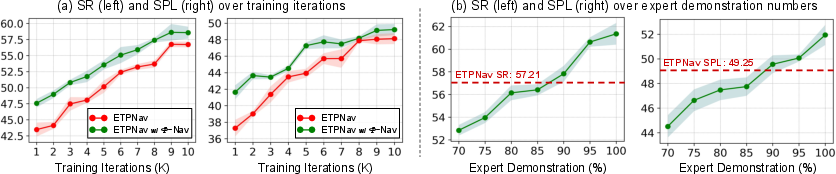
Figure 4: Sample efficiency analysis showing that Phi-Nav reaches higher success rates with significantly fewer expert demonstrations and environmental interactions relative to vanilla on-policy baselines.
On RxR-CE, a more challenging setting due to longer, linguistically denser instructions, Phi-Nav continues to yield SR and SPL improvements (+1.04%, +1.06%) on val-unseen, but the magnitude is reduced, revealing increased difficulty in hindsight instruction synthesis for extended trajectories.
Instruction Generation and Supervision Quality
Ablative studies highlight the necessity of expert-in-context conditioning for LVLM-based instruction generation. Table-based analyses show substantial improvements in BLEU/ROUGE and structural transfer to human-authored instructions compared to zero-shot or template-based prompting, translating directly into higher navigation SPL.
Furthermore, trajectory-instruction alignment weighting (TIAW)—especially in its landmark-aware variant—produces quantitatively superior sample filtering than fixed weighting schemes. TIAW scores align with semantic faithfulness: highest for expert references, followed by expert-in-context, and lowest for unconstrained zero-shot generations, confirming its utility as an online supervision filtration mechanism.

Figure 5: The distribution of trajectory-instruction alignment weights (TIAW) over sampled on-policy episodes, demonstrating adaptive filtering of supervision quality during training.
LVLM Backbone and Computational Analysis
Experiments with different LVLM backbones confirm that scaling the model (e.g., from Qwen2.5-VL-3B to Qwen2.5-VL-7B and Qwen3-VL-8B) enhances both instruction quality and downstream navigation. The additional computational cost—mainly the LVLM forward pass per episode—is justified given the substantial gain in supervision density and quality.
Implications and Future Directions
Phi-Nav represents an evolution in semantic exploration for VLN agents, raising practical and theoretical implications. Methodologically, it demonstrates that path-level hindsight instruction relabeling enables agents to self-supervise from off-manifold or erroneous behaviors, greatly enhancing sample efficiency (competitive or superior performance with up to 10% less expert demonstration data). The trajectory-instruction alignment machinery provides a principled mechanism for filtering unreliable retrospectives, a necessity as LVLM generations scale in variability.
Practically, the framework reduces human annotation costs and enables scalable embodied AI training pipelines. From a research standpoint, it opens new frontiers in:
- Hindsight reasoning beyond VLN: Retrospective alignment and relabeling can be adapted for other sequential instruction-following or goal-conditioned tasks, including object-object navigation or multi-agent collaboration.
- Trajectory-aware semantic filtering: Improving trajectory-instruction alignment metrics, possibly leveraging emerging 3D vision-LLMs, could enable even denser and more reliable supervision.
- Intermediate, not just post-hoc, hindsight: Integrating stepwise reflection during navigation—rather than only after trajectory termination—may yield richer credit assignment and facilitate error correction in long-horizon tasks.
Conclusion
Phi-Nav establishes a robust paradigm for bridging the semantic supervision gap in on-policy VLN, converting agent-driven exploration into a source of dense, linguistically-grounded training data. By leveraging pre-trained, in-context LVLMs and a rigorous alignment-based weighting mechanism, the approach not only yields stronger navigation baselines but also substantially improves sample efficiency and robustness. The implications extend well beyond VLN, suggesting general applicability of hindsight-relabeled, instruction-rich self-supervision in embodied intelligence domains.