- The paper introduces a novel ROM framework that maps density solutions to optimal transport signatures, preserving mass and positivity.
- It employs symmetric skeleton decomposition and neural network regression to achieve efficient low-rank approximation and online prediction.
- Numerical experiments show rapid singular value decay and stable generalization with W2 errors around 0.021 for high-dimensional PDEs.
Structure-Preserving Reduced-Order Modeling via Low-Rank Transport Signatures
Introduction and Motivation
Reduced-order modeling (ROM) for parametrized PDEs involving density-valued solutions presents severe limitations for classical linear approaches, particularly in transport-dominated regimes. Traditional linear subspace models such as POD encounter the Kolmogorov-width barrier, producing suboptimal low-rank structure for problems characterized by sharp advection, translation of coherent features, or nonlinear transport phenomena. These challenges are exacerbated for solutions conceptualized as mass-preserving probability distributions, where linear operations in the ambient Hilbert space may violate fundamental structural constraints such as positivity and conservation.
To address these deficiencies, the paper introduces a structure-preserving reduced-order modeling framework based on low-rank approximations in a transport-signature space induced by optimal transport (OT) theory (2607.01696). The methodology reframes the ROM problem by mapping each parameterized distribution ρ(μ) to its associated Kantorovich potential, yielding a representation where dominant transport modes are more naturally aligned with the underlying problem structure than in the original solution space.
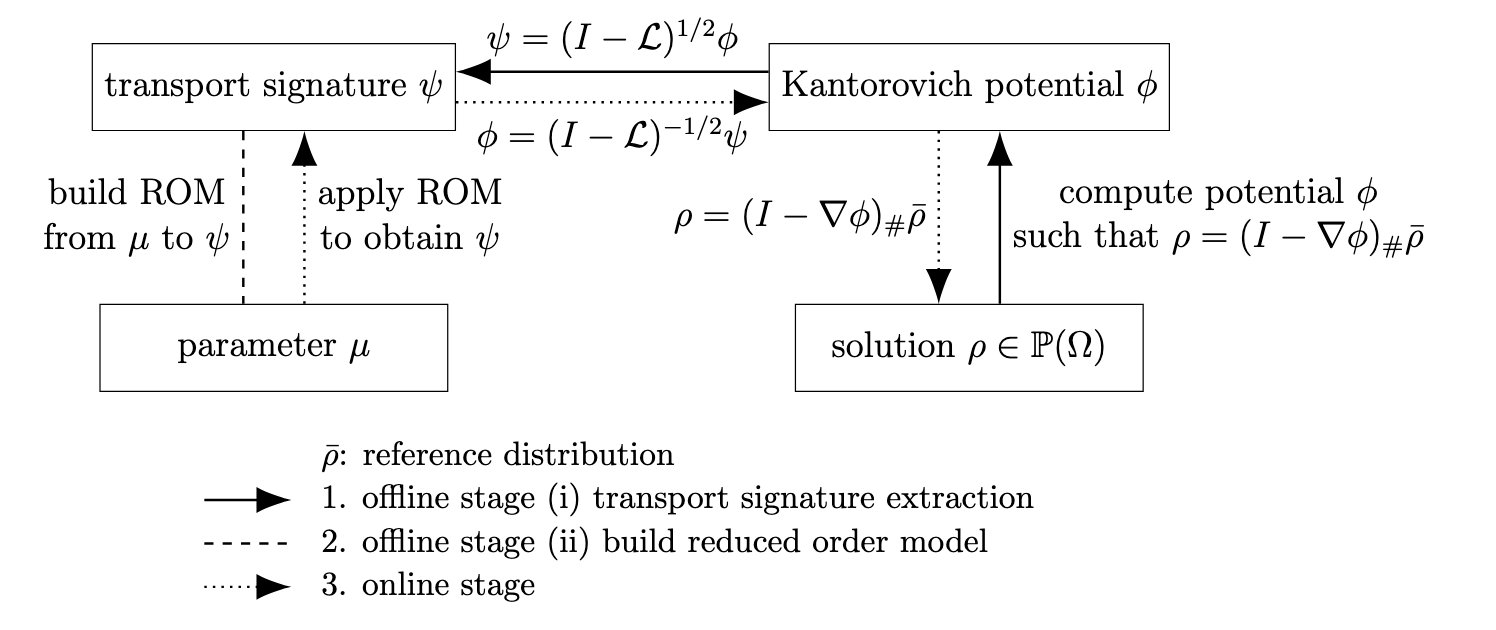
Figure 1: Overview of the optimal-transport-based reduced-order model pipeline, emphasizing transformation to transport signatures, low-rank selection, and structure-preserving online prediction.
Methodology
Optimal Transport and Transport Signatures
Each density-valued solution ρ(μ) is recast in terms of the Kantorovich potential ϕ(μ) defining the optimal transport map from a fixed reference measure ρˉ to ρ(μ). The relevant transport map is given as Tρˉ→ρ(μ)=I−∇ϕ(μ). To enable an effective Hilbert space embedding that controls Wasserstein discrepancies, the potential is transformed into a “transport signature”:
Ψ(μ,x)=(I−L)1/2ϕ(μ),
where L denotes the weighted Laplacian with respect to ρˉ. This operation both regularizes the representation and ensures that errors in transport signature space reflect W2 errors between output distributions.
Low-Rank Model Construction via Skeleton Decomposition
Transport signatures for a training set of parameter values are assembled into a large data matrix indexed by parameter and space. Rather than SVD, the method exploits symmetric skeleton (CUR) decompositions using a maximal-volume criterion, yielding an interpretable low-rank factorization where selected basis vectors correspond to actual parameter instances. The rows associated with maximal-volume submatrices represent "dominant" transport signatures, and projection coefficients for new parameters are subsequently regressed.
Coefficient Map Learning
To facilitate nonintrusive and efficient online inference, a feed-forward neural network is trained to approximate the mapping from parameters ρ(μ)0 to transport signature coefficients ρ(μ)1. The online evaluation then proceeds as follows: given ρ(μ)2, compute coefficients via the learned network, reconstruct the transport signature, invert the Laplacian transform, recover the OT potential, and finally push forward ρ(μ)3 via the approximate transport map. This pipeline preserves mass and guarantees output positivity by construction.
Error Controls and Theoretical Guarantees
The paper provides a rigorously separated mean-squared ρ(μ)4 error bound for the end-to-end ROM, decomposing the total generalization error into (i) deterministic low-rank error from skeleton approximation in the transport-signature space, (ii) discretization and quadrature error from spatial sampling, (iii) coverage error in parameter space, and (iv) statistical error from finite learning sample size. The analysis establishes that, under regularity and fill-distance assumptions, the dominant error contributions track the (r+1)-th singular value of the (integral) transport-signature kernel, with learning rates on the order of ρ(μ)5 for ρ(μ)6-dimensional parameter manifolds.
Numerical Experiments
The framework is demonstrated on a two-dimensional continuity equation with parameterized, time-dependent velocities. The main empirical observations are as follows:
- Low-Rank Structure: The matrix of transport signatures exhibits rapid singular value decay, significantly outpacing that of the raw density snapshots. For instance, the ratio ρ(μ)7 for transport signatures falls below ρ(μ)8, while for density snapshots it remains above ρ(μ)9, confirming the stronger low-dimensionality in the transport-based embedding.
- ROM Performance: With ϕ(μ)0 basis signatures and ϕ(μ)1 training samples, the method yields average ϕ(μ)2 errors on the order of ϕ(μ)3 on both training and held-out testing data, across ϕ(μ)4-dimensional state representations.
- Generalization to Unseen Parameters: The method is robust to parameter extrapolation, attaining similar ϕ(μ)5 errors on entirely new parameter tuples not encountered during training, demonstrating strong out-of-sample consistency.
- Mass and Positivity: Mass conservation and non-negativity are built-in due to reconstruction via pushforward, ensuring physically meaningful outputs without post-hoc corrections.
Implications and Future Directions
The structural advantages of representing transport phenomena in terms of OT-based signatures are clearly established both theoretically and numerically. Such a representation enables low-rank surrogates for high-dimensional, transport-dominated dynamics where linear ROMs are provably suboptimal. The explicit error bounds and parameter learning architecture facilitate end-to-end certification for predictive reliability. Notably, interpretability is enhanced, as skeleton decomposition selects actual transport modes associated with real parameters, in contrast to SVD-based black-box modes.
Practically, this approach is suited to a broad class of PDEs where solutions are measures/distributions, especially in uncertainty quantification, Bayesian inversion, and parametric studies for kinetic or Fokker–Planck-type systems. The model is non-intrusive and compatible with black-box solvers. Computational performance is competitive, especially in regimes where FFT-based Laplacian evaluation and efficient OT solvers are applicable.
Prospective theoretical developments include adaptive selection or learning of the reference measure ϕ(μ)6, extension to multi-modal target distributions (potentially requiring local reference measures), and more scalable computation of Kantorovich potentials in higher spatial dimensions. Furthermore, improved understanding of the geometry of the transport-signature mapping could motivate the design of even more efficient sampling or manifold learning strategies in parameter space.
Conclusion
This work formalizes and demonstrates an OT-based framework for reduced-order modeling of parametrized, transport-dominated PDEs with density-valued solutions. By mapping parameterized distributions to low-rank manifolds of transport signatures, the method overcomes the limitations of linear ROMs, while ensuring structure preservation and offering provable error guarantees. These innovations advance both the theoretical landscape and the toolbox for simulating and controlling high-dimensional dynamical systems.