- The paper presents a ROM for parametrized OT that reduces high-dimensional linear programs through snapshot-based reduced bases.
- It employs primal reduction via nonnegative cone combinations and dual reduction using affine subspaces to enhance computational efficiency.
- Certified a posteriori error bounds via c-transform and continuity analyses ensure reliable performance in real-world applications.
Reduced-Order Modeling for Parametrized Optimal Transport
Introduction and Context
The paper "A reduced-order model for parametrized Optimal Transport problems" (2604.09325) addresses the computational bottleneck inherent in optimal transport (OT) problems that are solved repeatedly for a family of measures parametrized by a variable α, a context prevalent in applications such as uncertainty quantification, shape optimization, and image processing. The fundamental insight is that while standard OT numerics (e.g., linear programming, Sinkhorn iterations) become infeasible for high-resolution or large-scale parametric sweeps, the Kantorovich potentials and transport plans often admit significant dimensionality reduction across the parameter space due to the underlying regularity and structure.
To this end, the authors introduce a Reduced-Order Model (ROM) for parametrized OT, built via snapshot-based reduced bases for both primal and dual variables, supplemented by certified a posteriori error bounds and an empirical interpolation strategy for efficient error evaluation. The approach enables significant online acceleration while providing rigorous control on approximation quality.
Reduced-Basis Construction for OT
The ROM is constructed by projecting the high-fidelity primal and dual OT problems onto low-dimensional subspaces (for the dual potentials) and nonnegative cones (for the primal plans), selected from solutions at carefully chosen parameter values ("snapshots"). Specifically, for a given parametric family of OT problems discretized on sets X and Y, with measures arising as convex combinations of basis marginals, the ROM proceeds as follows:
- Primal variable reduction: The transport plan is approximated as a nonnegative linear combination of precomputed solutions at a finite set of extreme parameters. The reduced space thus forms a positive cone W+.
- Dual variable reduction: The Kantorovich potentials are restricted to low-dimensional affine subspaces U and V, constructed via orthogonalization (e.g., Gram-Schmidt) or other snapshot-based techniques on the dual potentials.
This framework transforms the original large-scale linear program (dimension NxNy) into a reduced problem of dimension R (number of primal basis elements) and N+M (dimensions of the dual bases), with the feasible set and constraints accordingly compressed.
A critical technical contribution is the explicit characterization of the extreme points of the parameter polytope, which ensures solvability of the reduced system for any admissible parameter and provides guidance for constructing a minimal, well-posed basis.
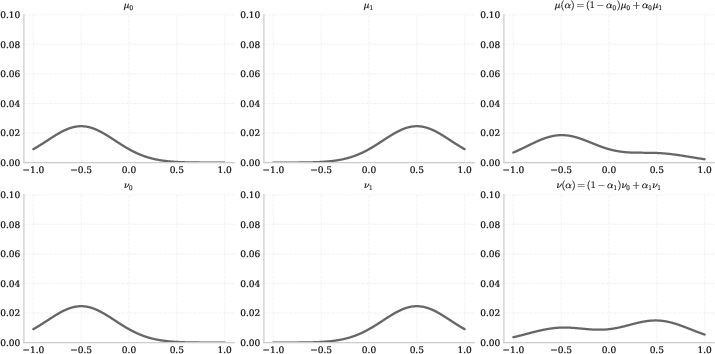
Figure 1: Visualization of parametrized marginals demonstrating the variability in the source and target measures across the parameter set.
A Posteriori Error Estimation
A particular strength of the presented methodology is the emphasis on certified, efficiently computable a posteriori error bounds. The authors develop two estimation strategies:
Numerical Experiments
The method is validated on several synthetic and real-world scenarios, demonstrating high-fidelity approximation, orders-of-magnitude online speedup, and robust error certification.
1D Parametric OT
On a 1D benchmark problem (Gaussian mixtures as marginals, quadratic cost), the ROM quickly converges to the high-fidelity OT solution as the number of basis snapshots increases.
- Error decay: The ROM error (in OT value) decreases monotonically with the size of the reduced basis, rapidly approaching machine precision.
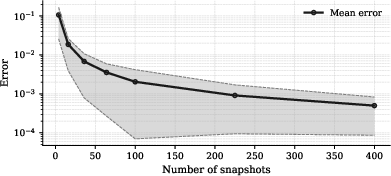
Figure 3: Evolution of the mean error between high-fidelity and ROM solutions over a test set of 50 random parameters as the number of snapshots increases.
- Comparison with Sinkhorn: For equal precision, the ROM achieves substantially greater computational speedup compared to entropic-regularized Sinkhorn, especially as the regularization parameter X3 decreases.
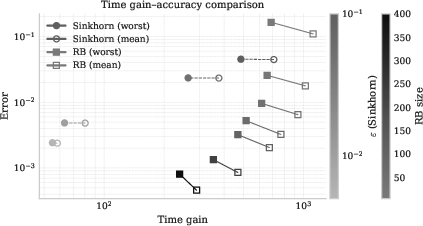
Figure 4: Comparative analysis of ROM vs. Sinkhorn in terms of absolute precision and time gain over a test set.
A Posteriori Estimator Performance
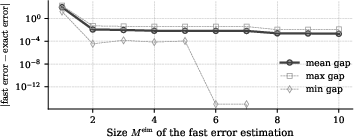
- The EIM-accelerated a posteriori estimator closely tracks the exact error bound (with gap decaying as EIM basis increases), and post-hoc calibration further enhances accuracy.
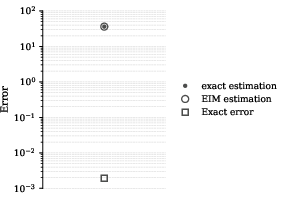
Figure 5: Comparison of mean true error and estimated a posteriori error across 50 parameters, emphasizing the conservative nature of the estimator.
- Similar patterns hold for continuity-based estimates, with improved tightness as training/estimation set density increases.
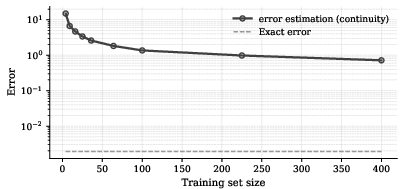
Figure 6: A posteriori estimation using continuity bounds with varying size of the training set.
Applications: Color Transfer via Parametric OT
A compelling application is parametric color transfer, where an image's color histogram is transported to a target palette formed as a convex combination of exemplar palettes—corresponding to a high-dimensional (X4) OT problem.
- The ROM is constructed with only a handful of basis snapshots (e.g., 3), yielding online speedups of over two orders of magnitude compared to direct Sinkhorn solvers, with visually and quantitatively comparable results.
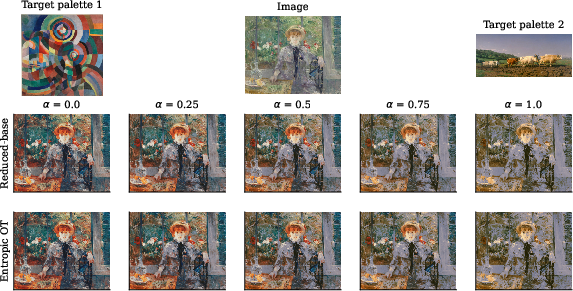
Figure 7: Color transfer maps generated by the reduced-basis ROM (middle row) versus reference solution (top row) for varying palette mixing coefficient X5.
- Fine analysis of results reveals localized differences in color richness, assessable via the developed error bounds.

Figure 8: Detail comparison at high palette interpolation value (X6), highlighting subtle deviations in color rendering between ROM and full OT solution.
Implications and Future Directions
This work provides a rigorous and scalable framework for parametric OT via reduced-order modeling, including offline/online decomposition and certified error control. Practically, the method opens the door to real-time OT solvers in settings such as image processing, morphology interpolation, and probabilistic computing, wherever repeated OT evaluation on structured parameter sets is required.
On the theoretical side, the approach is grounded in precise regularity and duality analysis, with robust error certification mechanisms, contributing to the reliability and interpretability of model reduction in nonlinear, nonlocal problems such as OT.
Possible future developments include:
- Adaptive basis enrichment, driven by error estimators, for optimal coverage of complex parameter manifolds.
- Extension to semi-discrete, multi-marginal, and unbalanced OT settings.
- Integration with machine learning and kernel methods for data-driven basis selection and nonlinear approximation.
- Acceleration of a posteriori error evaluation for even higher-dimensional or real-time systems.
Conclusion
The authors achieve a comprehensive methodology for efficient, reliable ROM in parametrized OT. The proposed approach, integrating snapshot-based reduced bases, duality-aware constraint reduction, and rigorous error control, achieves high acceleration while preserving solution quality. The treatment is comprehensive, incorporating theoretical regularity results, systematic numerical validation, and application to challenging real-world imaging tasks. This framework establishes a solid foundation for future advances in both parametric OT and reduced-order modeling for high-dimensional nonlocal problems.