Imagining the Sense of Touch: Touch-Informed Manipulation via Imagined Tactile Representations
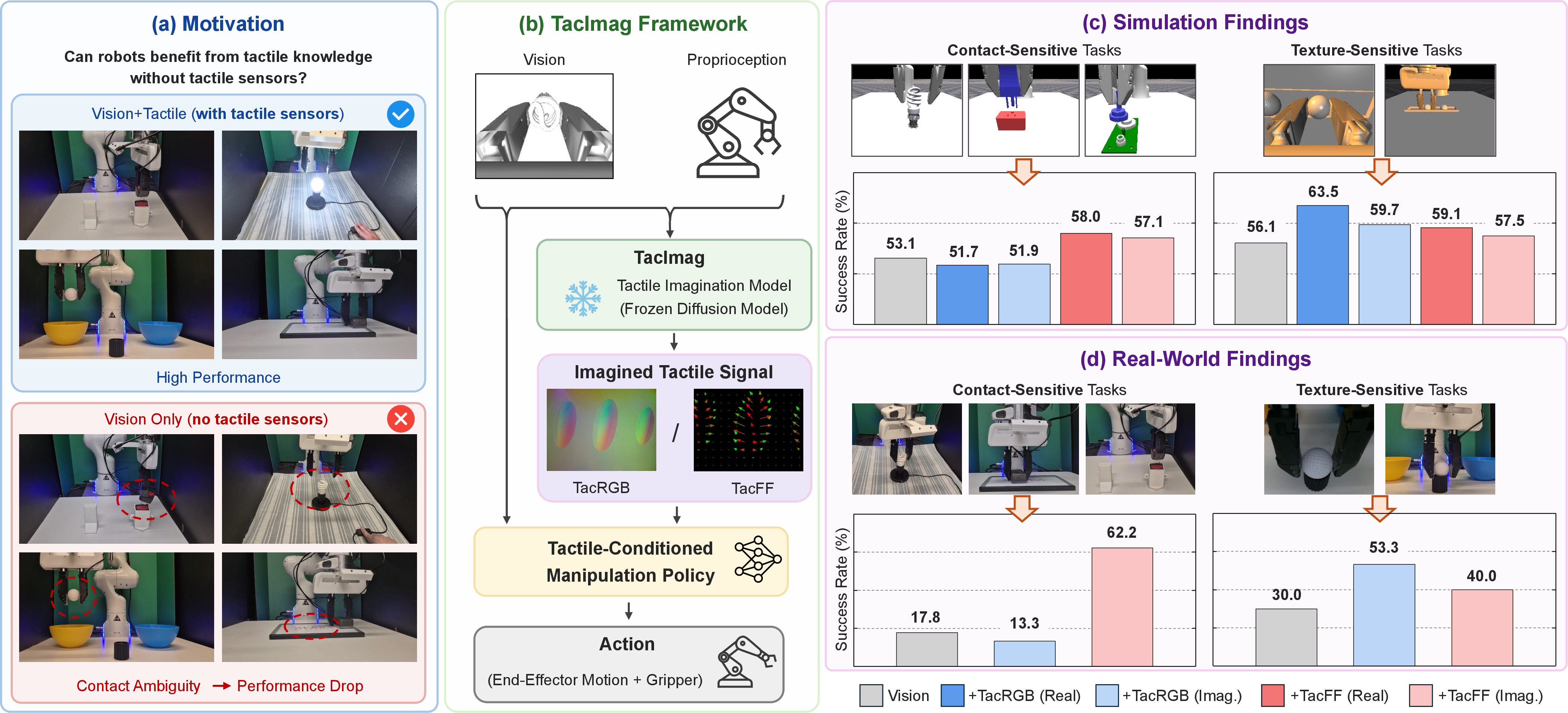
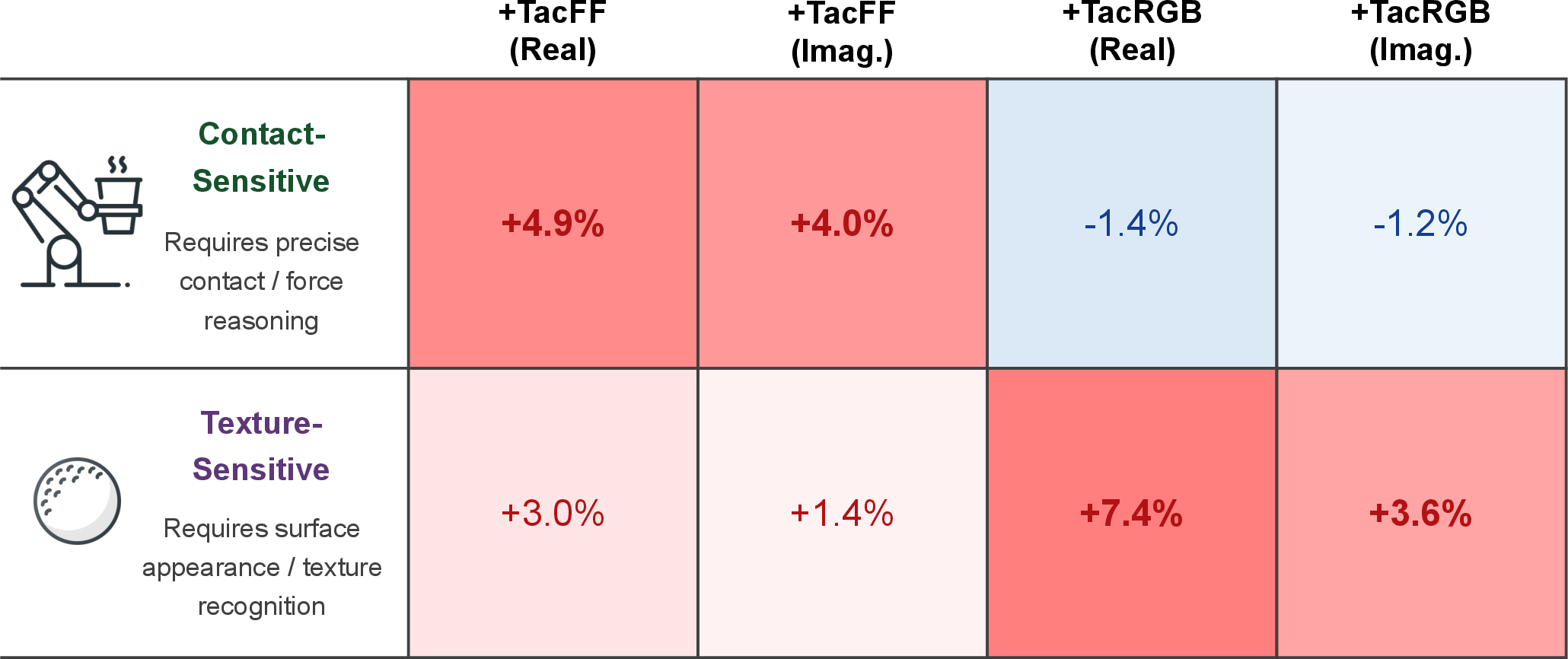
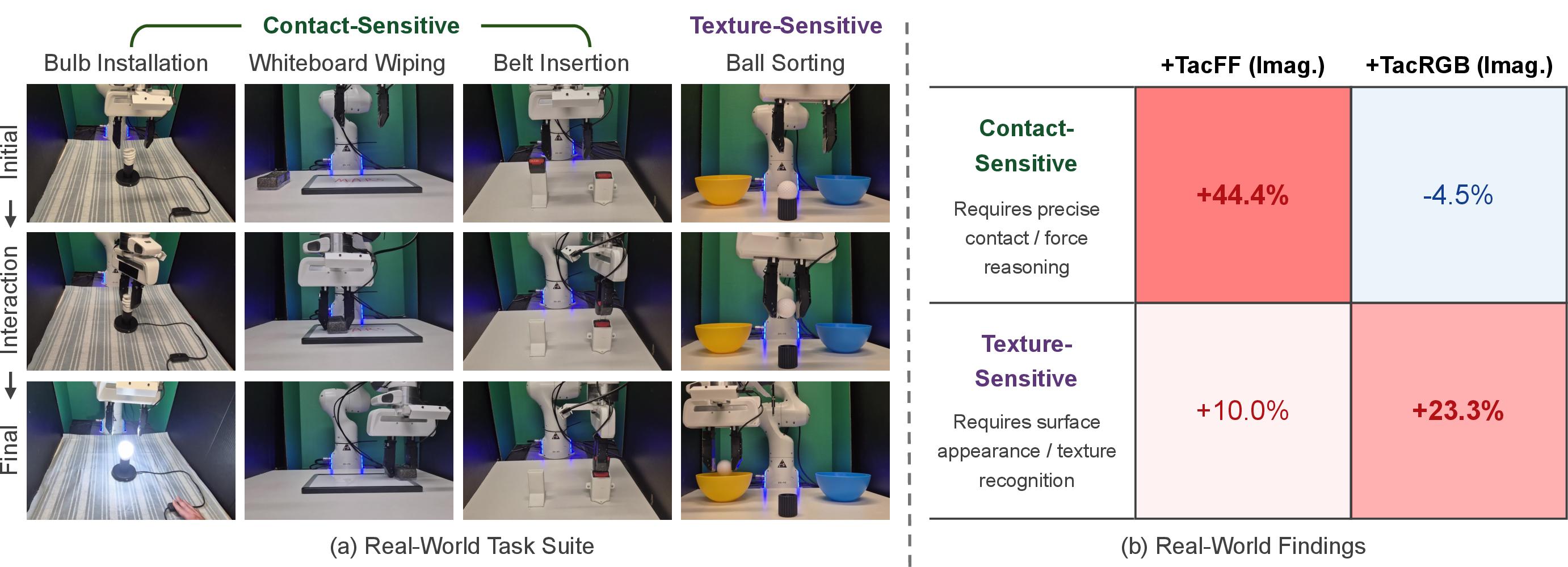
Abstract: Tactile sensing can substantially improve contact-rich robotic manipulation, yet its practical deployment remains limited by the fragility, calibration requirements, and maintenance burden of tactile hardware. This raises a fundamental question: can robots benefit from tactile knowledge without requiring tactile sensors at deployment? We present TacImag, a tactile imagination framework that predicts tactile observations from vision and proprioception and uses the generated signals to guide manipulation policies. Trained from paired visuotactile demonstrations, TacImag enables touch-informed manipulation using only visual observations at test time. We evaluate TacImag on six simulated and four real-world manipulation tasks. Across simulation and real-world experiments, imagined tactile observations consistently improve manipulation performance without requiring tactile hardware. In real-world experiments, imagined force fields improve contact-sensitive tasks by 44.4% on average, whereas imagined tactile images improve texture-sensitive tasks by 23.3%, revealing that the effectiveness of tactile imagination depends strongly on the relationship between tactile representation and task requirements. Our results further suggest that tactile imagination does not simply recover missing tactile measurements. Instead, it acts as a form of contact-aware supervision that transforms subtle visual interaction cues into representations that are easier for manipulation policies to exploit.
Paper Prompts
Sign up for free to create and run prompts on this paper using GPT-5.
Top Community Prompts
Explain it Like I'm 14
What is this paper about?
This paper is about teaching robots to “imagine” the sense of touch so they can handle tricky, contact-heavy tasks (like plugging in a cable or screwing in a light bulb) without needing fragile or expensive touch sensors during use. The authors build a system called TacImag that learns to predict what a touch sensor would feel, using only what the robot sees with a camera and knows about its own arm position. The imagined touch is then used to guide the robot’s actions.
What questions did the researchers ask?
- Can a robot get the benefits of touch sensing without actually having a touch sensor when it’s working?
- What kinds of “imagined touch” are most helpful for different tasks?
- Does imagined touch simply replace missing touch measurements, or does it act more like smart guidance that helps the robot understand contact from subtle visual clues?
How did they do it?
Think of two stages: learning and doing.
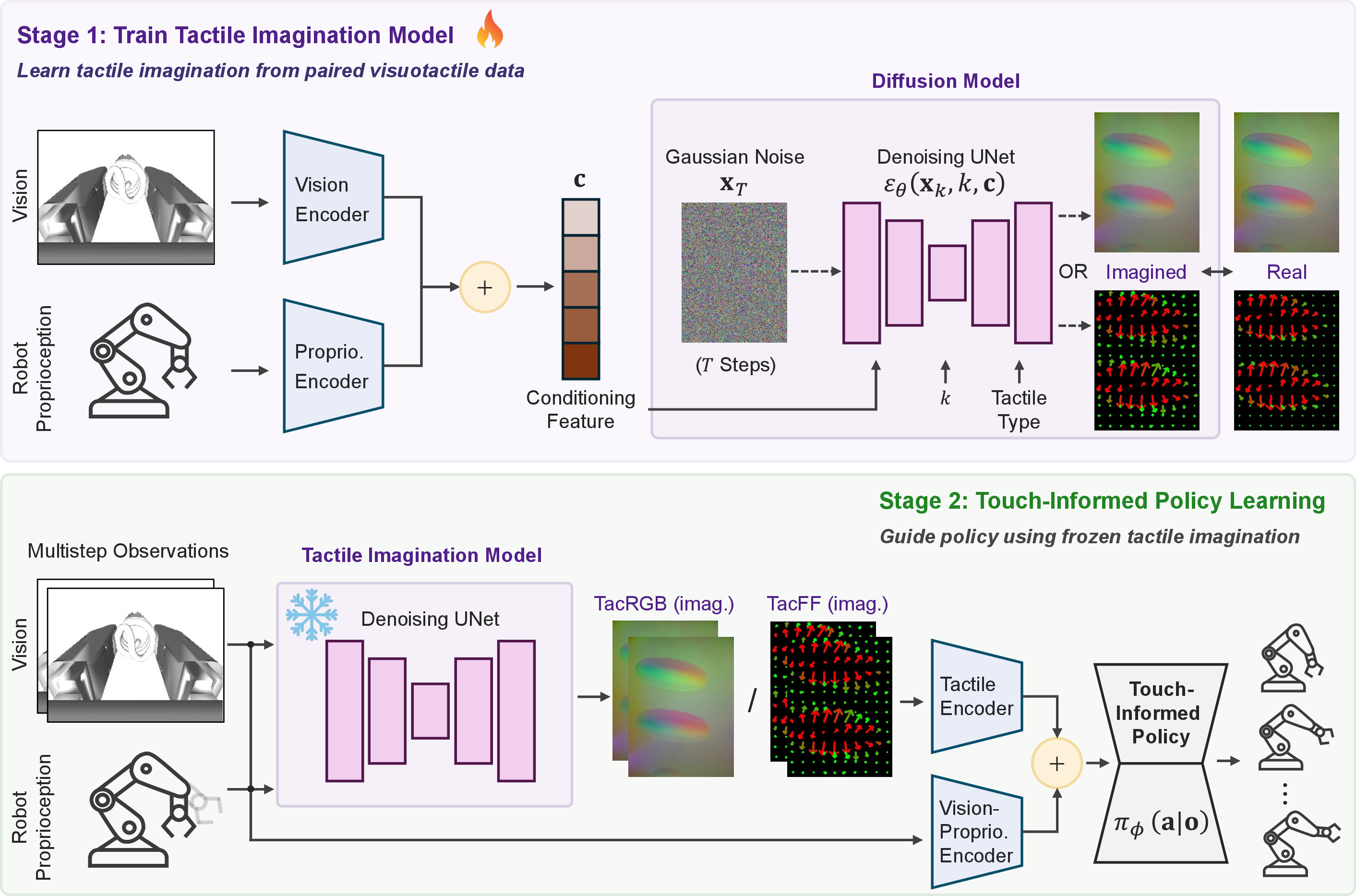
Stage 1: Learning to imagine touch
- The robot watches and “feels” paired demonstrations: camera images (vision), what the robot’s joints and gripper are doing (proprioception), and readings from a real touch sensor (tactile data).
- It trains a special generator (a conditional diffusion model) to predict tactile signals from vision + proprioception.
- Diffusion model, in simple terms: imagine starting with TV static and slowly “de-noising” it into a realistic touch reading, guided by what the camera sees and how the robot is moving.
- The model learns two styles of touch:
- TacRGB: touch “pictures” (like images from a GelSight sensor) that show detailed surface patterns and textures.
- TacFF: compact “force maps” that show where and how strongly the contact pushes or slides (normal and shear forces).
Stage 2: Using imagined touch to act
- After learning, the touch generator is frozen (no more training).
- The robot trains a control policy (a learned controller) that takes vision + proprioception + the imagined touch and learns to act (e.g., move the gripper).
- At test time, the robot no longer uses a real touch sensor. It only uses cameras and its own joint info, but the frozen model fills in the touch as if a sensor were there.
Analogy: It’s like a person learning to guess how something feels by looking at it and feeling their own hand position—then later doing the task with eyes open but gloves that don’t feel, using their learned “touch imagination” to guide them.
What did they find?
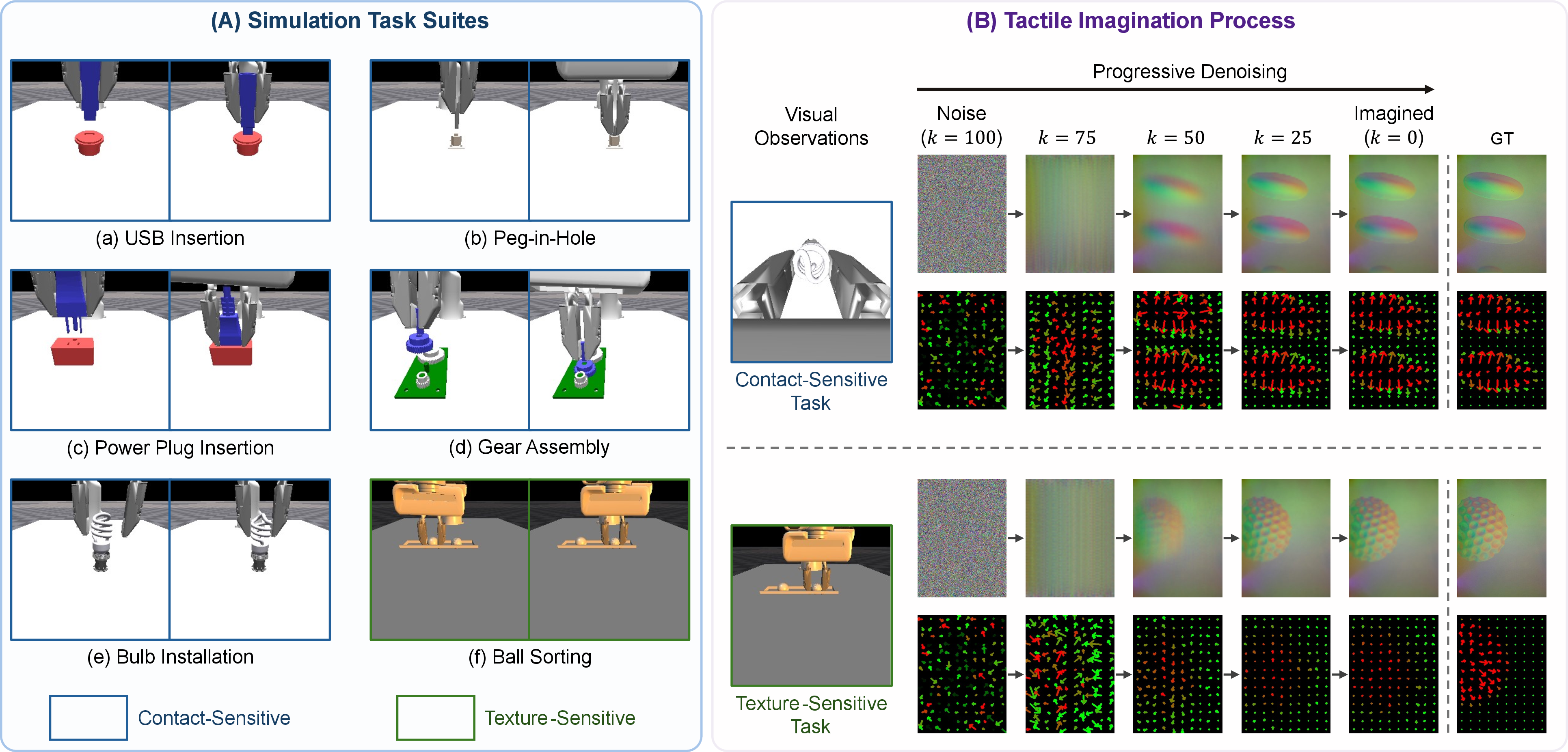
The authors tested TacImag on 6 simulated tasks (like USB insertion, gear assembly, peg-in-hole, and sorting balls by surface) and 4 real-world tasks (like screwing in a light bulb and sorting golf vs. ping-pong balls). Here’s what stood out:
- Imagined touch boosts performance without real touch hardware.
- In simulation, imagined touch often came close to real touch in success rates.
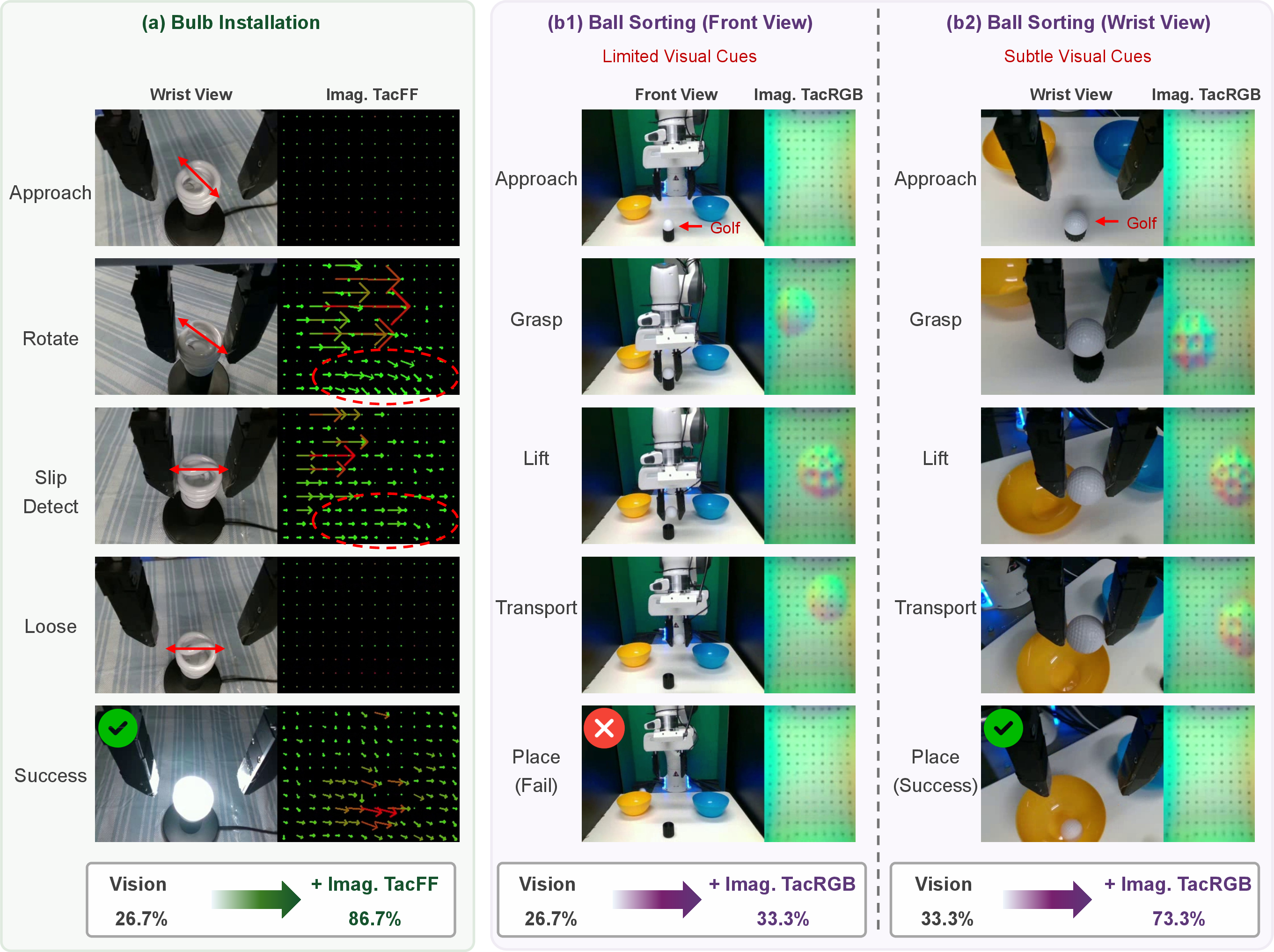
- In real robots, imagined force maps (TacFF) raised success on contact-sensitive tasks by about 44 percentage points on average (e.g., bulb installation jumped from 26.7% to 86.7%).
- The best imagined touch depends on the task:
- Contact-sensitive tasks (insertion, assembly, screwing) benefit most from TacFF (force maps). These tasks need clear info about contact and force direction.
- Texture-sensitive tasks (telling golf balls from ping-pong balls) benefit more from TacRGB (touch images), because surface patterns and textures matter.
- Imagined touch doesn’t “make up” new information—it clarifies what’s already there.
- When the camera view already contains subtle contact clues (tiny motions, slight deformations, lighting changes), TacImag turns those into clear, useful touch signals the policy can use.
- If the camera view hides key details (e.g., far-away front view for texture), imagined touch helps less because it can’t invent missing facts.
- Examples:
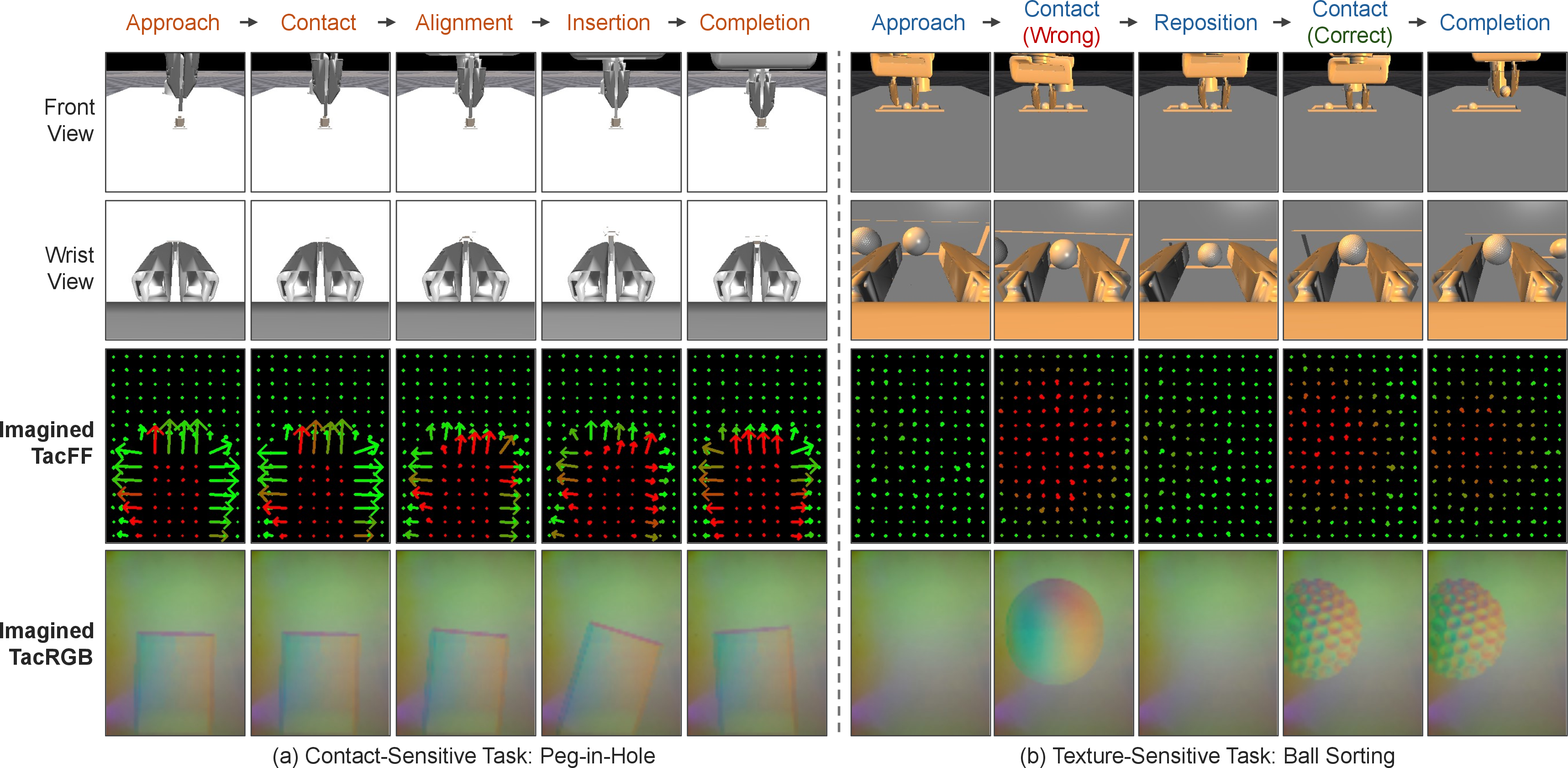
- Peg-in-hole: imagined force maps became structured after contact, showing force directions that helped alignment.
- Bulb installation: imagined force maps revealed grip and slip during rotation—very helpful for finishing the task.
- Ball sorting: with close wrist-view images, imagined touch images showed the golf ball’s dimples vs. the ping-pong ball’s smooth surface, improving sorting. With a distant front view (fewer details), the gains were smaller.
Why does this matter?
- Practical impact: Robots can get touch-like guidance without needing touch sensors during deployment. That means less cost, fewer breakdowns, and simpler setups, while still performing much better on real-world, contact-heavy tasks.
- Scientific insight: The big win isn’t just “replacing” tactile sensors. It’s turning hard-to-read visual hints into a touch-like format that policies find easier to use—like translating a tricky language into one the robot “understands” for action.
- When to use what:
- If the task depends on forces and precise contact, prefer imagined force maps (TacFF).
- If the task depends on surface details and texture, prefer imagined touch images (TacRGB).
- Limits and future work:
- If the camera view doesn’t show enough subtle clues, imagined touch can’t conjure missing info. Better viewpoints or active camera moves could help.
- Next steps include longer tasks, richer touch representations, and combining “touch imagination” with full world models and smarter perception.
Overall, TacImag shows a promising path: teach robots to imagine touch from what they can see and feel about themselves, and use that imagined touch to do delicate tasks more reliably—no physical touch sensor required at run time.
Knowledge Gaps
Knowledge gaps, limitations, and open questions
The paper introduces TacImag and demonstrates benefits across selected tasks; however, several aspects remain unresolved. Future work could address the following concrete gaps:
- Training-time tactile dependency: TacImag eliminates tactile hardware only at deployment; it still requires paired visuotactile demonstrations. How can we reduce or remove this requirement (e.g., self-supervision, synthetic tactile pretraining, or weak labels)?
- Data efficiency and scaling: The experiments use 20–50 demonstrations per task and a single GelSight model in real. What is the performance/data trade-off as demonstrations shrink or task diversity grows? How does TacImag scale to hundreds of tasks and larger object families?
- Generalization to novel objects and contacts: The paper does not quantify zero-shot transfer to unseen object geometries, materials, textures, or contact regimes (e.g., high friction vs low friction, sticky vs lubricated). How robust is imagined tactile under such shifts?
- Viewpoint and occlusion sensitivity: Results show strong viewpoint dependence (front vs wrist). How does tactile imagination degrade under severe occlusions, poor lighting, motion blur, or camera placement changes, and can active viewpoint selection mitigate this?
- Uncertainty handling: The diffusion model inherently represents a distribution, but the policy consumes a single imagined tactile sample. How can uncertainty (e.g., ensembles or sampling) be exposed to the controller for risk-aware decisions, and does it improve robustness?
- Temporal consistency: Tactile imagination is generated frame-by-frame with short observation horizons. How stable and consistent are imagined signals across time, especially during fast transients, and can temporal priors or recurrent models reduce flicker/drift?
- Long-horizon, multi-stage tasks: Experiments focus on short, single-skill tasks. Can TacImag support long-horizon assembly with multiple contacts, regrasping, and recovery from failures, and how does error compound over extended sequences?
- Deformable objects and complex contact dynamics: Evaluation targets mostly rigid contacts. How does imagined tactile perform with deformables (cables, fabrics, food), non-linear compliance, or viscoelastic interactions where force history matters?
- Multi-finger/in-hand manipulation: The real system uses a single-finger GelSight during training. Can TacImag handle multi-finger, distributed contacts and synchronize multiple imagined tactile streams for dexterous manipulation?
- Force/torque and compliance control: Policies use kinematic actions; there is no evaluation of impedance/force control driven by imagined tactile. Can imagined TacFF safely modulate compliant behaviors (e.g., normal force targets, slip prevention)?
- Safety and failure detection: Misimagined tactile could cause excessive forces or jamming. How to detect imagination failures online, fail safely, and trigger recovery (e.g., revert to vision-only, replan, or seek new viewpoints)?
- Robustness to calibration drift: The method assumes consistent camera and robot kinematic calibration. What is the sensitivity to calibration errors, lens changes, or mechanical wear, and can calibration-aware training improve robustness?
- Real-time performance and latency: The paper omits timing/compute analysis. What are the inference latencies of the diffusion imagination and policy, and do they meet the control-loop requirements for high-frequency contact control?
- Representation breadth: Only TacRGB and TacFF are studied. Would alternative representations (e.g., contact patches, 3D contact geometry, friction/adhesion estimates, slip likelihoods, or learned low-dimensional tactile latents) further improve performance?
- Learning objectives beyond reconstruction: TacImag is trained with a DDPM noise-prediction loss; reconstruction metrics correlate imperfectly with control. Can task-aware or contrastive objectives yield tactile encodings better aligned with manipulation?
- End-to-end vs frozen imagination: The imagination model is frozen during policy training. Would joint fine-tuning, feature distillation, or alternating optimization improve performance or stability without collapsing the tactile modality?
- Baseline comparisons: The paper does not compare against strong missing-modality baselines (e.g., privileged-information distillation, hallucination networks, or sensory-augmented latent supervision). How does TacImag stack up on equal data/compute?
- Exploiting proprioception and other modalities: Proprioception is included, but no ablation on what signals matter (joint velocities, torques, gripper state). Would adding audio, IMU, or force/torque sensors at training further boost imagination quality?
- Policy architecture dependence: Only Diffusion Policy is used. Do the benefits of imagined tactile persist across alternative controllers (e.g., transformer policies, model-based MPC, visuomotor RNNs), and are some architectures more receptive?
- Metrics beyond success rate: Evaluation emphasizes binary success. How does TacImag affect contact forces, insertion time, slip frequency, energy use, or wear, and are there task-relevant trade-offs (e.g., gentleness vs speed)?
- Sim-to-real transferability: Simulation uses TacSL/IsaacGym; real experiments use one robot/sensor. Can a model trained in sim (or on one lab’s hardware) generalize to other robots, grippers, and tactile sensors without re-collection?
- Handling information scarcity: The paper shows TacImag falters when visual cues are weak. Can active perception, predictive world models, or memory augment imagination when critical cues are absent or ambiguous?
- Distribution shift detection: There is no mechanism to recognize out-of-distribution scenes (novel textures/geometries). Can OOD detection or conformal prediction gate the use of imagined tactile to prevent misleading cues?
- Dataset artifacts and bias: Paired data may embed policy-specific or demo-specific biases (e.g., approach angles, lighting). How sensitive is imagination to such biases, and can domain randomization or augmentation reduce overfitting?
- Theoretical understanding: The “contact-aware supervision” hypothesis is not formalized. Can causal analyses or counterfactual interventions disentangle when imagined tactile truly adds information vs re-encoding visual cues more accessibly?
- Active tactile imagination: The framework is passive; it does not plan motions to elicit more informative visual cues for better imagination (e.g., strategic probing). How to couple action selection with imagination quality?
- Open-world object categories: Ball sorting uses two ball types. Can TacImag support open-set recognition and manipulation where object categories and textures are unbounded?
- Failure mode taxonomy: Beyond success rates, the paper does not categorize failures (e.g., misalignment vs slip vs misclassification). A systematic taxonomy could guide targeted model or representation improvements.
Practical Applications
Immediate Applications
Below are concrete use cases that can be deployed now with moderate integration effort, leveraging TacImag’s ability to generate task-relevant tactile representations (TacFF and TacRGB) from cameras and proprioception, without tactile sensors at runtime.
- Touch-informed insertion and assembly without tactile sensors
- Sectors: robotics, manufacturing, electronics assembly, automotive
- Use cases: connector/plug insertion, peg-in-hole, screw/bolt start, belt threading, bulb installation, snap-fit assembly, press fits
- Tools/products/workflows:
- A “Vision-to-Touch” ROS2 node that ingests wrist-camera frames and joint states and publishes imagined TacFF (force-field) for a diffusion-policy controller
- Retrofitting existing cobot cells with a wrist camera and TacImag policy to improve alignment and force-awareness without adding fragile tactile hardware
- In-line “contact-quality monitors” that use imagined TacFF to detect misalignment, slippage, or insufficient seating before committing force
- Assumptions/dependencies: paired visuotactile demos collected once per task/fixture; similar camera pose/lighting at deployment; compliant control and force limits for safety; TacFF preferred for contact-sensitive tasks
- Contact-consistent cleaning, wiping, and polishing
- Sectors: robotics, manufacturing, facilities maintenance
- Use cases: whiteboard or panel wiping, adhesive residue removal, polishing flat surfaces
- Tools/products/workflows:
- TacFF-guided force consistency checker to maintain uniform contact across a planned path
- Visual overlays showing imagined force vectors to alert operators during teach-and-repeat
- Assumptions/dependencies: trained on representative surfaces/tools; calibrated wrist view; end-effector compliance or torque limits
- Texture/material-based sorting under challenging visibility
- Sectors: logistics, recycling, food handling, light manufacturing
- Use cases: separating items with similar color/shape but distinct texture (e.g., ping-pong vs. golf balls, coated vs. uncoated parts, rubberized vs. smooth handles)
- Tools/products/workflows:
- TacRGB-driven classification head fused with vision for robustness under dim lighting or occlusion
- Front- or wrist-view camera configurations depending on when surface cues become visible
- Assumptions/dependencies: TacRGB representation and camera views that expose texture cues during contact; dataset with texture variability; lighting reasonably stable
- Teleoperation and cobot assistance with “virtual tactility”
- Sectors: robotics, field service, training
- Use cases: operator alignment aids for insertions, live force-field overlays for delicate maneuvers
- Tools/products/workflows:
- Operator UI that overlays imagined TacFF arrows on video feeds and triggers haptic/visual cues when slip or side-loading is inferred
- Assist-as-needed controller that gates motion when imagined force patterns indicate misalignment
- Assumptions/dependencies: low-latency inference (e.g., 10-step DDIM), reliable wrist camera, tuned thresholds to avoid over-conservatism
- Academic and R&D toolchain for visuotactile policy learning without runtime touch
- Sectors: academia, applied research, software
- Use cases: missing-modality learning, representation studies, benchmarking contact-rich skills
- Tools/products/workflows:
- Open-source TacImag module integrated with Diffusion Policy, Isaac Gym/TacSL simulators, and dataset loggers for paired visuotactile demos
- Ablation pipelines to choose TacFF vs. TacRGB per task class
- Assumptions/dependencies: GPU training budget; reproducible camera calibration; task-specific model selection based on whether tasks are contact- or texture-sensitive
- Cost and reliability optimization in existing lines
- Sectors: manufacturing operations, procurement
- Use cases: removing tactile hardware that drives downtime (wear, drift, calibration), while retaining its performance benefits via TacImag
- Tools/products/workflows:
- ROI calculators comparing sensor maintenance vs. one-time visuotactile data collection and model training
- Deployment playbook: temporary sensorization for data collection → train TacImag → replace with dummy finger → monitor with imagined tactile
- Assumptions/dependencies: stable process windows; periodic re-training when parts/fixtures change; MLOps for model versioning
Long-Term Applications
These use cases are promising but require further research, broader validation, scaling, or integration with additional sensing and safety safeguards.
- General-purpose, sensorless tactile inference across diverse assemblies
- Sectors: manufacturing, electronics, automotive
- Use cases: plug/socket families, multi-stage assemblies, torque-sensitive fastening, learned re-alignment strategies across product variants
- Tools/products/workflows:
- Foundation visuotactile models pre-trained on large, multi-task datasets for zero/few-shot adaptation
- Skill libraries that auto-select TacFF/TacRGB conditioning per step
- Assumptions/dependencies: large-scale visuotactile datasets; robust domain adaptation across cameras, fixtures, and parts; formal safety cases
- Mobile manipulation in constrained or hazardous environments without tactile hardware
- Sectors: energy/utilities (substations, turbines), disaster response, space, underwater
- Use cases: valve turning, connector mating, panel manipulation where tactile sensors are impractical
- Tools/products/workflows:
- Ruggedized vision-only manipulators with TacImag inference onboard; contact-aware motion planners using imagined force cues
- Assumptions/dependencies: severe occlusion and visibility changes; strong domain shift; need for active perception and viewpoint planning
- Healthcare and medical robotics with inferred contact cues
- Sectors: healthcare, medical devices
- Use cases: catheter/wire insertion assistance, tissue interaction assessment, tool alignment in MIS/robotic surgery (as representational cues to the surgeon or controller)
- Tools/products/workflows:
- Surgical UIs that visualize inferred contact states; safety layers that halt motion when imagined force patterns indicate risk
- Assumptions/dependencies: stringent regulatory approval, formal verification, extensive clinical validation; integration with force/torque sensing for fail-safe redundancy
- Prosthetics and assistive devices with vision-to-haptic feedback
- Sectors: healthcare, rehabilitation, consumer health
- Use cases: mapping camera observations on prosthetic hands to vibrotactile feedback for grasp stability and slip warnings
- Tools/products/workflows:
- Lightweight TacFF-to-haptic encoders on embedded hardware; adaptive feedback tuned to user comfort and task
- Assumptions/dependencies: user studies, comfort and latency constraints, on-device efficiency, ethical considerations
- AR/VR and telepresence: synthetic haptics from video
- Sectors: software, gaming, training
- Use cases: rendering tactile sensations based on video of interactions; training simulators where contact cues are generated from camera feeds
- Tools/products/workflows:
- Real-time TacRGB/TacFF generators feeding haptic devices; authoring tools that auto-annotate contact events in training content
- Assumptions/dependencies: multi-user latency and stability, content diversity, calibration between displays and haptic devices
- Deformable object manipulation at scale
- Sectors: cable harnessing, textile handling, household robotics, recycling
- Use cases: cable routing, threading, knot-tying, garment folding, bag opening/closing
- Tools/products/workflows:
- World models that fuse TacImag with dynamics models of deformables; planners using imagined force fields to avoid snags and minimize slip
- Assumptions/dependencies: richer training sets with deformables, improved temporal modeling of contact, active perception to reduce occlusion
- Automated quality inspection via inferred contact properties
- Sectors: manufacturing, consumer electronics
- Use cases: detecting cross-threading, insufficient seating, poor surface finish or coating via contact-induced cues
- Tools/products/workflows:
- “Contact QA” services that flag anomalous imagined TacFF/TacRGB signatures during assembly or end-of-line tests
- Assumptions/dependencies: tight coupling to process and tolerances; labeled fault datasets; explainability for auditors
- Standards, governance, and safety certification for sensorless contact reasoning
- Sectors: policy, standards bodies, insurance
- Use cases: guidelines for safe force limits and compliance when tactile sensors are absent; validation protocols for imagined-tactile systems
- Tools/products/workflows:
- Benchmark suites and conformance tests (task taxonomies: contact- vs. texture-sensitive); documentation templates for hazard analysis
- Assumptions/dependencies: consensus on evaluation metrics, multi-stakeholder validation, periodic re-certification as models evolve
Cross-cutting assumptions and dependencies
- Data collection: Requires initial paired visuotactile demonstrations; after training, tactile hardware can be removed. Quality and diversity of this data bound generalization.
- Representation choice: TacFF for contact-sensitive tasks; TacRGB for texture-sensitive tasks. Misalignment of representation to task reduces gains.
- Observability: TacImag helps most when contact-relevant cues are at least partially visible; it will not recover information absent from vision.
- Deployment fidelity: Camera pose, lighting, and object/fixture variation should match training or be addressed via calibration and domain adaptation.
- Real-time constraints: Diffusion inference must meet control-loop latency; may require model distillation, GPU/edge acceleration, or fewer sampling steps.
- Safety: Use compliance, force limits, and watchdogs; consider fallback sensors (e.g., low-cost F/T) for high-risk tasks or certification-heavy domains.
- MLOps: Versioning, monitoring for drift, and re-training as parts, tools, or environments change.
Glossary
- Contact-aware supervision: A training signal that emphasizes contact-relevant information to guide policy learning. "it acts as a form of contact-aware supervision that transforms subtle visual interaction cues into representations that are easier for manipulation policies to exploit."
- Contact-sensitive tasks: Manipulation tasks whose success depends critically on accurate contact and force reasoning. "Contact-sensitive tasks correspond to USB insertion, power-plug insertion, peg-in-hole, gear assembly, and bulb installation"
- Conditional denoising diffusion probabilistic model (DDPM): A generative model that learns to sample from complex conditional distributions via iterative denoising. "we employ a conditional denoising diffusion probabilistic model (DDPM)~\cite{ho2020denoising}."
- Denoising Diffusion Implicit Models (DDIM): A non-Markovian sampling method that accelerates diffusion model inference. "use 10-step DDIM~\cite{DDIM} sampling during inference."
- Diffusion Policy: An imitation-learning framework that models action sequences with diffusion processes. "we employ a tactile-conditioned imitation learning policy based on Diffusion Policy~\cite{chi2023diffusion}."
- End-effector: The robot’s tool or gripper at the end of its kinematic chain that interacts with the environment. "The action corresponds to a relative end-effector motion command together with an optional gripper action."
- Force-direction cosine similarity: A metric comparing the directional similarity of force vectors between predicted and ground-truth tactile signals. "TacFF is evaluated using force-direction cosine similarity."
- Force-field (tactile force field): A spatial representation encoding distributed normal and shear forces over a grid. "TacFF observations are represented as a force-field grid."
- GelSight: A vision-based high-resolution tactile sensor that captures contact geometry and texture. "High-resolution tactile sensors such as GelSight~\cite{yuan2017gelsight,wang2021gelsight}"
- Imitation learning: Learning policies by mimicking expert demonstrations rather than optimizing explicit reward signals. "Recent advances in imitation learning have enabled impressive progress on such tasks using visual observations alone~\cite{chi2023diffusion,zhao2023aloha,ze20243d,zhang2025canonical}."
- Isaac Gym: A GPU-accelerated physics simulation platform for large-scale robot learning. "built on TacSL~\cite{akinola2025tacsl} and IsaacGym~\cite{makoviychuk2021isaac}: USB insertion,"
- LPIPS (Learned Perceptual Image Patch Similarity): A perceptual metric that measures similarity between images using deep learned features. "TacRGB is evaluated using structural similarity (SSIM) and learned perceptual image patch similarity (LPIPS)."
- ManiFeel: A benchmark suite for evaluating visuotactile manipulation policies. "We evaluate TacImag on six contact-rich manipulation tasks in the ManiFeel benchmark~\cite{luu2025manifeel} built on TacSL~\cite{akinola2025tacsl} and IsaacGym~\cite{makoviychuk2021isaac}: USB insertion, power-plug insertion, peg-in-hole (PIH), gear assembly, bulb installation, and ball sorting under dim lighting."
- Modality hallucination networks: Models that infer missing sensing modalities during training to provide auxiliary supervision. "modality hallucination networks that infer missing modalities as auxiliary supervision~\cite{hoffman2016hallucination}."
- Peg-in-hole (PIH): A precise insertion task where a peg must be aligned and inserted into a hole. "peg-in-hole (PIH)"
- Policy distillation: Transferring knowledge from a more informative or privileged policy into a deployable policy. "privileged learning and policy distillation~\cite{chen2020learningbycheating}"
- Privileged learning: Training with access to additional modalities or state that are not available at deployment. "Prior work has explored privileged learning and policy distillation~\cite{chen2020learningbycheating}"
- Privileged tactile latent distillation: A method that distills tactile information into a policy’s latent space to enable deployment without tactile sensors. "privileged tactile latent distillation transfers tactile information into deployable policies through latent-space supervision~\cite{chen2026ptld}"
- Proprioception (proprioceptive states): Internal robot sensing of joint positions, velocities, and other kinematic states. "predict tactile observations from visual observations and proprioceptive states."
- Sim-to-real transfer: Techniques for leveraging models trained in simulation to perform effectively in the real world. "synthesizes tactile observations from visual inputs and contact conditions for simulation and sim-to-real transfer."
- SSIM (Structural Similarity Index Measure): An image similarity metric focusing on structural and luminance/contrast fidelity. "TacRGB is evaluated using structural similarity (SSIM) and learned perceptual image patch similarity (LPIPS)."
- TacFF: A compact tactile representation encoding spatial force distributions over the contact patch. "TacFF provides larger gains on contact-sensitive tasks, whereas TacRGB is more beneficial for texture-sensitive tasks."
- TacImag (Tactile Imagination): A framework that predicts tactile signals from vision and proprioception to guide manipulation policies without tactile hardware. "We address this question through Tactile Imagination (TacImag) (Fig.~\ref{fig:overview})."
- TacRGB: A high-dimensional tactile representation using RGB images of the contact surface. "tactile RGB images (TacRGB)"
- TacSL: A library for simulating visuotactile sensors and generating tactile signals in physics simulators. "TacSL provides both a GelSight-style tactile image (TacRGB) and a tactile force-field representation (TacFF)~\cite{wang2021gelsight}."
- Tactile-conditioned manipulation policy: A policy that takes tactile signals (real or imagined) as inputs alongside vision and proprioception. "imagined tactile signals, which are subsequently consumed by a tactile-conditioned manipulation policy."
- Torque-sensitive manipulation: Tasks where success depends on correctly applying or responding to rotational forces. "covering tight-tolerance insertion, multi-stage assembly, torque-sensitive manipulation, and visually degraded perception scenarios."
- Visuotactile: Relating to the joint use or learning from combined visual and tactile sensing modalities. "Trained from paired visuotactile demonstrations"
Collections
Sign up for free to add this paper to one or more collections.