- The paper introduces a decentralized OPF framework embedding algebraic small-signal stability constraints for inverter-based grids.
- It analyzes how droop coefficients and reactive power costs impact economic performance through shadow price activation.
- Extensive numerical experiments on two-bus and IEEE 39-bus systems validate the practical integration of stability constraints in market operations.
Decentralized Stability-Constrained Optimal Power Flow in Inverter-Based Power Systems
Introduction
The paper "Decentralized Stability-Constrained Optimal Power Flow for Inverter-Based Power Systems" (2604.17603) addresses a pivotal challenge in modern power system operations driven by the increased integration of inverter-based resources (IBRs). As synchronous machines are replaced by power electronics, the dynamic characteristics of the grid fundamentally change, necessitating novel operational tools that ensure economic efficiency while guaranteeing small-signal stability. This work proposes a decentralized framework for stability-constrained optimal power flow (OPF) that lends itself to scalable implementation, interpretability, and practical integration into grid operations with inverter-dominated architectures.
Decentralized Small-Signal Stability Constraints
Traditional approaches to stability-constrained OPF are either centralized—requiring global system-wide models, eigenvalue analysis, or time-domain simulations—or ill-suited for integration with optimization-based operations due to their reliance on frequency-domain or dynamical variables. The main advance in this work is the development and integration of algebraic, decentralized small-signal stability constraints expressible entirely in steady-state voltage differences. These constraints take the form
Vj−Vi≤Γi,∀j∈Nired
where Γi is an explicit function of local bus parameters and network susceptance. Such constraints enable "local certification" of stability without recourse to global state information, eigenvalue calculation, or dynamic simulation.
The conservativeness of these decentralized criteria is characterized extensively. The gap ratio ξ is empirically evaluated by comparing the region certified by these constraints to the region certified by the true eigenvalue-based small-signal condition over a wide range of network and inverter parameters.
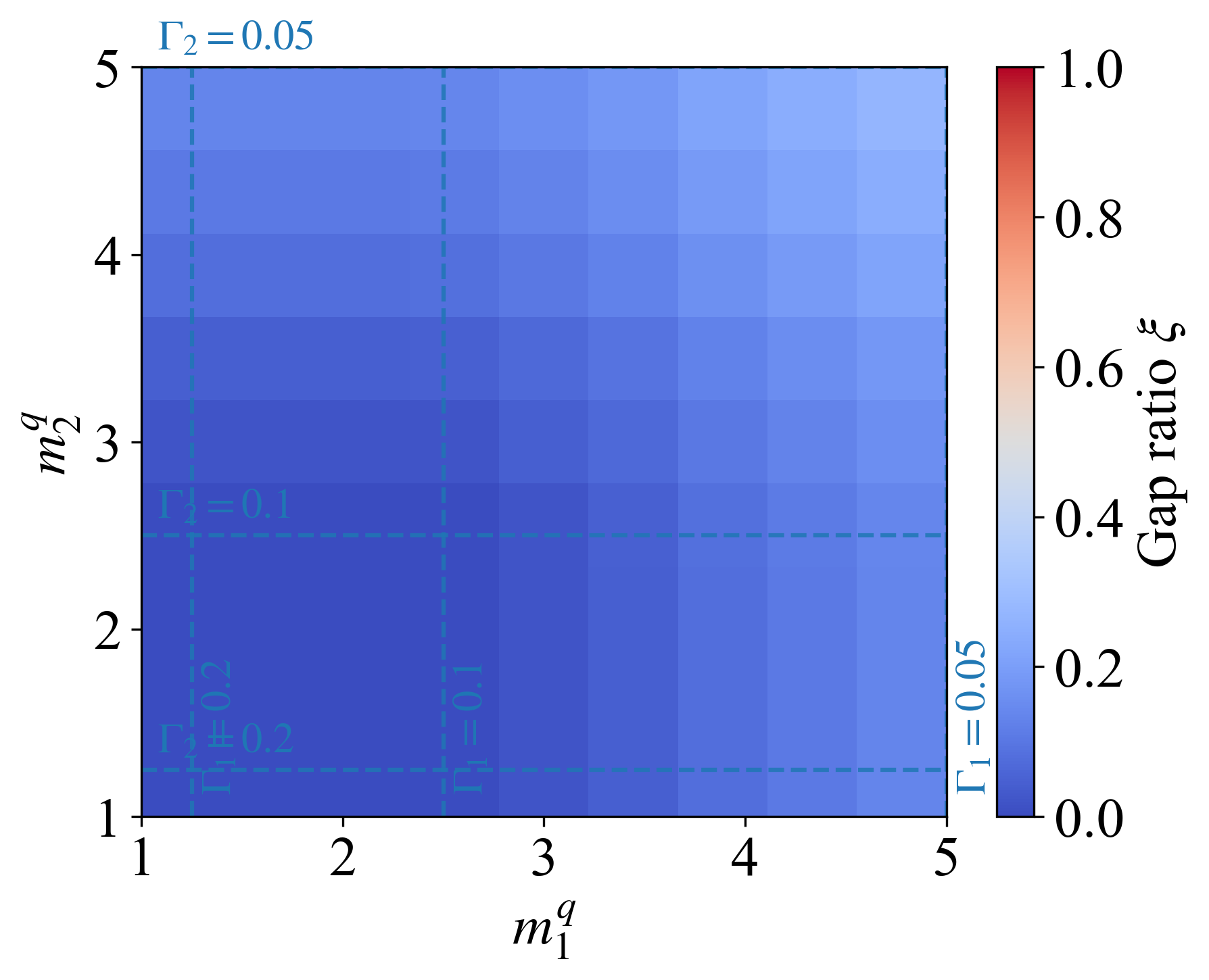
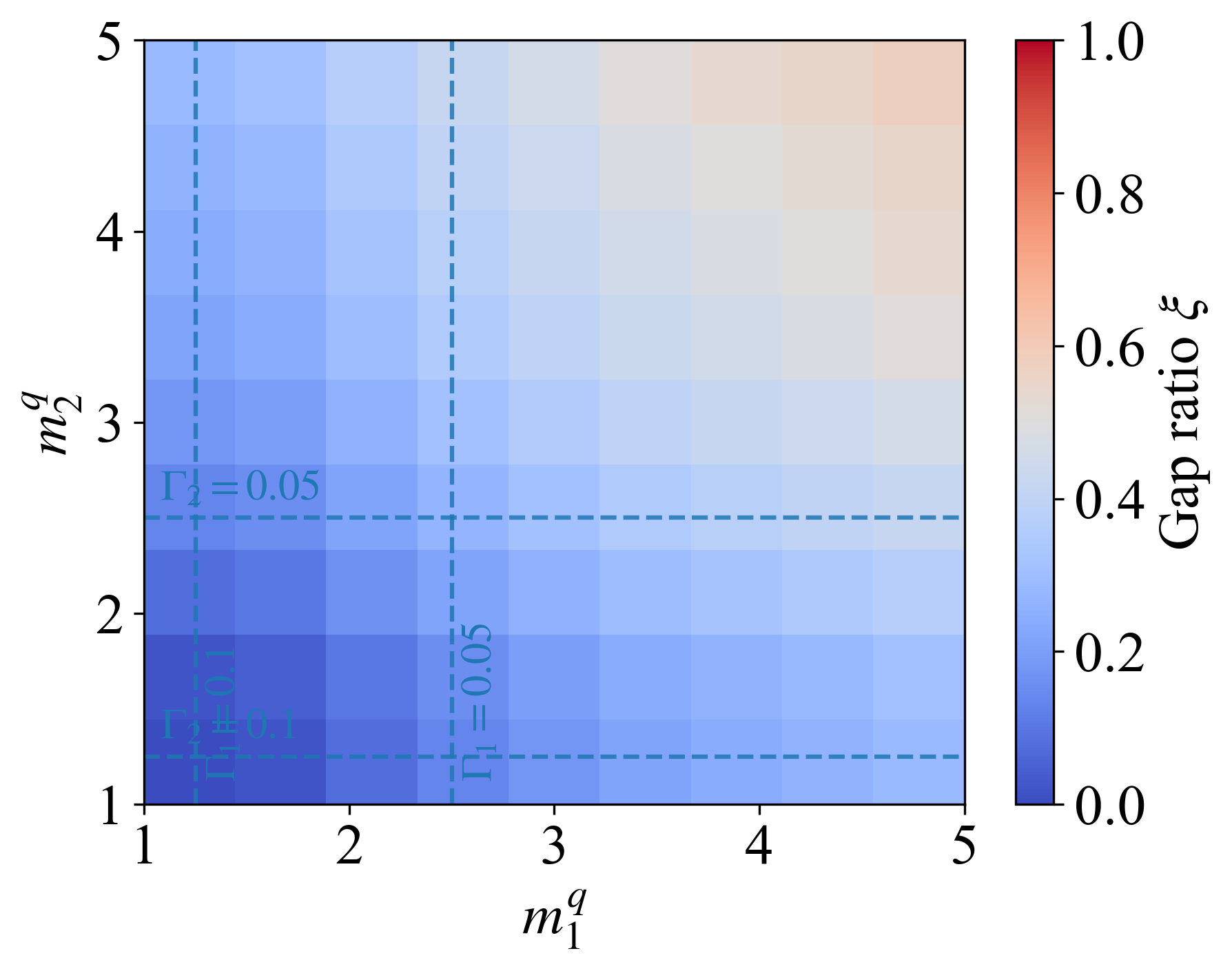
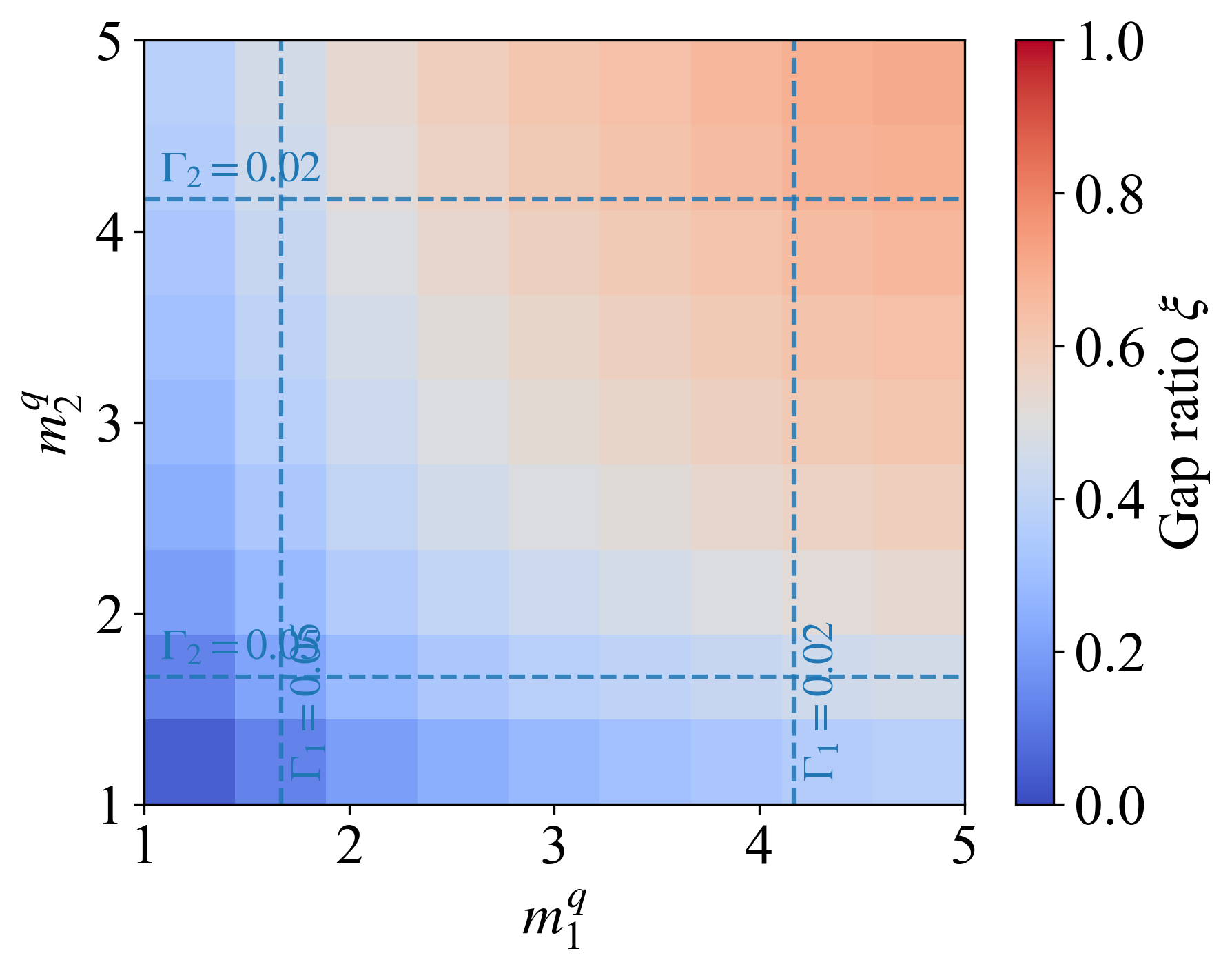
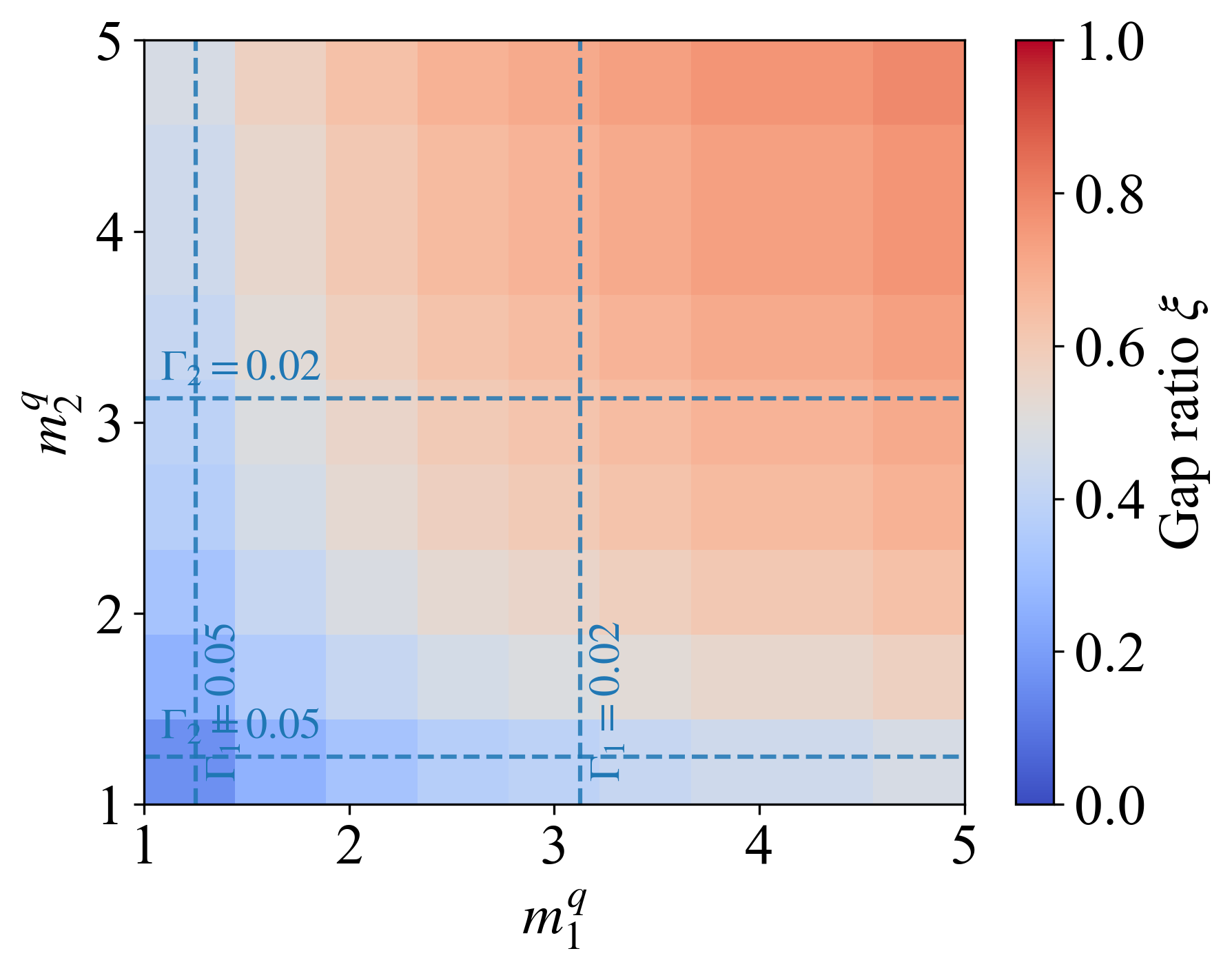
Figure 1: Heatmap of the gap ratio ξ over the space of droop parameters m1q,m2q for different values of B.
For moderate network coupling (lower B) and low droop coefficients, the decentralized criterion closely matches the true stability region. As B or droop coefficients increase, the conservativeness increases, but this regime is generally associated with tight voltage regulation, and thus more critical grid conditions.
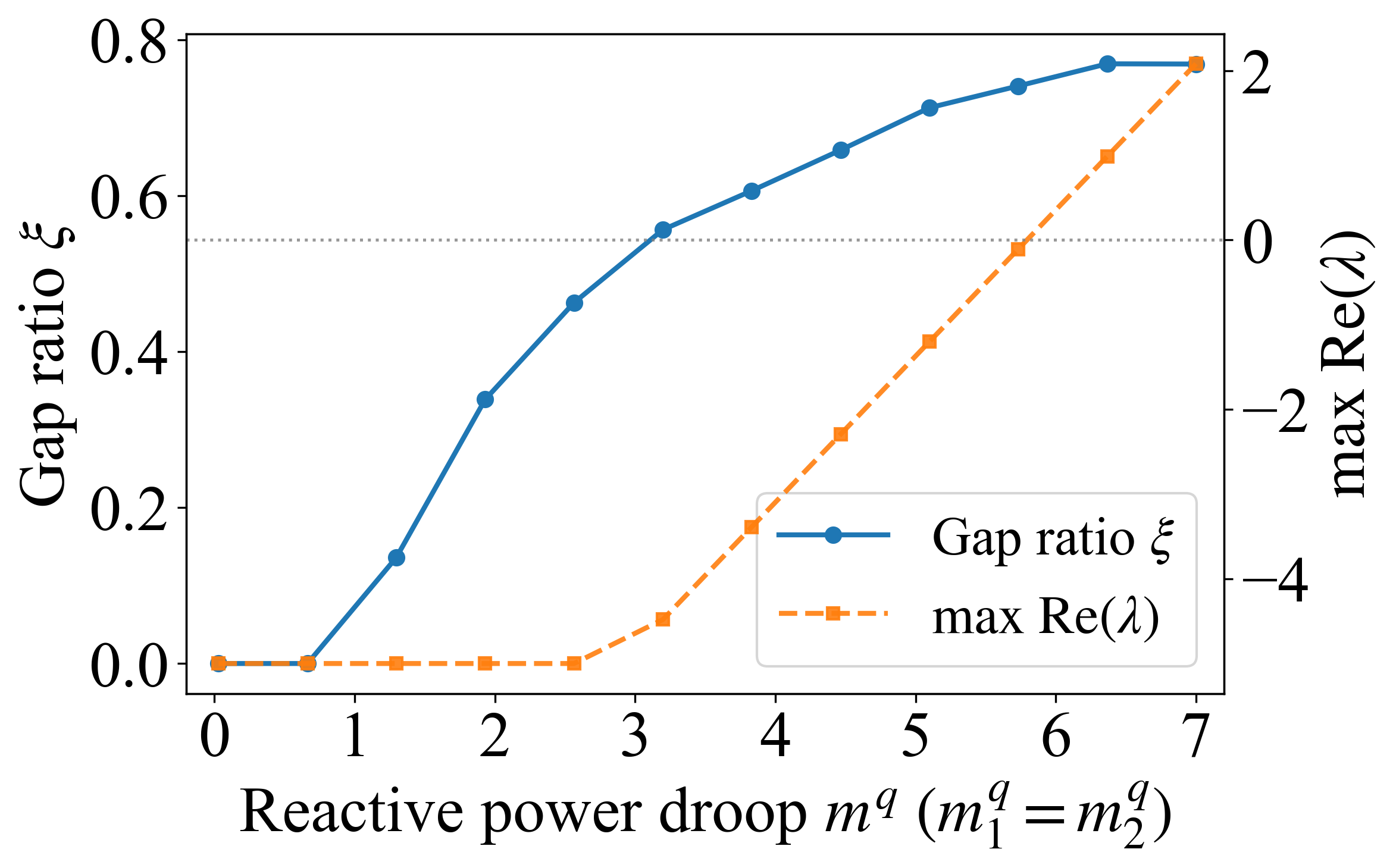
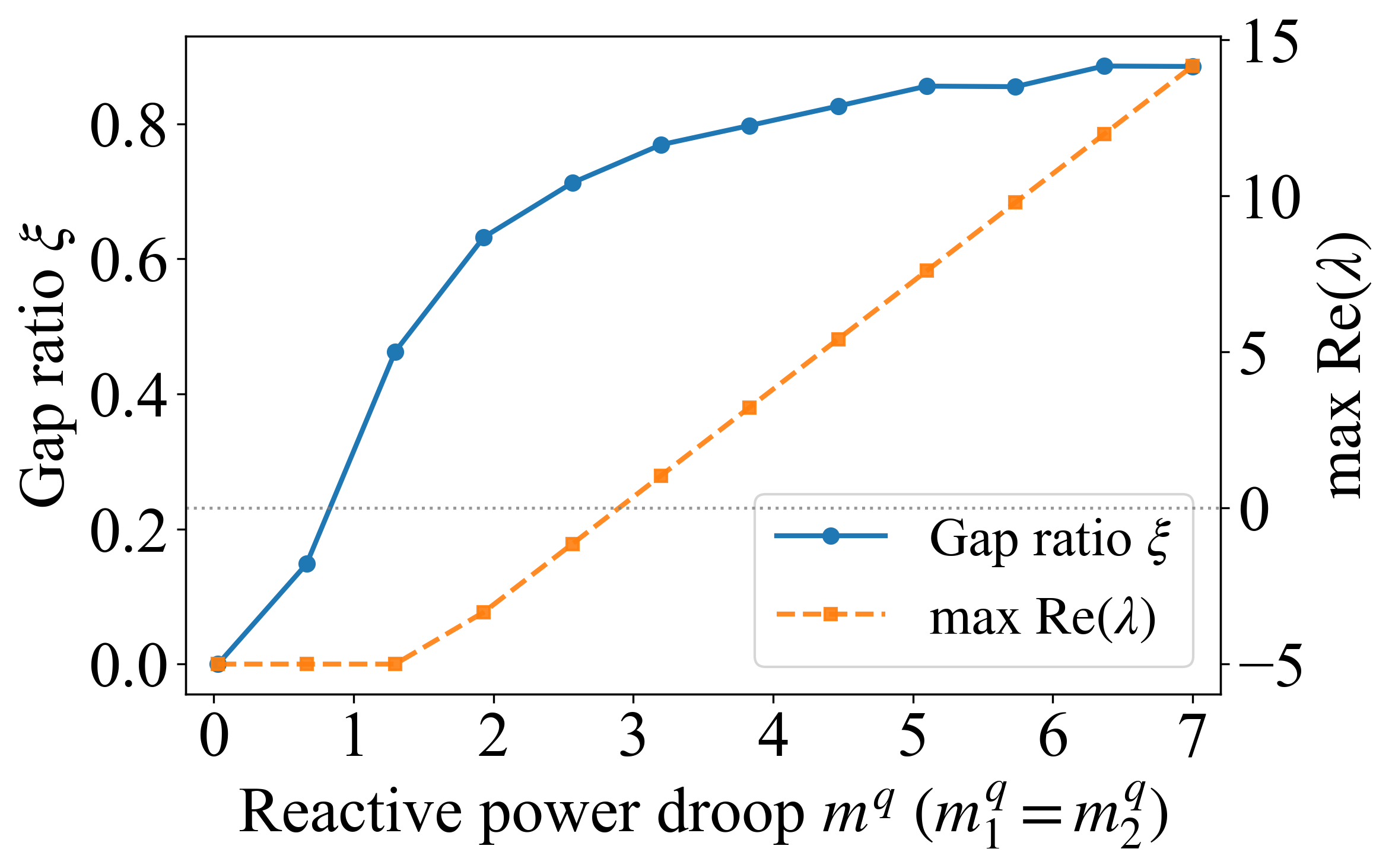
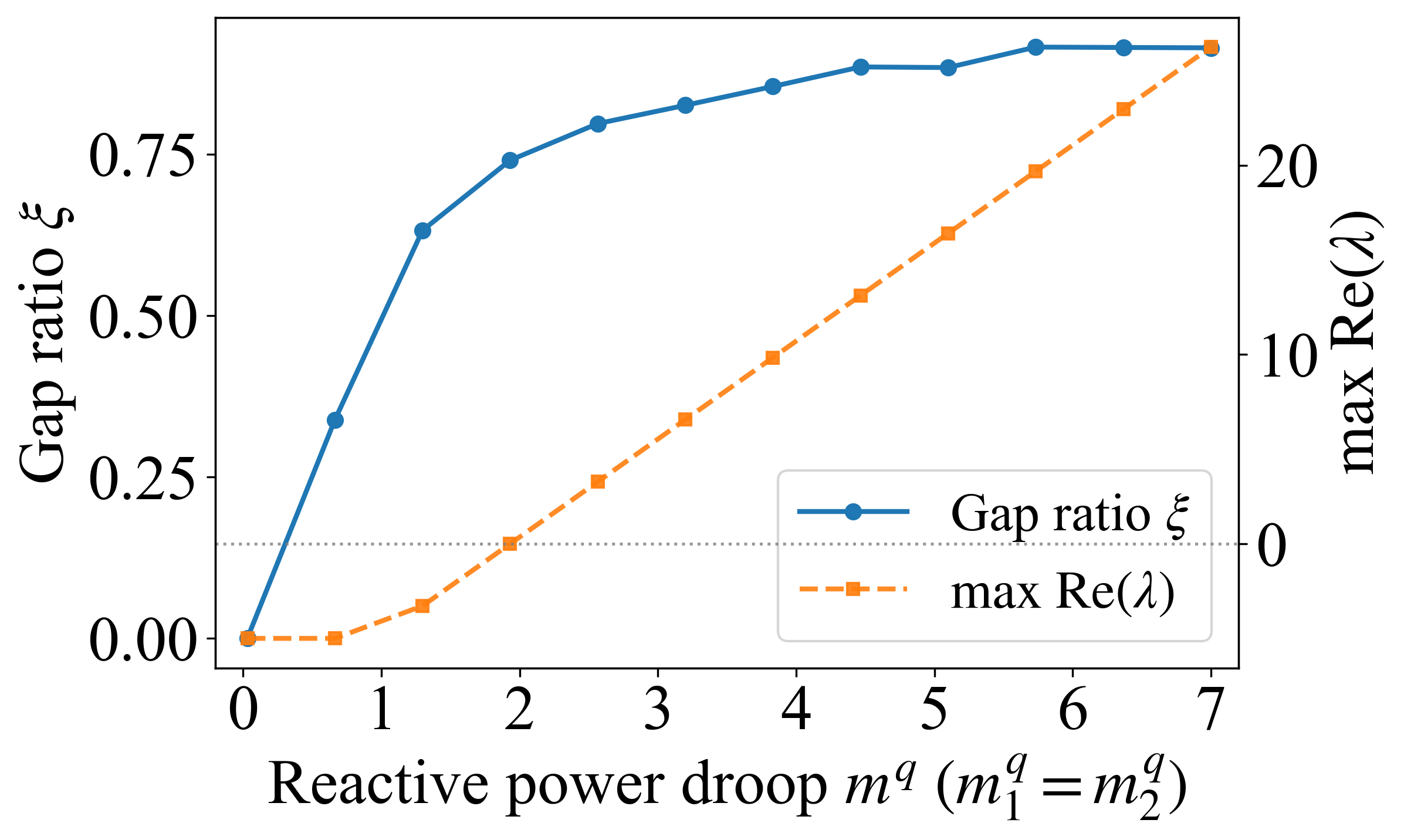
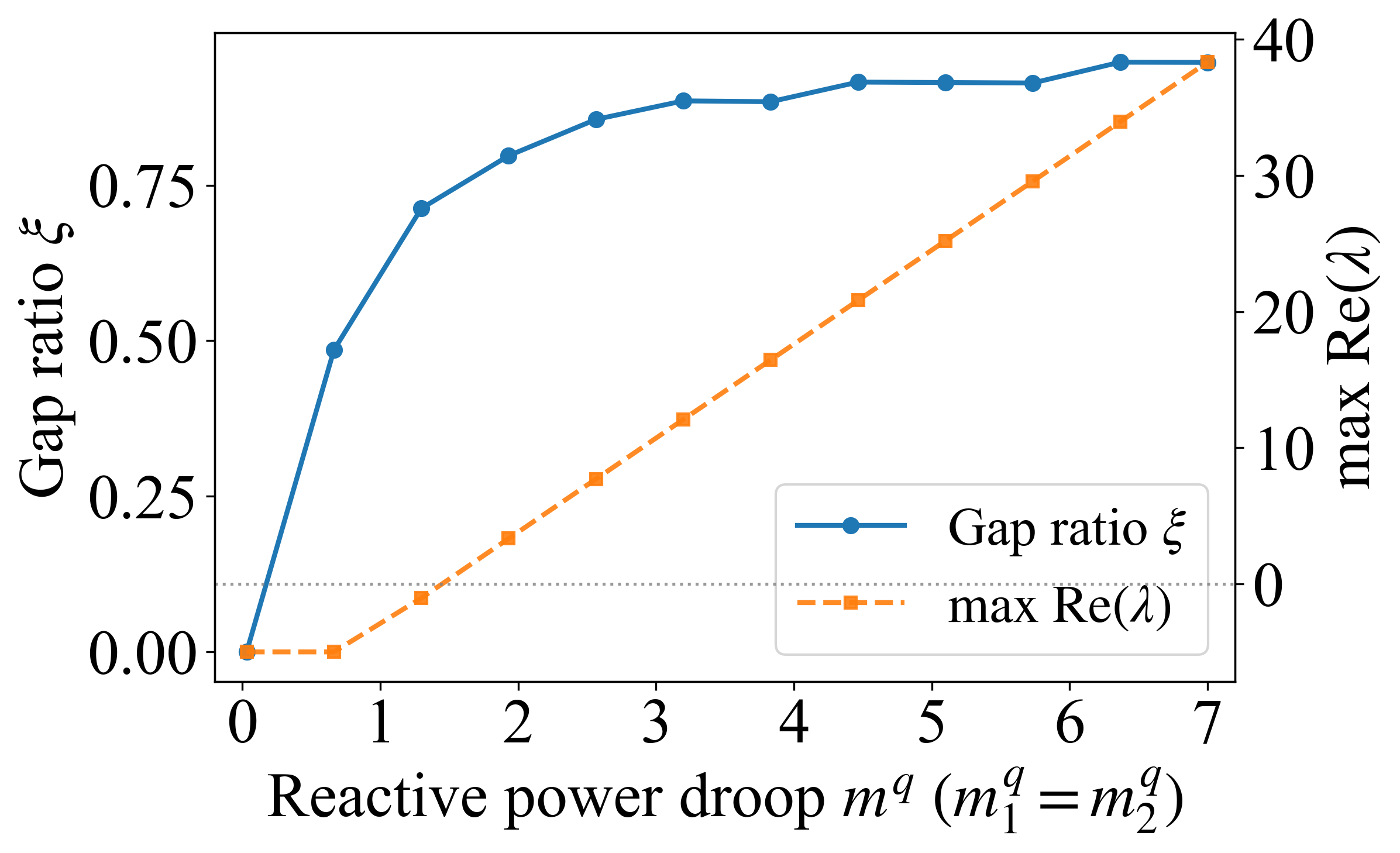
Figure 2: Gap ratio ξ and the eigenvalue-based stability margin maxRe(λ) along Γi0 for different Γi1.
The decentralized stability constraints are directly embedded into the OPF formulation. The resulting problem involves the minimization of a quadratic generation cost, subject to power flow equations, operational limits (generation, voltage, thermal), and the stability constraints derived above.
A central theoretical contribution is the characterization of dual variables ("shadow prices") associated with these stability constraints, defined as the Nodal Stability Shadow Price (NSSP). The analysis demonstrates that, in lossless networks with generation costs depending only on active power, stability constraints—even if binding—yield zero shadow prices as long as all operational inequality constraints are inactive. This implies stability is "costless" in this idealized scenario, and adjustments do not trade off against the economic objective.
However, when reactive power cost is incorporated (reflecting the physical limitations of IBRs and practical dispatch formulations), stability constraints carry positive shadow prices—reflecting real opportunity costs and leading to actual economic impacts when stability limits are binding. This observation resolves the theoretical degeneracy and establishes the importance of including reactive power costs in realistic formulations.
Numerical Validation and Parameter Effects
Comprehensive numerical experiments are performed on both a two-bus system and the IEEE 39-bus test system. The sensitivity of stability margins, the impact on the economic objective, and the activation of shadow prices are explored with respect to droop gains, the network susceptance scaling, and the cost coefficient on reactive power.
Shadow Prices and Droop/Network Parameters
Key results include:
- For Γi2-only objectives, stability constraints activate only at large droop, and the associated shadow prices remain zero.
- When reactive power cost is present, stability constraints can activate at practical operating points and induce significant, strictly positive shadow prices.
- Shadow price activation is sharply localized, with only a small subset of "critical" buses bearing nonzero NSSPs, especially under high stress.
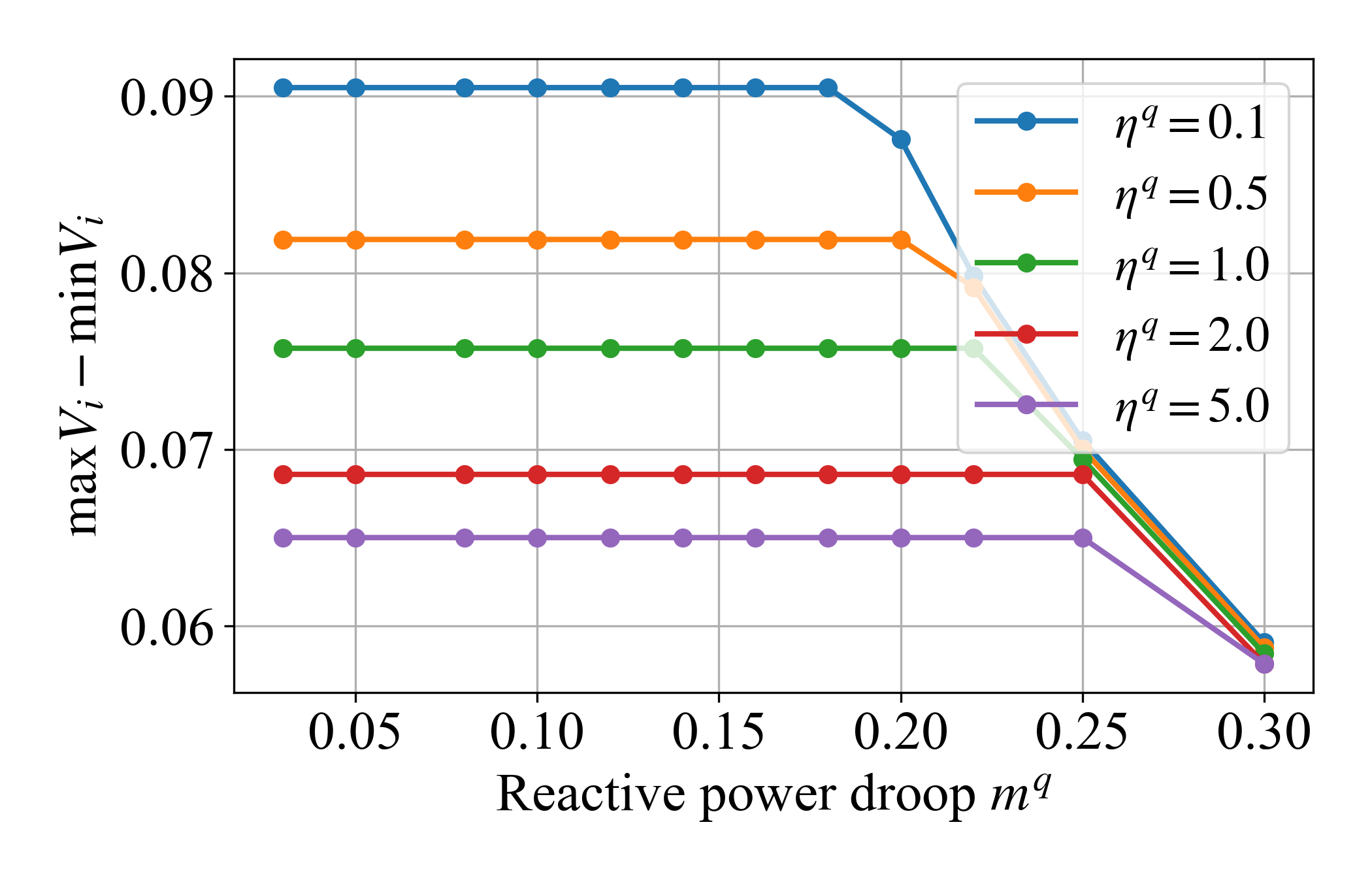
Figure 3: Maximum voltage difference across generator buses (Γi3) under different values of Γi4 and Γi5.
- The value and activation set of shadow prices is strongly dependent on both the droop parameter Γi6 and the network strength Γi7, as well as on the cost scaling Γi8 of reactive power in the objective function.
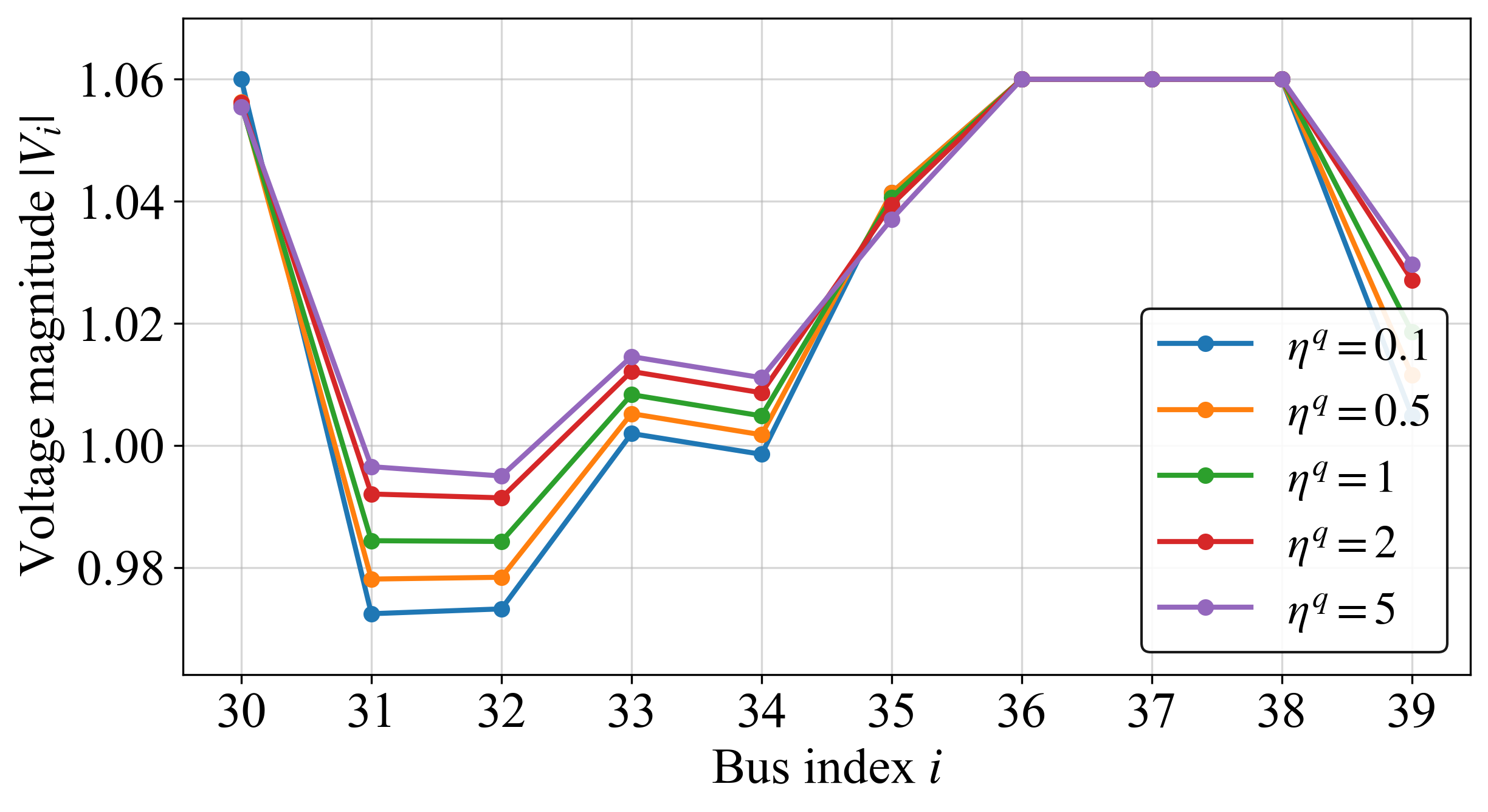
Figure 4: Voltage profiles across generator buses (30–39) for different values of Γi9, with ξ0 fixed at 0.2.
- Introducing reactive power costs leads to more balanced voltage profiles and increases the critical droop threshold for which stability constraints become active. Thus, the inclusion of reactive power cost smooths trade-offs between economic and stability requirements.
Theoretical and Practical Implications
The results rigorously show that decentralized, local algebraic constraints can act as reliable surrogates for global stability certification and can be seamlessly integrated into steady-state optimization processes. The introduction and interpretation of the NSSP provide a tool for localized market-based assessments of stability contribution—essential for future markets with high IBR shares.
On the theoretical front, the strict conditions for activation of nonzero stability shadow prices clarify under what modeling and market assumptions stability genuinely becomes an economic constraint, informing both system design and regulatory practices. The findings also highlight the nontrivial role of reactive power economics, grid-forming inverter design (via droop), and network strengthening.
Future Directions
Potential research avenues include extending the approach to networks with losses, integrating distribution-level constraints, dynamic and market-based allocation of stability resources, and co-optimization of inverter and network control parameters with stability-economic trade-off explicitly represented and priced.
Conclusion
This work presents a decentralized, computationally tractable, and economically interpretable framework for incorporating small-signal stability constraints into OPF for inverter-dominated grids. The algebraic form of the constraints supports scalability and decentralization, while the dual price analysis provides a foundation for nodal market-based mechanisms for stability. Theoretical results and extensive numerics clearly demonstrate the interplay among control, network, and economic parameters, opening directions for new stability services and dispatch tools in low-inertia power systems.

