Study of ZZ and ZH production in the bbττ final state and search for high-mass spin-0 and spin-1 resonances in proton-proton collisions at s = 13 TeV
Published 2 Jul 2026 in hep-ex | (2607.01589v1)
Abstract: A study of the production of pairs of Z bosons (ZZ) and of the associated production of a Z boson and a Higgs boson (ZH) in final states containing two b quarks and two tau leptons (bbττ) is presented. The analysis is based on proton-proton collisions collected at s = 13 TeV by the CMS experiment at the LHC, corresponding to an integrated luminosity of 138 fb<sup>−1. The nonresonant analysis targets the standard model ZZ and ZH processes in the bbττ final state, motivated by the prominent role of this channel in searches for nonresonant Higgs boson pair production. The resonant searches target physics beyond the standard model, probing heavy spin-0 resonances X that decay into ZZ and spin-1 resonances Z' that decay into ZH, with masses in the 0.2−5 and 0.5−6 TeV ranges, respectively. Upper limits at 95% confidence level are set on the product of production rate and branching fraction σ(X)B(X → ZZ), ranging from 300 pb to 24 fb, and σ(Z')B(Z' → ZH), ranging from 0.4 pb to 12 fb. These are the first measurements to probe the ZZ/ZH → bbττ processes. No deviation from standard model expectations is observed.
The paper presents a detailed analysis of ZZ and ZH production in the bbττ final state, setting stringent upper limits on high-mass spin-0 and spin-1 resonances.
It employs advanced reconstruction tools and deep neural networks, including DeepJet, ParticleNet, and DeepTau, to enhance signal extraction and background rejection.
Results are consistent with Standard Model predictions, with projections indicating potential observation of ZZ signals at the HL-LHC with increased luminosity.
Study of ZZ and ZH Production in the bbττ Final State and Search for High-Mass Spin-0 and Spin-1 Resonances in Proton-Proton Collisions at s=13 TeV
Introduction and Motivation
The analysis presented in "Study of ZZ and ZH production in the bbττ final state and search for high-mass spin-0 and spin-1 resonances in proton-proton collisions at s = 13 TeV" (2607.01589) explores diboson production mechanisms ($\PZ\PZ$ and $\PZ\PH$) in a final state containing a pair of b quarks and a pair of tau leptons. This final state is of significant interest for multiple reasons: it is a crucial channel for Standard Model (SM) measurements, including processes used as benchmarks for the eventual observation of non-resonant Higgs boson pair ($\PH\PH$) production, and it provides sensitivity to resonant Beyond Standard Model (BSM) signatures, such as high-mass spin-0 and spin-1 resonances decaying to these diboson final states.
Backgrounds in this channel primarily arise from ttˉ and Drell–Yan production, but the channel offers a favorable balance between background rates and signal sensitivity, particularly due to the dominant bbˉττ branching for s=130-like topologies and third-generation enhanced couplings for some BSM scenarios.
Experimental Strategy and Object Reconstruction
The dataset consists of 138 fbs=131 of LHC proton-proton collisions at s=132 TeV collected with the CMS detector. The analysis investigates three s=133 decay modes (lepton–lepton, lepton–hadronic, and hadronic–hadronic) covering 87.6% of tau decay topologies, and targets both resolved and boosted regimes for the s=134 and s=135 pairs.
Sophisticated particle identification and reconstruction algorithms are utilized, including:
DeepJet for AK4 s=136-jet identification, exploiting advanced DNN techniques for efficient heavy-flavor discrimination.
ParticleNet for boosted s=137 systems (AK8 jets), with a dynamic graph convolutional architecture optimized for particle cloud features.
Hadrons-plus-strips (HPS) and DeepTau for high-fidelity s=138 reconstruction across standard and boosted topologies, noting that BoostedDeepTau provides additional performance in collimated environments typical of high-mass resonances.
FastMTT for tau pair mass reconstruction, leveraging a matrix element approach under the collinear approximation to mitigate the impact of missing neutrino s=139.
Object isolation and event categorization are performed with tight kinematic and discriminant-based selection, considering overlap removal, opposite charge, and angular separation criteria.
Signal and Background Modeling
Signal samples for SM and BSM processes are produced at NLO or LO precision using MADGRAPH5_aMC@NLO and POWHEG, with cross section normalization to NNLOQCD wherever available. Spin-0 (heavy scalar) resonances decaying to ττ0 and spin-1 (heavy vector) resonances decaying to ττ1 are generated across a mass range spanning 200 GeV to 6 TeV, employing the narrow-width approximation to ensure model-independent interpretation.
Dominant backgrounds—ττ2, Drell–Yan, QCD multijet, single top, ττ3+jets, diboson, triboson, and rare SM processes—are modeled from simulation where feasible. The QCD background is extracted from data using a robust ABCD method in orthogonal control regions, exploiting charge and ττ4 identification discriminants for effective normalization and shape estimation.
Event Selection, Categories, and DNN-Based Signal Extraction
Events are selected using dedicated triggers for each ττ5 channel, adjusting strategy between resolved and boosted regimes to maximize acceptance. After baseline selection, events are split into the following mutually exclusive categories for optimal sensitivity:
Resolved 2b: Events containing two ττ6-tagged AK4 jets.
Resolved 1b: Events with a single ττ7-tagged AK4 jet.
Boosted ττ8: Events with a high-ττ9 AK8 jet passing ParticleNet selection.
Boosted s0: Events where tau candidates are highly collimated.
These are further subdivided by s1 decay mode, resulting in 12 orthogonal analysis categories. Mass-window and elliptical selections in the reconstructed s2 vs. s3 plane are implemented to enhance purity.
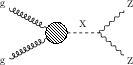
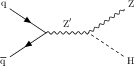
Figure 1: Illustrative diagrams describing the production of a high-mass resonance: a spin-0 resonance (left) and a spin-1 resonance (right).
Process-specific DNNs are trained for SM s4 and s5 measurement regions.
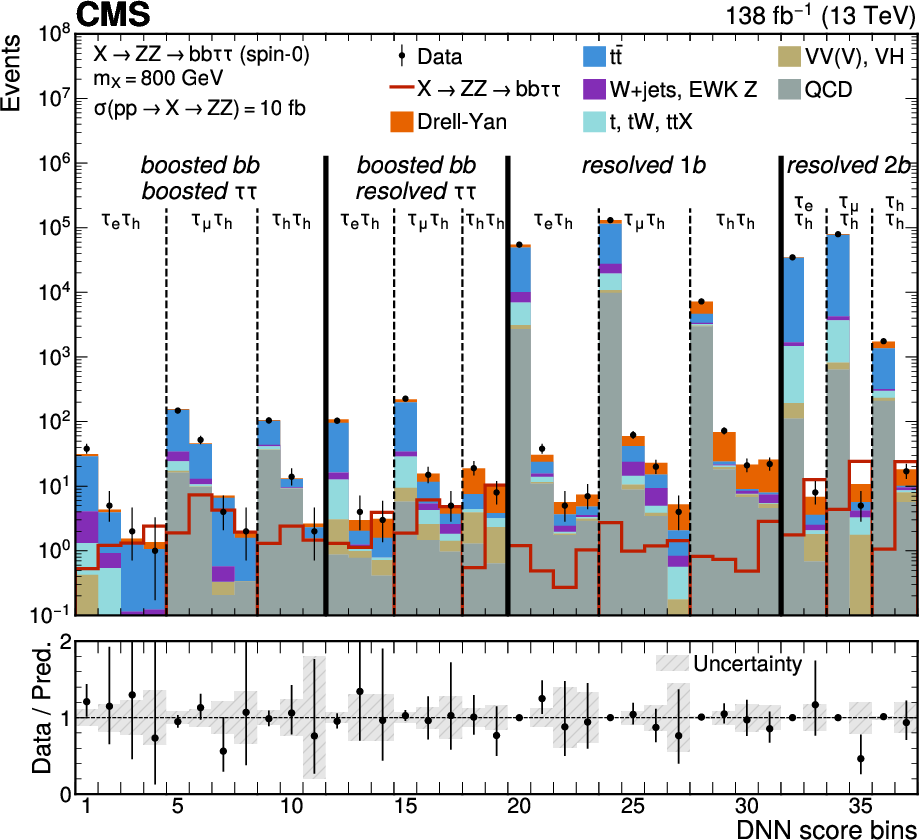
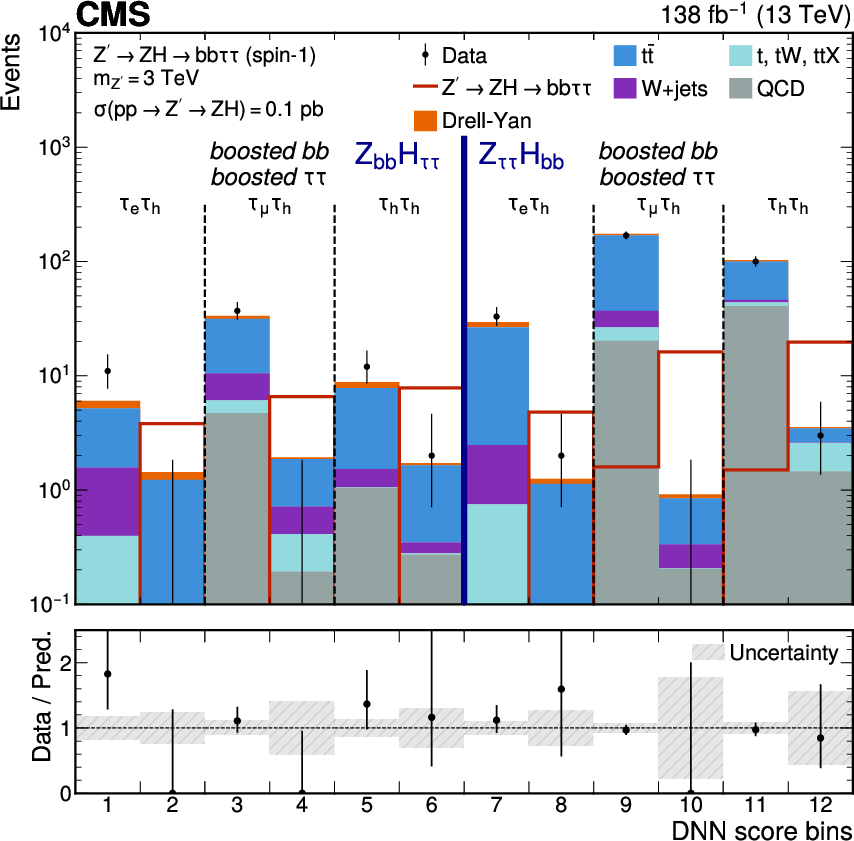
Parameterized DNNs are deployed for the resonant searches, with the resonance mass as an explicit input, enabling smooth interpolation across wide mass hypotheses.
DNN inputs include jet and lepton kinematics, flavor tagger scores, category information, invariant masses, angular variables, and data-taking conditions, ensuring high discrimination across the full analysis phase-space.
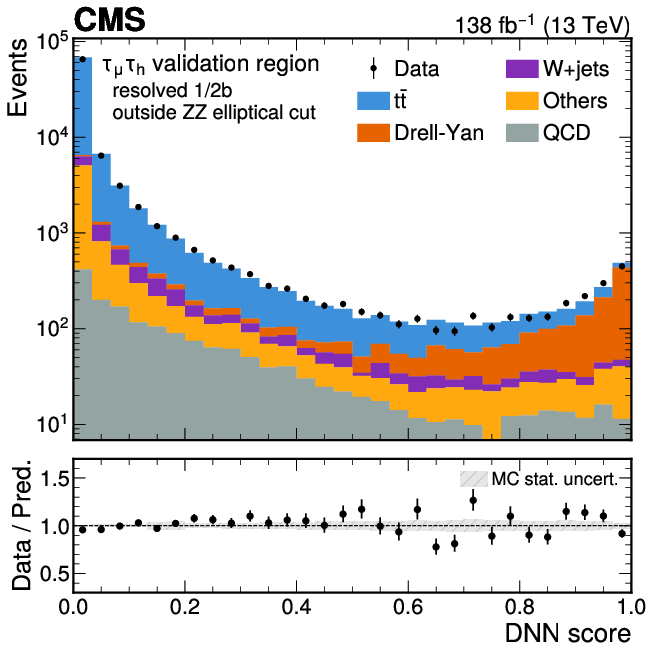
Figure 2: Distribution of the nonresonant DNN used for signal extraction in a validation region defined by inverting the elliptical mass selections.
Results and Statistical Interpretation
A binned maximum-likelihood fit of the DNN outputs is performed across all categories, simultaneously extracting signal strengths and setting upper limits. Systematic uncertainties—covering luminosity, object reconstruction, trigger and selection efficiency, background normalization and modeling, theoretical cross sections, and limited MC statistics—are incorporated as dedicated nuisance parameters.
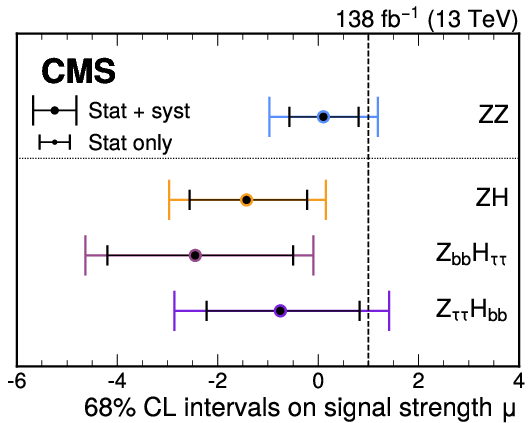
SM s6: The extracted signal strength is s7, consistent with the SM expectation.
SM s8: The result is s9, again agreeing with the SM.
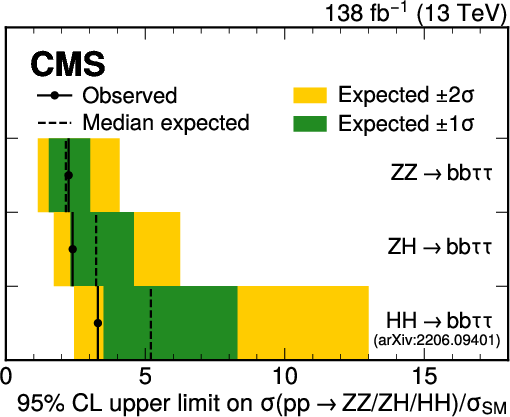
95% CL upper limits: $\PZ\PZ$0 and $\PZ\PZ$1 the SM expectation are set on the $\PZ\PZ$2 and $\PZ\PZ$3 cross sections, respectively.
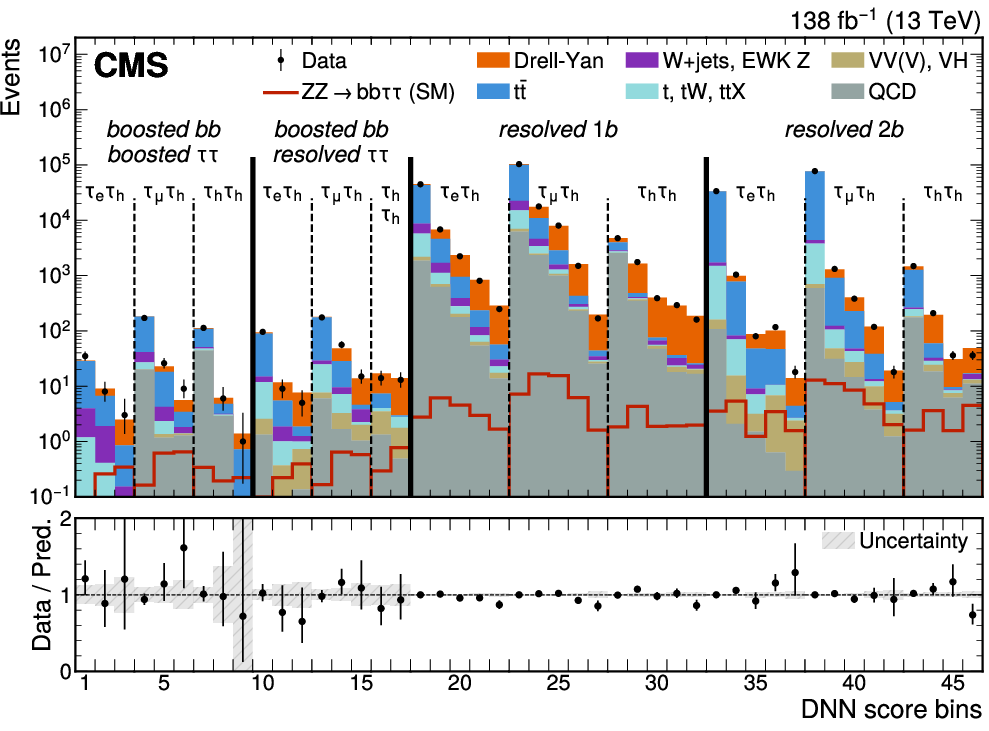
Figure 3: Distributions of the output of the DNN used for SM signal extraction. The lower panel shows the ratio of the data to the background prediction with uncertainties.
Figure 4: Best fit signal strengths and approximate 68\% CL intervals for SM $\PZ\PZ$4 and $\PZ\PZ$5, from a profile likelihood fit.
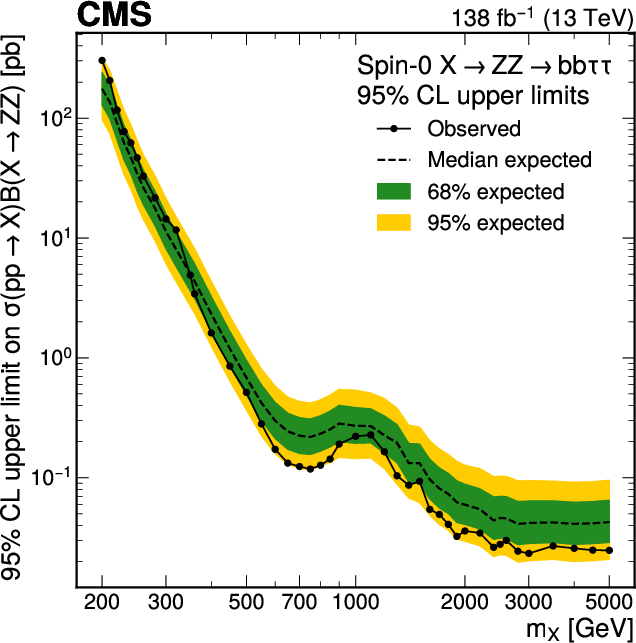
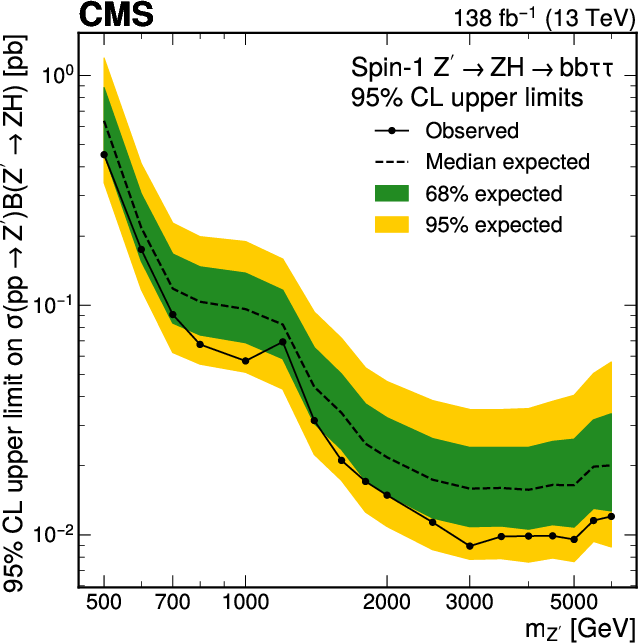
Figure 5: Upper limits on the production cross section for the $\PZ\PZ$6 process (left, spin-0 resonance) and the $\PZ\PZ$7 process (right, spin-1 resonance), under the narrow-width approximation.
For resonant BSM searches, $\PZ\PZ$8 CL upper limits are set on $\PZ\PZ$9 and $\PZ\PH$0 in the ranges 300 pb $\PZ\PH$1 24 fb (spin-0) and 0.4 pb $\PZ\PH$2 12 fb (spin-1), respectively. No significant deviation from SM predictions is observed, imposing stringent constraints on extended Higgs sector and heavy vector triplet models.
Figure 6: Example DNN output distributions for the resonant DNN used for signal extraction, for $\PZ\PH$3 GeV (spin-0) and $\PZ\PH$4 TeV (spin-1).
Projections for HL-LHC and Theoretical Implications
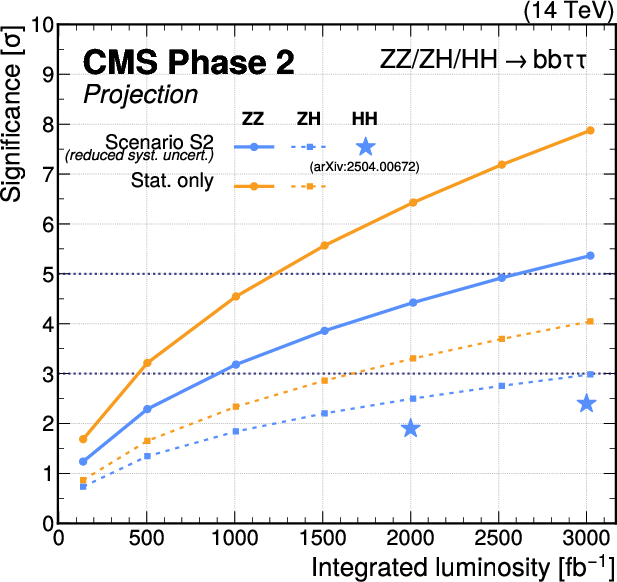
Expected sensitivities at the HL-LHC are extrapolated for both $\PZ\PH$5 and $\PZ\PH$6 in $\PZ\PH$7 using scenario-driven systematic assumptions. Evidence for $\PZ\PH$8 production in this final state is reachable with $\PZ\PH$9 abb0, and b1 observation with b2 abb3; b4 observation remains systematically limited even at 3 abb5, unless further analysis and detector improvements are realized.
Figure 7: Projected significance for SM b6 and b7 processes as a function of integrated luminosity at the HL-LHC with two different systematic uncertainty scenarios.
These results advance the use of b8 and b9 processes as standard candles for $\PH\PH$0 searches in the $\PH\PH$1 channel, providing a direct test bed for background models and analysis methodology essential for self-coupling–sensitive Higgs pair measurements. The analysis sets the first upper limits for the $\PH\PH$2 and $\PH\PH$3 resonant BSM production in the $\PH\PH$4 final state, substantially extending prior diboson reach in the $\PH\PH$5 sector.
Conclusion
This analysis provides the most comprehensive study to date of $\PH\PH$6 and $\PH\PH$7 production in the $\PH\PH$8 final state and establishes the first limits on high-mass resonant production in this channel. Advanced reconstruction and machine learning-based categorization and discrimination methods yield sensitivities approaching the thresholds necessary for evidence at the forthcoming HL-LHC. The findings have significant impact on both SM precision tests and the search for BSM resonances, particularly in models that enhance couplings to third generation fermions. The measurement framework and background-handling strategies will be directly applicable to future $\PH\PH$9 searches and broader di-boson studies as large datasets become available.