Search for heavy resonances decaying into two Higgs bosons in the bbˉτ+τ− final state in proton-proton collisions at s=13TeV with the CMS detector
Published 26 Apr 2026 in hep-ex | (2604.23502v1)
Abstract: A search is presented for massive narrow-width resonances in the mass range of 1-4.5TeV decaying into pairs of Higgs bosons (HH), using proton-proton collision data at a center-of-mass energy of 13TeV collected with the CMS detector at the LHC during the 2016-2018 data-taking. The data correspond to an integrated luminosity of 138fb<sup>−1. The analysis targets final states where one Higgs boson decays into a pair of bottom quarks and the other into a pair of tau leptons, X→HH→bbˉτ<sup>+τ<sup>−. The observed data are found to be consistent with standard model background expectations. Upper limits at 95% confidence level (CL) are set on the production cross section for resonant HH production for masses between $1$ and 4.5TeV. This analysis sets the most sensitive LHC limits to date on X→HH→bbˉτ<sup>+τ<sup>− decays in the mass range of $1.4$ to 4.5TeV.
The paper demonstrates a novel search for heavy resonances decaying into two Higgs bosons, achieving stringent 95% CL upper limits on production cross sections.
Advanced deep learning algorithms, including BoostedDeepTau and ParticleNet, are employed for boosted object identification in a challenging merged decay environment.
No significant excess over the SM background is observed, thereby constraining BSM scenarios and informing future searches for high-mass resonance signals.
Search for Heavy Resonances Decaying to Higgs Boson Pairs in the bbτ+τ−ˉ Final State with CMS
Introduction and Motivation
The Standard Model (SM) Higgs discovery has not resolved several key open questions, driving extensive probes for physics beyond the SM (BSM), particularly at the TeV scale. Among these, many BSM scenarios—such as warped extra-dimension models with either spin-0 (scalar) or spin-2 (Kaluza–Klein graviton) resonances—predict resonant production of Higgs boson pairs (HH) at cross sections significantly above SM backgrounds. The analysis presented in "Search for heavy resonances decaying into two Higgs bosons in the bbτ+τ−ˉ final state in proton-proton collisions at s=13TeV with the CMS detector" (2604.23502) targets the phenomenologically clean final state X→HH→bbˉτ+τ−, leveraging the complete Run 2 CMS dataset.
Experimental Strategy and Object Reconstruction
In the kinematic region with resonance masses $1-4.5$ TeV, Higgs bosons are produced with substantial boosts, leading to highly collimated decay products. The H→bbˉ decay yields bottom quarks that frequently merge into single large-radius (AK8) jets, classified using the ParticleNet tagger, which provides both object identification and a mass regression critical for signal definition. For H→ττ, where the τ decay products spatially overlap, advanced algorithms for boosted τ identification are essential. This analysis introduces the BoostedDeepTau convolutional neural network, an extension of DeepTau, tailored for efficient discrimination of merged hadronic τ pairs in the high-bbτ+τ−ˉ0 regime.
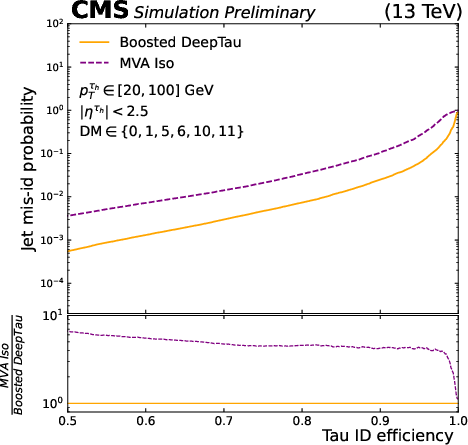
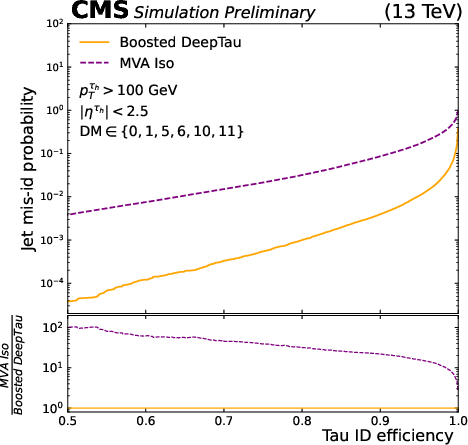
BoostedDeepTau incorporates both low-level detector data and a large set of handcrafted features, achieving a factor of 2–4 improvement in background rejection at bbτ+τ−ˉ1 GeV, and bbτ+τ−ˉ2 at higher bbτ+τ−ˉ3 compared to previous MVA-based discriminants.
Figure 1: BoostedDeepTau shows a discrimination power that is a factor of 2--4 (bbτ+τ−ˉ4) better than the MVA Iso discriminator for individual reconstructed bbτ+τ−ˉ5 from a boosted ditau system at low (left) and high (right) bbτ+τ−ˉ6.
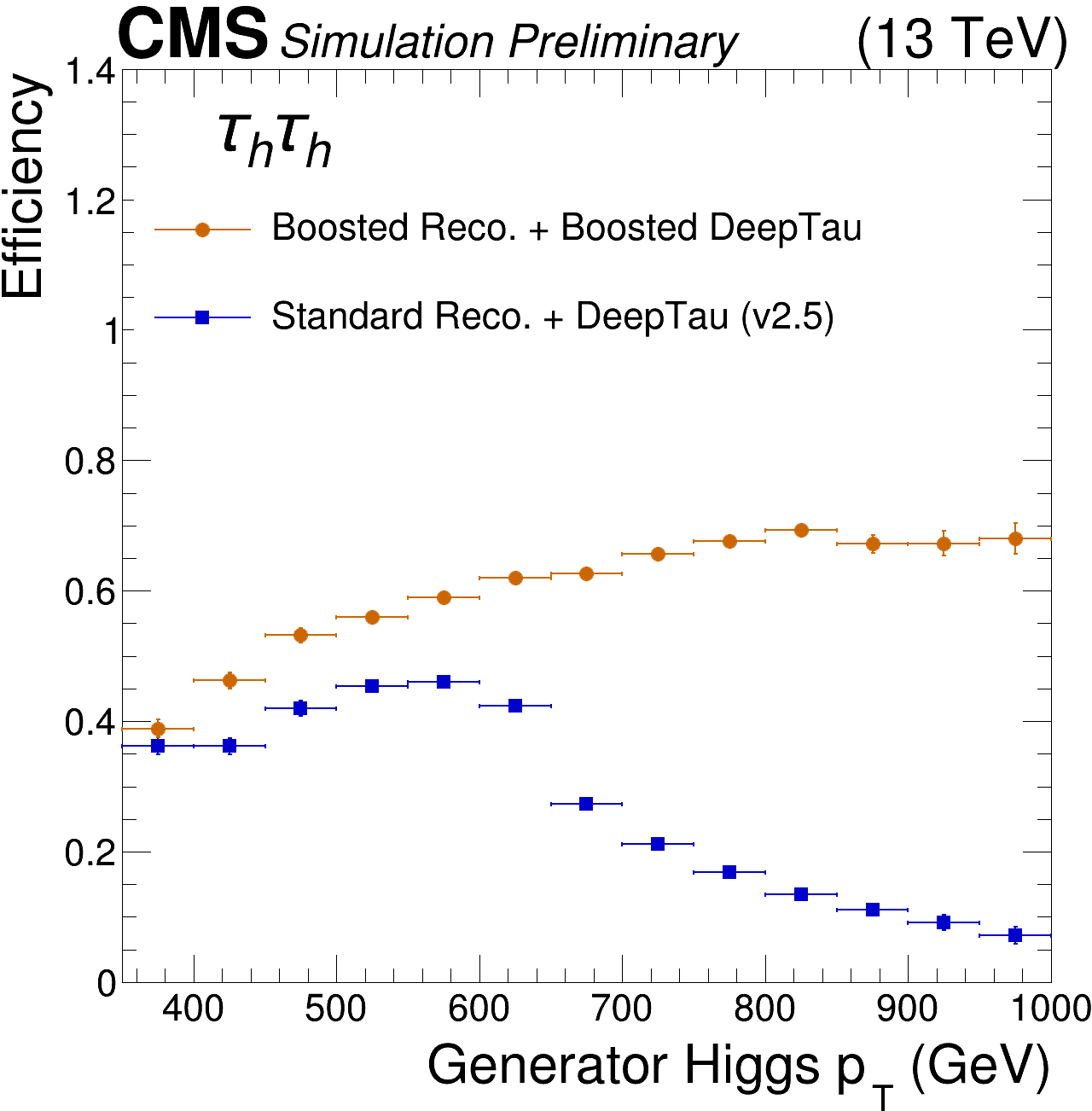
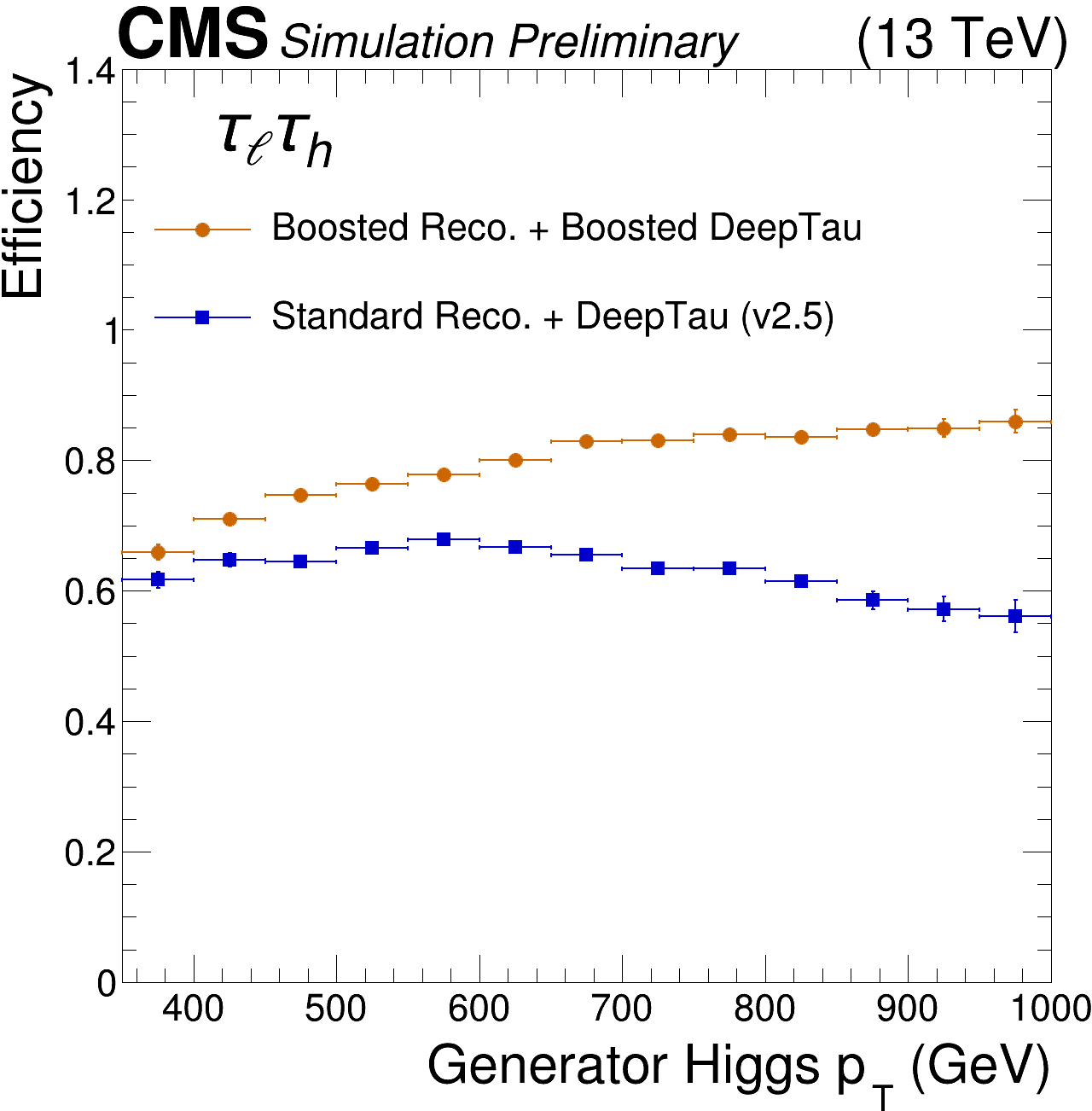
The identification and reconstruction efficiency as a function of the generator-level Higgs bbτ+τ−ˉ7 exceeds 95% for the employed loose working point, demonstrating robust detector performance for both hadronic and semileptonic bbτ+τ−ˉ8 final states.
Figure 2: bbτ+τ−ˉ9 reconstruction and identification efficiency versus generator–level Higgs s=13TeV0 for fully hadronic and semileptonic final states.
Event Selection and Signal Extraction
Events are selected with strict missing transverse momentum requirements (s=13TeV1 GeV offline), exploiting triggers efficient for the signal topology. Only events with at least one Higgs boson reconstructed as a large-radius jet, and another decaying to s=13TeV2 or s=13TeV3, are retained. The FastMTT algorithm is used for reconstructing the di-s=13TeV4 four-momentum, employing a likelihood approach with collinear approximation.
Overall selection efficiencies for simulated spin-0 resonances range from 2–14% in s=13TeV5 and 4–11% in s=13TeV6 channels. After full selection, the dominant background is s=13TeV7, with contributions from s=13TeV8+jets depending on the channel. The modeling of this background is improved through an unconstrained bin-by-bin normalization in the resonance mass (s=13TeV9) spectrum, fitted simultaneously in signal and sideband regions. Systematic uncertainties, including those associated with object ID efficiencies, luminosity, and data-driven backgrounds, are comprehensively incorporated.
The post-fit reconstructed mass distributions for the resonance are shown for both the signal and sideband regions, indicating consistency with background-only expectations.
Figure 3: Post-fit X→HH→bbˉτ+τ−0 distributions for the signal (left) and sideband (right) regions in the merged X→HH→bbˉτ+τ−1 and X→HH→bbˉτ+τ−2 channels.
Results and Upper Limits
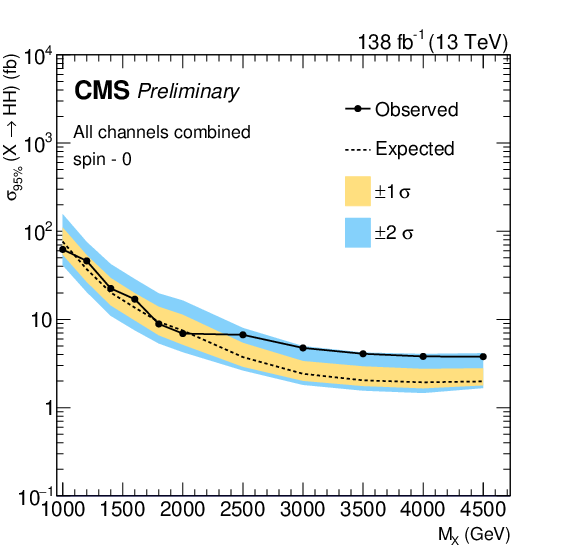
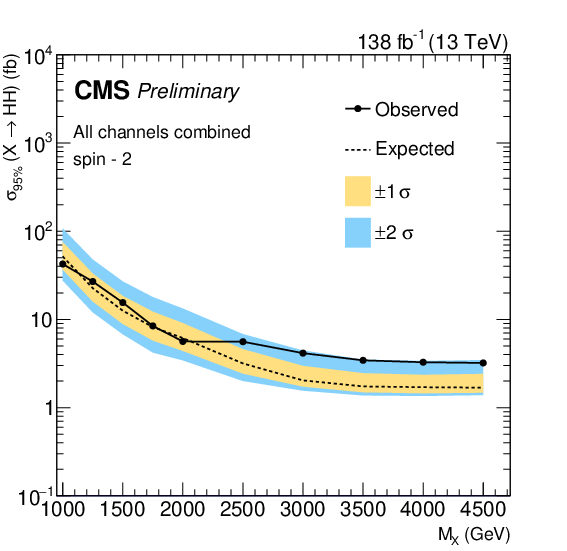
No statistically significant excess over the SM background is observed. Upper limits at 95% confidence level are set on X→HH→bbˉτ+τ−3 production cross sections for both spin-0 and spin-2 resonance hypotheses as a function of X→HH→bbˉτ+τ−4, covering the X→HH→bbˉτ+τ−5 TeV range.
For resonance masses above 1.4 TeV, this analysis yields the most sensitive constraints on X→HH→bbˉτ+τ−6 decays to date, surpassing the sensitivity of previous ATLAS and CMS results for both low and high mass ranges.
Figure 4: Expected and observed 95% CL upper limits on the resonant X→HH→bbˉτ+τ−7 production cross section for spin-0 (left) and spin-2 (right) hypotheses.
Implications and Future Directions
The null result further constrains BSM scenarios predicting narrow-width heavy resonances decaying to HH final states in the merged-jet, boosted X→HH→bbˉτ+τ−8 regime. The paradigm of deep ML-based object identification, such as BoostedDeepTau and ParticleNet, undergirds the advanced sensitivity demonstrated. The results underscore the necessity of dedicated reconstruction algorithms for highly Lorentz-boosted signatures, a trend likely to continue as future LHC datasets push to even higher mass ranges and more challenging topologies. The analytical strategy, including advanced background modeling and simultaneous likelihood fitting, provides a robust template for future LHC experimental analyses addressing similar final states or exploring alternative models (non-resonant HH, extended Higgs sectors, etc.).
Conclusion
This CMS study establishes stringent upper limits on heavy resonance production in the X→HH→bbˉτ+τ−9 final state using the entire Run 2 dataset. The reported sensitivity, bolstered by advanced deep learning identification techniques and rigorous statistical treatment, currently represents the most powerful constraint on this class of BSM scenarios for resonance masses above 1.4 TeV. Future datasets and refined algorithms will further probe this channel and extend the search reach across a broader theoretical landscape.