- The paper presents an MDP framework that optimizes both admission control and locker assortment for multi-size systems through a novel always-accept (AA) policy approach.
- It demonstrates that the AA policy is optimal under most practical conditions, with negligible optimality gaps (<0.1%) even in stress-test scenarios.
- The study integrates exact value iteration, simulation, and relaxation-based methods to drastically cut computational costs while offering actionable insights for real-world deployment.
Admission and Assortment Optimization in Multi-size Automated Parcel Lockers: An MDP and Certification Analysis
This paper presents a comprehensive Markov Decision Process (MDP) formulation for optimizing both admission control and assortment design in automated parcel locker systems with multiple locker and parcel sizes. The system allows smaller parcels to exploit larger lockers via “overflow,” creating a nontrivial opportunity cost structure that must balance current admissions with the risk of future high-penalty rejections. The state space captures the number of parcels by size, and actions involve decision rules for admitting incoming parcels subject to compatibility and prioritized assignment constraints.
Key features include:
- Stochastic Poisson arrivals for each parcel size,
- A memoryless pickup model,
- Finitely many locker sizes (indexed 1,…,n, ordered by increasing size),
- Rejection penalties πi with π1<π2<⋯<πn,
- Compulsory deterministic relocation of parcels to the smallest feasible lockers at each replenishment,
- Admission phase with size-prioritized processing and overflow to larger lockers when required.
The paper implements a relative value iteration algorithm for finite-state, average-cost MDPs, exploiting the tail sum structure to reduce optimization complexity.
Policy Characterization: Always-Accept (AA) Analysis
A focal contribution is the analysis of the “always-accept” (AA) policy: admit all feasible arriving parcels into compatible capacity, filling from smallest available locker upward. The authors prove a novel, conservative single-cycle sufficient optimality condition: For each interface i (between sizes i and i+1), if the size-i penalty satisfies πi≥πnqimax, where qimax is a worst-case probability bound that smaller parcels occupy larger lockers across one cycle, then AA is optimal.
Numerical evidence demonstrates that AA is optimal across a broad parameter regime. For two-size, three-size, and four-size systems, AA is optimal in virtually all tested configurations except slow-pickup and extreme penalty ratio cases. Even when AA deviates from optimality, the observed optimality gaps are negligible (<0.1% in every case).
Following this, the authors use simulation and exact stationary distribution calculations (in cases certified by the sufficient condition) to substantially reduce computational expense versus generic value iteration for policy evaluation.
Empirical Certification of AA Policy
To systematically explore AA’s region of optimality, the authors conduct multi-dimensional sweeps over capacity, load, penalty, and pickup parameters. For two-size systems, AA is optimal in 647/648 configurations; the unique exception exhibits a minuscule relative gap πi0.
Certified regions for AA (via sufficient condition and value iteration) are mapped as follows:
The stress-test with a higher penalty ratio demonstrates robustness and delineates marginal regions where AA ceases to be strictly optimal:
The strong pattern is that, with typical penalty ladders and pick-up rates, AA is essentially optimal unless both penalty ratios are extreme and parcel dwell times are persistently long. Extension to three- and four-size systems, as well as capacity scaling, confirms and amplifies this result: as system size grows, the advantage of minor reservation policies vanishes. For instance, with three sizes, the largest observed optimality gap is πi5; for four sizes, πi6.
Locker Assortment Optimization
The second primary contribution involves optimizing the capacity vector (“assortment”) of lockers to minimize combined facility and expected rejection cost. The authors develop a bound-and-enumerate algorithm with strong lower-bounding relaxations: (1) a pooled tail relaxation (tail-sum lower bound), and (2) a preemptive-relaxation model allowing eviction of previously admitted parcels at replenishment. These lower bounds effectively screen out most candidate capacity vectors.
The objective surface πi7 (optimized rejection cost as function of capacity vector) displays strong regularity and diminishing returns but fails to satisfy global πi8-convexity or supermodularity; however, local search heuristics find optima reliably in all tested instances.
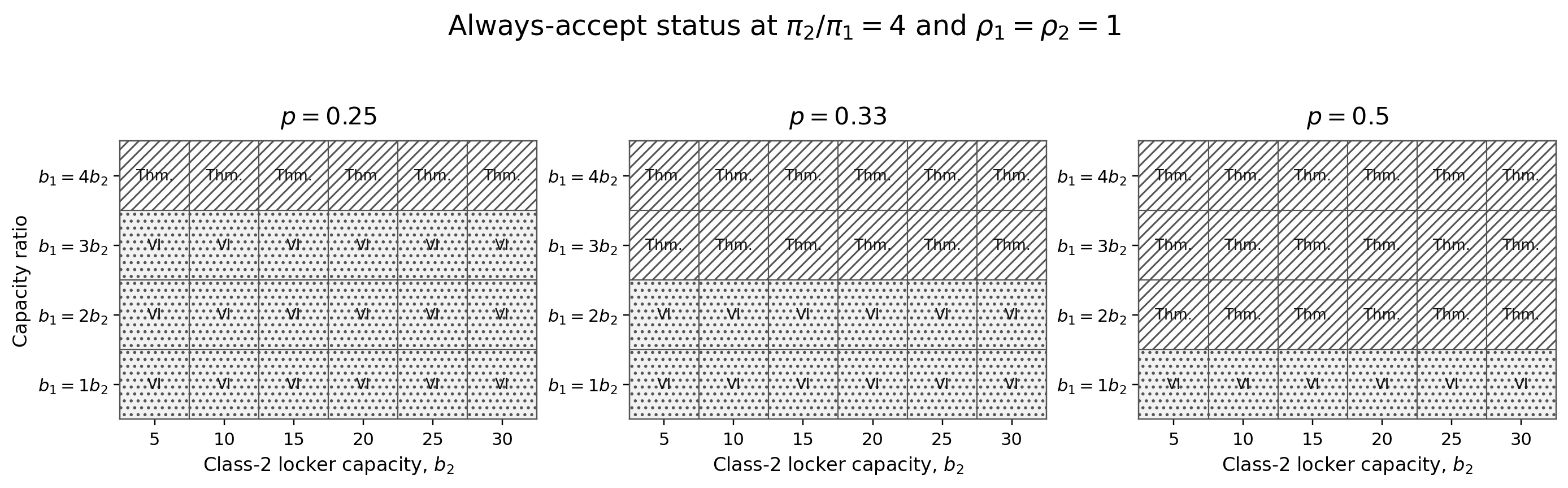
Figure 1: Optimal average daily penalty over the locker-assortment grid πi9, demonstrating the smooth and diminishing-returns structure.
Numerical Methods and Practical Recommendations
The authors support their analytical findings with an extensive empirical campaign:
- AA policy certification over hundreds of synthetic instances varying size, penalty, and arrival parameters,
- Exact value iteration for all tractable small and moderate scale systems,
- Exchange-neighborhood local search for capacity optimization, subsequently globally certified by bound-and-enumerate with DTMC relaxations,
- Simulation-based heuristics for large-scale locker banks, showing that AA-based local search recovers the globally certified optimum in all cases where certification is feasible.
Key computational results:
- In all 270 assortment optimization instances (for 3- and 4-size lockers), local search finds the certified optimum and the global minimum is always confirmed within a manageable number of exact MDP evaluations.
- Relaxation-based pruning reduces the number of required MDP evaluations by over π1<π2<⋯<πn0.
- For larger systems beyond current MDP tractability, AA-based local search remains effective and fast, with simulation confirming near-optimal regimen placement.
Theoretical and Practical Implications
This work establishes that, except in contrived and practically irrelevant parameter regimes, reserving larger lockers for future larger parcels is rarely beneficial in parcel locker admission control. This finding directly contrasts with multi-priority single-size settings, where reservation policies may substantially improve system performance. The AA policy provides a robust baseline for both system operation and assortment design.
From a theoretical standpoint, the paper formalizes the precise conditions under which structure-exploiting policies are optimal in high-dimensional finite-state MDPs with resource-substitutability constraints. The local nonconvexity of the optimal cost surface does not impair the empirical efficacy of local search, suggesting an avenue for future work in discrete optimization landscapes that defy classical convexity.
In practical deployment, the results suggest that operators can avoid the complexity and operational burden of dynamic reservation strategies for future larger parcels, focusing instead on simple AA-admittance and scalable simulation-based assortment optimization. This remains true even when precise penalty calibration and demand forecasting are infeasible, given the observed insensitivity of performance to moderate parameter mis-specification.
Future Directions
Potential extensions include policy design and certification for models with age-dependent pickup probabilities, heterogeneous demand classes, local reallocation costs, and service-level constraints. Incorporating richer state representations (e.g., explicit seniority) would enable reinforcement learning and approximate dynamic programming methods for even larger locker banks and more general customer behaviors.
Conclusion
The authors demonstrate that AA-type policies are effectively optimal for multi-size automated parcel lockers across a comprehensive range of configurations. Certification via value iteration, relaxations, and simulation supports both optimal admission policy selection and robust scalable locker-assortment optimization. These results guide efficient operational practice and establish the technical boundaries for when more sophisticated dynamic reservation is justified in last-mile logistics systems.