- The paper introduces a certified learning proxy to replace exact subproblem solves in Benders decomposition, significantly accelerating convergence.
- The integrated predict–project–complete framework produces dual-feasible cuts that maintain theoretical guarantees across optimality and infeasibility regimes.
- Empirical results on facility location and multicommodity network design show speedups up to 161× while keeping optimality gaps minimal.
Proxy Benders Decomposition: Certified Learning-Integrated Decomposition for Large-Scale Mixed-Integer Optimization
Introduction
Benders decomposition (BD) remains a mainstay algorithmic framework for mixed-integer optimization, exploiting decomposable structure to split large-scale problems with complicating variables into tractable subproblems and an iteratively strengthened master problem. The canonical formulation involves repeatedly solving parametric recourse subproblems as the master variables evolve, with dual solutions yielding cutting-plane certificates (optimality and feasibility cuts) added to the master. Despite widespread practical adoption, classical BD—and even its modern stabilized and cut-aggregation variants—suffer from subproblem redundancy and zigzagging convergence, especially prevalent in large-scale or high-recourse-cost regimes.
The paper "The Proxy Benders Decomposition" (2606.07403) proposes an alternative approach: replacing exact on-line subproblem optimization with a certified optimization proxy—a trainable surrogate—that produces dual-feasible certificates, while providing the same theoretical validity guarantees as classical BD. This proxy is trained self-supervised to maximize the strength of the resulting Benders cuts and is integrated within a predict–project–complete certification architecture that generalizes over both optimality and infeasibility regimes. The empirical evaluation demonstrates substantial reductions in wall-clock time and number of cut separations without measurable loss in final solution quality across several benchmark problem classes.
Proxy-BD Framework and Certification Mechanism
A central insight behind Proxy-BD is recognizing the parametric and repetitive structure of Benders subproblems: for a fixed master variable y, the recourse problem (e.g., linear or conic program) is solved, and an extreme dual certificate is extracted. Since successive subproblem instances are often closely related, amortizing computation by learning the parametric mapping from master variable to dual certificate is possible.
The Proxy-BD pipeline consists of the following components:
- Predict: Given Benders state (ξ,yˉ), with ξ encoding the problem instance and yˉ the current master solution, a neural network outputs a partial dual solution.
- Project: The prediction is mapped (via e.g., nonnegativity and norm constraints) into the set of dual-feasible or Farkas-certificate candidates.
- Complete: For dual variables not directly predicted, closed-form or efficiently-solvable completion steps are used to finalize the dual certificate.
- Certify: The resulting pair (λ^,μ^) or slice-normalized Farkas certificate produces a structurally valid Benders cut for the master problem, guaranteed by weak duality and the certification architecture.
For infeasibility detection, a slice-normalization (e.g., adding a e⊤λ≤1 constraint) is used to avoid the scaling ambiguity of Farkas rays, thereby making the proxy learn over a compact set without compromising certificate strength.
Self-Supervised Learning Objective
A notable distinction of Proxy-BD is its training approach: self-supervised maximization of certified cut strength. Unlike supervised learning of dual solutions (which is ill-posed due to dual degeneracy and not directly related to decomposition performance), the network parameters are optimized such that, for a representative distribution of Benders states (ξ,yˉ), the certificate value (i.e., the cut right-hand side under the current dual prediction and completion) is maximized (for optimality cuts) or strictly positive at infeasible points (for feasibility cuts). Training examples are generated by running Oracle Benders processes on problem instances, with only Benders states and not optimal dual multipliers used for supervision.
This objective, together with gradient flows enabled by closed-form or differentiable completions, aligns proxy training to maximize actual impact on the outer decomposition process, and enables knowledge reuse across instances and iterative separation.
Extension and Integration with State-of-the-Art Benders Pipelines
Proxy-BD is not limited to classical outer-loop BD, but is readily integrated into modern decomposition paradigms such as branch-and-Benders-cut (B&BC) algorithms, cut-aggregation, and accelerated variants. At each callback where a cut is needed (integer/fractional nodes or feasibility separation points), the proxy is invoked and provides a certified cut, replacing the expensive LP or MIP-based recourse solve. This leads to a direct reduction in cumulative subproblem solution time, especially as instance size and tree width increase.
Empirical Results
Facility Location (CAP/UFL)
Empirical evaluations were conducted on classical and large-scale versions of capacitated (CAP) and uncapacitated facility location (UFL) instances, with dimensions up to (ξ,yˉ)1. Notably, on UFL:
- Median optimality gaps of the proxy solutions are below (ξ,yˉ)2 at all instance sizes; on the two smallest ((ξ,yˉ)3, (ξ,yˉ)4), the proxy matches exact oracle performance at the median.
- Speedups scale with instance size: up to (ξ,yˉ)5 median speedup at (ξ,yˉ)6, with the proxy typically requiring (ξ,yˉ)7 orders of magnitude fewer separated cuts for convergence (see Figure 1 bottom).
- The empirical benefit is especially pronounced when recourse cost dominates total time; for instance sizes where master reoptimization cost dominates, proxy speedup is limited.
True-cost re-ranking of all integer solutions visited during branch-and-Benders-cut ensures that the best solution found is returned, even if the approximate cuts induce poor incumbent rankings.
Multicommodity Network Design (MCNDP)
For MCNDP, which features multicommodity flows, capacitated arcs, and possible recourse infeasibility, the proxy-driven pipeline is validated via held-out generalization with a monotonic repair heuristic (guided by proxy dual prices) used to guarantee a feasible final design when proxy cuts underapproximate. Post-repair feasibility is (ξ,yˉ)8 on all test instances, with median optimality gaps remaining within (ξ,yˉ)9 on smaller instances and less than ξ0 on the largest, while computational speedups up to ξ1 are observed.
Theoretical Guarantees
A key claim—supported by detailed proofs—is that all proxy-generated cuts are always valid, regardless of the accuracy of the proxy's prediction; that is, they do not eliminate any feasible solution or compromise global convergence of BD or B&BC variants. The full impact of cut looseness manifests as suboptimality in returned solutions (i.e., inexact proxy fixed points), rather than loss of feasibility or search termination.
Structural and Practical Implications
Proxy-BD marks a shift in the incorporation of learning into mathematical programming pipelines: all prior attempts to amortize or accelerate decomposition via ML have lacked any theoretical validity mechanism, requiring explicit verification of certificate correctness and risking heuristic error. By contrast, the projection-completion architecture ensures that every cut—even if network prediction is arbitrary—remains a legitimate Benders cut, with self-supervised learning serving only to strengthen cuts and hence close optimality gaps faster.
Practically, Proxy-BD enables:
- Real-time deployment in settings with repeated or streaming optimization tasks, where repeated recourse solves over a parametric family are costly.
- Integration with existing BD/B&BC codebases without modification of the master logic or the need for additional verification.
- Modular addition of expressive neural architectures, including size-agnostic and graph-based models, to further improve cut tightness.
- Hybrid deployments, where proxy and exact oracles are combined adaptively for further robustness and performance.
Limitations and Future Directions
The principal limitation observed is the potential looseness of proxy cuts when under-trained or when facing recourse regimes larger than those seen during training. In such cases, while structural validity is maintained, more expressive or size-invariant architectures (e.g., graph neural networks) are indicated. Formal convergence and approximation analyses quantifying the propagation of cut strength loss into final optimality gaps remain an important open theoretical avenue.
Possible future extensions include stochastic and multi-stage settings, fully hybrid oracle–proxy methods, and more systematic integration with general cutting-plane pipelines.
Conclusion
"The Proxy Benders Decomposition" (2606.07403) establishes a certified learning-augmented paradigm for decomposition algorithms in large-scale mixed-integer optimization, combining amortized inference with strong dual-based theoretical guarantees. Its framework demonstrates that learned proxies can fully supplant the expensive subproblem oracle within decomposition—yielding order-of-magnitude computational gains—while preserving correctness and quantifiable solution quality. This represents a significant advancement for scalable, real-time, and repeated-optimization applications, with direct implications for both theory and practice in combinatorial and stochastic optimization.
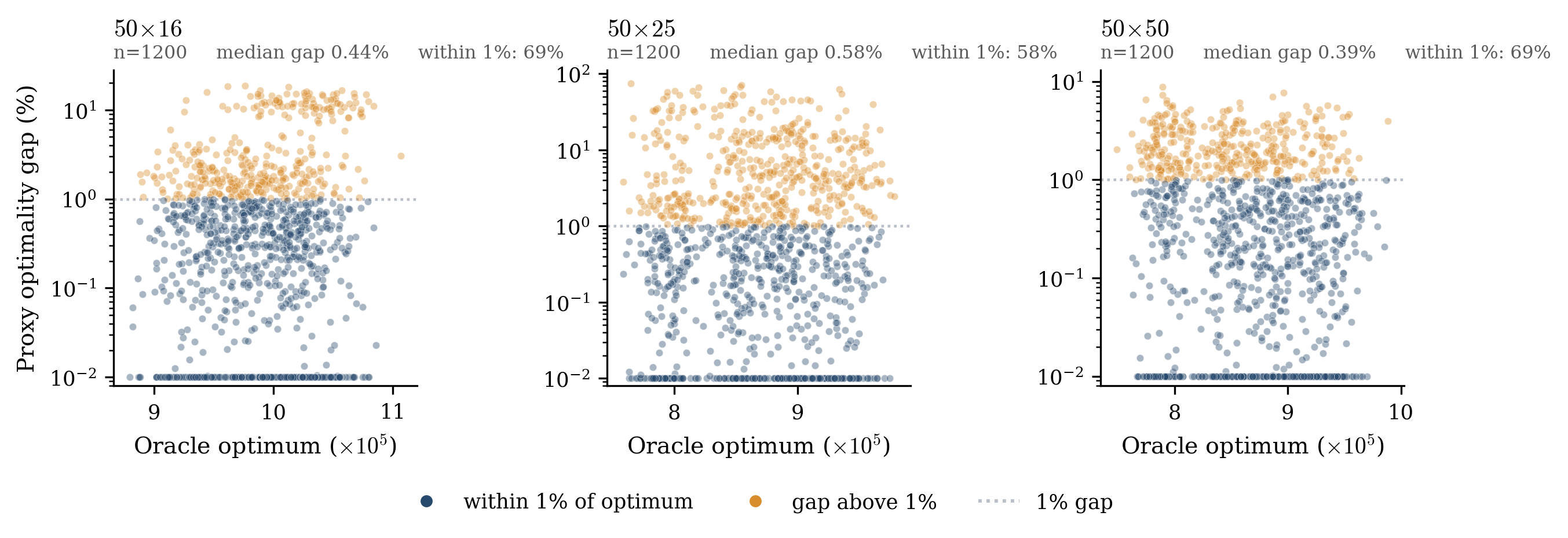
Figure 2: Convergence of the optimality gap against the number of cuts separated for CAP. The proxy returns near-optimal points with significantly fewer cuts compared to the exact solver.
References
- "The Proxy Benders Decomposition" (2606.07403)
For full experimental details, code, and data, see (2606.07403).