- The paper demonstrates a novel integration of position-independent caching with hybrid-attention LLMs that reduces time-to-first-token (TTFT) by up to 2.45× on average.
- It introduces constant-time state composition and localized recomputation at segment boundaries to efficiently accelerate long-context model inference.
- Experiments confirm significant throughput gains and scalability improvements, achieving up to 8.6× TTFT reduction with minimal loss in task accuracy.
Hypic: Accelerating Hybrid-Attention LLM Serving with Position-Independent Caching
Motivation and Problem Statement
LLM inference for retrieval-augmented generation (RAG) and agentic workflows involves assembling long contexts from independently retrieved or generated segments. This compositional prompt structure exacerbates prefill costs, leading to high time-to-first-token (TTFT) and limiting serving throughput. Two recent advances in LLM serving—position-independent caching (PIC) and hybrid-attention models—address scalability from different axes but have proved fundamentally incompatible.
PIC approaches, highly effective for full-attention Transformers, are incapable of splicing and correcting at the per-token level when linear-attention layers are present, since the recurrent state propagated therein is not individually tokenized or directly amenable to splicing operations. Meanwhile, hybrid-attention models, with the vast majority of layers replaced by various forms of linear attention, have become the de facto production baseline (e.g., Qwen3.5, MiniMax-M1, Kimi-Linear). Hence, serving efficiency for long-context, compositional workloads is bottlenecked by the inability to apply PIC to hybrid stacks.
System Overview
Hypic introduces the first serving system providing efficient, position-independent caching for hybrid-attention LLMs. The system comprises three main components:
- Hypic Router: Splits a request into segments and dispatches cache misses for parallel prefill.
- Hypic Store: Maintains both segment-level public caches (for reusable states) and per-request private caches.
- Hypic Assembler: Composes cached and freshly computed states into the running context for decoding.
This architecture allows Hypic to exploit segment self-containment for parallelism and cache state management efficiently.
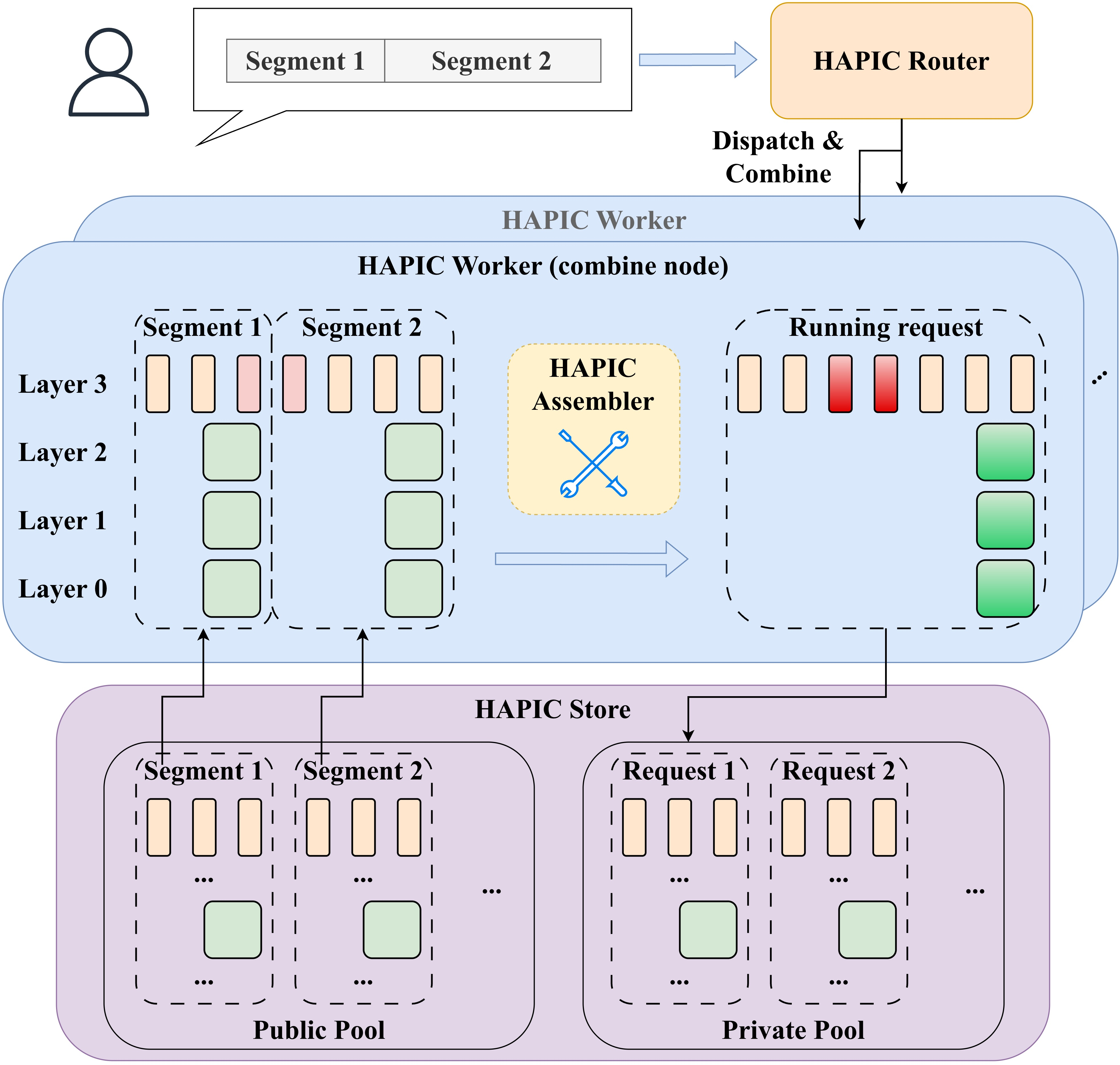
Figure 1: Schematic of Hypic architecture, detailing the router, store, and assembler design.
Algorithmic Innovations
Constant-Time State Composition for Linear Attention
For all advanced forms of linear attention in use today, the core algebraic insight is that the segment-cumulative transition operator TC (a matrix product over per-token transitions) and the zero-start end-state SC∣0 fully determine the mapping from any input state to the segment's end-state. By caching (TC,SC∣0) per segment, Hypic enables exact, constant-time state composition at each segment boundary.
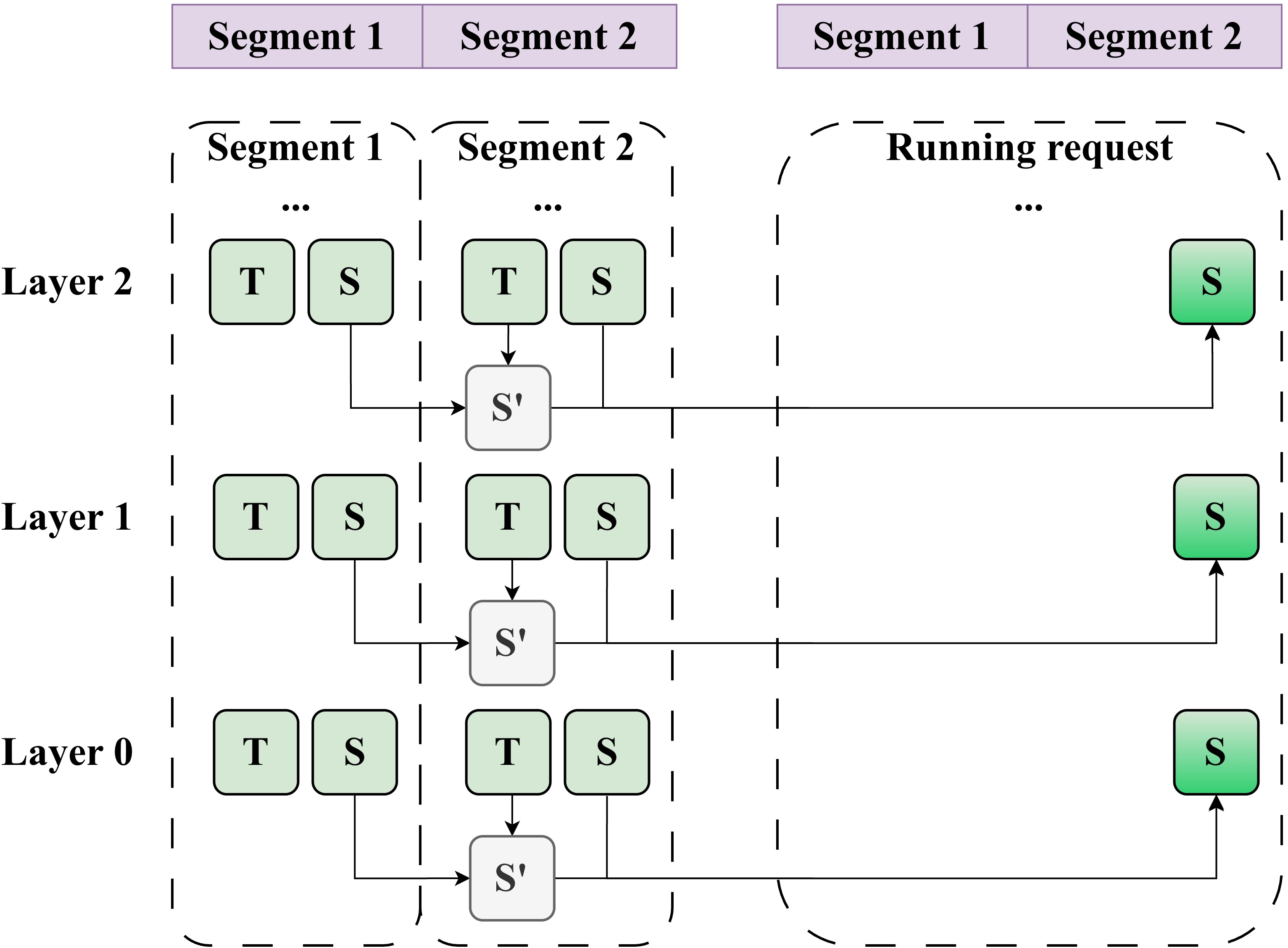
Figure 2: For each segment, the tuple (TC,SC∣0) is cached, enabling state composition during prompt assembly.
Given a sequence of n segments, composition is simply:
Sfinal=TCn⋯TC1Sprefix+i=1∑n(j=n∏i+1TCj)SCi∣0
This operation is independent of segment length, resulting in substantial acceleration for long prompts with many segments.
Boundary-Anchored Alignment in Full Attention
Because hybrid stacks interleave sparse full-attention layers (carrying long-range dependency), naive PIC primitives cannot repair inter-segment context without per-token recurrent states, which are not available. Empirical analysis of attention-score deviations in hybrid-attention models reveals that errors are highly localized at segment boundaries—especially the w tokens at the head and tail.
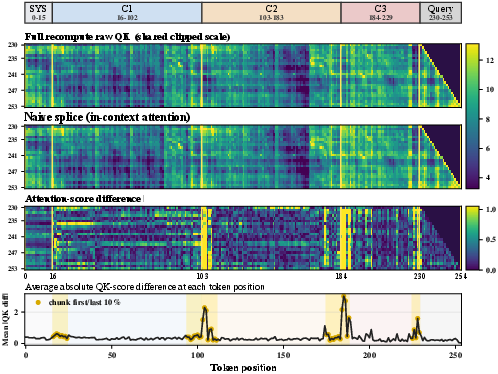
Figure 3: Attention-score deviation concentrates at segment boundaries, minimal in the interior; only the boundary windows require correction.
Thus, Hypic recomputes only a small seam window of w tokens on each side of the boundary, repairing both the attention sink and cross-segment lookback by recomputing the contiguous window through the cached state.
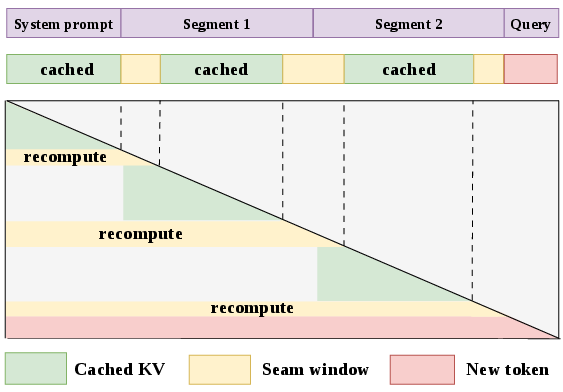
Figure 4: Schematic of seam window handling—only the last and first w tokens of each segment are excluded from the cache and recomputed.
Segment-Parallel Prefill for Cache Misses
Unlike prior systems constrained by sequential, monolithic prefill, Hypic leverages the algebraic self-containment guarantee of the PIC paradigm. Each cache-miss segment is dispatched to a separate worker for parallel prefill. The combine node collects prefilled segments, assembles the running state, and guarantees decoding can proceed once all segments are processed.
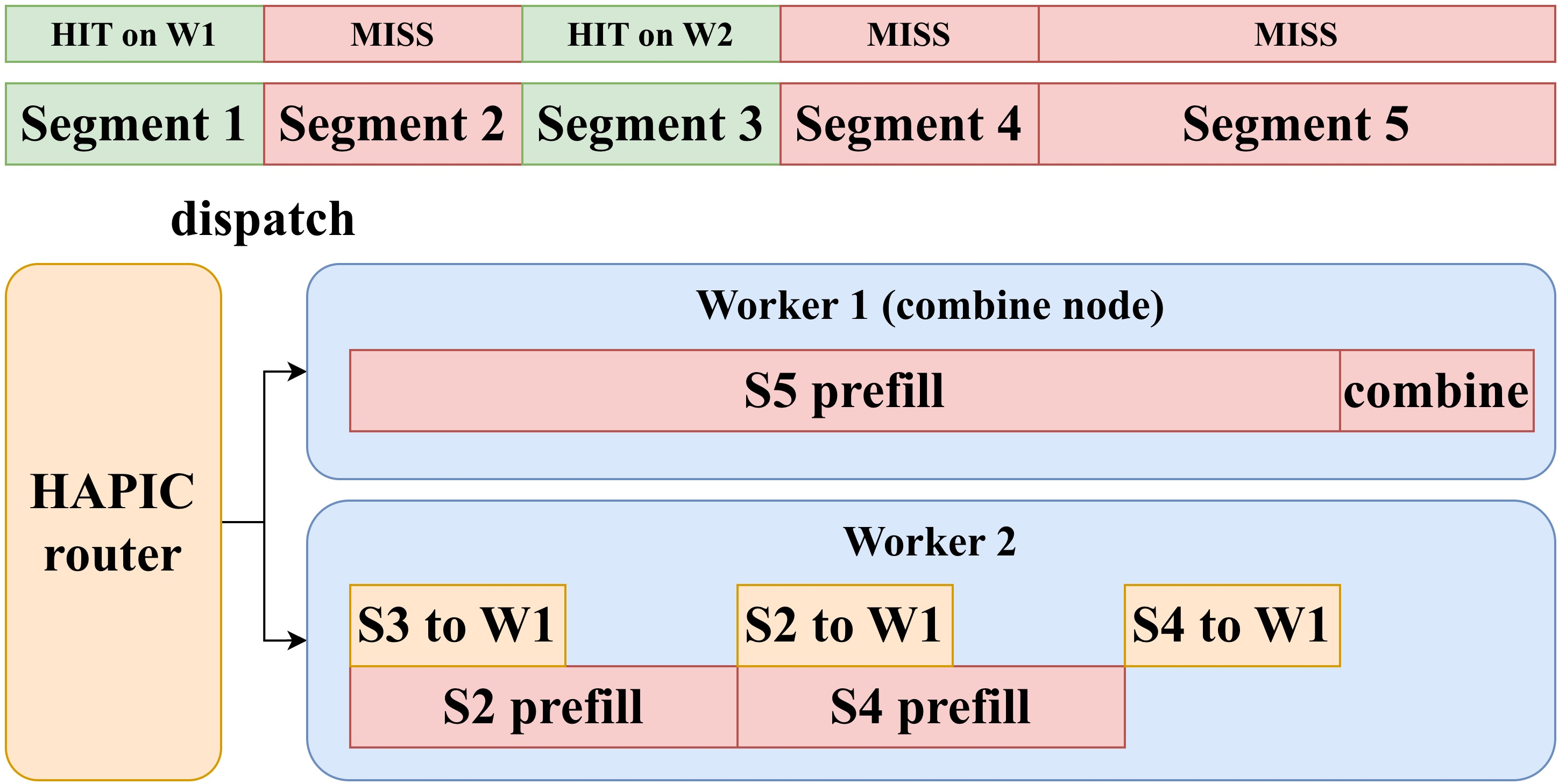
Figure 5: Segment parallelism: only cache-miss segments are distributed to a worker pool, prefilled in parallel, and reassembled at the combine node.
Load-balancing is handled via an LPT (Longest-Processing-Time-first) greedy policy. The design ensures the prefill bottleneck scales as O(⌈n/m⌉⋅∣C∣+c), rather than SC∣00, essentially removing long cold requests as a source of tail latency.
Experimental Results and Empirical Analysis
Evaluation on four hybrid attention models (e.g., Qwen3.5-35B/122B, Ring-mini-linear-2.0) and diverse long-context workloads shows:
- TTFT Reduction: Hypic provides a mean SC∣01 reduction in p50 TTFT over prefix cache (the incumbent baseline), and up to SC∣02 in the extreme case (Qwen3.5-122B on MultiNews).
- Throughput Gains: Peak throughput improves up to SC∣03 compared to existing deployments at the same SLO.
- Cache-Miss Prefill: On cold-only requests, segment parallelism yields a SC∣04 TTFT speedup at 8 workers.
- Accuracy Envelope: The average drop in task metric (F1/ROUGE-L) is limited to SC∣05 points, and state drift in deep linear attention layers is bounded below 10% relative SC∣06.

Figure 6: Pareto frontier of task accuracy versus TTFT for various models and datasets.

Figure 7: Impact of system load (QPS) on p50 TTFT and per-GPU throughput.
- Scalability: Hypic's composition law achieves SC∣07 compute for state assembly and SC∣08 scaling with segment count, independent of segment length.
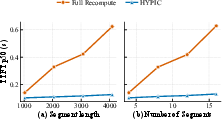
Figure 8: State composition scaling: TTFT is constant in segment length and grows linearly in segment count.
- Seam Window Sensitivity: Task accuracy saturates for seam width SC∣09, with negligible additional gains for wider windows and only a marginal increase in TTFT.

Figure 9: Task accuracy and TTFT as seam window width (TC,SC∣0)0 is varied; (TC,SC∣0)1 is near-optimal.
- Parallelism Breakdown: As worker count increases, TTFT scales nearly inversely with (TC,SC∣0)2; communication and composition costs remain insignificant.
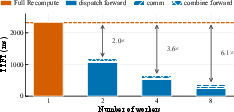
Figure 10: TTFT breakdown by subphase as prefill worker count increases; dispatch forward dominates at small (TC,SC∣0)3, comm and combine costs are flat.
Theoretical and Practical Implications
Hypic's results establish that it is algebraically possible, with practical engineering tradeoffs, to unify PIC and hybrid attention in a production setting. For large-scale RAG, agentic orchestration, and any scenario where sub-contexts are reused or reordered, this removes the main architectural bottleneck. Theoretically, the algebraic insight—that all linear-attention variants' recurrent state transitions can be generalized and composed—may inform both future model designs and caching architectures.
For practitioners, Hypic enables operators to deploy advanced hybrid-attention models without the serving penalty incurred by long prompt compositions. Notably, the architecture is orthogonal to intra-instance parallelism; Hypic's loop-level parallelism in prefill coexists with hardware acceleration and batching inside each worker.
Potential for Future Directions
- Adaptive Seam Width: Dynamic seam sizing based on workload or model introspection could further minimize recompute without compromising alignment.
- Model Co-Design: Training models with Hypic's state-reuse semantics in mind may reduce state drift and improve compositional robustness.
- End-to-End System Integration: Extension of Hypic principles to multi-modal or cross-LLM agentic architectures can generalize to broader multi-context AI deployments.
Conclusion
Hypic provides the first PIC solution compatible with hybrid-attention LLMs, achieving both theoretical precision in linear attention composition and practical speedup in end-to-end serving. It leverages segment-local transition operators, localized window recomputation for full attention, and segment-parallel cold prefill to realize large, compositional prompt serving with controllable computational and accuracy costs. Hypic thus removes a critical obstacle to efficient, scalable long-context LLM inference in production.