- The paper introduces a universal scaling theory that captures short-imaginary-time quantum critical dynamics near boundaries by identifying distinct decay exponents for ordered versus disordered initial states.
- It employs extensive projector QMC simulations on the 2D quantum Ising model to confirm power-law decay and scaling collapse of boundary order parameters across different system sizes.
- The findings reveal counterintuitive negative boundary initial slip exponents at ordinary transitions, offering novel insights for interpreting relaxation dynamics in quantum systems with open interfaces.
Universal Short-Imaginary-Time Quantum Critical Dynamics Near Boundaries
Introduction and Motivation
Quantum criticality in systems with boundaries has long been recognized as a source of rich and nontrivial universality, with boundary degrees of freedom introducing scaling phenomena not present in homogeneous bulks. While classical boundary criticality is well characterized, the dynamical aspect—particularly in the setting of quantum systems evolved in imaginary time—remains underexplored. This work systematically investigates universal short-imaginary-time quantum critical dynamics near boundaries, developing a scaling theory for such processes and verifying its predictions via extensive projector QMC simulations on the 2D quantum Ising model.
Scaling Theory for Boundary Quantum Critical Dynamics
The authors generalize the boundary short-distance expansion (SDE), originally established in classical contexts, to the early-stage imaginary-time evolution of quantum critical systems. For ordered initial states, the boundary order parameter Ms exhibits a power-law decay in imaginary time: Ms∼τ−β1/νz. Here, β1 is the boundary order parameter exponent, while ν and z retain their meaning as the bulk correlation length and dynamical exponents respectively. For disordered initial states, new exponents θ1 and θ1′ emerge and govern the decay/growth rates of boundary autocorrelation and small-magnetization order parameter, distinct from their bulk counterparts.
The work demonstrates that, unlike the well-known static boundary exponents, the dynamic exponents θ1 and θ1′ deviate from the predictions of quantum-to-classical correspondence. Specifically, θ1′ is negative for the ordinary boundary transition but positive for the special boundary transition—signaling qualitative differences in the emergence of order and critical fluctuations at boundaries.
Numerical Verification in the 2D Quantum Ising Model
Ordered Initial State: Boundary Order Parameter Dynamics
QMC simulations starting from fully ordered product states show that Ms∼τ−β1/νz0 decays as Ms∼τ−β1/νz1 at short times, with Ms∼τ−β1/νz2 (ordinary) and Ms∼τ−β1/νz3 (special). Scaling collapse across different system sizes unambiguously verifies the predicted scaling form. The behavior persists until finite-size effects dominate at large Ms∼τ−β1/νz4.
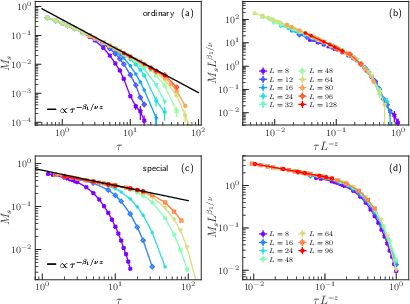
Figure 1: Dynamics of the boundary order parameter Ms∼τ−β1/νz5 from the ordered initial state for both ordinary and special transitions, showing power-law decay consistent with exponent Ms∼τ−β1/νz6.
Disordered Initial State: Two-Point Correlation Dynamics
From an uncorrelated state, both the transverse Ms∼τ−β1/νz7 and longitudinal Ms∼τ−β1/νz8 two-point correlation functions are characterized by nontrivial scaling dictated by the SDE:
- Ms∼τ−β1/νz9
- β10
For both boundary universality classes, the data demonstrate expected exponential decay and correct power-law prefactors, with system-size-independent coefficients in the exponential, matched by excellent scaling collapse.
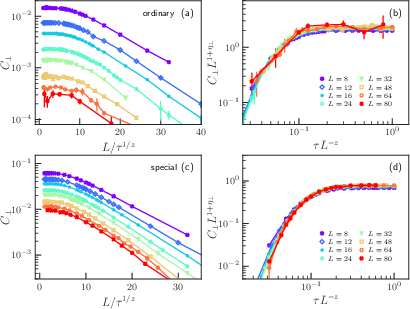
Figure 2: Dynamics of the transverse correlation β11 from the disordered initial state reveal exponential decay and scaling collapse for both ordinary and special boundaries.
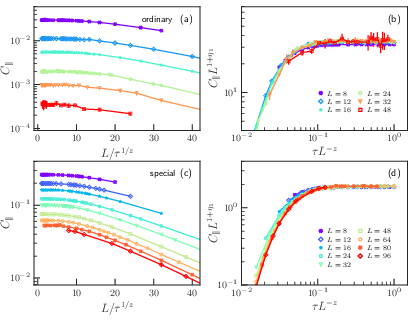
Figure 3: Dynamics of the longitudinal correlation β12 showing similar scaling with respect to β13 and collapse for both universality classes.
Critical Initial Slip and Autocorrelation
Critical initial slip at the boundary is characterized via the autocorrelation β14, which scales as β15. Notably, β16 is negative for the ordinary transition and positive for the special transition (β17 and β18, respectively), a stark contrast to the generic positive bulk value. Finite-size scaling further supports this nontrivial boundary dynamical behavior.
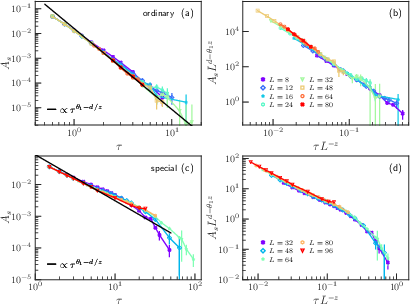
Figure 4: Dynamics of the boundary autocorrelation β19 from the disordered initial state display power-law decay with the sign of the scaling exponent dependent on the boundary universality class.
Additional Scaling Crossovers and Diagnoses
The authors extend their analyses to spatial crossovers from bulk to boundary regimes using the 1D quantum Ising model, further establishing the generality of their scaling forms. The full scaling functions interpolate correctly between bulk-like and boundary-dominated dynamics as a function of the ratio ν0. Supplemental results demonstrate how two-time and mixed correlation functions (ν1, ν2, ν3, ν4) provide alternative measurements of the same exponents, confirming the robustness of the theoretical framework.
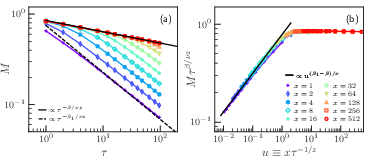
Figure 5: Scaling crossover of ν5 in the 1D quantum Ising model, confirming bulk-to-boundary scaling interpolation for ordered initial states.
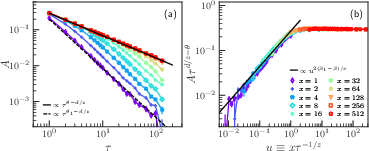
Figure 6: Scaling crossover of ν6 in the 1D quantum Ising model with a disordered initial state, illustrating boundary-dominated decay at short distances.
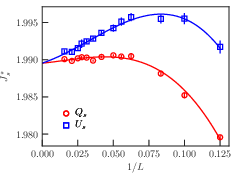
Figure 7: Finite-size analysis of crossing points used to precisely locate the special transition.
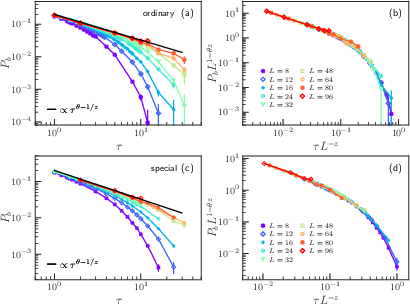
Figure 8: Bulk local two-time correlation ν7 showing scaling behavior.
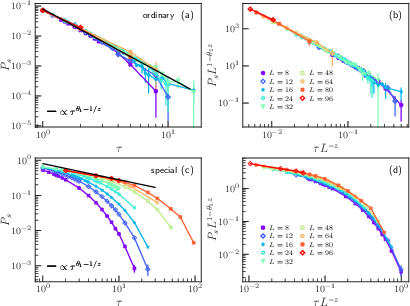
Figure 9: Boundary local two-time correlation ν8 verifying boundary scaling predictions.
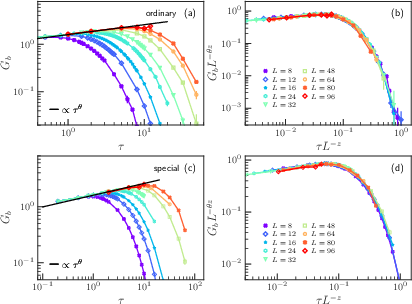
Figure 10: Bulk mixed two-time correlation ν9 demonstrating bulk initial slip scaling.
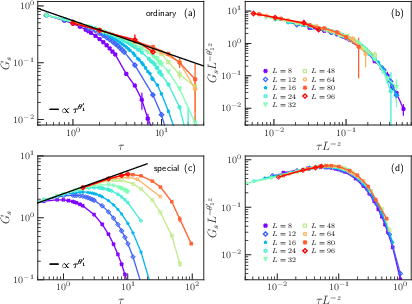
Figure 11: Boundary mixed two-time correlation z0 exhibiting the sign-changing boundary exponent z1 for ordinary and special transitions.
Implications and Future Directions
This study brings nonequilibrium boundary criticality in quantum many-body systems into sharp focus, providing a unified scaling description for both conventional and exotic universality classes. Crucially, the identification of negative boundary initial slip exponents at ordinary transitions has direct consequences for interpreting relaxation and equilibration processes in quantum devices with open boundaries or interfaces. The work also raises new questions regarding short-imaginary-time dynamical signatures in systems with topological boundaries and in models manifesting extraordinary-log universality, where logarithmic, rather than power-law, correlations may prevail.
Experimentally, the scaling relations established here suggest protocols for extracting boundary critical exponents from early-time relaxation of boundary observables, dramatically reducing computational and experimental requirements for exploring quantum critical boundary behavior in both numerics and quantum simulation platforms.
Conclusion
Universal short-imaginary-time quantum critical dynamics near boundaries is governed by a comprehensive scaling theory involving conventional static exponents as well as boundary-specific dynamical exponents z2 and z3. Numerical results in the 2D quantum Ising model fully support these predictions, including the counterintuitive emergence of negative exponents at ordinary transitions. These findings extend the paradigm of boundary criticality to nonequilibrium dynamical regimes and set the stage for future work on exotic boundary phenomena in quantum many-body dynamics.