- The paper establishes that the A1²/A1² singularity is the unique geometric source inducing nontrivial monodromy in planar vineyards.
- It employs singularity theory and symmetry set analysis to classify persistent homology behavior under the radial persistence transform.
- The study provides a local characterization that aids in algorithmic detection of monodromy, with implications for robust feature tracking in TDA.
The Singular Source of Vineyard Monodromy: A Technical Analysis
Introduction
The paper "The Singular Source of Vineyard Monodromy" (2607.01046) advances the theoretical understanding of monodromy phenomena in vineyards—collections of time-parameterized persistence diagrams—arising in topological data analysis (TDA). The authors identify and characterize, via singularity theory, the unique geometric configurations in planar 1-manifolds that act as sources of nontrivial monodromy for families of persistence diagrams generated by the radial persistence transform. This complete local classification establishes a fundamental criterion, connecting monodromy to specific isolated singularities on the symmetry set, and thereby elucidates when feature tracking via persistence can fail due to topological obstructions of the underlying filtration space.
Background: Persistence, Vineyards, and Monodromy
Vineyards are families of persistence diagrams indexed by a parameter, typically constructed from a sequence of filtrations on a topological manifold induced by a parameterized function such as distance to a moving base point. Interest in vineyards is driven by the need to track the evolution of topological features (birth-death pairs) in data as it changes over time or other parameters. Monodromy refers to the phenomenon where, after traversing a closed loop in parameter space, the diagram points can permute, implying nontrivial topology of the mapping from parameter values to persistence diagrams. This undermines canonical feature tracking and obstructs consistent correspondence between features across the parameter loop.
Previous results have both exhibited monodromy in explicit 2D and higher-dimensional examples [Arya et al., Chambers et al.] and described sufficient geometric conditions to preclude its occurrence, especially for star-shaped domains. However, these results did not provide a sharp, local geometric characterization of the minimal obstructions to trivial monodromy.
Symmetry Sets, Focal Sets, and the Classification of Singularity Types
The paper's central contribution is a systematic analysis combining persistence theory, the geometry of the symmetry set (the locus of centers of circles tangent in at least two points to the manifold), and singularity theory. The symmetry set and the focal set (the evolute, or centers of curvature) together constitute the "generalized symmetry set". For closed smooth plane curves, the singular points of these sets correspond to the critical events in the family of distance functions that can potentially generate nontrivial monodromy in the associated vineyard.
The classification of generic singularities in the plane follows Arnold's notation: A1, A2, A3, A12, A13, A1A2, A2/A2, A12/A2, and crucially A12/A12 (where the slash denotes contact with concentric circles of different radii). The topological behavior of the vineyard near each singularity type is central to the main results.
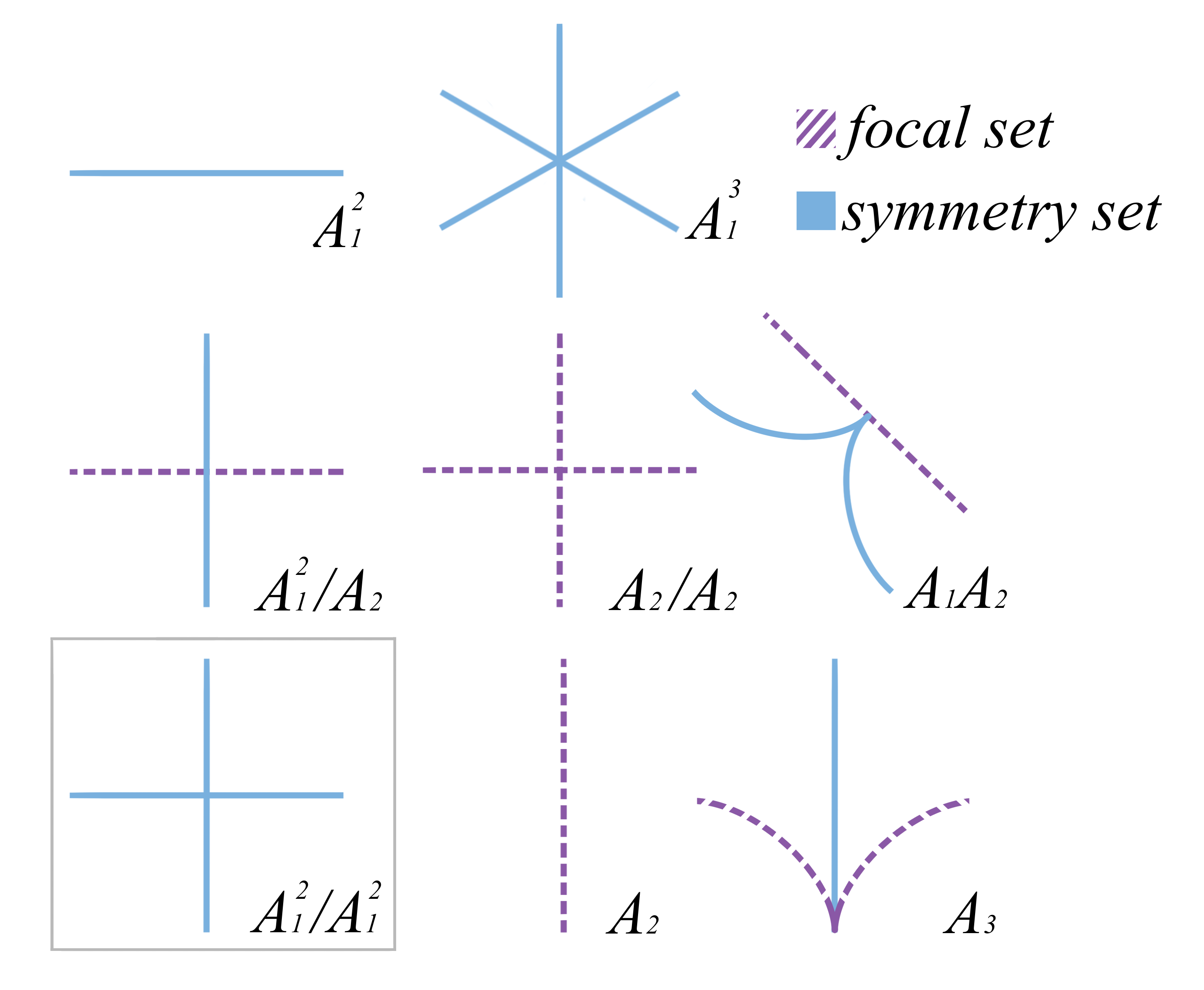
Figure 1: The singularities of the symmetry and focal set in the plane. The lower left boxed A12/A12 singularity is uniquely capable of exhibiting local monodromy.
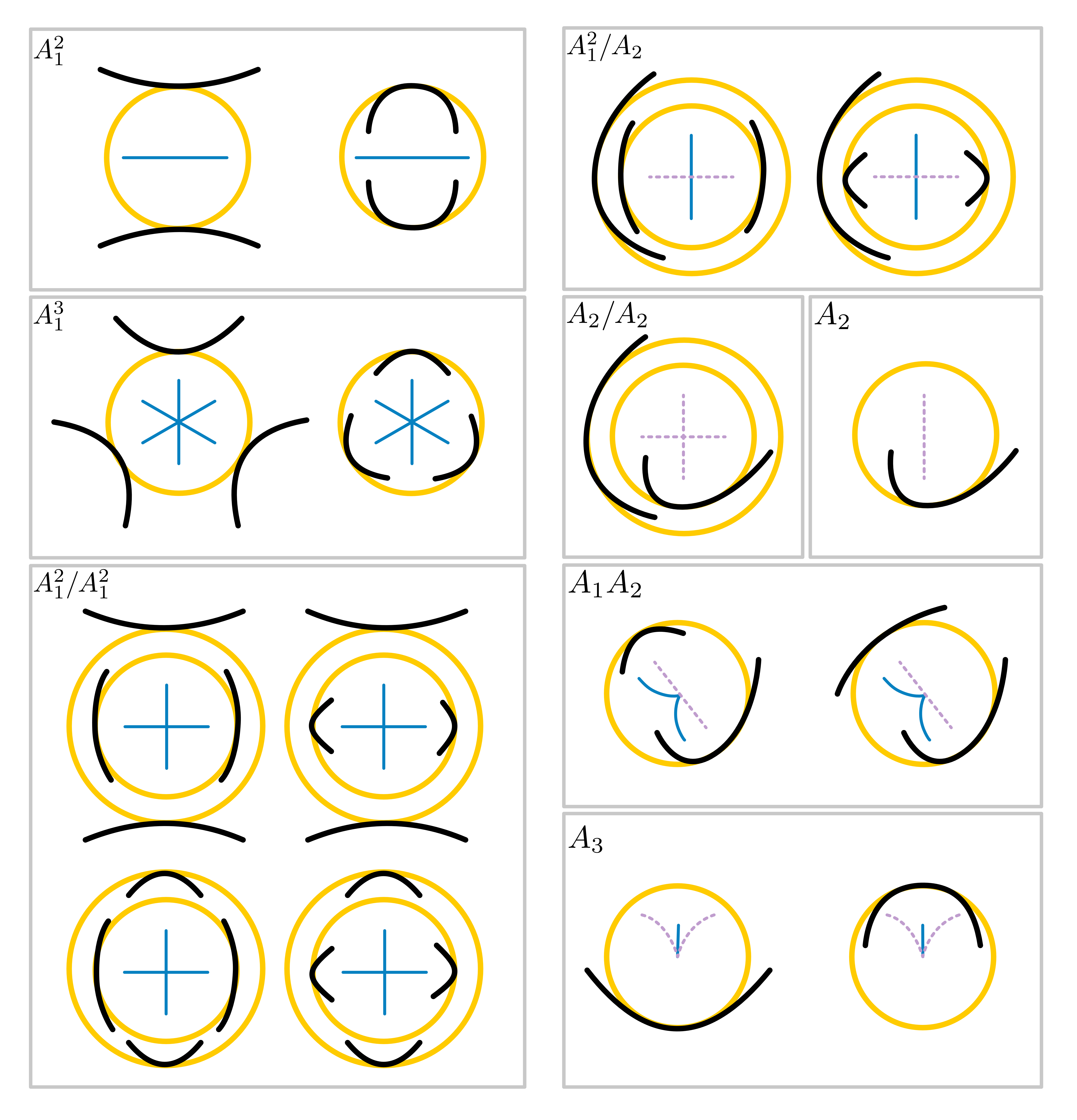
Figure 2: Distinct notational conventions and geometric elements of the symmetry (blue) and focal (dashed purple) sets, illustrating the generic singularities.
Detailed Local Analysis of Vineyard Behavior Near Singularities
By systematically studying the effect of small observation loops A20 enclosing each singularity, the authors provide a sharp dichotomy:
- For all generic codimension-0 and codimension-1 singularities of the generalized symmetry set except A21, the resulting vineyard either remains topologically trivial (vines are unlinked) or vine pairing changes are always undone after traversal, yielding no monodromy.
- Only the A22 singularity, a transverse intersection of two A23 strata, can locally generate nontrivial monodromy. At such a point, the local rearrangement of feature pairings by the elder rule upon crossing the symmetry set branches can realize an interchange of persistence points after a full loop, yielding a nontrivial cycle in the space of diagrams.
This exhaustive local analysis is illustrated via explicit geometric configurations and the associated evolution of persistence points.
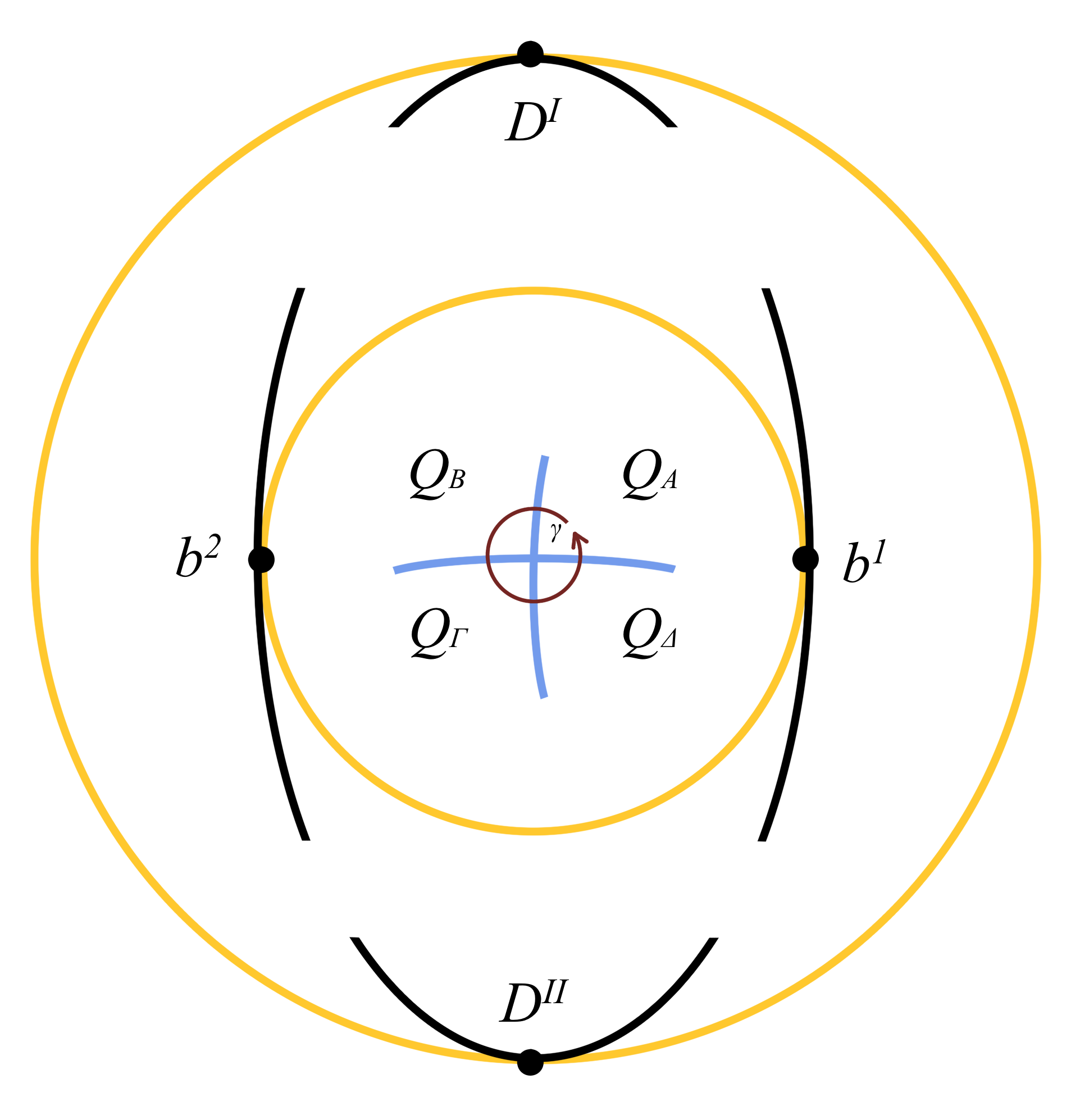
Figure 3: Necessary conditions on the manifold A24 and local structure of the symmetry set for an interchange, indicating quadrant structure produced by A25.
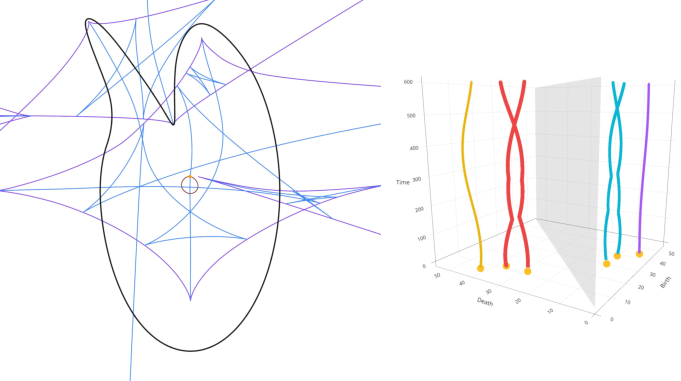
Figure 4: [Left] The symmetry and focal sets for a manifold with a A26 singularity. [Right] The corresponding vineyard exhibits nontrivial monodromy, with vines switching their endpoints after encircling the singularity.
Strong Claims and Theoretical Results
The principal theorem asserts: for a generic closed smooth plane curve A27 and a sufficiently small loop A28 in parameter space, the vineyard A29 admits nontrivial monodromy if and only if the interior of A30 contains a singularity of type A31. All other singularities generate only trivial permutations or unlinked vines.
This result is strongly structural: it provides a complete local classification, reduces the search for monodromy to combinatorics of the symmetry set, and implies that monodromy cannot be "hidden" or globally synthesized except by assembling such singularities in accordance with the geometric pairing changes dictated by elder rule transitions.
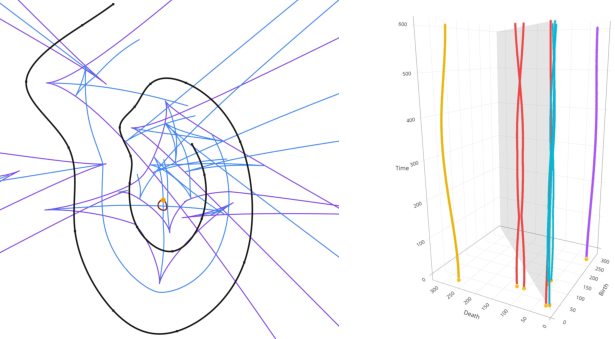
Figure 5: Example of a deformed spiral with a central A32 singularity, again leading to monodromy in the corresponding vineyard.
Non-Monodromy at All Other Singularities
The paper provides diagrams and arguments demonstrating that loops enclosing A33, A34, A35, A36, A37, A38, and A39 singularities—while associated with reordering or pair creations/annihilations—always yield trivial topology or unlinked vines. In particular, pair creation at the focal set yields ephemeral features with small persistence that do not interact with existing off-diagonal points. Interchange is impossible due to stringent requirements on the number and type of involved critical points.
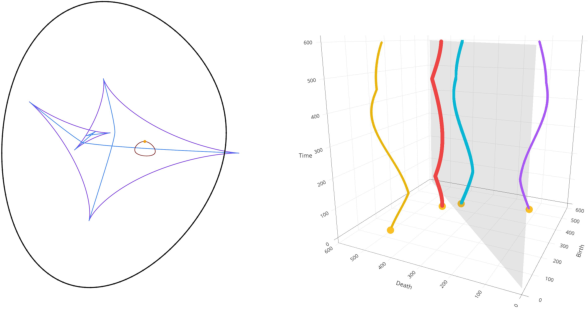
Figure 6: A loop enclosing a A120 singularity and the associated vineyard, which is trivial—monodromy does not occur.
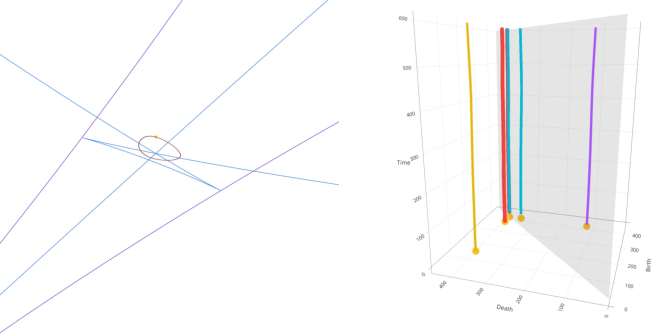
Figure 7: A loop enclosing an A121 singularity and its vineyard. No monodromy: the possibility of interchange is excluded by dimensionality and pairing constraints.
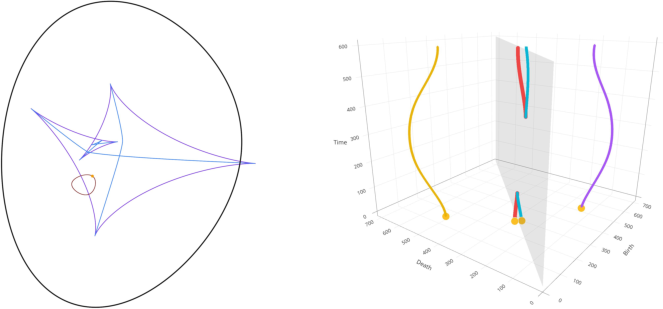
Figure 8: Enclosure of an A122 bifurcation; only an ephemeral pair is created and annihilated, no monodromy or feature interchange arises.
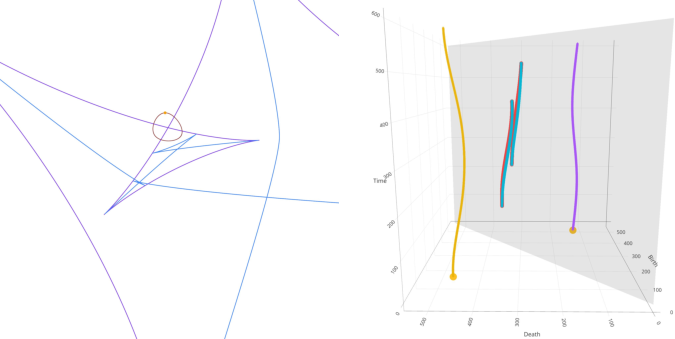
Figure 9: Encircling an A123 singularity; the two ephemeral pairs produced do not couple to robust cycles, hence no monodromy.
Non-Local Effects and Global Complexity
A significant subtlety is that the local sufficiency of A124 for monodromy does not guarantee that monodromy persists for arbitrarily large enclosing loops. The interplay of multiple singularities and their global arrangement can destroy the monodromy generated by a single local configuration. The paper demonstrates that a large loop encircling an A125 singularity can result in a trivial vineyard if the loop also contains additional structure that cancels the effect.
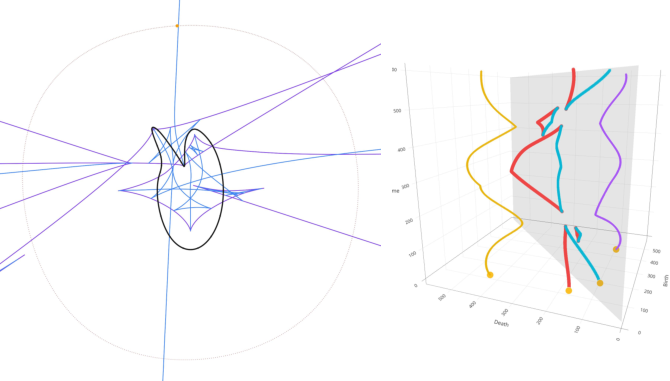
Figure 10: For large enough loops, even if a singularity of type A126 is enclosed, the vineyard of the loop can be trivial—monodromy need not occur globally.
Implications and Directions for Future Work
This singularity-theoretic classification has several notable ramifications:
- It enables algorithmic detection (and avoidance) of monodromy in practical TDA applications, as symmetry and focal set computations are already mature tools in computational geometry and shape analysis.
- The connection to knot theory and the topological complexity of the space of vineyards suggests avenues for encoding intricate topological and geometric information in data-driven settings, with the possibility of constructing manifolds (or filtrations) to force prescribed monodromy signatures.
- The result establishes that in two dimensions, all local sources of monodromy are encapsulated by a single singularity type, with higher-dimensional generalizations accessible via extensions of singularity classifications.
- The limitations and open problems surrounding the assembly of global monodromy of prescribed order from local A127 singularities remain, with outstanding questions about computational construction and characterization in both theoretical and applied settings.
Conclusion
The paper rigorously establishes that the unique local geometric generator of monodromy in planar vineyards derived from the radial persistence transform is the A128 singularity—intersections of two A129 symmetry set branches. Other singularities generate only ephemeral or trivial topological effects in the vineyard. While global assembly of monodromy remains intricate, this local classification provides a foundational link between singularity theory and persistent homology and is likely to influence future developments in both TDA methodology and the theoretical study of parameterized homological invariants.