- The paper demonstrates that synthesizing compound pulse gadgets with the GRAPE algorithm drastically reduces execution time for QSVT-based Hamiltonian simulation.
- It contrasts compound gadget synthesis with conventional modular LUT-based schedules, showing that continuous control tracks mitigate decoherence and lookup latency in trapped-ion devices.
- Robustness assessments under Lindblad models reveal that this pulse-level compilation enhances state preservation and extends computational depth by compressing temporal schedules.
Pulse-Level Compilation with Compound Pulse Gadgets for Hamiltonian Simulation on Trapped-Ion Devices
Motivation and Background
The gate-level abstraction in quantum compilers, wherein each logical operation is transpiled into a rigid sequence of discrete hardware-native gates, introduces severe inefficiencies for executing deep quantum circuits such as those arising in Quantum Singular Value Transformation (QSVT)-based Hamiltonian simulation. On trapped-ion platforms, standard modular transpilation yields highly fragmented pulse schedules with steep time-domain edges, significantly increasing T2 decoherence and anomalous motional heating. This control-layer fragmentation arises from treating quantum algorithms as disconnected sequences of pulse primitives, exacerbating state preservation challenges and severely limiting achievable computational depth.
Compound Pulse Gadget Synthesis and Methodological Framework
This work presents a holistic pulse-level compilation methodology that bypasses conventional gate-by-gate transpilation in favor of end-to-end synthesis of continuous, compound pulse gadgets for executing entire algorithmic blocks. The workflow consists of three main phases: (1) mapping the H2 molecular Hamiltonian to a QSVT specification for three trapped-ion qubits (two logical, one ancilla); (2) synthesizing physical control schedules with both a modular look-up table (LUT)-based baseline and the proposed compound gadget approach; (3) evaluating performance with noisy open-system Lindblad simulations.
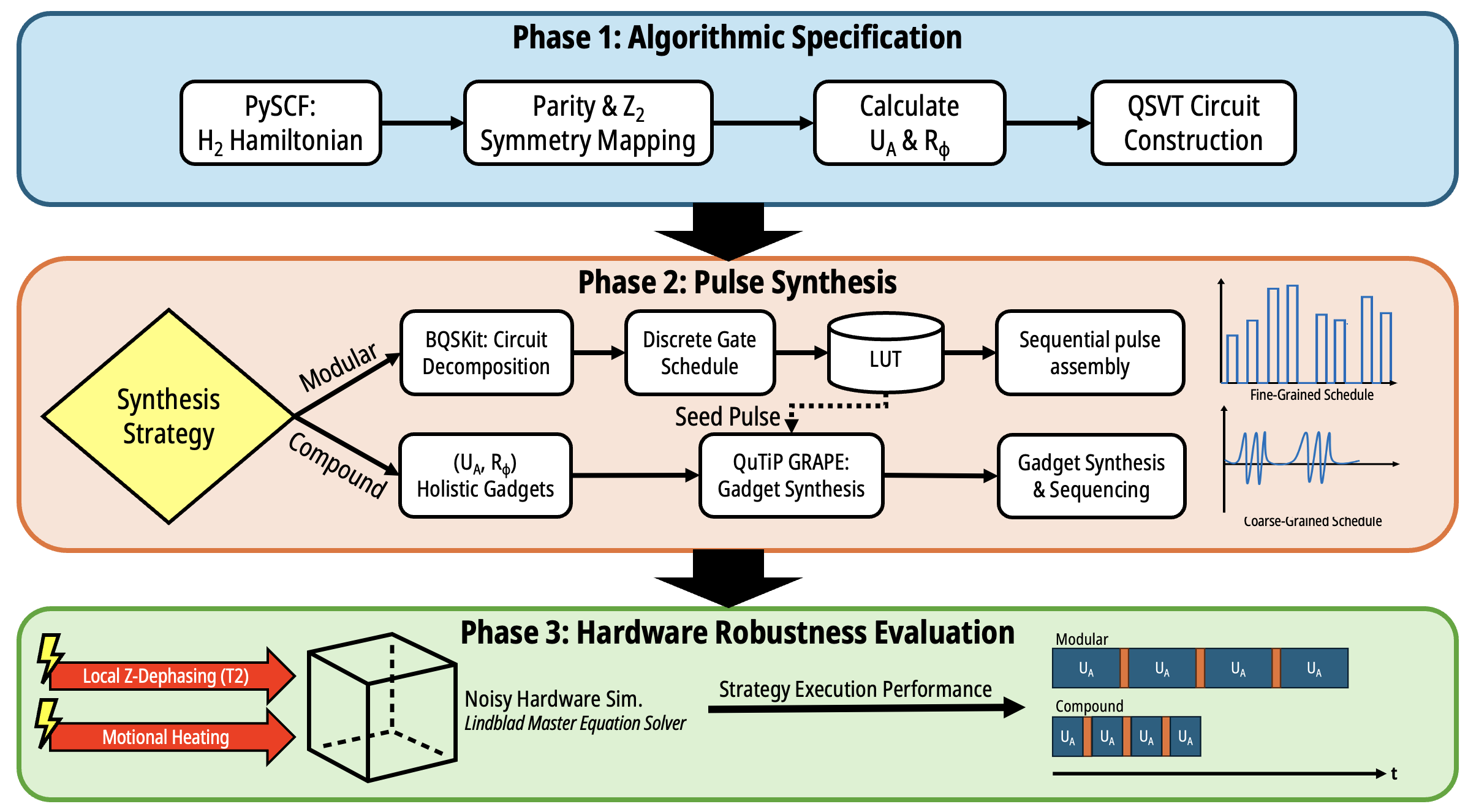
Figure 1: Phase 1 encodes the H2 Hamiltonian as a 3-ion QSVT problem; Phase 2 contrasts baseline modular schedule assembly with holistic compound synthesis; Phase 3 compares execution using open-system Lindblad benchmarks.
The modular baseline decomposes the target unitary into 144 scheduled native gates (RXX, RX, RZ), assembling waveforms via LUT lookups and virtual Z rotations. Physical pulses are stitched sequentially without cross-operator optimization. In contrast, the compound gadget synthesis strategy targets entire interleaved (UA,Rϕ) blocks using the Gradient Ascent Pulse Engineering (GRAPE) algorithm. The optimizer generates continuous, hardware-native waveforms that enact the full unitary evolution, avoiding schedule fragmentation and associated lookup latency.
Comparative Analysis: Temporal Compression and Latency Elimination
The elimination of fine-grained pulse stitching enables aggressive temporal compression. Holistic compound gadgets compress physical schedule durations by directly mapping optimized multi-qubit unitaries to continuous control tracks, drastically reducing total run-time for QSVT blocks compared to the modular approach.
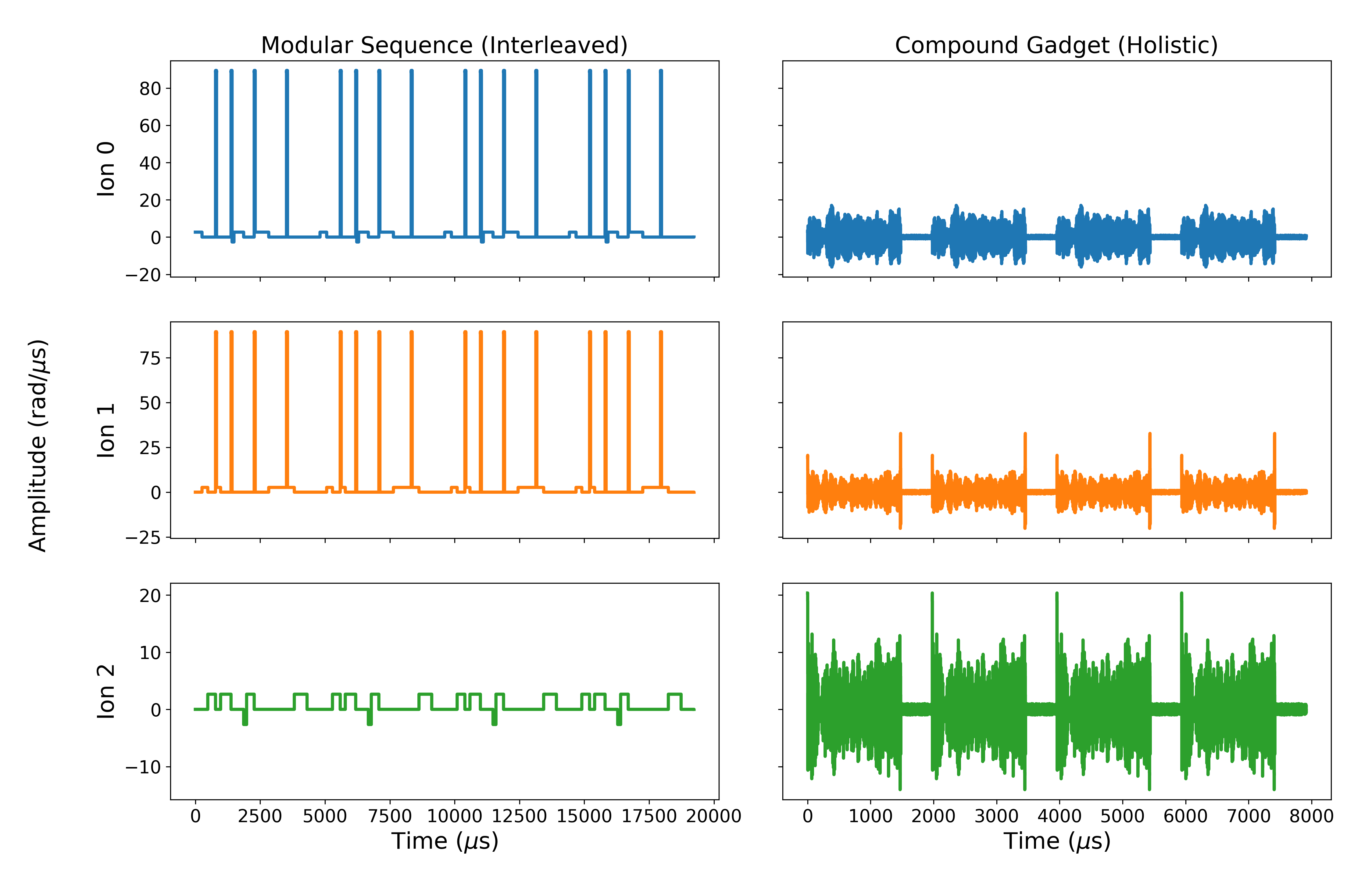
Figure 2: Compound pulse gadgets yield temporally compressed schedules relative to the fragmented sequences required in modular LUT-based baseline synthesis for QSVT simulation.
Additionally, the lookup overhead caused by fragmented gate assembly is fundamentally eliminated; the system synthesizes only d macro-blocks (with d the QSVT degree), reducing instruction layer latency by orders of magnitude and thereby streamlining overall control execution.
Robustness Assessment via Open-System Simulation
To confirm physical viability, both strategies are benchmarked under realistic noise using open-system Lindblad models, including local T2 dephasing and anomalous heating. The compressed schedules derived from compound gadgets preserve quantum state purity more effectively over fixed execution windows, as reduced run times directly mitigate the impact of static decoherence channels.
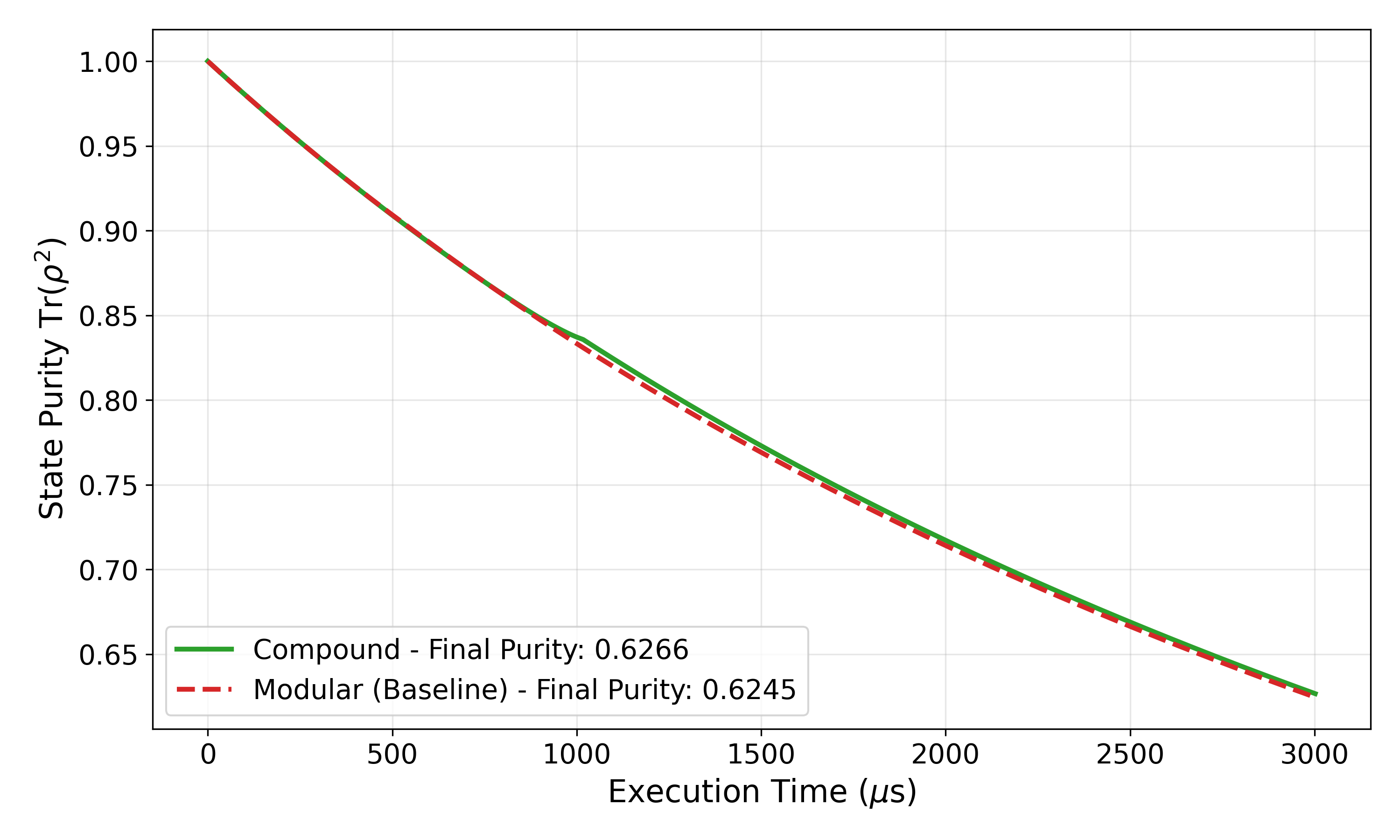
Figure 3: Hardware-level state preservation (measured by Tr(ρ2)) is superior for compound gadget synthesis versus modular stitching, demonstrating enhanced resilience to open-system noise on the 3-ion testbed.
Implications and Future Directions
The demonstrated temporal compression and control-layer efficiency substantiate the viability of direct pulse-level compilation for near-term quantum simulation workloads. By increasing the algorithmic block size that fits within decoherence constraints, the methodology extends the computational reach of current trapped-ion systems. The results strongly motivate scaling the technique to larger Hamiltonians and more complex circuits (e.g., LiH), contingent on managing the exponential scaling of direct holistic synthesis. This points towards the integration of partitioning and circuit cutting techniques to balance tractability and compression. Additionally, further incorporation of explicit hardware noise models into the optimal control objective may yield physical schedules with enhanced robustness, transcending the limitations of post-facto error mitigation at the control layer.
Conclusion
This study substantiates that synthesizing compound pulse gadgets via optimal control is a viable path for executing deep QSVT-based Hamiltonian simulation on trapped-ion hardware, overcoming the limitations inherent to discrete gate-level transpilation. With demonstrated temporal compression, reduced control latency, and strengthened robustness to system noise, pulse-level compilation frameworks can maximize near-term quantum hardware utility, and their further generalization and scaling constitute pressing avenues for advancing quantum algorithm implementation capabilities.

