- The paper demonstrates that echoed lemniscate pulses cancel the leading η⁴ error, reducing GHZ state infidelity to scale as η⁶.
- It employs amplitude and phase modulation to create geometric phase-space trajectories, achieving infidelities below 2×10⁻⁶ for 20-ion chains.
- The method is practical for current ion trap hardware and offers a scalable solution for robust multi-qubit entanglement.
Lemniscate Phase Trajectories and High-Fidelity GHZ State Preparation in Trapped-Ion Chains
Introduction and Motivation
Multipartite entanglement—and, in particular, the preparation of Greenberger-Horne-Zeilinger (GHZ) states—remains a critical benchmark for quantum computation, quantum metrology, and quantum communication with trapped ions. In the context of trapped-ion quantum computers, GHZ state generation natively leverages the collective qubit-phonon interaction facilitated by a global Mølmer-Sørensen (MS) entangling gate. While state-of-the-art experimental fidelities have improved, out-of-Lamb-Dicke effects have emerged as a significant barrier, especially as system size grows. The work in "Lemniscate phase trajectories for high-fidelity GHZ state preparation in trapped-ion chains" (2604.02301) presents a methodical analysis of this limitation and introduces a novel pulse engineering strategy—the echoed lemniscate pulse—that demonstrates superior error scaling and practical relevance for medium-scale quantum registers.
Theoretical Analysis: Out-of-Lamb-Dicke Error and Its Scaling
The MS gate exploits a collective spin-dependent force (SDF) to entangle qubits via the axial center-of-mass (COM) phonon mode, provided the ion-laser interaction lies in the Lamb-Dicke regime. However, deviations from this regime introduce higher-order terms in the Lamb-Dicke expansion, fundamentally limiting achievable GHZ state fidelities. The paper's perturbative treatment shows that, for conventional rectangular or bell-like pulses, the GHZ preparation infidelity scales as η4, where η is the COM-mode Lamb-Dicke parameter. Notably, for chains with tens of ions and η in the 0.03–0.05 range, the compounded infidelity may reach percent levels—comparable to or above current technical noise floors.
A critical insight is that the out-of-Lamb-Dicke error is not suppressed by increasing the gate time, in contrast with off-resonant carrier transitions or excitation of non-COM phonon modes.
Amplitude and Phase Modulation: Lemniscate Trajectories
To suppress the leading η4 contribution, the authors propose constructing amplitude- and phase-modulated pulses such that the SDF-induced phase-space trajectory of the phonon mode traces a figure-eight (lemniscate of Gerono) in the complex plane.
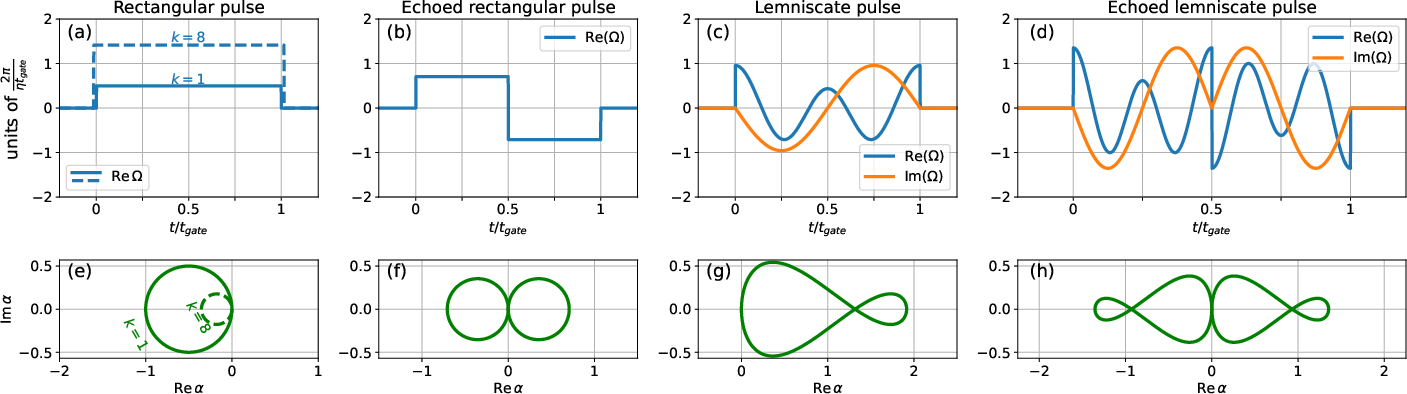
Figure 1: Pulse shapes and phase trajectories for (a, e) rectangular pulse, (b, f) echoed rectangular pulse, (c, g) lemniscate pulse, (d, h) echoed lemniscate pulse.
Unlike traditional pulses, the lemniscate trajectory is engineered so that the weighted area integral governing the η4 error cancels. Furthermore, by echoing this pulse—that is, inverting the amplitude in the second half—the protocol additionally cancels off-diagonal terms responsible for phonon creation, leaving a residual error scaling as η6.
The presented framework systematically compares the GHZ state preparation infidelity for rectangular, echoed rectangular, lemniscate, and echoed lemniscate pulses. For rectangular pulses, not only does infidelity rapidly increase with ion number, but even optimized amplitude adjustment cannot overcome the intrinsic η4 scaling.
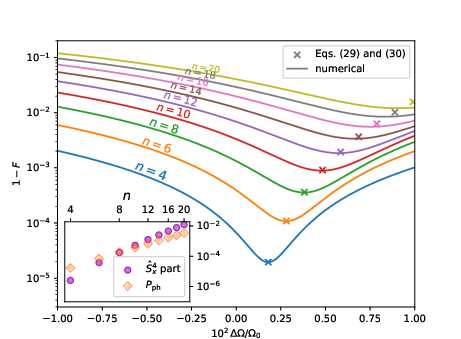
Figure 2: The GHZ state preparation infidelity as a function of field amplitude of a rectangular pulse for the number of ions from 4 to 20; solid lines are numerical results, markers show analytic optimal points.
By numerically solving the time-dependent Schrödinger equation with the all-orders Lamb-Dicke Hamiltonian, the authors map the infidelity landscape as a function of pulse parameters. The infidelity minimum is sharply localized for the echoed lemniscate pulse, and at η=0.03 and n=20, the optimal configuration achieves 1−F<2×10⁻⁶.
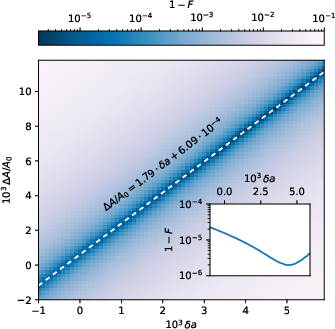
Figure 3: GHZ preparation infidelity for the echoed lemniscate pulse as a function of two lemniscate parameters η0 and η1 for η2, η3.
A comprehensive analysis as a function of both η4 and η5 demonstrates:
- For fixed η6, the infidelity of the echoed lemniscate pulse scales as η7, while all other pulse shapes follow η8 scaling.
- For η9 ranging from 4 to 20 and fixed η0, the echoed lemniscate pulse is superior for all system sizes considered.
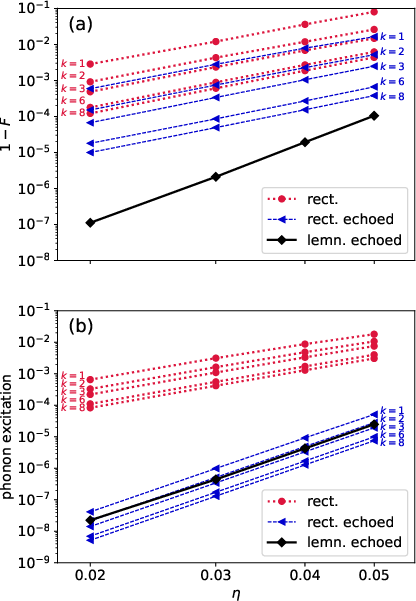
Figure 4: Optimized 20-qubit GHZ state preparation (a) infidelity and (b) phonon excitation probabilities for different pulse schemes as functions of η1.
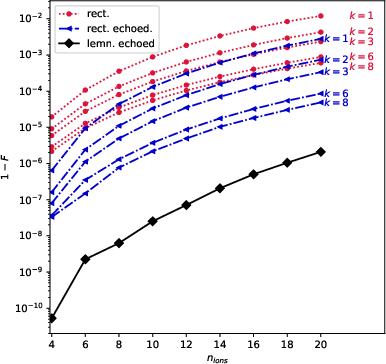
Figure 5: Optimized GHZ state preparation infidelity as a function of ion number for several pulse shapes at η2.
Practical Implementation and Discussion
The construction of the lemniscate (and echoed) pulses requires amplitude and phase modulation but is compatible with available pulse-programming hardware in leading ion trap platforms. The highest field amplitudes required by lemniscate pulses are comparable to those of high-η3 rectangular schemes, with a moderate increase in optical power or total gate duration.
Smooth amplitude ramps should be considered to avoid additional non-adiabatic errors at pulse discontinuities, but such engineering does not alter the core η4 scaling result. The method is robust with respect to small fluctuations in pulse shape or detuning, as evidenced by the narrow minima in the fidelity landscapes.
Conclusion
This paper provides a rigorous treatment of out-of-Lamb-Dicke effects as a fundamental fidelity constraint for GHZ state generation in trapped-ion processors. It establishes that amplitude and phase engineering—specifically through echoed lemniscate pulses—suppresses the error scaling from η5 to η6. For up-to-20-ion chains, the protocol enables infidelities below η7 with realistic experimental parameters. The approach is both general and readily implementable, offering a pathway to high-fidelity entanglement generation in large trapped-ion registers and impact for quantum metrology, state engineering, and benchmarking.
Future directions could include the application of lemniscate phase trajectories to other multi-qubit gates, tailoring such protocols for robust operation under experimental noise, and scaling to even larger ion arrays. The method signifies a conceptual shift toward geometric control in error suppression for analog quantum gates.

